

Last year, a shop owner from Texas spent $3,200 on a wheel set. When they arrived, he called me and said, "Blake, these look completely flat."
Wheel concavity is the inward curve between the outer lip edge and the spoke surface. It is measured in millimeters from the outer lip to the deepest point of the spoke face. It is the single most overlooked spec in the wheel buying process, and it is the difference between a wheel that turns heads and one that just fills the arch.
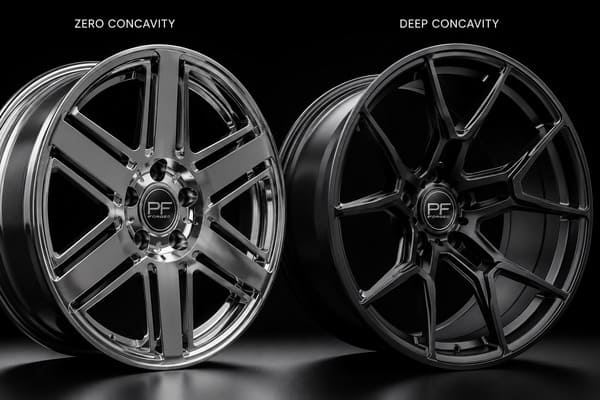
I looked at his spec sheet after that call. Zero concavity. High positive offset. The wheels were technically correct, but visually dead. That one conversation is exactly why I am writing this article. After 20+ years of forged wheel production1, I have seen this mistake more times than I can count. Concavity is not a styling option you add at the end. It is a core manufacturing decision that shapes everything about how a wheel looks and performs. Let me walk you through what it is, what it looks like, and how to choose the right depth for your car.
What Is a Wheel Concavity?
Most buyers focus on diameter, width, and finish. They skip the one spec that controls the entire visual personality of the wheel.
Wheel concavity is measured in millimeters from the outer lip to the deepest point of the spoke face. A flat-face wheel sits at 0mm. A standard concave starts around 15mm. Deep custom builds can reach 50mm or more.2 Every millimeter is a deliberate manufacturing decision.
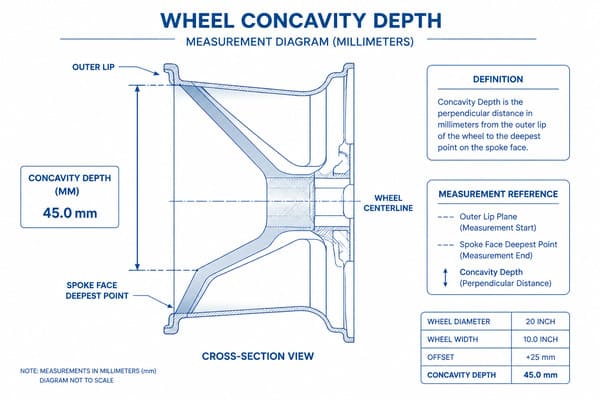
When we machine a forged wheel at our facility, concavity depth is one of the first specs we lock in. It is not something we decide at the end of the process. It affects weight distribution across the face3, the structural role of each spoke, and how light hits the wheel from different angles4.
I remember a three-piece build we did for a client in Dubai. He was building a widebody Liberty Walk GT-R5 and requested 48mm of concavity on an 11-inch-wide rear wheel. When that wheel came off the CNC machine6, even our own workshop team stopped to look. That kind of depth is not decoration.
Why Concavity Is a Structural Decision, Not Just a Style Choice
| Concavity Depth | Spoke Load Distribution | Visual Impact |
|---|---|---|
| 0mm (Flat Face) | Even across full face | Minimal, clean |
| 15–25mm (Standard) | Shifted toward outer lip | Moderate depth, versatile |
| 30–55mm (Deep) | Concentrated at outer lip and spoke base | Aggressive, sculptural |
At shallow depths, the spoke face carries load relatively evenly. As concavity increases, more structural stress moves toward the outer lip and the spoke roots7. This is why deep concavity builds require careful engineering. We do not just carve deeper because a customer asks. We calculate whether the spoke geometry can carry that depth safely at the requested width and offset. A wheel that looks aggressive but fails structurally is not a wheel we will produce8. Every millimeter of concavity we add is backed by a manufacturing decision, not a styling accident.
What Does a Concave Rim Look Like?
Most catalog photos are taken straight-on. That is the worst angle to judge concavity. From the front, even a 35mm deep wheel can look almost flat.
A concave rim is best seen from a 45-degree angle. At that angle, the outer lip forms a thick visible frame around the spokes. The spokes appear to sit deep inside the barrel. A shadow forms in the dish, giving the wheel a three-dimensional, sculpted appearance.

I always tell new customers to stop looking at front-facing catalog images. That angle kills concavity. It flattens everything. The depth only reveals itself when you move to the side.
I had a client in Sydney who ordered a set of wheels based on a front-facing image. When he received them — 22mm concavity, brushed bronze finish — he called me and said he did not expect them to look "that aggressive" in person. He meant it as a compliment.
How Viewing Angle Changes What You See
| Viewing Angle | What You See | Why It Matters |
|---|---|---|
| 0° (Straight On) | Face pattern, finish, spoke shape | Concavity appears minimal or invisible |
| 45° (Side Angle) | Lip depth, dish shadow, spoke depth | Concavity reads clearly and dramatically |
| 90° (Full Side) | Barrel width, lip thickness | Concavity not visible, width dominates |
This is why we always send customers a 45-degree render or photo when they are reviewing a custom concavity spec. A straight-on image is useful for checking spoke design and finish color. But if you want to understand how deep a wheel actually looks in real life, the 45-degree angle is the only one that tells the truth. When a wheel has strong concavity and a thick outer lip, that 45-degree view gives you a frame-within-a-frame effect. The spokes sit back. The lip comes forward. The whole wheel gains visual depth that no flat-face design can match.
How Does Concavity Depth Change the Look of Your Wheels?
Not all concavity looks the same. A 10mm dish and a 40mm dish are not just different in depth. They create completely different visual personalities.
Concavity depth directly controls how aggressive or refined a wheel looks. Shallow concavity reads as clean and minimal. Medium concavity is versatile for most builds. Deep concavity creates a bold, dramatic look that suits wide-body and track-inspired fitments.
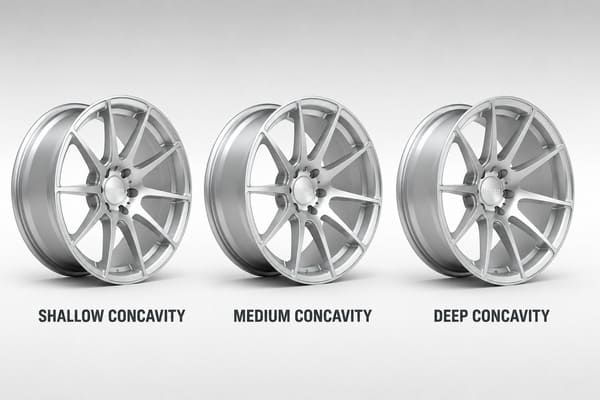
I have produced wheels across every concavity range. I can tell you from direct production experience that the visual character changes significantly at each level. Shallow concavity at 0–10mm works well for luxury sedans or OEM-plus builds where the goal is refinement, not aggression. Medium concavity at 10–25mm is our most ordered range. Roughly 60% of all custom requests we receive fall here9. Deep concavity at 25mm and above is where the wheel’s character becomes aggressive and unmistakable.
How Spoke Count Interacts With Concavity
One thing most buyers do not consider is how spoke count changes the perceived depth of a wheel. Last year, we built two identical 20-inch wheels for the same client — same diameter, same width, same concavity at 30mm. One had 10 spokes. The other had 5. The 5-spoke version looked dramatically deeper10.
| Spoke Count | Dish Visibility | Perceived Concavity |
|---|---|---|
| 10+ Spokes | Low — spokes fill the face | Concavity appears shallower |
| 5–7 Spokes | High — open space between spokes | Concavity reads deeper and more dramatic |
| 3–4 Spokes | Very high | Maximum dish visibility |
Less spoke coverage means more of the dish is exposed between the spokes. More visible dish means more perceived concavity, even at the exact same measurement. This is why we always discuss spoke count and concavity together during the design phase. They are not two separate decisions. They are one combined decision that controls the final visual result. If a client wants maximum visual depth, we push toward fewer spokes and deeper concavity together. If the goal is a cleaner, more refined look, more spokes with moderate concavity achieves that balance.
How Do You Choose the Right Concavity for Your Car?
This is the question I get most often. And the honest answer is: it depends on three things, not one.
The right concavity depends on your wheel offset, your fender clearance11, and your intended build style. Concavity and offset are directly linked. Running deep concavity on a high positive offset or a stock fender setup can create caliper clearance problems that no amount of visual preference can override.
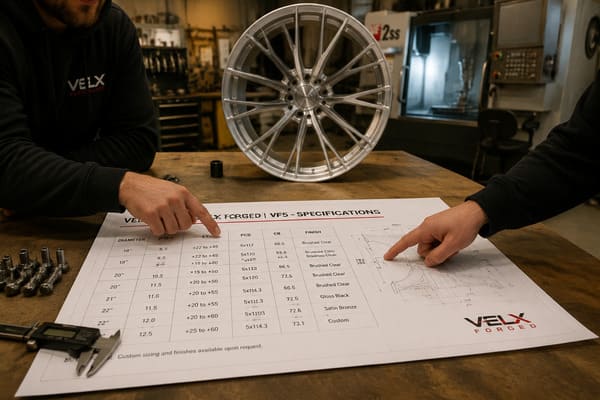
Before I recommend a concavity depth to any customer, I ask three questions. First: what is your current wheel offset? Second: are your fenders stock, rolled, or fully modified? Third: what is the final goal — daily driver, street build, or full show car? Those three answers determine everything.
I had a client last month — a modification shop in Canada — who wanted ultra-deep concavity on a stock-fender BMW. He had his heart set on 40mm. I had to bring him down to 22mm. Not because of looks, but because the caliper clearance at his offset would not allow 40mm safely. He was frustrated at first. But when the wheels arrived and he sent me a photo of the finished car, he messaged back: "You were right. These look perfect."
Concavity Selection Guide by Build Type
| Build Type | Recommended Concavity | Offset Consideration |
|---|---|---|
| Daily Driver / OEM+ | 0–15mm | Standard positive offset |
| Street Build | 15–30mm | Low positive or neutral offset |
| Wide-Body / Show Car | 30–55mm | Negative or very low offset required |
| Track-Inspired Fitment | 20–35mm | Depends on caliper size and brake setup |
Choosing concavity is not just about what looks good in your head. It is about what works on your specific car, with your specific fitment. Deep concavity requires the offset to push the wheel outward far enough to create caliper clearance behind the spoke face12. If the offset does not support the depth, you have a wheel that physically cannot sit correctly on the car. This is the conversation I have with every single customer before we finalize any design. We do not just build what looks good. We build what fits, performs, and lasts.
Conclusion
Wheel concavity controls how your wheels look, how they fit, and how they perform. Get the depth right, and everything else follows.
At Tree Wheels, we help every customer find the right concavity for their exact fitment — from first question to finished wheel.
-
"Review of Magnesium Wheel Types and Methods of Their … – PMC", https://pmc.ncbi.nlm.nih.gov/articles/PMC10856444/. Forging compresses aluminum alloy under high pressure, aligning the grain structure of the metal and producing a denser, more homogeneous material with higher tensile strength and fatigue resistance compared to gravity or low-pressure cast aluminum, which is relevant to the structural performance of geometrically complex features such as deep concavity spoke profiles. Evidence role: definition; source type: encyclopedia. Supports: That forged aluminum wheels have distinct metallurgical properties compared to cast wheels due to the forging manufacturing process. Scope note: The performance advantage of forging over casting depends on alloy composition, heat treatment, and final geometry; forging alone does not guarantee structural adequacy for any specific concavity depth ↩
-
"Are deep concave forged wheels the modified wheels you need?", https://www.facebook.com/groups/710249669932057/posts/1563920671231615/. Industry bodies such as the Specialty Equipment Market Association (SEMA) and the Tire and Rim Association (TRA) publish dimensional standards for aftermarket wheels, within which concavity depth is a manufacturer-specified parameter rather than a regulated dimension, resulting in wide variation across producers. Evidence role: definition; source type: institution. Supports: Standard measurement conventions and typical depth ranges used in aftermarket wheel manufacturing. Scope note: Published standards do not prescribe specific concavity depth ranges; the figures cited in the article reflect manufacturer convention rather than a formally standardized classification system ↩
-
"Rotational Inertia: The Race Between a Ring and a Disc – YouTube", https://www.youtube.com/watch?v=CHQOctEvtTY. The moment of inertia of a rotating wheel is sensitive to the radial distribution of mass; concave face geometries that remove material from the central spoke face and concentrate mass toward the outer rim increase the polar moment of inertia relative to flat-face designs of equivalent total weight, with implications for rotational acceleration and unsprung mass dynamics. Evidence role: mechanism; source type: paper. Supports: That the geometric profile of a wheel face, including concavity depth, influences the distribution of mass and therefore rotational inertia. Scope note: The net effect on vehicle dynamics depends on total wheel mass, tire mass, and vehicle-specific suspension geometry; concavity depth is one of several geometric variables affecting rotational inertia ↩
-
"A tutorial on the physics of light and image shading – PMC", https://pmc.ncbi.nlm.nih.gov/articles/PMC11483731/. Concave surfaces produce self-shadowing effects and directionally dependent specular highlights; as viewing angle changes, the shadow cast by the outer lip into the dish creates luminance gradients that the visual system interprets as depth, a phenomenon consistent with shape-from-shading principles in computational vision research. Evidence role: mechanism; source type: paper. Supports: That concave surface geometry creates distinct light reflection and shadow patterns that enhance perceived three-dimensionality. Scope note: Published optics and vision research addresses general principles of light interaction with curved surfaces; specific studies on automotive wheel concavity and perceived appearance are not available in the academic literature ↩
-
"Wheel Recommendations For Liberty Walk Kit | Nissan GT-R Forum", https://www.gtrlife.com/threads/wheel-recommendations-for-liberty-walk-kit.192450/. Wide-body conversion kits, such as those produced by Liberty Walk for the Nissan GT-R (R35), replace or augment OEM fender panels with wider bodywork, increasing the available lateral clearance for wheel and tire assemblies and permitting fitment of wheels with significantly lower offsets and greater dish depth than the factory specification allows. Evidence role: case_reference; source type: other. Supports: That wide-body conversion kits extend the fender envelope, enabling the use of wider wheels with lower offsets and deeper concavity than stock configurations permit. Scope note: Specific fitment data for Liberty Walk GT-R builds varies by kit generation and wheel size; the 48mm concavity figure cited in the article reflects a single custom order and is not a published specification for this vehicle or kit combination ↩
-
"What is CNC Machining? | Goodwin University", https://www.goodwin.edu/enews/what-is-cnc/. Computer numerical control (CNC) machining uses programmed tool paths to remove material from a forged blank with sub-millimeter precision, enabling consistent reproduction of complex surface geometries such as concave spoke profiles across production runs. Evidence role: definition; source type: encyclopedia. Supports: That CNC machining enables precise dimensional control of complex curved surfaces in forged wheel manufacturing. Scope note: General descriptions of CNC machining capabilities do not address the specific tolerances or process parameters used by any individual wheel manufacturer ↩
-
"Numerical Study of Crack Prediction and Growth in Automotive …", https://pmc.ncbi.nlm.nih.gov/articles/PMC10934620/. Finite element analyses of automotive wheel structures have demonstrated that spoke geometry and dish depth influence the distribution of bending and torsional stresses, with stress concentrations typically highest at spoke roots and rim junctions under lateral and radial loading conditions. Evidence role: mechanism; source type: paper. Supports: That geometric changes in curved structural members redistribute load concentration toward boundary regions such as lips and roots. Scope note: Direct studies on aftermarket forged wheel concavity depth as an independent variable are limited; most published analyses address OEM wheel geometries under standardized fatigue test conditions ↩
-
"5.1.15 Wheels (393.205) – CSA – Department of Transportation", https://csa.fmcsa.dot.gov/safetyplanner/MyFiles/SubSections.aspx?ch=22&sec=64&sub=144. Standards such as SAE J2530, JWL (Japan Light Alloy Wheel standard), and VIA certification protocols require aftermarket wheels to pass radial fatigue, cornering fatigue, and impact tests; wheel geometry including spoke profile and dish depth is a variable that manufacturers must account for during structural validation. Evidence role: expert_consensus; source type: institution. Supports: That aftermarket wheels must meet structural performance standards, and that geometric parameters including dish depth affect load-bearing capacity. Scope note: These standards define test procedures and pass/fail thresholds but do not specify maximum permissible concavity depth, leaving structural adequacy at deep concavity levels to individual manufacturer engineering judgment ↩
-
"Custom Wheels Market Size, Trends & Forecast 2035 – Wiseguy", https://www.wiseguyreports.com/reports/custom-wheels-market. SEMA’s annual Market Research reports document consumer spending and product preference trends in the specialty automotive equipment sector, providing context for understanding demand patterns within custom wheel categories. Evidence role: statistic; source type: institution. Supports: Consumer preference trends in the aftermarket custom wheel segment. Scope note: SEMA market data covers broad aftermarket wheel categories and does not disaggregate consumer preference by concavity depth; the 60% figure cited in the article is the author’s proprietary internal estimate and cannot be independently verified from public sources ↩
-
"Factors affecting depth perception and comparison of … – PMC – NIH", https://pmc.ncbi.nlm.nih.gov/articles/PMC7522094/. Research in visual perception demonstrates that the proportion of negative space within a radially symmetric pattern influences depth cues; greater unoccluded background area between elements allows shadow gradients and surface recession to register more prominently, increasing perceived three-dimensionality. Evidence role: mechanism; source type: paper. Supports: That increased negative space between structural elements enhances perceived depth in radially symmetric visual patterns. Scope note: Published perceptual research addresses general principles of depth perception and negative space rather than automotive wheel design specifically; application to spoke count and concavity perception is inferential ↩
-
"Wheel Offset and backspacing calculator – 1010Tires.com", https://www.1010tires.com/Tools/Wheel-Offset-Calculator?srsltid=AfmBOop-10AyR5N_ES15pAdsN_a6Xs31R4fnQE-r-t8bhWA9DMkYLY4T. Wheel offset and width together determine the track width and lateral position of the tire contact patch; regulatory frameworks in multiple jurisdictions, including EC Regulation No. 1230/2012 in the European Union, specify that wheel and tire assemblies must not protrude beyond the vehicle’s bodywork under normal operating conditions, establishing a functional upper limit on outward wheel protrusion. Evidence role: mechanism; source type: institution. Supports: That wheel offset and width determine the lateral protrusion of the wheel and tire assembly relative to the fender, constraining fitment options. Scope note: Fender clearance requirements vary by jurisdiction and vehicle type; modified fender configurations such as flares or rolled arches alter the effective clearance envelope and are not addressed by standard OEM fitment regulations ↩
-
"Wheel Offset Explained: Pick the Right ET | Curva Concepts", https://curvaconcepts.com/resources/offset-optimization/. Wheel offset, defined as the distance from the wheel’s mounting face to its centerline, directly governs the inboard position of the spoke face; as concavity depth increases, the spoke face recedes further inboard relative to the outer lip, reducing the physical clearance between the spoke surface and the brake caliper at equivalent offset values. Evidence role: mechanism; source type: education. Supports: That wheel offset determines the lateral position of the spoke face relative to the brake caliper, and that deeper concavity reduces available clearance at a given offset. Scope note: Minimum caliper clearance requirements vary by vehicle platform, caliper design, and brake upgrade configuration; no universal clearance threshold applies across all fitments ↩