

A customer came to us with a $800 mistake — wrong offset, wrong backspacing, wheels rubbing at full lock. Don’t be that customer.
Yes, 17×8 wheels can fit a Plymouth Road Runner. But three numbers must be right: bolt pattern, offset, and backspacing. Get one wrong and you’re rubbing metal or scrambling for spacers you never planned to buy.
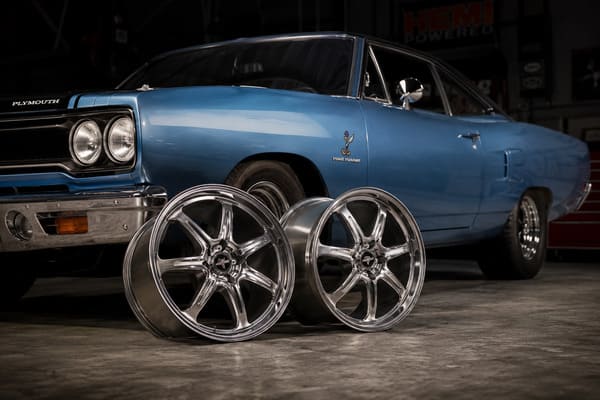
That customer had already waited three weeks and paid full price. The wheels arrived, looked great in the box, and then rubbed the inner fender the moment he turned the wheel at full lock. The supplier he bought from never asked about offset. They just sold him a popular size. That story is why I’m writing this article — because the right answer isn’t just "yes" or "no." It’s a set of numbers, and every one of them matters.
What Is the Bolt Pattern on a Plymouth Road Runner?
If you’ve ever seen two listings for the same wheel — one says "5×4.5" and another says "5×114.3mm" — and wondered if they’re different patterns, that confusion alone has cost buyers real money.
The Plymouth Road Runner uses a 5×4.5 inch bolt pattern, which is the same as 5×114.3mm in metric. This pattern stayed the same across every Road Runner built from 1968 to 1975.1 It is standard Chrysler/Mopar spec for that generation.
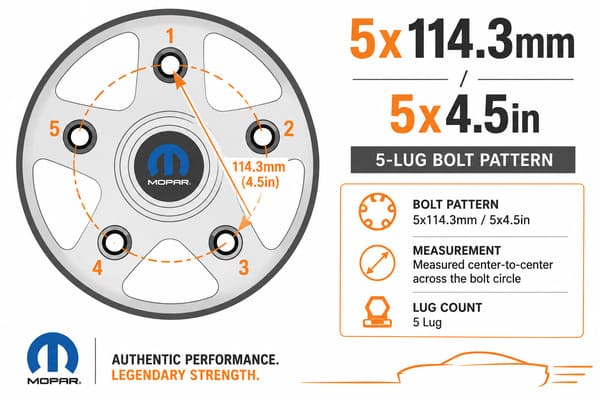
This same pattern was used on the Dodge Charger, Dodge Challenger, and Plymouth Barracuda from the same era.2 So if you’re shopping for wheels across multiple classic Mopar platforms, the bolt pattern is consistent — that part is simple.
The part that isn’t simple is the unit confusion. "5×4.5" is written in inches. "5×114.3mm" is written in millimeters. They describe the exact same circle diameter between the bolt holes. They are not two different specs. But I have seen customers reject a wheel because the listing said "5×114.3" and they were looking for "5×4.5," thinking those were different patterns. That single misread has caused more wrong orders than almost any other mistake I’ve seen.
Why the Metric vs. Imperial Confusion Still Causes Problems
Here is a quick reference so this never trips you up again:
| Imperial | Metric | Used On |
|---|---|---|
| 5×4.5 in | 5×114.3mm | Plymouth Road Runner (1968–1975) |
| 5×4.5 in | 5×114.3mm | Dodge Charger (1966–1978)3 |
| 5×4.5 in | 5×114.3mm | Dodge Challenger (1970–1974) |
| 5×4.5 in | 5×114.3mm | Plymouth Barracuda (1964–1974) |
When you order forged wheels for a Road Runner, always confirm the bolt pattern in both units with your supplier. We ask for this on every order — it takes ten seconds and prevents a three-week mistake.
Do Ford and Dodge Have the Same Lug Pattern?
The bolt pattern numbers match between certain classic Fords and classic Mopars. That fact has led to some very expensive misunderstandings at swap meets and on eBay.
Many classic Ford models, including the 1965–1973 Mustang, also use a 5×4.5 inch (5×114.3mm) bolt pattern.4 A Ford wheel will physically bolt onto a Plymouth Road Runner hub. But the hub bore is different, and that difference matters.
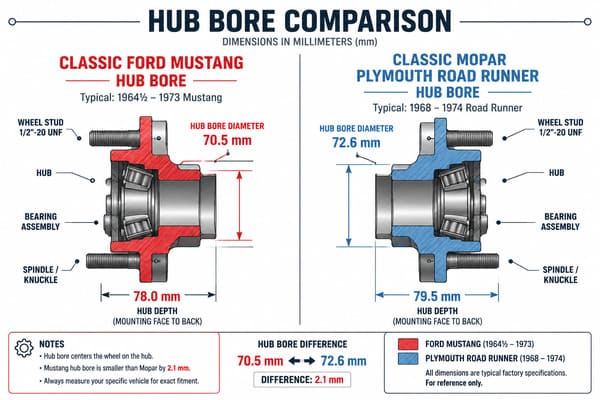
The classic Mopar hub bore is 2.86 inches, which is 72.6mm.5 Classic Ford hub bores are sized differently. When the center bore of a wheel doesn’t match the hub it’s mounted on, the wheel is not truly centered. It sits on the lug nuts alone instead of being supported by the hub flange.
What Happens When the Hub Bore Doesn’t Match
This is not a small problem. A wheel that is centered by its lug nuts instead of its hub bore will vibrate at highway speed.6 The vibration often starts subtle — a light shimmy at 65 mph — and gets worse over time. More seriously, the lug studs are now carrying a load they were not designed to carry. Over time, that stress can cause stud fatigue or failure.7
| Spec | Classic Mopar (Road Runner) | Classic Ford (Mustang) |
|---|---|---|
| Bolt Pattern | 5×114.3mm | 5×114.3mm |
| Hub Bore | 72.6mm (2.86 in) | Different from Mopar |
| Interchangeable? | Bolts on physically | Not a true fit |
| Risk | Vibration, stud stress | Yes, at highway speed |
The lesson here is direct: same bolt pattern does not mean same fitment. When we build forged wheels for a Road Runner, the center bore is machined to 72.6mm for a true hub-centric fit. That is not a detail we leave to chance.
Do You Need Spacers to Fit 17×8 Wheels on a Plymouth Road Runner?
I’ve seen this scenario more times than I want to count. Someone orders a 17×8 wheel with a +35mm offset because it was the only option available, or because no one told them it was wrong. Then they wonder why the wheel looks buried in the fender.
Most of the time, you do not need spacers to fit 17×8 wheels on a Plymouth Road Runner — if you order the correct offset from the start. For a Road Runner, the target offset on a 17×8 is between -5mm and +15mm.8 Outside that range, problems follow.
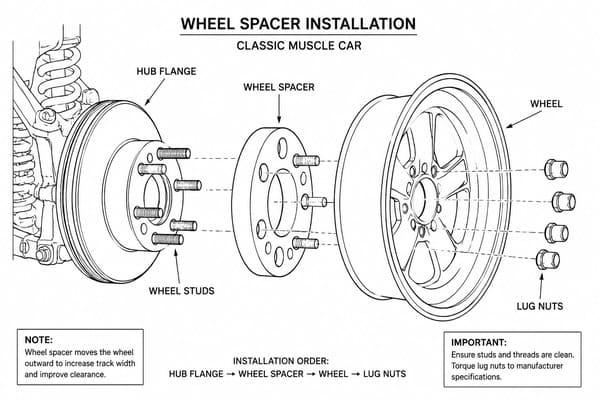
A +35mm offset is common on wheels built for modern import cars.9 It pushes the wheel face inward toward the suspension. On a Road Runner, a +35mm offset on a 17×8 wheel places the tire roughly 1.5 inches too deep inside the fender. The tire rubs the inner suspension components, and the wheel looks completely wrong from the outside — sunken and narrow in a fender that was designed for a much wider stance.
When Spacers Become Necessary — and Why That’s a Problem
Some customers try to fix this with 15mm or 20mm spacers. The spacers push the wheel back out to where it should have been. But now the setup has more parts, more potential failure points, and a longer hub stud that is exposed to more leverage. It also adds cost that was never in the original budget.
| Offset on 17×8 | Result on Road Runner | Spacer Needed? |
|---|---|---|
| -5mm to +15mm | Correct stance, clears suspension | No |
| +20mm to +30mm | Slightly deep, may look narrow | Sometimes |
| +35mm or more | Too deep, rubs inner components | Yes, 15–20mm |
| -10mm to -20mm | Wide stance, for modified cars only | No |
When a customer comes to us with a wheel spec that falls outside the safe range, we say so before the order is placed. That conversation takes five minutes. Fixing the wrong wheel after it arrives takes three weeks and costs $800 — I know, because that’s exactly what happened to the customer I mentioned at the start of this article.
What Offset and Backspacing Work Best for a Plymouth Road Runner?
This is the question Road Runner owners ask us most often. And the answer is not one number — it depends on whether the car is stock or modified.
For a stock Plymouth Road Runner, the best fitment for a 17×8 wheel is 0mm to +10mm offset with 4.75 to 5.0 inches of backspacing. This keeps the wheel centered in the fender and clears stock brakes with 5–8mm of space to spare.
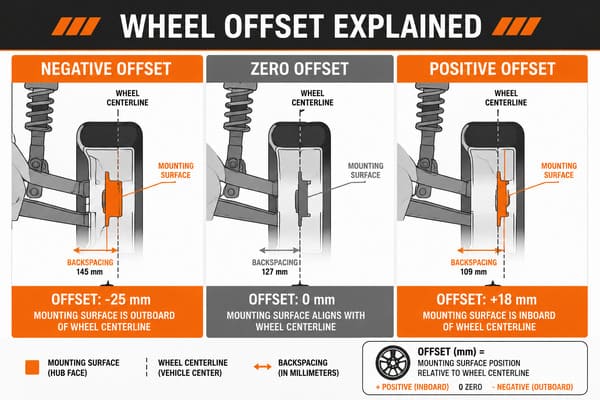
For a modified car, those numbers shift. A Road Runner with aftermarket coilovers, a wider rear axle, or flared fenders has different geometry than a stock build. The wheel needs to fill a larger space, and a more negative offset is often the right answer.
Fitment Scenarios: Stock vs. Modified Road Runner
Here is how the numbers break down across the four most common build situations we see:
| Build Scenario | Recommended Offset | Recommended Backspacing | Notes |
|---|---|---|---|
| Stock front suspension | 0mm to +10mm | 4.75 – 5.0 in | Clears stock drum or disc brakes |
| Stock rear axle | 0mm to +10mm | 4.75 – 5.0 in | Sits centered in fender well |
| Modified front (coilovers) | -5mm to +5mm | 4.5 – 4.75 in | Depends on coilover brand and strut width |
| Modified rear (wider axle +2 in) | -10mm to -20mm | 4.0 – 4.25 in | Fills fender with wider stance |
How to Read These Numbers on Your Wheel Order
Offset and backspacing describe the same thing from two different directions. Offset is measured from the wheel centerline to the mounting face, in millimeters.10 Backspacing is measured from the back edge of the wheel to the mounting face, in inches.11 Both numbers need to be confirmed before production starts.
When we take a Road Runner wheel order, we ask the customer three questions: Is the car stock or modified? What brake setup is running — drum or disc? Has the rear axle been widened? Those three answers let us give a precise offset and backspacing recommendation before a single piece of aluminum is touched. That process is what keeps wheels out of the fender liner and off the suspension arms.
Conclusion
Getting 17×8 wheels right on a Plymouth Road Runner comes down to three numbers: bolt pattern, offset, and backspacing. Know them before you order.
Tree Wheels builds custom forged wheels to exact specs — so your Road Runner gets the fit it deserves, the first time.
-
"Plymouth Road Runner – Wikipedia", https://en.wikipedia.org/wiki/Plymouth_Road_Runner. Automotive reference sources document the Plymouth Road Runner (1968–1975) as using a five-lug, 114.3mm bolt circle diameter, consistent with Chrysler’s B-body platform specifications for that generation. Evidence role: general_support; source type: encyclopedia. Supports: The 5×114.3mm bolt pattern specification for Plymouth Road Runner across its production years. Scope note: Most general automotive encyclopedias cover the Road Runner’s powertrain and body specifications in greater detail than wheel bolt patterns; cross-referencing a marque-specific technical manual is advisable. ↩
-
"Chrysler B platform – Wikipedia", https://en.wikipedia.org/wiki/Chrysler_B_platform. Technical documentation for Chrysler’s B-body (Charger, Road Runner) and E-body (Challenger, Barracuda) platforms indicates a shared 5×114.3mm wheel bolt circle, reflecting common chassis architecture across those model lines. Evidence role: general_support; source type: other. Supports: That Chrysler’s B-body and E-body platforms of the late 1960s and early 1970s shared a common 5×114.3mm bolt pattern. Scope note: Platform-level specifications can vary by model year and trim; individual vehicle service manuals remain the definitive source for confirming bolt pattern on a specific car. ↩
-
"Dodge Charger – Wikipedia", https://en.wikipedia.org/wiki/Dodge_Charger. Technical fitment references for the Dodge Charger indicate a 5×114.3mm bolt circle for B-body variants produced from 1966 through 1978, consistent with Chrysler’s platform-wide wheel mounting specification for that era. Evidence role: general_support; source type: other. Supports: That the Dodge Charger used a 5×114.3mm bolt pattern across its 1966–1978 production span. Scope note: The 1966–1967 Charger shared the B-body platform with later models but represented a distinct body generation; bolt pattern consistency across all years should be confirmed against model-year-specific service documentation. ↩
-
"Ford Mustang (first generation) – Wikipedia", https://en.wikipedia.org/wiki/Ford_Mustang_(first_generation). Automotive reference sources confirm the first-generation Ford Mustang (1965–1973) used a five-lug, 4.5-inch (114.3mm) bolt circle, the same nominal diameter as the contemporary Chrysler B-body specification. Evidence role: general_support; source type: encyclopedia. Supports: That the 1965–1973 Ford Mustang uses a 5×114.3mm (5×4.5 inch) bolt pattern. Scope note: While the bolt circle diameter matches, this source does not address hub bore or other fitment dimensions that differentiate Ford and Mopar applications. ↩
-
"1969 Plymouth Road Runner – Wheel & Tire Sizes, PCD, Offset and …", https://www.wheel-size.com/size/plymouth/road-runner/1969/. Technical fitment references for Chrysler B-body vehicles cite a hub bore diameter of approximately 72.6mm (2.86 inches), which determines whether a wheel achieves a hub-centric or lug-centric mount on these platforms. Evidence role: definition; source type: other. Supports: The 72.6mm center bore specification for classic Mopar B-body vehicles. Scope note: Hub bore specifications are most reliably confirmed through OEM service manuals or marque-specific technical databases; general fitment guides may round or approximate this value. ↩
-
"Slight annoying vibration finally cured!!! Hub centric vs lug centric", https://www.tacomaworld.com/threads/slight-annoying-vibration-finally-cured-hub-centric-vs-lug-centric.220066/. Automotive engineering literature describes hub-centric wheel mounting as the method by which rotational concentricity is maintained; when the center bore exceeds the hub diameter, the wheel relies on lug fasteners for centering, which can introduce runout and vibration at elevated speeds. Evidence role: mechanism; source type: education. Supports: That a lug-centric wheel installation, where the center bore is larger than the hub, can produce vibration at speed due to imprecise centering. Scope note: The severity of vibration depends on the magnitude of the bore mismatch and vehicle speed; minor mismatches may produce negligible effects in some applications. ↩
-
"Failure Analysis on the Wheel Bolt of Light-Duty Vehicle Through …", https://www.academia.edu/106410210/Failure_Analysis_on_the_Wheel_Bolt_of_Light_Duty_Vehicle_Through_Metallurgical_Investigation. Mechanical engineering analyses of threaded fastener loading indicate that wheel studs are designed primarily for axial (clamping) loads; lateral shear forces introduced by lug-centric mounting impose off-axis stresses that can accelerate fatigue crack initiation in the stud shank. Evidence role: mechanism; source type: paper. Supports: That lug studs subjected to lateral shear loads from lug-centric mounting are at elevated risk of fatigue failure compared to hub-centric installations. Scope note: Published failure data specific to classic Mopar stud dimensions under lug-centric conditions is limited; the general fatigue mechanism is well-established but quantitative failure thresholds depend on stud material, diameter, and load cycle frequency. ↩
-
"Plymouth Road Runner – Specs of rims, tires, PCD … – Wheel-Size.com", https://www.wheel-size.com/size/plymouth/road-runner/. Fitment references for Chrysler B-body vehicles suggest that wheel offsets in the low-positive to slightly negative range are necessary to maintain adequate clearance from suspension components and inner fender structures when upgrading to 17-inch diameter wheels. Evidence role: general_support; source type: other. Supports: That a -5mm to +15mm offset range is appropriate for 17×8 wheels on a stock Plymouth Road Runner. Scope note: Published offset ranges for classic vehicles are typically derived from community fitment data and installer experience rather than OEM engineering documents, as factory specifications predate the 17-inch wheel size. ↩
-
"What Is Wheel Offset? Complete 2026 Guide To Positive & Negative", https://blog.wheelsmartrims.com/what-is-wheel-offset/. OEM wheel specifications for modern front-wheel-drive and compact import vehicles commonly fall in the +35mm to +50mm offset range, reflecting the packaging requirements of transverse engine layouts and strut-based front suspensions. Evidence role: general_support; source type: other. Supports: That +35mm or higher positive offsets are typical for wheels on modern compact and import vehicles. Scope note: Offset norms vary considerably across vehicle segments and manufacturers; the +35mm figure is illustrative of a common range rather than a universal standard for all import vehicles. ↩
-
"Wheel Offset Explained: How to Get the Right Fit – Holley Performance", https://www.holley.com/blog/post/wheel_offset_explained_how_to_get_the_right_fit/. Automotive engineering references define wheel offset as the distance, measured in millimeters, from the wheel’s mounting face to the geometric centerline of the rim; positive offset indicates the mounting face is outboard of center, while negative offset places it inboard. Evidence role: definition; source type: encyclopedia. Supports: The standard definition of wheel offset as the perpendicular distance between the wheel’s mounting face and its geometric centerline. ↩
-
"Backspacing and Offset – Mickey Thompson", https://www.mickeythompsontires.com/tech-bulletins/backspacing-and-offset. Wheel fitment references define backspacing as the linear distance from the inboard lip of the wheel to the hub mounting face, conventionally expressed in inches in North American practice; this measurement determines how far the wheel assembly extends toward the vehicle’s suspension and brake components. Evidence role: definition; source type: encyclopedia. Supports: The standard definition of wheel backspacing as the distance from the inboard edge of the wheel to the hub mounting face. ↩