
I’ve processed over 500 custom wheel orders since we started. The first thing every customer asks about is the spoke design — not the finish, not the size.
Spoke design is the single decision that affects everything — weight, strength, ride feel, and style. The pattern you choose changes how the wheel behaves at speed, not just how it looks on the car.
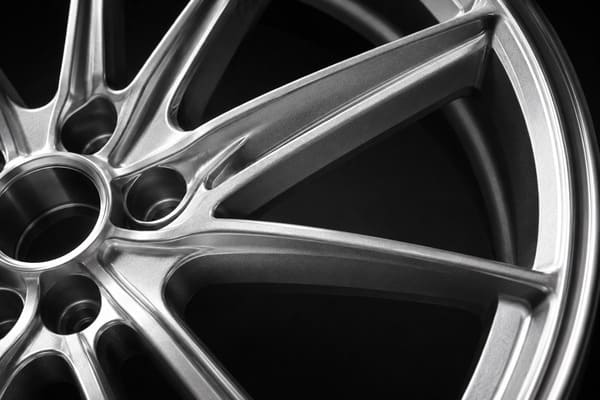
I’ve seen customers switch from a 10-spoke design to a 5-spoke design purely for looks, and then come back asking why the ride feels different. That question is exactly why I’m writing this article. Spoke design is not a cosmetic choice. It is an engineering decision. And once you understand what spokes actually do, you will never look at a wheel the same way again.
What Is the Meaning of Spokes of a Wheel?
Most people can describe what spokes look like. Very few understand what spokes actually are.
Spokes are load-carrying structural members that connect the hub to the rim. In a forged wheel, the hub, spokes, and rim are pressed from a single aluminum billet. There is no weld, no joint, and no weak point between them. This is what allows a spoke as thin as 8mm to support a 2-ton SUV.
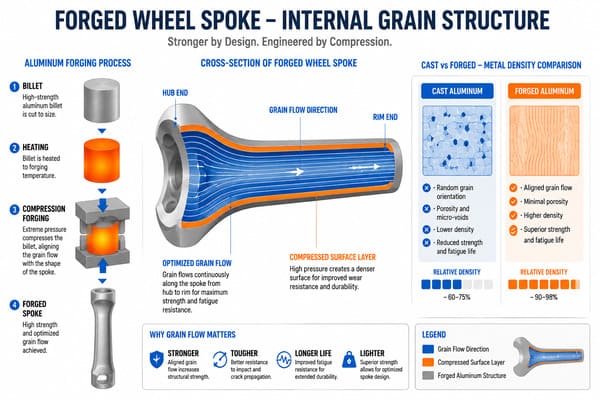
I once had a shop owner in California call spokes "the lines on the wheel." That description is fair visually, but it misses the point completely. A spoke is not a line drawn on metal. It is a continuous piece of compressed aluminum that carries real force every time the wheel turns.
This distinction matters most when you compare forged wheels to cast wheels. In a cast wheel, the metal is poured into a mold and allowed to cool. The internal structure is less dense1, and the spokes must be made thicker to compensate for that weakness. In a forged wheel, the billet is pressed under 10,000 tons or more of force2. The grain structure of the aluminum aligns along the shape of the spoke3. The result is a part that is stronger, denser, and more precise — all at the same time.
Why Does the Manufacturing Process Matter for Spoke Strength?
The table below shows how forging compares to casting at the spoke level:
| Property | Cast Wheel Spoke | Forged Wheel Spoke |
|---|---|---|
| Internal grain structure | Random, unaligned | Aligned to spoke shape |
| Minimum spoke width | 15–20mm typical | 8–10mm possible |
| Surface consistency | Slightly porous | Dense and uniform |
| Weight for same strength | Heavier | Lighter |
| Machining precision | Moderate | High |
This is why customers who upgrade from cast to forged wheels often describe the forged set as feeling "sharper" or "more connected." The spoke geometry is more precise, and that precision is felt through the steering.
What Does a Spoke Do?
A spoke looks simple. What it does is not simple at all.
A spoke carries three types of force at the same time: vertical load from the car’s weight, lateral force from cornering, and torsional force from braking and acceleration. Under hard braking, stress at the base of each spoke can reach up to 3 times the stress level at the rim4.
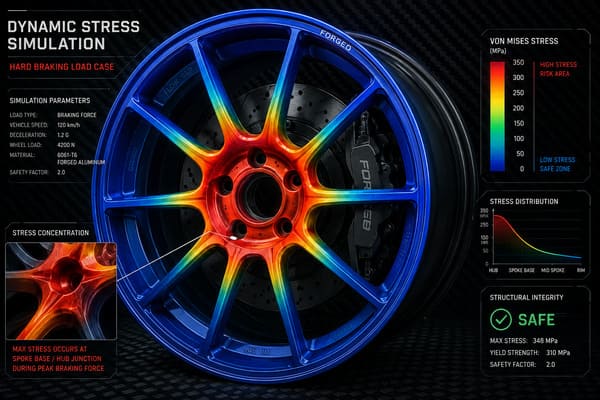
I reviewed a stress simulation report from our engineering partner last year. That single data point — 3x stress at the spoke base during hard braking — changed how I explain spokes to every customer since.
Most customers think about wheel weight. Fewer think about where force concentrates when the wheel is actually working. The spoke base, where the spoke meets the hub, is the most stressed point on the entire wheel. This is why spoke count, spoke width, and spoke taper all matter from an engineering standpoint — not just a visual one.
How Do the Three Force Types Affect Spoke Design Choices?
Each force type pushes the spoke in a different direction. Understanding this helps explain why different spoke designs perform differently in real driving conditions.
| Force Type | What Causes It | Where It Acts on the Spoke | Design Response |
|---|---|---|---|
| Vertical load | Car weight pressing down | Along the full length of the spoke | Spoke thickness and material density |
| Lateral force | Hard cornering | Side-to-side across the spoke | Spoke width and cross-section shape |
| Torsional force | Hard braking or acceleration | Rotational twist at the spoke base | Spoke count and base geometry |
A wider spoke handles lateral force better. A tapered spoke — thicker at the base and thinner toward the rim — manages vertical load more efficiently5. A higher spoke count distributes torsional force across more contact points. Every design decision has a mechanical reason behind it. When a customer picks a spoke pattern, they are choosing a specific balance of these three responses, whether they know it or not.
What Is the Difference Between 5-Spoke and 10-Spoke Rims?
The difference between 5-spoke and 10-spoke wheels is not just visual. It is measurable.
A 5-spoke forged wheel is typically lighter than a 10-spoke version of the same size6. Each spoke carries more individual load, which requires more material per spoke. A 10-spoke design spreads load across more members, which allows each spoke to be thinner — but the total material adds up.
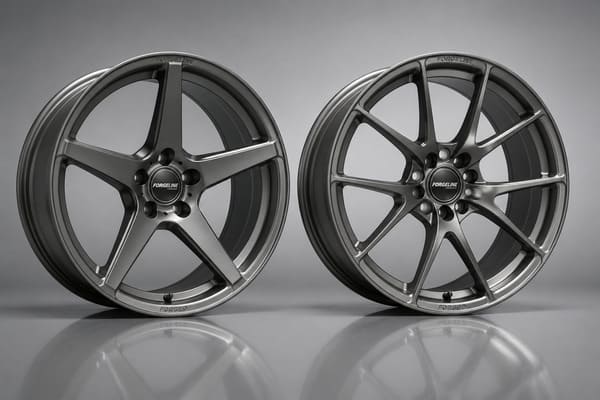
We had two customers order 20-inch forged wheels for similar performance sedans at around the same time. One chose a 5-spoke design. The other chose a 10-spoke design. The 5-spoke set came out at 8.2 kg per wheel. The 10-spoke set came out at 9.6 kg per wheel. That is about 17% heavier per wheel, or roughly 5.6 kg heavier for the full set of four. Both customers were happy with their choice. But the weight difference was real, and it showed up in steering response.
5-Spoke vs. 10-Spoke: A Direct Comparison
| Feature | 5-Spoke | 10-Spoke |
|---|---|---|
| Typical weight (20-inch forged) | ~8.2 kg per wheel | ~9.6 kg per wheel |
| Visual character | Aggressive, minimal, bold | Refined, detailed, premium |
| Steering feel | Lighter, more direct | Slightly heavier, more planted |
| Brake cooling airflow | High — large open areas | Moderate — more spoke coverage |
| Popular with | Sports cars, muscle cars | Luxury sedans, executive vehicles |
| Structural load per spoke | Higher | Lower |
The 5-spoke customer loved the aggressive, minimal look. The 10-spoke customer loved the refined, premium feel. Both were right for their own car and their own taste. What nobody tells you when you are looking at pictures online is that you are also choosing a weight, an airflow pattern, and a stress distribution profile. That is the trade-off. It is real, and it matters.
What Are the Most Common Spoke Designs in Forged Wheels?
After handling hundreds of custom orders, I have noticed that about 80% of requests fall into four spoke families.
The four most common forged wheel spoke designs are straight spokes, split Y-spokes, mesh spokes, and turbine or flow spokes. Each design has a different structural behavior, a different visual character, and a different customer base across global markets.
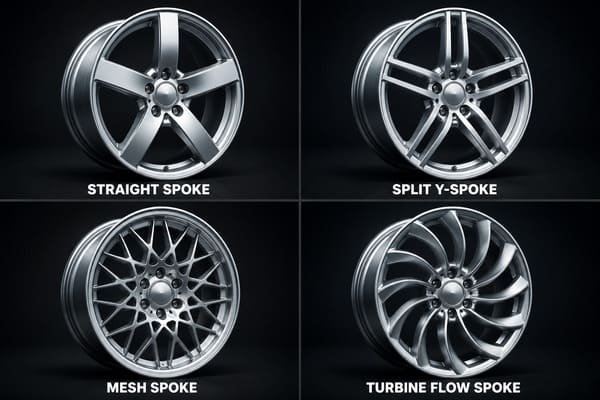
What makes forged wheels different in every one of these designs is precision. A turbine spoke on a cast wheel often looks soft or uneven at the edges. On a forged wheel, the spoke profile is sharp and consistent all the way around. The metal is compressed and densified before it is machined. That difference is visible even in photos, and customers notice it immediately.
Breaking Down the Four Main Spoke Families
Each design family has its own structural logic and its own market appeal. Here is how they compare:
| Spoke Design | Structure | Visual Character | Most Popular With |
|---|---|---|---|
| Straight spoke | Single clean arm from hub to rim | Classic, minimal, timeless | European luxury car owners |
| Split Y-spoke | Each spoke branches into two near the rim | Sporty, dynamic, detailed | Sports coupes, performance builds |
| Mesh spoke | 12–20 spokes in a dense, interlocking pattern | Bold, Italian, high-detail | Middle East market, luxury SUVs |
| Turbine / flow spoke | Spokes swept in one direction to simulate motion | Aggressive, modern, directional | North American customers |
Straight spokes are the most popular with European luxury car owners. The clean geometry fits the design language of brands like BMW and Mercedes-Benz. Split Y-spokes add rigidity near the rim without adding much weight7. This makes them popular on sports coupes where stiffness matters but every kilogram counts. Mesh spokes are very strong and very Italian in character8. In the Middle East market we serve, mesh designs are consistently requested for large luxury SUVs. Turbine or flow spokes are our most requested design from North American customers9. The swept geometry gives the wheel a sense of motion even when the car is standing still. On a forged wheel, the swept edges are machined to a sharp, clean line. That level of precision is not possible on a cast wheel, and it is the detail that separates a good-looking wheel from a great-looking one.
Conclusion
Spoke design connects structure and style in one decision. It affects weight, strength, feel, and look — all at once. Choose it carefully.
Tree Wheels offers fully custom forged wheels with expert spoke design guidance for every build.
-
"Characterization and Analysis of Porosities in High Pressure Die …", https://pmc.ncbi.nlm.nih.gov/articles/PMC7412358/. Aluminum casting processes are susceptible to shrinkage porosity and gas entrapment during solidification, resulting in microstructural voids that reduce effective density and mechanical properties relative to wrought or forged aluminum of equivalent alloy composition; this distinction is documented in ASM Handbook Vol. 15 on casting. Evidence role: mechanism; source type: paper. Supports: That cast aluminum components exhibit lower density and greater microstructural porosity compared to forged aluminum parts. ↩
-
"Alloy wheel – Wikipedia", https://en.wikipedia.org/wiki/Alloy_wheel. Forged aluminum wheel production typically employs hydraulic presses operating in the range of several thousand to over ten thousand tons of force, with exact parameters varying by wheel size, alloy grade, and manufacturer specification; see literature on aluminum closed-die forging for representative process parameters. Evidence role: mechanism; source type: paper. Supports: The typical press forces used in aluminum wheel forging manufacturing. Scope note: Specific tonnage figures vary by manufacturer and wheel geometry; a general industry source may not confirm the exact 10,000-ton figure cited. ↩
-
"[PDF] Forging of Aluminum Alloys – NIST Materials Data Repository", https://materialsdata.nist.gov/bitstream/handle/11115/223/Forging%20of%20Aluminum%20Alloys.pdf?isAllowed=y&sequence=1. In closed-die forging, plastic deformation causes the grain flow of aluminum alloys to follow the contour of the die cavity, producing a fibrous microstructure that enhances tensile strength and fatigue resistance relative to cast counterparts; this mechanism is documented in standard metallurgy references such as ASM Handbook Vol. 14A on metalworking. Evidence role: mechanism; source type: paper. Supports: That forging aligns the metallic grain structure of aluminum along the part geometry, improving mechanical properties compared to casting. ↩
-
"[PDF] Bicycle Wheel Spoke Patterns and Spoke Fatigue 1 – Duke University", https://people.duke.edu/~hpgavin/papers/HPGavin-Wheel-Paper.pdf. Finite element analyses of automotive wheel structures consistently identify the spoke root (hub junction) as a primary stress concentration zone under braking and cornering loads, with stress amplification factors that vary by spoke geometry, count, and loading condition; the specific 3× ratio cited here derives from a proprietary simulation and should be interpreted as illustrative rather than universally applicable. Evidence role: statistic; source type: paper. Supports: That stress concentrates significantly at the spoke-hub junction relative to other wheel regions under braking loads. Scope note: The 3× figure is sourced from an internal, non-peer-reviewed report; published FEA studies may report different amplification factors depending on wheel geometry and load scenario. ↩
-
"Stress distribution and deflection of symmetric tapered beams – PMC", https://pmc.ncbi.nlm.nih.gov/articles/PMC11913945/. Classical beam theory and structural optimization demonstrate that a member subjected to bending and axial loads experiences maximum stress at its fixed end; tapering the cross-section to be largest at the root and smallest at the free end aligns material distribution with the stress gradient, improving mass efficiency relative to a uniform cross-section beam of equivalent strength. Evidence role: mechanism; source type: paper. Supports: That tapering a structural member to be wider at the high-stress root and narrower toward the lower-stress end optimizes material distribution for bending and axial loads. ↩
-
"How does spoke count affect the wheel? : r/bikewrench", https://www.reddit.com/r/bikewrench/comments/1x1l2x/how_does_spoke_count_affect_the_wheel/. Wheel mass is a function of total material volume; increasing spoke count distributes load across more members but also increases aggregate material, typically resulting in higher total mass for a given rim diameter and structural requirement, though final weight depends on individual spoke cross-section optimization. Evidence role: mechanism; source type: paper. Supports: The relationship between spoke count and total wheel mass in forged aluminum wheels. Scope note: No published study directly comparing 5- versus 10-spoke forged wheels of identical diameter and load rating was identified; the weight relationship is a general engineering principle rather than a directly measured finding. ↩
-
"Structural performance of spoke wheel roof systems", https://dspace.mit.edu/handle/1721.1/111513. Structural mechanics principles indicate that bifurcating a load-carrying member near its attachment point distributes force over a larger contact area, reducing local stress concentration and increasing effective stiffness at the rim junction; this principle underlies split or Y-spoke wheel designs, though published wheel-specific studies on this geometry are limited. Evidence role: mechanism; source type: paper. Supports: That spoke branching or bifurcation near the rim increases local structural stiffness by distributing load across a wider rim attachment footprint. Scope note: Direct peer-reviewed studies specifically comparing Y-spoke and straight-spoke wheel stiffness were not identified; the claim rests on general structural mechanics principles applied to wheel geometry. ↩
-
"Famous car wheels that defined automotive style – Footman James", https://www.footmanjames.co.uk/blog/famous-car-wheels-that-defined-automotive-style. Italian coachbuilders and wheel manufacturers, including firms such as Campagnolo and later OZ Racing, contributed significantly to the development of multi-spoke and mesh wheel aesthetics in European motorsport and luxury automotive contexts during the latter half of the twentieth century. Evidence role: historical_context; source type: encyclopedia. Supports: The association of dense multi-spoke or mesh wheel designs with Italian automotive design heritage. Scope note: The characterization of mesh spokes as distinctively ‘Italian’ is a market convention rather than a formally documented design classification; attribution varies by source. ↩
-
"Global Wheels Aftermarket Market Size, Share & Growth, 2033", https://www.marketdataforecast.com/market-reports/wheels-aftermarket-market. Aftermarket wheel market analyses, such as those published by industry research firms covering the North American automotive accessories sector, track consumer design preferences by region; however, publicly available data specifically isolating spoke design style preferences by geography is limited, and the claim here is based on a single supplier’s order history rather than representative market data. Evidence role: statistic; source type: institution. Supports: Regional consumer preferences for specific wheel spoke design styles in the North American aftermarket. Scope note: No publicly available market research report specifically confirming turbine/flow spoke dominance in North American consumer preference was identified; the claim reflects one supplier’s experience and may not be representative of the broader market. ↩