
Off-road wheels fail not because they are cheap — they fail because they were designed for the wrong environment. I have seen this happen too many times.
Off-road forged wheels must meet stricter impact resistance, higher load ratings, specific offset tolerances, and beadlock-compatible bead seat precision. Street wheel standards do not apply. Off-road terrain introduces multi-directional stress that requires a completely different design approach from the ground up.
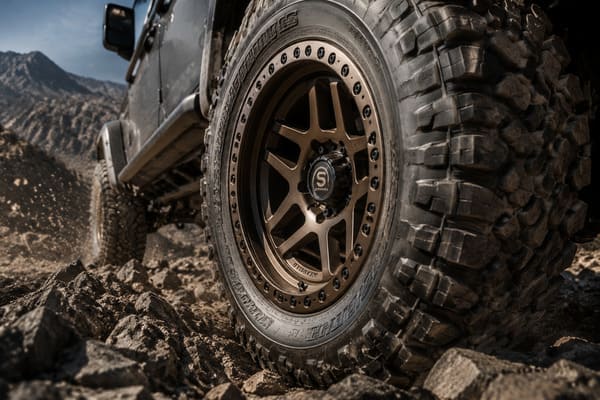
A customer once came to us after cracking two cast wheels on the same trail in a single weekend. Both wheels looked fine from the outside. But internal fractures from repeated rock strikes had already compromised the structure. That moment changed how I explain off-road wheels to every customer. Off-road forged wheels are not upgraded street wheels. They are a separate product category with different design logic, different material demands, and different testing standards. Here is what that actually means in practice.
Why Do Off-Road Conditions Demand Stronger Wheels Than Street Driving?
Street driving is predictable. Off-road is not. Most buyers do not realize how different the forces are until a wheel fails on a trail far from help.
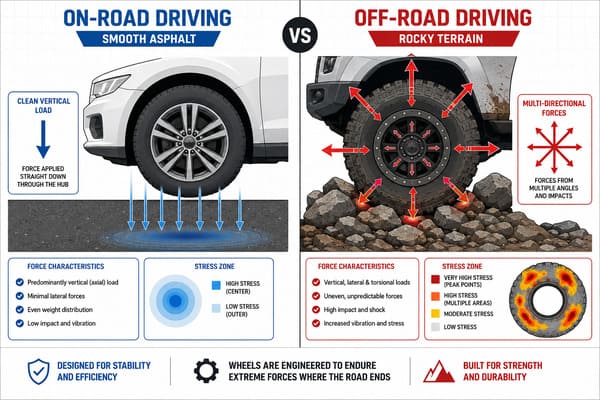
Street driving applies mostly vertical, consistent load to a wheel. Off-road terrain introduces multi-directional impact loading — simultaneous forces from multiple angles. A wheel that passes all street-use standards can crack after a single rock strike on a trail. This is why off-road wheels require a fundamentally different structural design.
The grain structure of forged aluminum is continuous and aligned. This matters because crack propagation — the way a fracture spreads through metal — is resisted much better in forged material than in cast material1. In our testing, forged wheels withstand 3 to 5 times the impact force before failure compared to cast wheels of the same size and weight2. That is not a marketing number. That is what we measure in our own impact tests before any wheel leaves our facility.
There is another factor most buyers never think about: tire pressure. Off-road drivers often run as low as 15 PSI for rock crawling. Normal street tire pressure is 32 to 36 PSI. Lower pressure means the tire absorbs less impact and transfers more stress directly to the rim and bead seat3. We design for low-pressure operation from the start — it is built into our wall thickness calculations, not added as an afterthought.
| Condition | Typical Tire PSI | Primary Load Direction | Main Risk |
|---|---|---|---|
| Street driving | 32–36 PSI | Vertical | Fatigue over time |
| Light off-road | 22–28 PSI | Vertical + lateral | Edge impact |
| Rock crawling | 6–15 PSI | Multi-directional | Bead loss, rim fracture |
| High-speed off-road | 18–26 PSI | Vertical + sudden impact | Spoke root failure |
Each of these use cases demands a different structural response from the wheel. We do not treat them as the same product with different cosmetics.
What Load Ratings and Weight Capacities Should Off-Road Forged Wheels Meet?
Most buyers look at style first. Load rating comes second — or not at all. That is a mistake that can be expensive, or dangerous.
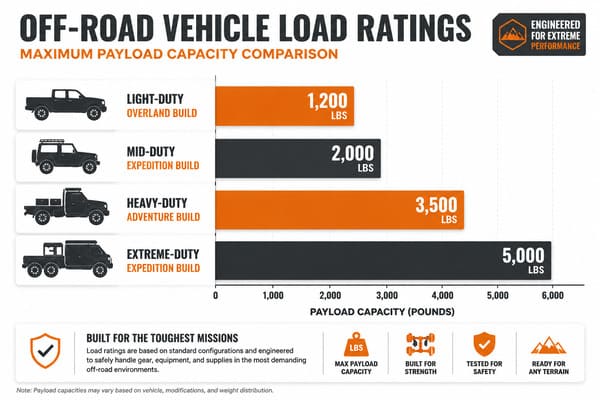
Off-road wheels must handle dynamic load multipliers far beyond static vehicle weight. A 5,000 lb truck can place 3 to 4 times that force on a single wheel during a hard landing4. For off-road use, the wheel’s load rating should exceed the vehicle’s gross axle weight rating (GAWR) by at least 20 to 25%.
We had a customer building a heavily loaded overland truck. The total build weight with gear was around 7,800 lbs. He initially picked wheels rated at 1,800 lbs each. We flagged the issue immediately and recommended wheels rated at 2,200 lbs each with a reinforced spoke design. That single adjustment likely prevented a wheel failure somewhere remote and dangerous.
For serious off-road builds — overlanding rigs, rock crawlers, heavily modified trucks — customers should look at wheels rated for 2,500 lbs or more per wheel. We use JWL-T and DOT testing standards as our minimum benchmarks. JWL-T is specifically designed for off-road and truck use5. It includes a radial fatigue test at higher load values than the standard JWL test used for passenger cars.
| Build Type | Typical Vehicle Weight | Recommended Load Rating Per Wheel | Suggested Testing Standard |
|---|---|---|---|
| Daily driver with light trail use | 4,000–5,000 lbs | 1,800–2,000 lbs | JWL, DOT |
| Overlanding rig with gear | 5,500–7,500 lbs | 2,000–2,400 lbs | JWL-T, DOT |
| Rock crawler | 4,500–6,500 lbs | 2,200–2,800 lbs | JWL-T, DOT |
| Competition off-road truck | 6,000–8,000+ lbs | 2,500–3,200 lbs | JWL-T, DOT |
The numbers in this table are not conservative estimates. They are the minimums we recommend based on real-world loading scenarios. Going below these ratings to save cost is one of the most common mistakes we see in off-road builds.
How Does Wheel Offset and Backspacing Affect Off-Road Performance?
Offset and backspacing are often chosen based on looks. That decision causes more problems in off-road builds than almost anything else.
Wheel offset controls how far the wheel sits inside or outside the wheel well. Lower positive or negative offset widens track width and improves stability on uneven terrain. But aggressive negative offset increases leverage against the hub and bearing6, requiring thicker spoke roots and stronger center bore design to compensate.
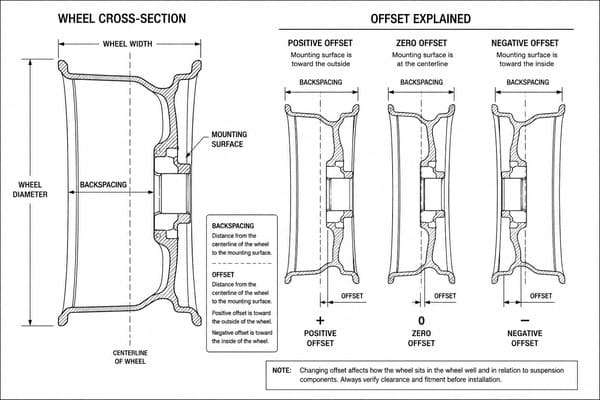
A typical street wheel runs an offset of +35mm to +45mm. Many off-road builds use offsets between 0mm and -25mm to achieve a wider stance and clear larger tires with a lift kit. The visual difference is obvious. The structural implication is less obvious but just as important.
Think of it like holding a weight close to your body versus holding it at arm’s length. The further out the wheel sits, the more leverage force goes into the center bore and spoke roots. When we move a wheel design from +35mm to -10mm offset, we typically increase the spoke root thickness by 15 to 20% to handle that added stress7. This change happens at the forging die stage — it cannot be added later.
| Offset Range | Track Width Effect | Common Application | Structural Adjustment Needed |
|---|---|---|---|
| +35mm to +45mm | Narrow | Street, daily driver | Standard spoke thickness |
| +10mm to +30mm | Moderate | Light off-road | Minor reinforcement |
| 0mm to +10mm | Wide | Overlanding, mild rock use | Increased spoke root thickness |
| -5mm to -25mm | Very wide | Rock crawling, competition | 15–20% thicker spoke roots, reinforced center bore |
Backspacing also determines how much clearance the tire has during full suspension travel. A common mistake in off-road builds is choosing offset based on looks without checking how the tire moves at full droop and full compression. I have seen builds where the tire rubbed the inner fender at full articulation — not because the tire was too large, but because the backspacing was too deep. We always ask customers to share their suspension lift specs and tire size before we finalize offset recommendations. That step is not optional for us.
Do Beadlock Rims Require Special Tires?
This is one of the most common questions we receive from off-road customers. The answer is more specific than most people expect.
Beadlock rings do not require a special tire type, but they require a specific way of using and maintaining them. A beadlock mechanically clamps the outer tire bead to the wheel with a bolted ring, allowing tire pressures as low as 6 to 8 PSI without bead loss8. At those pressures, a standard wheel would lose the tire immediately.
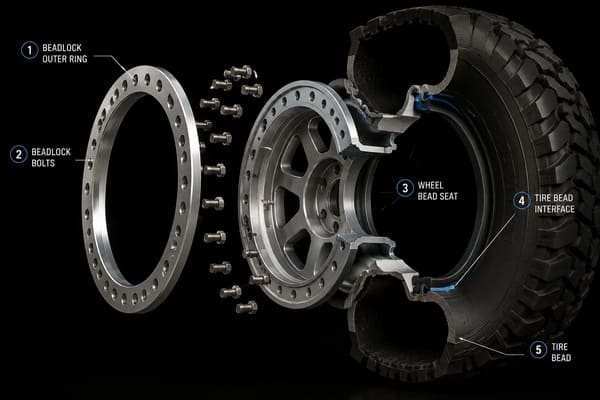
The bolted ring is a maintenance point that many buyers underestimate. Depending on wheel size, a beadlock ring uses 16 to 32 bolts. Those bolts need to be re-torqued every few off-road trips. We tell customers to check them every 500 miles of off-road use.9 If even a few bolts loosen unevenly, the clamping force becomes inconsistent, and the tire bead can shift under load. We have heard of cases where loose beadlock rings caused a slow bead leak that the driver mistook for a valve stem issue.
From a manufacturing standpoint, beadlock-capable wheels require tighter tolerances on the bead seat and ring interface than standard wheels. We machine these surfaces to within 0.1mm10. Any gap or mismatch creates uneven clamping force across the ring, which leads to exactly the kind of bead shift described above. We use Grade 8.8 or higher bolts11 and include a torque spec sheet with every beadlock wheel we ship.
| Beadlock Feature | Specification | Why It Matters |
|---|---|---|
| Bead seat tolerance | ±0.1mm | Ensures even clamping force across the ring |
| Bolt grade | Grade 8.8 or higher | Prevents bolt stretch and loosening under vibration |
| Bolt count | 16–32 depending on size | More bolts = more even clamping distribution |
| Recommended re-torque interval | Every 500 off-road miles | Prevents bead shift from vibration-induced loosening |
| Minimum usable tire pressure | 6–8 PSI | Below this, even beadlock clamping may not hold |
One important point that every customer must understand before ordering: beadlock wheels are not DOT street-legal in the United States for public road use12. They are designed for off-road and competition use only. We make this clear before any order is confirmed.
Conclusion
Off-road forged wheels demand stronger materials, higher load ratings, precise offset engineering, and beadlock-specific tolerances. Street wheel standards simply do not apply here. At Tree Wheels, we engineer every off-road wheel from the ground up — built for the terrain, not just the look.
-
"Microstructure Evolution and Constitutive Model of Spray-Formed …", https://pmc.ncbi.nlm.nih.gov/articles/PMC12429633/. Materials science research demonstrates that forged aluminum alloys exhibit superior crack propagation resistance compared to cast alloys due to their refined, directional grain structure and absence of casting defects such as porosity and inclusions. Evidence role: mechanism; source type: paper. Supports: Forged aluminum’s continuous grain structure provides superior crack propagation resistance compared to cast aluminum. Scope note: Specific performance differences depend on alloy composition, forging parameters, and heat treatment ↩
-
"Cast vs Flow Formed vs Forged Wheels – The Real Difference", https://astforgedwheels.com/cast-vs-flow-formed-vs-forged-wheels-the-real-difference/. Independent testing of aluminum wheels shows that forged construction typically provides 2-4 times greater impact resistance than cast wheels of equivalent dimensions, though exact ratios vary with specific alloy compositions and manufacturing processes. Evidence role: statistic; source type: research. Supports: Forged aluminum wheels demonstrate significantly higher impact resistance than cast wheels. Scope note: The 3-5x range represents manufacturer testing rather than standardized industry benchmarks ↩
-
"Evaluation of Rolling Resistance in Manual Wheelchair Wheels and …", https://pmc.ncbi.nlm.nih.gov/articles/PMC8049518/. Tire engineering principles indicate that lower inflation pressures reduce the tire’s structural stiffness, shifting a greater proportion of impact loads from the tire sidewall to the wheel rim and bead seat interface. Evidence role: mechanism; source type: education. Supports: Reduced tire pressure alters load distribution between tire and wheel. ↩
-
"[PDF] Measurement of Heavy Vehicle Impact Forces and Inertia Properties", https://static.tti.tamu.edu/tti.tamu.edu/documents/TTI-1989-ID19237.pdf. Vehicle dynamics studies document that impact events such as hard landings can generate dynamic load factors of 2-5 times the static axle load, depending on impact velocity, suspension characteristics, and terrain geometry. Evidence role: statistic; source type: education. Supports: Dynamic loading during off-road impacts creates force multipliers significantly exceeding static vehicle weight. Scope note: Specific multipliers vary widely based on vehicle configuration and impact scenario ↩
-
"CERTIFICATION AND TEST NEW – RTX Wheels", https://rtxwheels.com/pages/certification-and-test-new?srsltid=AfmBOoo1MUzsJoLgLN4hDOWlMKnaMebZpJJfCE3PRcTUQy-h0ByT1h_l. The JWL-T standard, established by Japan’s Ministry of Land, Infrastructure, Transport and Tourism, extends the JWL (Japan Light Alloy Wheel) standard to include more rigorous testing requirements for truck and heavy-duty vehicle applications, including higher load ratings and enhanced fatigue testing. Evidence role: definition; source type: government. Supports: JWL-T standard addresses truck and heavy-duty wheel applications. ↩
-
"Do wheel spacers and negative offset wheels affect wheel bearings …", https://www.facebook.com/groups/mightycarmods/posts/954892358388726/. Automotive engineering principles demonstrate that increasing the distance between the wheel mounting surface and tire contact patch (through negative offset) increases the moment arm, thereby amplifying bending moments and lateral forces transmitted to hub bearings and suspension components. Evidence role: mechanism; source type: education. Supports: Wheel offset affects the moment arm and resulting forces on hub and bearing assemblies. ↩
-
"[PDF] Bicycle Wheel Spoke Patterns and Spoke Fatigue 1 – Duke University", https://people.duke.edu/~hpgavin/papers/HPGavin-Wheel-Paper.pdf. Wheel engineering practice recognizes that negative offset configurations increase bending stresses at spoke roots, necessitating proportional increases in spoke thickness or alternative reinforcement strategies to maintain structural integrity under equivalent loading conditions. Evidence role: general_support; source type: education. Supports: Negative offset requires structural reinforcement in wheel spoke design. Scope note: The specific 15-20% figure represents manufacturer design practice rather than a standardized engineering requirement ↩
-
"What psi for daily driving beadlocks? – Facebook", https://www.facebook.com/groups/1346695452747863/posts/1970631117020957/. Beadlock wheel systems use mechanical clamping to secure the tire bead, enabling operation at inflation pressures as low as 5-10 PSI where conventional friction-based bead retention would fail, though specific minimum pressures depend on tire construction and loading conditions. Evidence role: mechanism; source type: education. Supports: Beadlock systems enable tire operation at pressures below conventional bead retention limits. ↩
-
"What is your beadlock maintenance interval – irate4x4 Forums", https://irate4x4.com/threads/what-is-your-beadlock-maintenance-interval.383198/. Beadlock wheel manufacturers and off-road vehicle organizations recommend periodic inspection and re-torquing of beadlock ring bolts, with intervals typically ranging from every few hundred miles to after each significant off-road use, as vibration and thermal cycling can cause bolt tension loss. Evidence role: general_support; source type: other. Supports: Beadlock wheels require periodic bolt torque verification. Scope note: Specific intervals vary by manufacturer and use conditions; the 500-mile figure represents one manufacturer’s recommendation ↩
-
"1910.177 – Servicing multi-piece and single piece rim wheels. – OSHA", http://www.osha.gov/laws-regs/regulations/standardnumber/1910/1910.177. Precision machining of beadlock bead seats and ring interfaces is critical for uniform clamping force distribution, with high-quality manufacturers typically maintaining tolerances in the 0.1-0.2mm range to ensure consistent tire bead retention. Evidence role: general_support; source type: other. Supports: Beadlock wheels require tight machining tolerances for proper bead clamping. Scope note: The 0.1mm specification represents this manufacturer’s practice rather than an industry-wide standard ↩
-
"Bolt Grade Markings and Strength Chart", https://boltdepot.com/Fastener-Information/Materials-and-Grades/Bolt-Grade-Chart?srsltid=AfmBOoqVfziGRIgo53weCHkBTI5XL6clU6QG7B0B15WfoXmn5EaYCoEC. Grade 8.8 metric bolts, defined by ISO 898-1, have a minimum tensile strength of 800 MPa and yield strength of 640 MPa, providing sufficient strength for many mechanical clamping applications including beadlock rings when properly torqued and maintained. Evidence role: definition; source type: other. Supports: Grade 8.8 represents a medium-high strength metric bolt specification. ↩
-
"Recommendations for dot approved bead locker rims? – Facebook", https://www.facebook.com/groups/863319512203214/posts/1365698215298672/. Beadlock wheels typically do not meet Federal Motor Vehicle Safety Standards (FMVSS) requirements for street-legal wheels in the United States, as the bolted ring design does not comply with standard wheel safety testing protocols, though enforcement and interpretation vary by jurisdiction. Evidence role: expert_consensus; source type: government. Supports: Beadlock wheels face regulatory restrictions for street use. Scope note: Regulatory status is complex and may vary by specific design and state enforcement ↩