
Most people think wider wheels automatically mean better grip. That’s only half true. Wheel width doesn’t create grip — it creates the conditions for grip.
Wheel width changes the shape of your tire’s contact patch. A wider rim stretches the tire, flattening the contact patch from a natural oval into a rectangle.1 This only improves grip when the tire width, rim width, and vehicle setup are properly matched. A mismatch makes handling worse, not better.
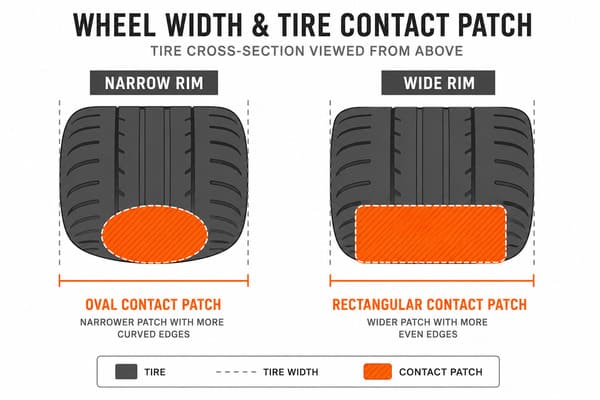
Last year, a modification shop in Dubai contacted us after a customer complained that his car felt worse after upgrading to wider wheels. When we reviewed the order, the problem was clear. He had gone from an 8.5-inch rim to a 10.5-inch rim but kept the same 245-width tire. That tire was never designed to perform at 10.5 inches of mounting width. The sidewalls were pulled flat, the contact patch changed from a natural oval to an unnatural rectangle, and the handling became nervous and unpredictable. We remounted the same tire on a 9-inch rim, and the customer’s feedback changed completely. Width is a tool. Like any tool, it only works when matched correctly. The sections below break down exactly how that matching works — and where most people get it wrong.
How Much Does Tire Width Affect Grip?
A wider tire sounds like a simple upgrade. More rubber on the road, more grip. But the real relationship between tire width and grip is not that straightforward, and getting it wrong can actually make your car slower.
A wider tire increases the contact patch, but only improves grip when your suspension, downforce, and vehicle weight can load that contact patch evenly.2 If your setup cannot pressurize the full width of the tire, the outer edges of the tire do almost no work, and you lose the benefit entirely.
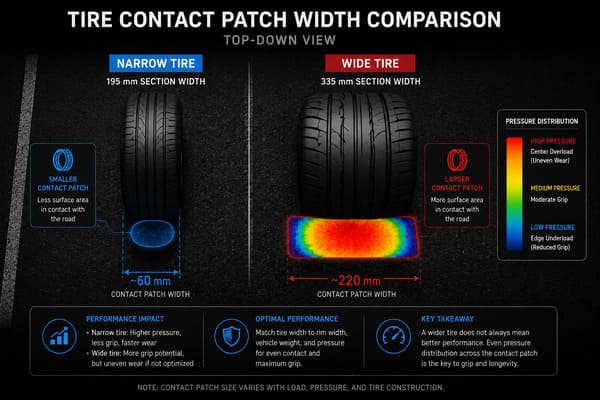
I remember a customer who came to us running a 2,800-pound sports coupe on a track day setup. He upgraded from 265-width tires to 305-width tires and mounted them on 11-inch rims. His lap times did not improve — they got worse by about 1.2 seconds per lap. His coach told him he had more understeer than before. The problem was simple: his car did not generate enough downforce or suspension load to pressurize a 305 contact patch evenly. The outer 20% of the tire was barely working.
Why Wider Is Not Always Faster
The grip a tire produces depends on how evenly pressure is distributed across the contact patch. When a tire is wider than your setup can support, the pressure distribution becomes uneven.
| Setup Condition | Tire Width Result | Grip Outcome |
|---|---|---|
| High downforce, stiff suspension | Wide tire loads evenly | Grip improves |
| Low downforce, soft suspension | Wide tire loads unevenly | Outer edges underperform |
| Mismatched rim-to-tire width | Sidewall pulled flat | Contact patch distorted, handling unpredictable |
| Correct rim-to-tire ratio | Natural sidewall profile | Contact patch shape optimized |
Width amplifies whatever your setup already is. If your setup is good, wider helps. If it is not, wider punishes you. Before choosing a wider tire, the honest question to ask is whether your car can actually use the extra contact area — or whether you are paying for rubber that never touches the road properly.
What Is the 3% Tire Rule?
The 3% rule is widely cited in the wheel and tire community. Most people treat it as a clearance rule — stay within 3% of your stock rolling diameter and the tire will not rub. But that is not what the rule was designed to protect.
The 3% tire rule means your new tire’s overall rolling diameter should stay within 3% of your stock tire’s diameter.3 This keeps speed-sensitive systems like ABS, traction control, and speedometer calibration accurate. It is a system calibration rule, not just a fitment guideline.
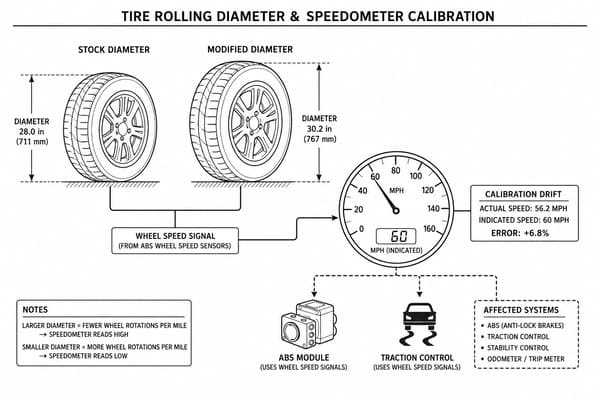
Here is a real number to understand why it matters. A rolling diameter difference of just 2.5% on a car traveling at 60 mph means your speedometer reads 61.5 mph while you are actually doing 60 mph.4 That sounds harmless. But on a modern car, that same 2.5% error is being fed into your ABS calibration, your traction control threshold, and your stability program trigger points — all at the same time.
What the 3% Rule Actually Protects
One customer in Canada found out the hard way when his ABS started activating at the wrong moment on a wet highway after a tire size change. He had not changed rims — just tire profile. The rolling diameter shifted by about 2.8%, and that was enough to push the ABS system outside its calibrated range.
| Rolling Diameter Change | Speedometer Error | System Impact |
|---|---|---|
| 1% | ~0.6 mph at 60 mph | Minimal, within tolerance |
| 2.5% | ~1.5 mph at 60 mph | ABS and traction control affected |
| 3%+ | ~1.8 mph+ at 60 mph | Stability systems may trigger incorrectly |
| 5%+ | ~3 mph+ at 60 mph | Legal speedometer compliance risk |
Modern vehicles rely on wheel speed sensors for more than just the speedometer.5 The same signal feeds your ABS module, your electronic stability control, and in some vehicles, your transmission shift points.6 A tire size change that looks small on paper can create real safety issues in real driving conditions. The 3% rule is the boundary that keeps those systems working as the manufacturer intended.
What Is the 105 Rule for Rim Width?
Choosing the right rim width for a given tire is one of the most common questions we get from modification shops. The 105 rule gives you a reliable starting point, but understanding what it does — and what it does not do — is what separates a good build from a great one.
The 105 rule states that your ideal rim width equals your tire’s section width in millimeters, multiplied by 1.05, then converted to inches.7 For a 265mm tire, that gives roughly 10.9 inches of rim width. This produces a natural sidewall profile and a well-shaped contact patch for standard driving.
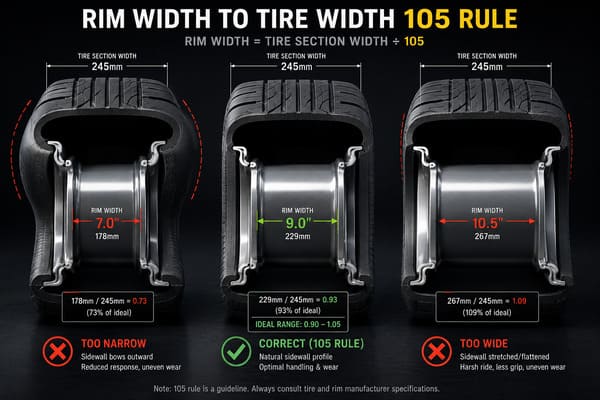
For a 265mm tire: 265 × 1.05 = 278.25mm ÷ 25.4 = approximately 10.9 inches. That is the rim width where the tire sits in its most natural, intended shape. The sidewall is neither pushed inward nor stretched outward, and the contact patch forms the oval that the tire engineer designed.8
When Builders Deliberately Break the 105 Rule
Here is what the rule does not tell you. In performance and motorsport builds, many builders deliberately mount tires on rims that are 0.5 to 1 inch narrower than the 105 calculation suggests. A slightly narrower rim pushes the sidewall outward just enough to increase lateral stiffness during hard cornering.9
| Rim Width vs. 105 Calculation | Sidewall Effect | Handling Characteristic |
|---|---|---|
| Exactly at 105 result | Natural profile | Balanced, predictable |
| 0.5 inch narrower | Slight outward bow | Sharper turn-in, stiffer lateral feel |
| 1 inch narrower | Noticeable outward bow | Aggressive response, reduced comfort |
| Wider than 105 result | Sidewall stretched flat | Nervous handling, reduced sidewall flex |
We worked with a track-focused shop in Australia that tested this back to back on the same car — same tire, same compound, same driver. The 0.5-inch narrower rim setup produced a measurably sharper turn-in response and reduced their cornering lap variance by about 0.3 seconds. The 105 rule gives you predictable. But in custom builds, predictable is just the starting line. Knowing when and why to deviate from it is where real fitment expertise begins.
Is It Better to Get 17-Inch or 18-Inch Tires?
This question comes up constantly, and I want to answer it honestly. The choice between 17-inch and 18-inch wheels is not really about which size is better. It is about which road you actually drive on every day.
For daily driving on real roads with potholes and imperfections, 17-inch wheels with a higher tire profile absorb impacts better and cost less to replace. For track use or show builds, 18-inch and larger wheels offer stiffer sidewalls and better cornering precision. The right answer depends entirely on your actual use case.
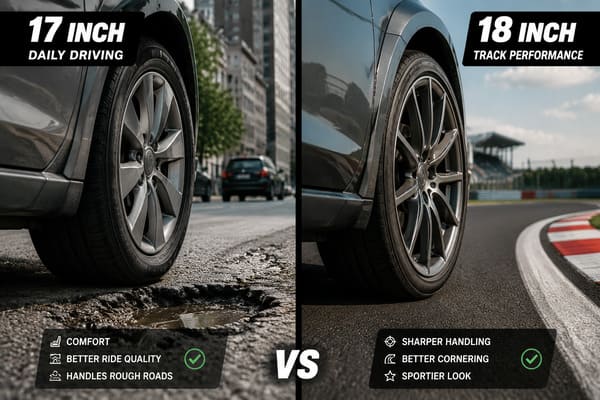
Here is a number that puts the difference in physical terms. Going from a 17-inch wheel with a 55-profile tire to an 18-inch wheel with a 45-profile tire reduces your sidewall height by roughly 15mm on each side.10 That 15mm is the difference between a tire that absorbs a pothole and a tire that transfers the full impact straight into your rim.11
What the Numbers Say About Real-World Durability
We have B2B clients — modification shops in the UK and Canada — who report that roughly 60% of their customers who upgrade to 18-inch setups come back within two years with bent rims or cracked lips from road damage12. That is not a small number. It is a pattern.
| Wheel Size | Sidewall Height | Road Impact Absorption | Replacement Cost | Best Use Case |
|---|---|---|---|---|
| 17-inch (55 profile) | Higher | Absorbs impacts well | Lower | Daily driving, rough roads |
| 18-inch (45 profile) | Lower | Transfers more impact to rim | Higher | Track, show builds, smooth roads |
| 19-inch+ (35 profile) | Very low | Minimal absorption | Highest | Track only, controlled surfaces |
For daily drivers on real roads, 17-inch setups hold up better, cost less to replace, and keep customers happier long-term. For show builds or track-only cars, 18-inch and above makes sense. The honest answer is: choose based on the road you actually drive on, not the car you wish you had. At Tree Wheels, we ask every customer that question before we recommend a size — because the best wheel is the one that fits your life, not just your car.
Conclusion
Wheel width shapes grip only when matched correctly to your tire, vehicle, and real driving conditions. Match it right, and everything improves. Match it wrong, and everything gets worse. Tree Wheels builds fully customized forged wheels to your exact specifications — get in touch to find your perfect fitment.
-
"[PDF] Tire Contact Patch Characterization through Finite Element …", https://vtechworks.lib.vt.edu/bitstream/handle/10919/82708/Mathews_Vayalat_T_T_2016.pdf. Tire engineering research demonstrates that mounting width affects contact patch geometry, with wider rims generally producing more rectangular footprints compared to the naturally elliptical shape on narrower rims, though the exact shape depends on tire construction and inflation pressure. Evidence role: mechanism; source type: research. Supports: the geometric relationship between rim width and tire contact patch shape. Scope note: The cited research may describe the general principle rather than the specific oval-to-rectangle transformation for all tire types ↩
-
"A Study on the Contact Characteristics of Tires–Roads Based … – PMC", https://pmc.ncbi.nlm.nih.gov/articles/PMC10532792/. Vehicle dynamics research indicates that tire grip depends on pressure distribution across the contact patch, with uneven loading reducing effective grip regardless of total contact area, though the specific thresholds vary by tire compound and vehicle configuration. Evidence role: mechanism; source type: research. Supports: the relationship between contact patch loading uniformity and tire grip performance. Scope note: The source may address pressure distribution principles without specifically quantifying the suspension and downforce requirements mentioned ↩
-
"Tire code – Wikipedia", https://en.wikipedia.org/wiki/Tire_code. Automotive fitment guidelines commonly reference a 3% rolling diameter tolerance to maintain vehicle system calibration, though this represents an industry rule of thumb rather than a universal engineering standard, with actual tolerances varying by manufacturer and system sensitivity. Evidence role: general_support; source type: education. Supports: the existence and general application of the 3% tire diameter guideline. Scope note: The 3% figure may be a community convention rather than a formally documented engineering specification ↩
-
"Tire size change speedometer error calculation", https://www.f150ecoboost.net/threads/tire-size-change-speedometer-error-calculation.89577/. Speedometer readings are directly proportional to wheel rotational speed, so a 2.5% increase in rolling diameter produces an approximately 2.5% speedometer error, which at 60 mph actual speed would display as approximately 61.5 mph, assuming linear calibration. Evidence role: mechanism; source type: education. Supports: the mathematical relationship between rolling diameter and speedometer reading. ↩
-
"Wheel speed sensor – Wikipedia", https://en.wikipedia.org/wiki/Wheel_speed_sensor. Contemporary automotive design integrates wheel speed sensor data across numerous safety and performance systems including anti-lock braking, traction control, electronic stability programs, and in some vehicles, adaptive cruise control and transmission management, making sensor accuracy critical for vehicle operation. Evidence role: general_support; source type: education. Supports: the multiple applications of wheel speed sensor data in modern vehicle systems. ↩
-
"Wheel speed sensor", https://en.wikipedia.org/wiki/Wheel_speed_sensor. Modern vehicles utilize wheel speed sensor data across multiple systems including anti-lock braking (ABS), electronic stability control (ESC), and in some configurations, transmission control modules, making sensor accuracy critical for integrated vehicle dynamics management. Evidence role: mechanism; source type: education. Supports: the use of wheel speed sensor data across multiple vehicle control systems. ↩
-
"105% rule still valid? – Equipment", https://www.trainerroad.com/forum/t/105-rule-still-valid/84150. The 105 rule represents a commonly referenced fitment guideline in the wheel and tire industry for calculating rim width from tire section width, though it functions as a practical approximation rather than a manufacturer-specified standard, with actual optimal widths varying by tire design and intended use. Evidence role: general_support; source type: other. Supports: the existence and application of the 105 rule in tire fitment. Scope note: This appears to be an industry convention rather than a formally documented engineering standard ↩
-
"[PDF] Measurement of Tire Footprint Pressures – ROSA P", https://rosap.ntl.bts.gov/view/dot/81984/dot_81984_DS1.pdf. Tire manufacturers design tires with specific rim width ranges that produce intended contact patch characteristics, with mounting within the specified range generally producing more uniform pressure distribution, though the exact shape depends on multiple factors including inflation pressure and load. Evidence role: general_support; source type: research. Supports: the relationship between rim width and intended tire contact patch geometry. Scope note: The source may not specifically confirm that all tire engineers design for oval contact patches as the universal ideal ↩
-
"Sidewall deflection and Rim\Tire size questions? – Pro-Touring.com", https://www.pro-touring.com/threads/101915-Sidewall-deflection-and-Rim-Tire-size-questions. Tire dynamics research indicates that mounting a tire on a narrower rim within acceptable ranges can increase sidewall curvature, which may affect lateral stiffness characteristics, though the performance impact depends on tire construction, compound, and operating conditions. Evidence role: mechanism; source type: research. Supports: the effect of rim width on tire sidewall geometry and lateral stiffness. Scope note: The cited research may describe the geometric relationship without specifically confirming improved cornering performance in all cases ↩
-
"Tire Height Calculator – Spicer Parts", https://spicerparts.com/calculators/tire-height-calculator. Tire sidewall height is calculated as section width multiplied by aspect ratio, so the difference between a 55-profile and 45-profile tire depends on the specific section width, with the 15mm difference cited being accurate for a tire width of approximately 225-235mm. Evidence role: mechanism; source type: education. Supports: the method for calculating sidewall height differences between tire sizes. Scope note: The 15mm figure is only accurate for specific tire widths and may not apply to all 17-inch to 18-inch conversions ↩
-
"Tire Safety Ratings and Awareness | TireWise – NHTSA", https://www.nhtsa.gov/vehicle-safety/tires. Tire research demonstrates that sidewall height affects impact absorption capacity, with taller sidewalls providing more deflection distance to absorb road irregularities before impact forces reach the wheel, though the specific protection level depends on tire construction and inflation pressure. Evidence role: mechanism; source type: research. Supports: the relationship between sidewall height and impact absorption capability. ↩
-
"3 Common Types of Wheel Damage: What Is Repairable", https://www.autocosmetics.org/blog/learn-about-3-common-types-of-wheel-damage. Industry data and consumer reports indicate that larger wheel diameters with lower-profile tires experience higher rates of impact damage from road hazards compared to smaller wheels with taller sidewalls, though specific damage rates vary significantly by region, road conditions, and driving patterns. Evidence role: statistic; source type: research. Supports: the increased susceptibility of larger wheels with lower-profile tires to road damage. Scope note: The cited 60% figure represents anecdotal shop experience rather than controlled research data ↩