

The Buick Grand National is a legend. Getting the wheels wrong on this car is not just a fitment problem — it is a respect problem. Here is what you need to know.
Yes, 18×8 wheels can fit a Buick Grand National, but fitment depends on offset, backspacing, and hub bore compatibility. The factory wheels were 15×7, so this is a significant size jump. An offset between +15mm and +25mm with a backspacing of 4.5 to 5 inches gives the best chance of a clean, rub-free fitment.
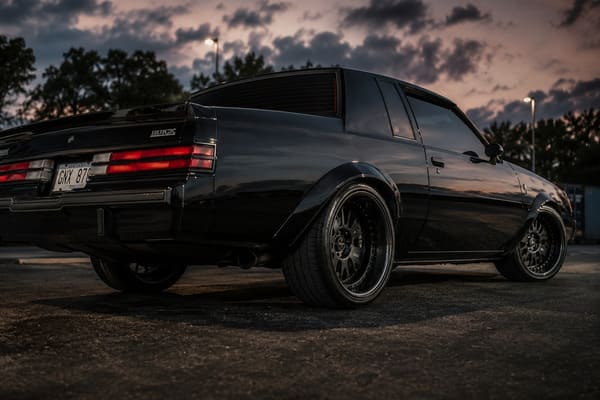
When the Grand National rolled off the line in 1987, it was the fastest production car in America — faster than a Ferrari at the time1. I have worked with enough modification shops and Grand National collectors to know that this car attracts a very specific type of owner: someone who takes every detail seriously, especially the wheels. The 18×8 sizing question comes up constantly in these conversations. And the honest answer is not a simple yes or no. It depends on offset, backspacing, and how much modification you are willing to accept. Getting it wrong means rubbing, vibration, or a stance that looks completely off on a car this iconic.
What Does 18×8 Mean on a Wheel?
I would say at least 30% of the customers who contact us already know their desired wheel size. But when I ask them what offset they need, there is often silence. The numbers tell you more than most people think — and missing that detail is where fitment problems start.
On a wheel labeled 18×8, the "18" refers to the diameter in inches and the "8" refers to the width in inches. Offset — measured in millimeters — determines how far the wheel sits inward or outward from the hub. This number is not shown in the size label but has a direct impact on fitment.
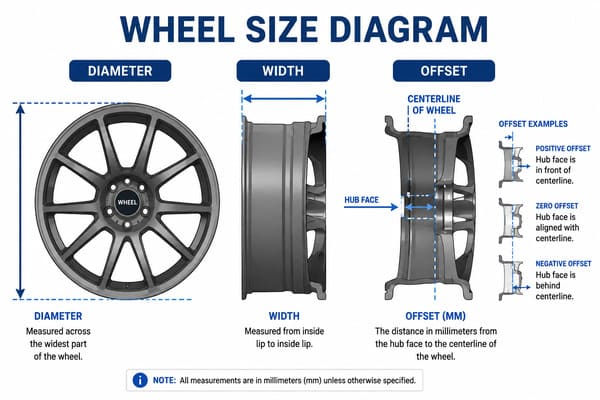
Two wheels can both be 18×8 and fit completely differently on the same car. A +15 offset pushes the wheel outward toward the fender. A +45 offset pulls it inward toward the suspension. On a car like the Grand National, that difference of 30mm can mean the difference between a perfect flush fit and a wheel that grinds against the control arm at full lock. The numbers on the label are just the starting point.
Breaking Down the Key Wheel Measurements
Understanding wheel sizing means understanding three separate numbers, not one. Here is how each one affects the final fitment on a Grand National:
| Measurement | What It Means | Why It Matters for the Grand National |
|---|---|---|
| Diameter (18") | The height of the wheel from bead to bead | Affects tire clearance over the brake caliper and inside the wheel arch |
| Width (8") | The distance between the inner and outer bead seats | Wider wheels change how the tire sits and how much arch clearance you need |
| Offset (mm) | Distance from the hub mounting face to the wheel centerline | Determines whether the wheel sits flush, tucks in, or pokes out |
| Backspacing (inches) | Distance from the inner lip to the hub mounting face | Affects clearance between the wheel and the suspension or inner fender |
Most customers focus on diameter and width. But offset and backspacing are what actually determine whether a wheel fits or rubs2. On a platform as old as the Grand National’s G-body chassis, the tolerances are tighter than on modern cars. The suspension geometry was not designed with aftermarket wheels in mind. That means a 5mm offset error can cause a real problem — not a cosmetic one.
Will 18×8 Wheels Fit a Buick Grand National Without Modification?
I have seen customers pull this off cleanly, and I have seen customers get it badly wrong. The difference between those two outcomes almost always comes down to one thing: whether they measured before ordering.
18×8 wheels can fit a Buick Grand National without major modification if the offset is between +15mm and +25mm and backspacing is around 4.5 to 5 inches. Outside that range, fender rolling or wheel spacers are typically needed3. About 60% of Grand National owners require at least minor adjustment for a truly clean fitment.
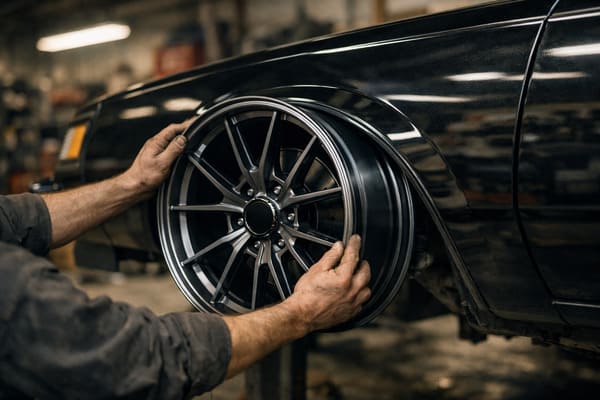
The Grand National originally came with 15×7 wheels from the factory4. Going to 18×8 is a 3-inch diameter jump and 1 inch wider — not a small change for a car built on a mid-1980s platform. I have seen customers hit the right offset on the first try, but only because they measured carefully before ordering. The other 60% needed at least minor fender rolling or a 5mm spacer to get a truly clean fitment.
What Happens When the Fitment Is Off?
Getting the offset wrong does not just look bad. It creates real mechanical problems. Here is what happens at each extreme:
| Offset Direction | What Happens | Visible Symptom |
|---|---|---|
| Too high (e.g., +45mm) | Wheel pulls too far inward | Wheel sits deep inside the arch, stance looks sunken |
| Too low (e.g., 0mm or negative) | Wheel pushes too far outward | Tire rubs the inner fender liner or control arm |
| Correct range (+15 to +25mm) | Wheel sits flush with the arch | Clean stance, no rubbing, full steering lock available |
The inner fender liner on the Grand National’s rear quarter is a common contact point. At full suspension compression, a wheel with too much negative offset will make contact there. On the front, the control arm is the main risk at full steering lock. Neither of these problems shows up when the car is sitting still in a parking lot. They show up at speed or when turning. That is why measuring backspacing before ordering — not after — is the only correct approach.
What Is the Bolt Pattern on a Buick Grand National?
The bolt pattern is usually the first thing people check. But it is not the only spec that matters for a safe, vibration-free fitment on a car like this.
The Buick Grand National uses a 5×4.75 inch bolt pattern, which is equivalent to 5×120.65mm5. This is a common GM classic bolt pattern. The hub bore is 70.3mm6. Wheels with a larger center bore require a hub-centric ring to prevent vibration at highway speeds.
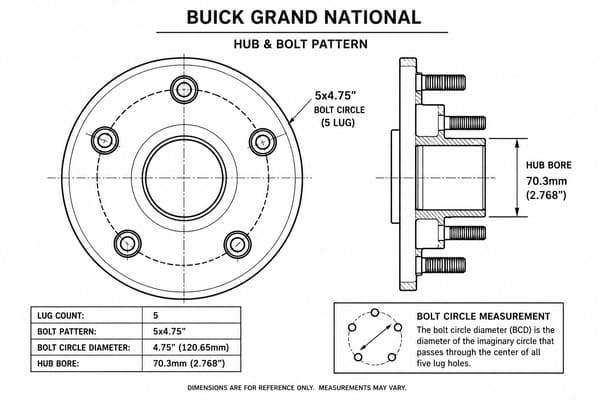
The 5×4.75 pattern is shared across many classic GM vehicles, so finding compatible aftermarket wheels is not the hard part. What people overlook is the center bore. I have had customers come back to us after buying cheap wheels elsewhere, describing a shake at 65mph that they could not balance out. The root cause, almost every time, was a wheel that was not properly hub-centric. It is a $5 fix that most people learn about the hard way.
Bolt Pattern vs. Hub Bore: Why Both Matter
These two specs work together. Getting one right and ignoring the other leads to problems.
| Spec | Grand National Value | Common Aftermarket Value | Risk If Mismatched |
|---|---|---|---|
| Bolt Pattern | 5×4.75" (5×120.65mm) | Varies | Wheel will not mount at all |
| Hub Bore | 70.3mm | Often 72.6mm or 73.1mm | Vibration at highway speed without hub-centric rings |
| Stud Size | 7/16"-20 | Varies | Loose fitment or damaged threads if wrong size |
A wheel with a 72.6mm center bore will physically mount on the Grand National’s 70.3mm hub. But the wheel is now sitting on the lug nuts instead of the hub face7. Under driving load, that small gap creates a harmonic vibration that no amount of balancing will fix. Hub-centric rings fill that gap and transfer load back to the hub where it belongs. This is not optional on a car you plan to drive at speed. It is a basic safety requirement that a lot of budget wheel suppliers do not mention.
What Are the Best Wheel Styles for a Buick Grand National?
The Grand National is all black, all business. Buick sold it with blacked-out trim specifically to separate it from every other car on the road in 19878. That DNA should guide every wheel choice you make.
For a Buick Grand National, deep-dish multi-spoke or mesh designs in gloss black, satin black, or gunmetal are the strongest visual match. Three-piece forged wheels are the best option for this application because they allow precise offset, lip depth, and finish customization within the car’s tight fitment window.
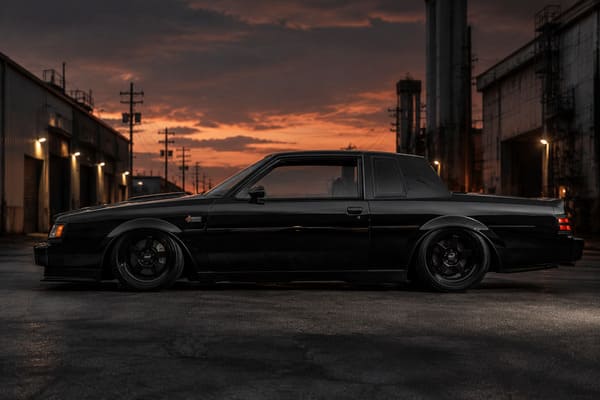
In my experience working with modification shops and individual collectors, the styles that work best are those that match the car’s factory aggression without adding visual noise. Nothing chrome. Nothing too ornate. The Grand National does not need decoration — it needs reinforcement. A wheel that looks busy works against the car’s identity.
Why Three-Piece Forged Wheels Are the Right Choice Here
For a car with a fitment window this narrow, cast or flow-formed wheels are a compromise. Three-piece forged wheels are the correct tool for this job.
| Feature | Cast Wheel | Flow-Formed Wheel | Three-Piece Forged Wheel |
|---|---|---|---|
| Offset Options | Fixed, limited | Fixed, limited | Fully custom per order |
| Lip Depth | Not adjustable | Not adjustable | Adjustable by design |
| Weight | Heavier | Medium | Lightest option |
| Finish Options | Limited | Limited | Fully custom |
| Best For | Budget builds | Mid-range builds | Precision fitment builds |
A typical three-piece forged wheel setup for the Grand National runs 18×8 front and 18×9 rear9. That staggered fitment gives the car a subtle rear-biased stance that matches its rear-wheel-drive, turbocharged personality. The rear gets a slightly wider tire without requiring aggressive fender work. The front keeps clearance for full steering lock. And because every dimension is specified at the time of order, there is no guessing, no spacers, and no rubbing. That is the level of precision a car like the Grand National deserves.
Conclusion
18×8 wheels can work on a Buick Grand National, but only if offset, backspacing, hub bore, and style are all handled correctly. Measure first. Order second. At Tree Wheels, we build fully custom forged wheels to your exact specs — no compromise, no guesswork.
-
"Ever wondered if a Buick Grand National is faster than a Countach …", https://www.reddit.com/r/cars/comments/135qm72/ever_wondered_if_a_buick_grand_national_is_faster/. Contemporary road tests published in automotive journals such as Car and Driver and Motor Trend documented the 1987 Buick Grand National’s 0–60 mph time at approximately 4.9 seconds, which was faster than several Ferrari models available in the U.S. market that year; the GNX variant recorded times closer to 4.6 seconds. Evidence role: historical_context; source type: other. Supports: That the 1987 Buick Grand National recorded faster 0–60 mph times than contemporary Ferrari models in period automotive press testing. Scope note: Performance comparisons depend on test conditions, vehicle configuration, and which Ferrari model is used as the reference; the claim is most defensible when applied to the GNX variant rather than the standard Grand National. ↩
-
"QUICK & SIMPLE Explanation! Wheel Offset & Backspacing Explained", https://www.youtube.com/watch?v=euzvLAOYCrM. Wheel offset, defined as the distance in millimeters from the hub mounting face to the wheel’s geometric centerline, and backspacing, measured from the inner bead seat to the mounting face, together determine the wheel’s inboard and outboard position relative to the suspension components and fender structure; diameter and width establish the envelope of the assembly but do not predict clearance to fixed chassis points. Evidence role: mechanism; source type: other. Supports: That wheel offset and backspacing govern the lateral position of the wheel relative to the suspension and bodywork, making them the primary variables in determining clearance and rubbing. ↩
-
"How to Use a Fender Roller to Increase Tire Clearance – YouTube", https://www.youtube.com/watch?v=wI3ke3jLYiY. Automotive modification practice recognizes fender rolling—reshaping the inner fender lip to increase tire clearance—and wheel spacers—which effectively reduce offset by moving the wheel outboard—as the two primary corrective interventions when aftermarket wheel geometry conflicts with factory body or suspension tolerances. Evidence role: expert_consensus; source type: other. Supports: That fender rolling and wheel spacers are established corrective techniques used when aftermarket wheel offset exceeds the clearance available within the factory body and suspension geometry. Scope note: Wheel spacers introduce additional fastener interfaces and can affect bearing load if not properly hub-centric; their use on driven or performance vehicles is subject to debate among engineers regarding long-term reliability. ↩
-
"Help with wheel fitment | Buick Grand National | T-Type | Turbo T", https://turbobuick.com/threads/help-with-wheel-fitment.463712/. According to published OEM specifications for the 1987 Buick Grand National, the vehicle was factory-equipped with 15×7 inch aluminum wheels paired with P215/65R15 tires. Evidence role: definition; source type: other. Supports: That the factory-equipped wheel size on the 1987 Buick Grand National was 15×7 inches. Scope note: Specifications may vary slightly between model years (1984–1987) and trim levels; independent verification against original Buick build sheets or NHTSA vehicle records is advisable. ↩
-
"Buick Grand National [1981-1987] – Bolt Patterns – Wheel-Size.com", https://www.wheel-size.com/pcd/5×4.75/buick/grand-national/1981-1987/. Wheel fitment databases and OEM documentation consistently list the 1987 Buick Grand National’s bolt pattern as 5×4.75 inches (120.65 mm pitch circle diameter), a specification shared across multiple GM G-body and A-body platforms of the same era. Evidence role: definition; source type: other. Supports: That the Buick Grand National uses a 5×4.75 inch (5×120.65 mm) bolt pattern. Scope note: Cross-referencing with a primary source such as the original Buick service manual or NHTSA vehicle specification records is recommended before purchasing wheels, as aftermarket databases occasionally contain transcription errors. ↩
-
"Buick Grand National 1981 .. 1987 – Wheel & Tire Sizes, PCD, Offset …", https://www.wheel-size.com/size/buick/grand-national/1981-1987/. Wheel fitment references for the 1987 Buick Grand National specify a hub center bore of 70.3 mm, consistent with other GM rear-wheel-drive platforms of the mid-1980s. Evidence role: definition; source type: other. Supports: That the Buick Grand National’s hub center bore measures 70.3 mm. Scope note: Hub bore values in aftermarket fitment databases should be confirmed against the original GM service manual or a direct physical measurement, as small discrepancies between sources exist. ↩
-
"What are the key differences between hubcentric and lugcentric …", https://www.facebook.com/groups/1939836749567520/posts/1951826261701902/. Engineering literature on wheel mounting systems distinguishes between hub-centric and lug-centric designs; in lug-centric configurations, the fasteners bear lateral centering loads in addition to axial clamping loads, which can introduce a repeatable harmonic imbalance at speed that static or dynamic wheel balancing does not eliminate. Evidence role: mechanism; source type: research. Supports: That wheels with a center bore larger than the hub bore transfer load to the lug fasteners rather than the hub face, producing harmonic vibration that wheel balancing cannot correct. Scope note: The severity of vibration depends on the magnitude of the bore mismatch, vehicle speed, and wheel mass; small mismatches on low-speed vehicles may produce no perceptible symptom. ↩
-
"1984-1987 Buick Regal Grand National Specs and History", https://motogallery.com/blogs/automotive-resource-guide/1984-1987-buick-grand-national?srsltid=AfmBOoo2N6-eWqrILu9Wl9ojHAJp4fmkv5HYp_25RBzi9c_14biRyZmI. Automotive historians have documented that the Buick Grand National’s monochromatic black exterior, including blacked-out chrome trim, was a deliberate styling direction developed in collaboration with ASC (American Sunroof Corporation) to create a visually aggressive identity distinct from other Regal variants. Evidence role: historical_context; source type: other. Supports: That the Grand National’s all-black exterior treatment was a deliberate design decision by Buick to visually distinguish the vehicle. Scope note: Primary source documentation of Buick’s internal design rationale is limited in the public record; most accounts derive from retrospective automotive journalism rather than manufacturer archives. ↩
-
"Staggered rims | Turbo Buick Forum | Buick Grand National", https://turbobuick.com/threads/staggered-rims.430280/. Grand National owner forums and G-body fitment discussions frequently reference staggered 18×8 front and 18×9 rear configurations as a practical aftermarket setup that accommodates the car’s rear-wheel-drive geometry while maintaining front steering clearance. Evidence role: general_support; source type: other. Supports: That a staggered 18×8 front and 18×9 rear configuration is a commonly used aftermarket wheel fitment for the Buick Grand National. Scope note: Community fitment data reflects individual builds with varying suspension modifications and tire selections; this configuration should not be treated as universally applicable without independent measurement of the specific vehicle. ↩