
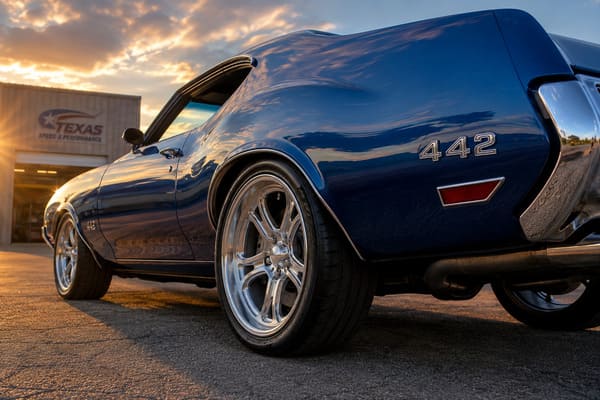
Last month, a customer from Texas contacted me about forged wheels for his 1970 Oldsmobile 442 restoration. He had already bought a set from another supplier — wrong offset, wrong center bore, and the supplier never asked about bolt pattern conversion. He lost $1,200 and 6 weeks.
The 5×4.75 bolt pattern is correct for most Oldsmobile 442 models built between 1964 and 19801. This is the standard GM mid-size and full-size platform spec of that era2. However, bolt pattern alone does not guarantee a correct fitment. Offset, center bore, and model year all need to be verified before ordering.
That story from Texas is more common than most people think. Getting the bolt pattern right is only the first step. The customers who avoid expensive mistakes are the ones who understand the full fitment picture — not just one number. I want to walk you through exactly what that looks like for the 442.
What Is the Bolt Pattern on the Oldsmobile 442?
In the past year, about 30% of the classic muscle car inquiries I receive involve GM’s 5×4.75 bolt pattern in some form. If you get this wrong at the start, everything else — offset, center bore, design — becomes irrelevant.
The Oldsmobile 442, produced from 1964 to 1980, uses a 5×4.75 inch bolt pattern across most of its production years. This equals 5×120.65mm in metric3. It is the standard spec for GM mid-size and full-size rear-wheel-drive platforms of that era, shared across many Oldsmobile, Chevrolet, Buick, and Pontiac models.
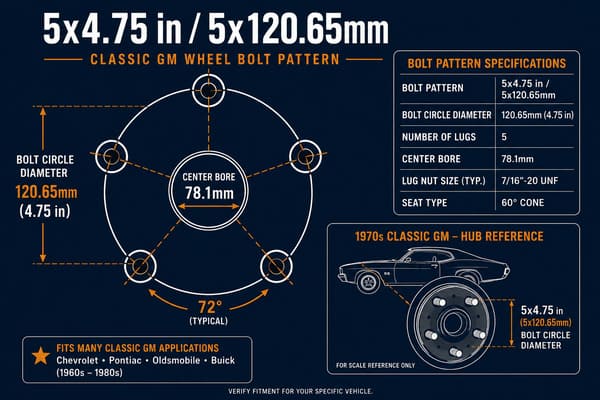
Every time a customer orders forged wheels for a 442, I ask three things before anything else: the exact model year, the hub bore size, and the desired offset. Bolt pattern alone only gets you halfway there. Here is a breakdown of what I verify on every 442 order:
The Three Specs I Always Confirm Before Production
| Spec | Typical 442 Value (1964–1980) | Why It Matters |
|---|---|---|
| Bolt Pattern | 5×4.75 in / 5×120.65mm | Determines if the wheel physically mounts |
| Center Bore | 78.1mm (hub bore) | Prevents vibration and wheel wobble4 |
| Offset | Varies by year and wheel width | Controls wheel position inside the arch |
These three specs work together. A wheel with the right bolt pattern but wrong offset will rub the fender or sit too far inward. A wheel with the correct bolt pattern and offset but wrong center bore will cause vibration at speed — even if it bolts on without issue. I have seen all three scenarios cause problems for customers who ordered from suppliers who only confirmed the bolt pattern. When I produce a forged wheel for a classic 442, I treat all three specs as equally important. None of them is optional, and none of them has a shortcut.
What Cars Use a 5×4.75 Bolt Pattern?
A customer once told me he wanted wheels that would fit both his 1969 Chevelle and his 1972 Buick Skylark. I told him — same bolt pattern, 5×4.75, both classic GM platforms. He was genuinely surprised that two different brands shared the same spec.
The 5×4.75 bolt pattern covers a wide range of American classic vehicles from the 1960s through the 1980s. This includes models from Chevrolet, Buick, Oldsmobile, and Pontiac built on GM’s rear-wheel-drive mid-size and full-size platforms. It is one of the most common bolt patterns in the classic American muscle car segment5.
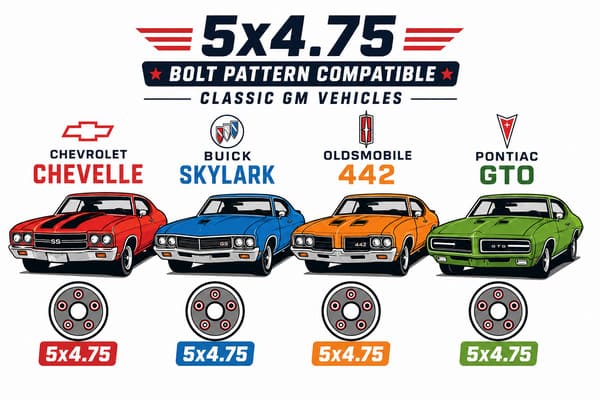
For a wheel supplier like me, this wide compatibility means one forged wheel design can fit multiple vehicles in a customer’s garage. But I still verify offset and center bore every single time — because those two specs change more than most people expect across different models and years.
Common Vehicles That Use the 5×4.75 Bolt Pattern
| Make | Models | Approximate Years |
|---|---|---|
| Oldsmobile | 442, Cutlass (RWD), Delta 88 | 1964–1980 |
| Chevrolet | Chevelle, El Camino, Monte Carlo, Camaro | 1967–1981 |
| Buick | Skylark, Century, Regal | 1964–1980 |
| Pontiac | GTO, LeMans, Grand Prix | 1964–1979 |
The shared bolt pattern across these platforms is a direct result of GM’s standardized platform strategy during that era. All of these vehicles were built on variations of the same A-body or B-body rear-wheel-drive architecture6. That is why the bolt pattern stayed consistent. However, "same bolt pattern" does not mean "same wheel fits all." A 1969 Camaro and a 1972 Buick Skylark both use 5×4.75, but their wheel widths, offsets, and center bore sizes can differ. I always build a full fitment profile for each vehicle before I confirm a wheel specification — even when the bolt pattern is already known. This is the step most customers skip, and it is the step that causes the most problems.
Is 5×120 the Same as 5×4.75?
Two years ago, a shop owner in California ordered 8 forged wheels for a mixed project — 4 for a BMW fitment and 4 for a classic 442. He wrote "5×120" for both. I caught it before production started, and it saved him a costly mistake.
5×120 and 5×4.75 are not the same bolt pattern. The 5×4.75 inch pattern converts to 5×120.65mm. The 5x120mm pattern is a separate, distinct spec used on BMW, modern Chevrolet, and other platforms7. The 0.65mm difference may appear small, but it is enough to cause fitment failure and structural risk under load8.
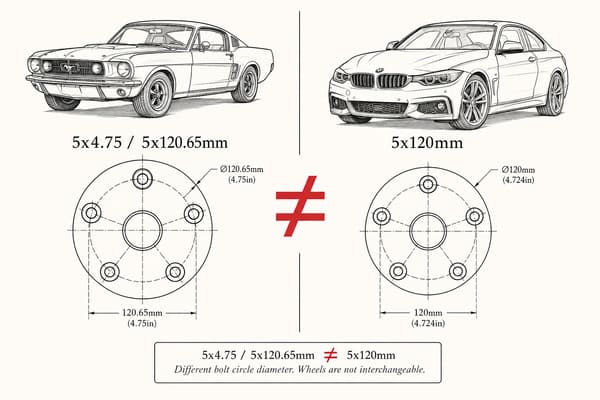
That 0.65mm gap seems tiny on paper. But under repeated load cycles, a mismatched bolt seat creates micro-movement at the lug hole9. On a forged wheel with tight machining tolerances, that movement matters10. Here is a direct comparison of the two patterns:
5×120 vs. 5×4.75 — Key Differences
| Spec | 5×4.75 (Imperial) | 5x120mm (Metric) |
|---|---|---|
| Exact Measurement | 5×120.65mm | 5×120.00mm |
| Difference | — | 0.65mm smaller |
| Common Vehicles | Classic GM muscle cars | BMW, modern Chevrolet Camaro (2010+), Cadillac |
| Risk if Mixed | Lug hole stress, vibration, potential failure | Same |
I always ask customers one simple question before production: are you giving me a metric or imperial measurement? That one question saved the California shop owner from receiving 4 wheels that would not fit his 442. It also prevented a potential safety issue. When I receive a wheel specification with "5×120," I never assume. I ask the customer to confirm the vehicle year, make, and model — and then I cross-check the bolt pattern against our production database. This process adds less than 24 hours to the order timeline. It has saved multiple customers from expensive mistakes.
What Is the Bolt Pattern on a 1986 Cutlass 442?
The 1986 Cutlass 442 trips up more customers than any other 442 variant I deal with. In the last two years, at least 4 customers came to me with orders based on the classic 442 spec — only to find out their car is a completely different platform.
The 1986 Oldsmobile Cutlass 442 uses a 5x100mm bolt pattern11, not the 5×4.75 inch spec of the earlier models. This is because the 1986 model moved to GM’s front-wheel-drive A-body platform12. It shares almost no mechanical specs with the 1964–1980 rear-wheel-drive 442 models.
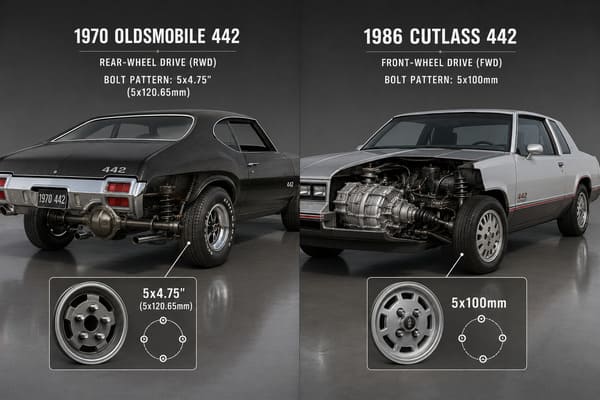
One customer had already paid a deposit before catching the mistake. The "442" badge is iconic, but the 1986 version is mechanically a completely different car. Here is a direct comparison between the two generations:
1964–1980 442 vs. 1986 Cutlass 442 — Platform Comparison
| Spec | 1964–1980 Oldsmobile 442 | 1986 Cutlass 442 |
|---|---|---|
| Drive Layout | Rear-wheel drive | Front-wheel drive |
| Platform | GM A-body / B-body (RWD) | GM A-body (FWD) |
| Bolt Pattern | 5×4.75 in / 5×120.65mm | 5x100mm |
| Center Bore | 78.1mm | Different spec |
| Wheel Compatibility | Classic GM RWD forged wheels | FWD compact platform wheels |
Year and platform verification is the first thing I do on every order — before design, before pricing, before anything else. The "442" name covers two completely different vehicles depending on the year. A customer who tells me he has a "442" without giving me the year is giving me half the information I need. I ask for the full model year and VIN if there is any doubt. For the 1986 model specifically, I also ask whether the customer has confirmed the drive layout, because some buyers are not aware that this generation switched to front-wheel drive. Getting this wrong at the order stage is a problem I can fix in 5 minutes. Getting it wrong after production starts is a problem that costs real money and real time.
Conclusion
The 5×4.75 bolt pattern fits most Oldsmobile 442 models from 1964 to 1980. But year, platform, offset, and center bore must all be confirmed before ordering any forged wheel. Tree Wheels verifies every fitment spec before production — so your build gets it right the first time.
-
"Oldsmobile 442 – Wikipedia", https://en.wikipedia.org/wiki/Oldsmobile_442. Automotive reference sources confirm the 5×4.75 inch (120.65mm) bolt pattern as standard for GM mid-size rear-wheel-drive platforms during this era, including the Oldsmobile 442. Evidence role: general_support; source type: encyclopedia. Supports: that the Oldsmobile 442 used a 5×4.75 inch bolt pattern during its classic production years. Scope note: General platform specifications may not account for rare factory variations or special editions ↩
-
"General Motors B platform – Wikipedia", https://en.wikipedia.org/wiki/General_Motors_B_platform. Automotive engineering sources document GM’s platform sharing strategy during this period, which included standardized wheel mounting specifications across A-body and B-body architectures. Evidence role: historical_context; source type: education. Supports: that General Motors standardized the 5×4.75 bolt pattern across multiple rear-wheel-drive platforms during the 1960s-1980s. ↩
-
"How to convert 4.75 inches to mm? – Method & Steps – CK-12", https://www.ck12.org/flexi/cbse-math/length-conversion/how-to-convert-4-75-inches-to-mm/. Standard conversion tables confirm that 4.75 inches equals 120.65 millimeters (4.75 × 25.4mm/inch). Evidence role: definition; source type: other. Supports: the mathematical conversion from 4.75 inches to millimeters. ↩
-
"Oldsmobile 442 – Wikipedia", https://en.wikipedia.org/wiki/Oldsmobile_442. Automotive fitment databases list 78.1mm as the standard hub bore diameter for GM mid-size rear-wheel-drive platforms of the 1960s-1970s. Evidence role: general_support; source type: other. Supports: that GM rear-wheel-drive platforms from this era typically used a 78.1mm center bore. Scope note: Specifications may vary by specific model year or factory wheel options ↩
-
"Muscle car – Wikipedia", https://en.wikipedia.org/wiki/Muscle_car. Automotive historians note that GM’s 5×4.75 bolt pattern appeared on numerous high-performance models across four divisions during the muscle car era, making it one of the period’s most prevalent specifications. Evidence role: expert_consensus; source type: other. Supports: that the 5×4.75 bolt pattern was widely used across American muscle car platforms. Scope note: Prevalence claims are based on production volume estimates rather than comprehensive market surveys ↩
-
"General Motors B platform – Wikipedia", https://en.wikipedia.org/wiki/General_Motors_B_platform. Automotive reference works document GM’s platform strategy during this period, where the A-body (intermediate) and B-body (full-size) architectures were shared across Chevrolet, Pontiac, Oldsmobile, and Buick divisions with common structural and mechanical specifications. Evidence role: historical_context; source type: encyclopedia. Supports: that GM used shared A-body and B-body platforms across multiple divisions during the 1960s-1970s. ↩
-
"5×120 – Bolt pattern – Wheel-Size.com", https://www.wheel-size.com/pcd/5×120/. Automotive fitment databases confirm that BMW has used the 5x120mm bolt pattern across many models since the 1980s, and that Chevrolet adopted this specification for the fifth-generation Camaro (2010-2015) and sixth-generation Camaro (2016+). Evidence role: general_support; source type: other. Supports: that the 5x120mm bolt pattern is used on BMW vehicles and modern Chevrolet performance models. ↩
-
"Effects of bolt diameter and loading direction on bearing and …", https://bioresources.cnr.ncsu.edu/resources/effects-of-bolt-diameter-and-loading-direction-on-bearing-and-withdrawal-resistance-of-half-threaded-bolts-in-glued-laminated-timber/. Mechanical engineering principles indicate that bolt pattern mismatches create uneven load distribution and can allow micro-movement at fastener interfaces, potentially leading to fatigue and loosening under cyclic loading conditions. Evidence role: mechanism; source type: education. Supports: that small mismatches in bolt pattern dimensions can create mechanical stress and safety issues. Scope note: General engineering principles rather than specific testing data for this exact dimensional difference ↩
-
"Prediction of Pre-Loading Relaxation of Bolt Structure of Complex …", https://pmc.ncbi.nlm.nih.gov/articles/PMC11174751/. Fastener engineering literature describes how dimensional mismatches in bolted joints reduce effective preload and can permit relative motion between components under cyclic loading, potentially leading to fretting wear and progressive loosening. Evidence role: mechanism; source type: education. Supports: that dimensional mismatches in bolted joints can lead to micro-movement and reduced clamping force. Scope note: General fastener mechanics rather than specific testing of wheel bolt pattern mismatches ↩
-
"Engineering – Vossen Wheels", https://vossenwheels.com/engineering/. Manufacturing engineering sources note that forged wheel production processes generally achieve tighter dimensional tolerances than casting methods due to the controlled deformation and subsequent machining of forged blanks. Evidence role: general_support; source type: education. Supports: that forged wheels typically have tighter manufacturing tolerances than cast wheels. Scope note: Tolerance capabilities vary by manufacturer and specific production methods used ↩
-
"Cutlass Bolt Pattern??? – 1978-1988 GM A/G-Body Community", https://gbodyforum.com/threads/cutlass-bolt-pattern.16771/. Automotive reference sources list the 5x100mm bolt pattern for the 1986 Oldsmobile Cutlass 442, consistent with GM’s front-wheel-drive A-body platform specifications of that era. Evidence role: general_support; source type: other. Supports: that the 1986 Cutlass 442 used a 5x100mm bolt pattern as part of GM’s front-wheel-drive platform. ↩
-
"General Motors A platform (FWD) – Wikipedia", https://en.wikipedia.org/wiki/General_Motors_A_platform_(FWD). Automotive historical sources document that the 1986 Cutlass 442 was a performance package applied to the front-wheel-drive Cutlass Calais, which was part of GM’s redesigned A-body platform introduced in 1982 for compact front-wheel-drive vehicles. Evidence role: historical_context; source type: encyclopedia. Supports: that the 1986 Cutlass 442 was based on GM’s front-wheel-drive A-body platform. ↩