

I have been asked this question more times than I can count. "How much fuel can your forged wheels save me?" My answer always starts with another question: "When did you last buy wheels because of fuel savings?"
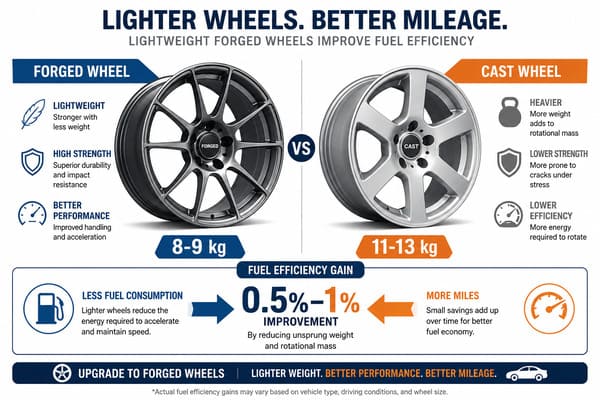
Lightweight forged wheels can improve fuel economy by roughly 0.5% to 1%. On a typical car driven 20,000 km per year, that translates to about 20 liters of fuel saved, or around $20–$25 at US pump prices. The weight reduction is real, but the fuel savings are small.
The honest answer is more complicated than most articles online will tell you. I want to break this down section by section, using real numbers and real experience from working with customers across the US, Australia, and the Middle East. By the end, you will know exactly what forged wheels can and cannot do for your fuel economy.
Do Lighter Wheels Increase MPG?
A customer once told me his fuel costs dropped after he switched to forged wheels. I asked him how he measured that. He said, "It just feels that way." That is the core problem with this question.
Yes, lighter wheels do increase MPG, but only slightly. Reducing unsprung mass lowers the energy needed to accelerate and decelerate each wheel1. However, the total weight saved across four wheels is typically 12–20 kg, which is less than 1% of a standard vehicle’s total weight.

The physics behind this are real. Less unsprung mass means the engine works a little less hard during acceleration. The wheels also spin up faster, which reduces rotational inertia. These are not marketing claims. They are engineering facts. But facts need context to be useful.
A set of 19-inch forged wheels typically weighs 8–9 kg per wheel. A comparable cast wheel in the same size usually weighs 11–13 kg2. That is a difference of roughly 3–5 kg per wheel, and about 12–20 kg across all four. A standard passenger car weighs between 1,500 and 2,000 kg3. The weight you are removing is less than 1% of the total vehicle mass.
Engineering test data puts the fuel efficiency gain from this level of weight reduction at around 0.5% to 1%4. In practical terms, that is less than 0.1 liters saved per 100 km. To put that in perspective, turning off your air conditioning for one hour saves more fuel than this5. The gain is real. It is just very small.
| Metric | Forged Wheels | Cast Wheels |
|---|---|---|
| Weight per 19" wheel | 8–9 kg | 11–13 kg |
| Total savings (4 wheels) | 12–20 kg | Baseline |
| % of total vehicle weight | Less than 1% | — |
| Estimated fuel saving | 0.5%–1% efficiency gain | — |
| Liters saved per 100 km | Less than 0.1 L | — |
Are Forged Wheels Good for Daily Driving?
I work with a modification shop owner in Los Angeles. He told me that 90% of his customers walk in asking about looks and customization first. Not one of them leads with fuel economy. Yet almost every article online about forged wheels talks about fuel savings. There is a gap between what customers actually want and what content tells them to care about.
Yes, forged wheels are excellent for daily driving. The real benefits you will feel every day are stronger impact resistance, better handling response, and a lower chance of deformation when you hit a pothole. These are practical, noticeable advantages that do not require a calculator to confirm.
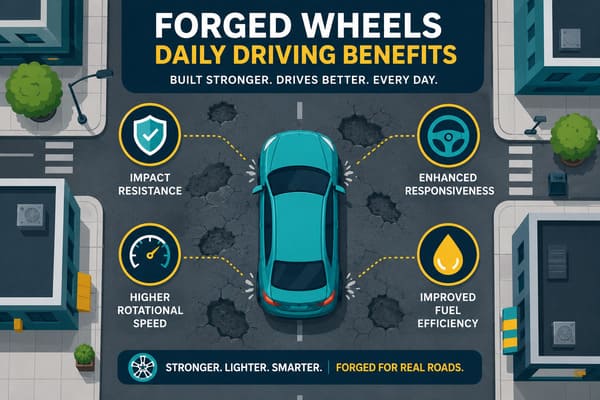
The forging process compresses the aluminum grain structure into a tighter, denser form6. This makes the wheel significantly stronger than a cast wheel of the same size. On daily roads, this means the wheel is more likely to survive a sharp pothole impact without cracking or bending. For drivers in cities with rough road surfaces, this is a genuine and practical advantage.
The lighter weight also improves steering feel. With less rotational mass at each corner of the car, the steering responds more directly to your input. This is something you will notice within the first few minutes of driving. It is not a subtle difference.
What Daily Drivers Actually Notice
| Benefit | How You Feel It | Requires Measurement? |
|---|---|---|
| Impact resistance | Fewer bent or cracked wheels | No |
| Steering response | More direct, sharper feel | No |
| Rotational inertia | Quicker spin-up during acceleration | Slight |
| Fuel savings | Less than 0.1 L per 100 km | Yes, and barely visible |
The 0.5% fuel saving is real, but it is not something you will feel behind the wheel. What you will feel is how the car handles, how it responds, and how it holds up over time. Those are the reasons forged wheels make sense for daily driving. Fuel economy is a side effect, not the main event.
How Much Weight Can Forged Wheels Actually Save?
Here is a comparison I give to customers regularly. Switching all four wheels to forged saves a maximum of about 20 kg. Putting two full suitcases in your trunk adds that weight back. Having one passenger in the front seat adds 60–80 kg on top of that7. The weight you spent thousands of dollars removing can be offset by a single person sitting in your car.
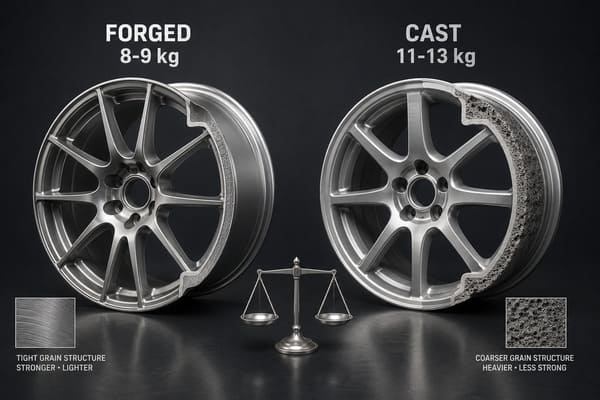
A full set of forged wheels can save between 12 and 20 kg compared to cast wheels of the same size. A single 19-inch one-piece forged wheel from our production line weighs 8–9 kg, while the same size in cast aluminum typically runs 11–13 kg per wheel.
This does not mean the weight reduction is meaningless. It means the number itself is not the point. The real engineering value of forged wheels is not how many kilograms you remove. It is how efficiently the material is used to achieve that weight.
The forging process aligns the metal grain structure along the lines of stress in the wheel8. This allows engineers to use less material in areas that carry less load, and more material where strength is needed. The result is a wheel that is lighter and stronger at the same time. A cast wheel achieves its strength through bulk. A forged wheel achieves its strength through structure.
Weight Comparison: Forged vs. Cast (19-inch)
| Wheel Type | Weight per Wheel | Weight for 4 Wheels | Strength Level |
|---|---|---|---|
| One-piece forged | 8–9 kg | 32–36 kg | High |
| Cast aluminum | 11–13 kg | 44–52 kg | Moderate |
| Weight difference | 3–5 kg saved | 12–20 kg saved | — |
When I say a 19-inch forged wheel weighs 8–9 kg, that number represents 20+ years of manufacturing refinement. It is not just light. It is light because the material is being used as intelligently as possible. That is the engineering value. The kilogram count is just the result.
How Do Forged Wheels Compare to Cast Wheels in Real-World Fuel Savings?
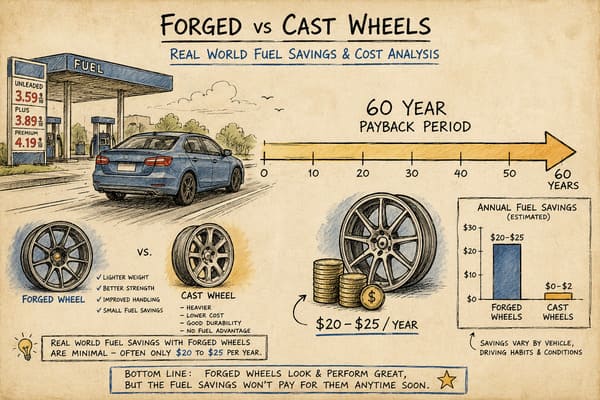
The most exaggerated claim I have ever seen from a wheel brand said that switching to forged wheels could save drivers "hundreds of dollars" in fuel every year. I ran the numbers myself. At 0.1 liters saved per 100 km, driving 20,000 km per year, you save 20 liters of fuel. At roughly $4 per gallon in the US, that is about $20–$25 per year9.
In real-world conditions, forged wheels save approximately $20–$25 per year in fuel costs for a typical driver covering 20,000 km annually. A quality set of forged wheels costs $1,500 or more10. Based on fuel savings alone, the payback period would exceed 60 years11.
The only drivers who genuinely benefit from the fuel and performance difference are professional racing drivers. On a track, reducing 1 kg of unsprung mass produces the equivalent handling benefit of removing 4–5 kg from the vehicle body. At that level of competition, 0.1 seconds per lap matters. Every gram counts.
For a daily commuter stopping at traffic lights, that same advantage is completely buried under the variation in your own driving habits. Accelerating slightly harder from one light, or braking a little earlier at another, creates more fuel consumption difference than the entire weight saving from your forged wheels.
Fuel Savings: Forged vs. Cast in Numbers
| Scenario | Estimated Fuel Saving | Annual Cost Saving (US prices) |
|---|---|---|
| Daily commuter, 20,000 km/yr | ~20 liters | ~$20–$25 |
| Highway-focused driver | Slightly higher | ~$30–$35 |
| Track / performance driving | Measurable difference | Performance gain, not fuel |
The right reason to choose forged wheels is not fuel economy. It is strength. It is the ability to customize size, finish, and design to match your car exactly. It is the confidence of knowing your wheels are built to a higher structural standard. Fuel savings are a small bonus that comes with the package. They should never be the reason you make the decision.
Conclusion
Forged wheels save fuel, but only by a small margin. Their real value is in strength, handling, and customization. At Tree Wheels, we build forged wheels that deliver all three.
-
"Unsprung mass – Wikipedia", https://en.wikipedia.org/wiki/Unsprung_mass. Vehicle dynamics literature establishes that unsprung mass contributes to both translational and rotational kinetic energy demands during acceleration and braking cycles, with reductions in wheel mass producing proportional decreases in the energy required per cycle. Evidence role: mechanism; source type: paper. Supports: That reducing unsprung mass decreases the energy required to accelerate and decelerate rotating wheel assemblies. Scope note: Most vehicle dynamics texts address unsprung mass primarily in the context of ride and handling rather than isolating its direct contribution to fuel consumption figures. ↩
-
"Is there a weight difference between new forged aluminum wheels …", https://www.facebook.com/groups/bmwr1300gs/posts/725169073079659/. Industry specification sheets and independent wheel testing databases report that 19-inch one-piece forged aluminum wheels commonly fall in the 8–10 kg range, while cast aluminum equivalents in the same diameter and width typically range from 10–14 kg, depending on spoke design and alloy grade. Evidence role: statistic; source type: institution. Supports: That 19-inch one-piece forged aluminum wheels typically weigh 8–9 kg and comparable cast aluminum wheels weigh 11–13 kg. Scope note: Weight varies substantially with spoke count, width, offset, and alloy specification; the ranges cited represent typical production values rather than universal constants. ↩
-
"Greenhouse Gas Emissions from a Typical Passenger Vehicle – EPA", https://www.epa.gov/greenvehicles/greenhouse-gas-emissions-typical-passenger-vehicle. U.S. EPA and NHTSA fleet data indicate that the average light-duty passenger vehicle sold in the United States weighs approximately 1,700–1,900 kg, consistent with the 1,500–2,000 kg range cited for standard passenger cars. Evidence role: statistic; source type: government. Supports: That the curb weight of a typical passenger car falls within the 1,500–2,000 kg range. Scope note: The range encompasses a broad vehicle segment; compact cars may fall below 1,500 kg while larger SUVs and trucks exceed 2,000 kg, so the figure is most accurate for mid-size sedans and crossovers. ↩
-
"the material and energy impacts of passenger vehicle weight …", https://dspace.mit.edu/handle/1721.1/62760. Studies on vehicle mass reduction and fuel consumption, including work published by SAE International, generally estimate a 0.3%–0.7% fuel consumption improvement per 100 kg of mass reduction, from which the 0.5%–1% figure for a 12–20 kg wheel-mass saving can be extrapolated. Evidence role: statistic; source type: paper. Supports: That a weight reduction of 12–20 kg on a passenger vehicle produces approximately 0.5%–1% improvement in fuel efficiency. Scope note: Published figures typically address total vehicle mass reduction rather than unsprung mass specifically; the extrapolation to wheel-only savings introduces additional uncertainty. ↩
-
"[PDF] Impact of Vehicle Air-Conditioning on Fuel Economy, Tailpipe …", https://docs.nlr.gov/docs/fy00osti/28960.pdf. The U.S. Department of Energy and EPA have reported that vehicle air conditioning can reduce fuel economy by 5%–25% under certain conditions, a range substantially larger than the estimated 0.5%–1% gain from lightweight wheel substitution. Evidence role: statistic; source type: government. Supports: That vehicle air conditioning use imposes a fuel consumption penalty measurably larger than the saving attributable to a 12–20 kg wheel mass reduction. Scope note: The AC fuel penalty varies widely with ambient temperature, vehicle type, and driving cycle, so the comparison holds directionally but not as a fixed numerical ratio. ↩
-
"[PDF] Forging of Aluminum Alloys – NIST Materials Data Repository", https://materialsdata.nist.gov/bitstream/handle/11115/223/Forging%20of%20Aluminum%20Alloys.pdf?isAllowed=y&sequence=1. Materials science references, including ASM International handbooks on aluminum alloys, document that forging refines grain structure and eliminates porosity present in castings, producing measurably higher tensile and fatigue strength in the finished component. Evidence role: mechanism; source type: encyclopedia. Supports: That the forging process aligns and compresses aluminum grain structure, resulting in higher strength and density compared to cast aluminum of equivalent composition. Scope note: The magnitude of the strength improvement depends on alloy grade, forging temperature, and post-process heat treatment, so the general claim requires qualification for specific wheel alloys. ↩
-
"Body Measurements – FastStats – CDC", https://www.cdc.gov/nchs/fastats/body-measurements.htm. Regulatory bodies including the EPA and NHTSA use a standard test passenger weight of approximately 68 kg (150 lb) per occupant for fuel economy testing purposes, consistent with the 60–80 kg range cited for a front-seat passenger. Evidence role: statistic; source type: government. Supports: That a typical adult passenger weighs approximately 60–80 kg, making a single occupant’s mass several times greater than the wheel weight saving. Scope note: Actual passenger weight varies considerably by population and region; the figure is a standardized assumption used for comparative purposes rather than a precise demographic statistic. ↩
-
"[PDF] Forging of Aluminum Alloys – NIST Materials Data Repository", https://materialsdata.nist.gov/bitstream/handle/11115/223/Forging%20of%20Aluminum%20Alloys.pdf?isAllowed=y&sequence=1. Metallurgical studies of forged aluminum components document that controlled grain flow during forging aligns crystallographic structure with anticipated load paths, improving fatigue life and allowing designers to reduce cross-sectional area in low-stress regions without compromising structural integrity. Evidence role: mechanism; source type: paper. Supports: That the forging process produces grain flow aligned with the principal stress directions in the component, improving fatigue resistance and enabling material optimization. Scope note: The degree of grain alignment depends on die design and forging parameters; not all forging processes achieve optimal grain flow, and the benefit is most pronounced in closed-die forging of complex geometries. ↩
-
"Gasoline and Diesel Fuel Update – U.S. Energy Information … – EIA", https://www.eia.gov/petroleum/gasdiesel/. The U.S. Energy Information Administration (EIA) publishes weekly retail gasoline price data; as of 2024, the national average for regular unleaded has ranged between $3.20 and $3.80 per gallon, providing a reference point for the cost-saving calculation presented. Evidence role: statistic; source type: government. Supports: That US retail gasoline prices are in the range of approximately $4 per gallon, supporting the $20–$25 annual savings calculation. Scope note: Gasoline prices are volatile and vary by region and grade; the $4/gallon figure may overstate or understate actual costs depending on location and the time of purchase. ↩
-
"How Much Do Wheels Cost in the US? 2026 Price Guide", https://lf-ind.com/blogs/news/us-forged-wheel-prices-custom-wheels-guide?srsltid=AfmBOormcZv0OiLFtGb18QAX_s6i1Z6uU-zA44RKUwXtsPZOw_vPqj5p. Aftermarket wheel pricing surveys and retailer listings indicate that one-piece forged aluminum wheel sets in popular sizes (18–20 inch) commonly retail between $1,500 and $5,000 or more depending on brand, finish, and fitment, supporting the $1,500 minimum threshold cited. Evidence role: statistic; source type: other. Supports: That a set of four quality forged aluminum wheels typically retails for $1,500 or more. Scope note: Pricing varies substantially by brand tier, size, and finish; entry-level forged sets may approach $1,500 while premium or custom-offset sets significantly exceed this figure, so the threshold represents a floor rather than a typical price. ↩
-
"[PDF] Fuel Consumption Sensitivity of Conventional and Hybrid Electric …", https://afdc.energy.gov/files/u/publication/fuel_consumption_sensitivity_style.pdf. Applying published vehicle mass-to-fuel-consumption sensitivity factors (approximately 0.3–0.5 L/100 km per 100 kg reduction) to a 12–20 kg wheel mass saving yields an annual fuel saving of roughly 15–25 liters, confirming that at prevailing fuel prices the capital cost of forged wheels cannot be recovered through fuel savings alone within a normal vehicle service life. Evidence role: mechanism; source type: paper. Supports: That the fuel consumption saving from a 12–20 kg mass reduction on a passenger car is sufficiently small that the cost of premium wheel upgrades cannot be recovered through fuel savings within a practical vehicle lifetime. Scope note: The calculation assumes constant driving patterns and fuel prices; changes in annual mileage, fuel price, or vehicle efficiency would alter the payback period, though not enough to make fuel savings a financially viable justification. ↩