
Lighter wheels sound like a simple win. But most buyers are chasing a number that barely moves the needle. Here is what the data actually shows.
Wheel weight does affect acceleration and handling, but the impact depends on how much weight you remove and from what starting point. Switching from cast to forged wheels saves 20–25 lbs of rotational mass across four wheels.1 That difference is real and noticeable. Saving 6 lbs between two forged sets is not.
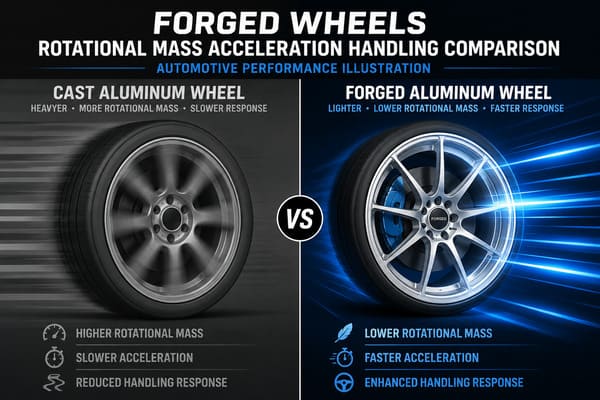
I work in forged wheel manufacturing. Every week, customers ask me the same question: "What is the lightest wheel you make?" I understand why they ask. The internet is full of content saying lighter equals faster. But I always give them a straight answer. If you are not a professional racing driver, a few pounds of difference between two forged sets will not change how your car feels on the road. The real question is not which forged wheel is lighter. The real question is whether you are still running cast wheels.
How Much Does Rim Weight Affect Acceleration?
Everyone wants a faster 0–60. But most people do not know how small the actual gain is when the weight difference is small.
Reducing rotational mass by 6 lbs across four wheels improves 0–60 time by roughly 0.05 to 0.1 seconds.2 Switching from cast to forged wheels, however, can remove 20–25 lbs of rotational mass. That is where real, measurable acceleration gains begin.
I had a customer driving a BMW M3. He switched to our one-piece forged wheels. Each wheel was about 1.5 lbs lighter than his previous forged set. Four wheels combined saved 6 lbs of rotational mass. He asked me how much faster his car would be. I told him: about 0.05 to 0.1 seconds on 0–60. He went quiet for a moment, then laughed.
Why Rotational Mass Matters More Than Static Weight
Rotational mass is not the same as static weight. When a wheel spins, the engine has to work harder to accelerate it. This is called rotational inertia. A pound of rotational mass at the wheel has a greater effect on acceleration than a pound of static weight inside the cabin.3
| Wheel Type | Typical Weight (18-inch) | Rotational Inertia Impact |
|---|---|---|
| Cast aluminum | 22–24 lbs | High |
| Forged aluminum | 16–18 lbs | Lower4 |
| Difference per wheel | 6–8 lbs | Significant |
| Difference across 4 wheels | 24–32 lbs | Noticeable to most drivers |
A cast wheel at 22–24 lbs versus a forged wheel at 16–18 lbs means roughly 25 lbs less rotational mass across the full set. Most drivers can feel this difference. It shows up in how quickly the car responds when you accelerate from a stop, and how easily the car changes direction in corners. A 6 lbs difference between two forged sets is a different story. That gap lives in data sheets, not in your hands on the steering wheel.
How Much Does 200 lbs Affect Gas Mileage?
Fuel economy is one of the most common reasons people look at weight reduction. But the numbers are often misunderstood.
The U.S. Department of Energy estimates that reducing vehicle weight by 100 lbs improves fuel economy by roughly 1–2%.5 A 200 lbs reduction saves approximately 2–4%. But four forged wheels combined weigh only 8–10 lbs less than four comparable cast wheels in some comparisons, making the fuel saving effect under 0.1%.
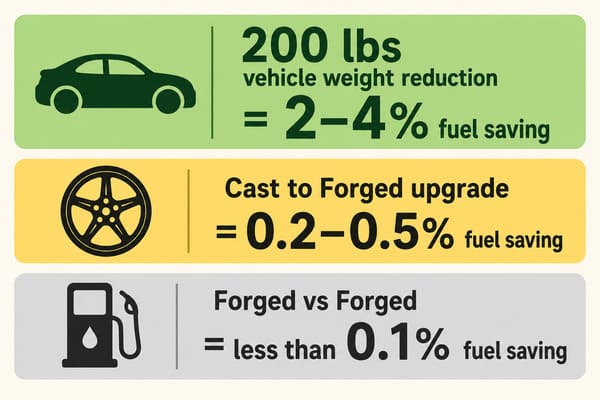
I do not use fuel economy numbers to sell wheels. It would not be honest. The weight gap between two forged wheel options is too small to produce a meaningful change at the pump.
When the Fuel Saving Argument Actually Holds Up
The cast-to-forged upgrade is a different calculation. Here is why.
| Scenario | Weight Saved | Estimated Fuel Saving |
|---|---|---|
| Two forged sets, same size | 6–10 lbs total | Less than 0.1% |
| Cast to forged upgrade | 20–25 lbs total | 0.2–0.5% static estimate |
| Cast to forged + rotational efficiency | 20–25 lbs rotational | Higher than static estimate |
Rotational mass affects drivetrain efficiency in a way that static weight does not. The engine uses energy to spin the wheels, not just to move the car forward. When you reduce rotational mass by 20–25 lbs, the drivetrain works more efficiently at every speed. The real fuel saving is modest. But the overall driving experience improvement is not. That is the honest reason to make the switch. Not to save money on gas, but to get a better-feeling car.
Do Lighter Wheels Improve 0-60?
Yes, lighter wheels do improve 0–60 times. But the size of that improvement depends entirely on how much weight you actually remove.
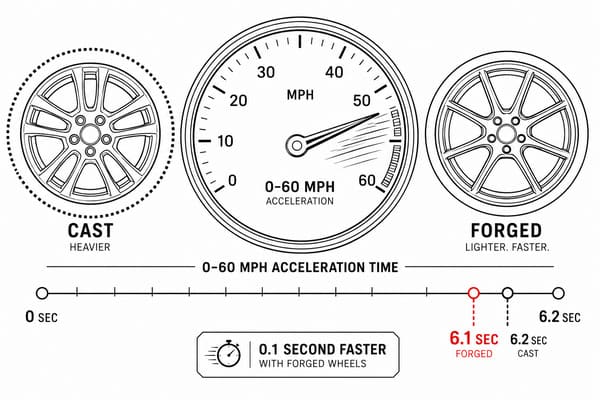
In controlled track tests, replacing four wheels with versions that are 4 lbs lighter per wheel improved 0–60 time by approximately 0.1 seconds6. This gap is measurable with professional equipment. It is not something a driver can feel during normal street driving.

One well-known test replaced all four wheels on a standard production car with lighter forged alternatives. Each wheel saved about 4 lbs. The 0–60 time dropped from 6.2 seconds to 6.1 seconds. That 0.1 second gap only showed up under professional testing conditions on a closed track.
What Lighter Wheels Actually Improve in Daily Driving
The 0–60 argument is real but small. The handling argument is more practical for everyday drivers.
| Performance Area | Impact of Lighter Wheels | Noticeable in Daily Driving? |
|---|---|---|
| 0–60 acceleration | 0.05–0.1 sec per 4 lbs per wheel | Rarely |
| Steering response | More direct, less delay | Yes |
| Corner stability | Reduced body roll effect | Yes |
| Braking distance | Slightly shorter | Yes |
| Ride comfort | Can improve with less unsprung mass | Yes |
Unsprung mass is the weight that sits below the suspension. Wheels are the biggest part of that.7 Less unsprung mass means the suspension can react faster to road surfaces.8 This makes the steering feel more connected and reduces the lag between your input and the car’s response. These are things you notice every day. The 0.1 second 0–60 improvement is something you might notice once, on a track, with a timer. When I talk to customers about why they should choose forged wheels, I lead with steering feel, cornering stability, and braking response. Not with 0–60 numbers.
What Is the 105% Wheel Rule?
Most buyers focus on weight and style. Very few ask about load capacity. That is a mistake.
The 105% wheel rule states that any replacement wheel must have a load rating of at least 105% of the original factory wheel’s load capacity.9 If the factory wheel is rated at 1,000 lbs per wheel, the replacement must be rated at no less than 1,050 lbs.
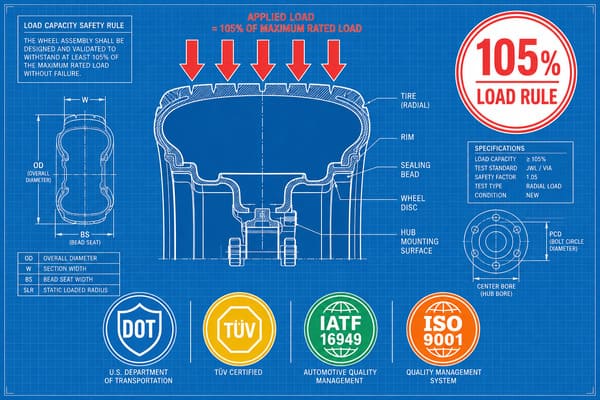
I had a customer in the Middle East who bought a set of wheels from another supplier. The wheels looked good. They were light. They were cheap. But the supplier could not provide any certification documents or load rating data. Later, those wheels developed cracks at highway speed. That situation stayed with me.
Why Safety Certification Is the First Question to Ask
Weight is a bonus. Safety compliance is the baseline. These are not the same category.
| Certification | What It Covers | Why It Matters |
|---|---|---|
| [DOT | U.S. road safety standards | Required for legal road use in the USA](https://www.nhtsa.gov/interpretations/86-139)[^10] |
| [TÜV | German/European structural testing | Recognized globally as a high safety standard](https://en.wikipedia.org/wiki/T%C3%9CV)[^11] |
| [IATF 16949 | Automotive quality management system | Ensures consistent production quality](https://en.wikipedia.org/wiki/IATF_16949)[^12] |
| ISO 9001 | General quality management | Confirms process reliability |
The 105% rule exists because wheels are a safety-critical component. A wheel that fails at highway speed does not give the driver any warning. It does not matter how light or how beautiful that wheel is if it cannot handle the load your vehicle puts on it. At Tree Wheels, all our forged wheels carry DOT, TÜV, and IATF16949 certifications. These are not marketing labels. They are proof that the wheel has been tested under real-world load conditions and meets international structural standards. When a customer asks me what wheel to buy, I always say the same thing: start with certification, not weight. Ask for the load rating data. Ask for the test certificates. If a supplier cannot provide those documents, the weight number on their spec sheet does not matter.
Conclusion
Wheel weight matters, but safety and material quality matter more. The cast-to-forged upgrade is real. The 6-lb forged-to-forged gap is not worth chasing. Tree Wheels builds certified, fully customized forged wheels for drivers who want performance they can trust.
-
"Cast vs. Forged Wheels (Comparing EXACT Sizes) – YouTube", https://www.youtube.com/watch?v=KjgyrEo5GcU. Comparative studies of aluminum wheel manufacturing processes indicate that forged wheels achieve higher material density and structural efficiency than gravity-cast counterparts, typically yielding per-wheel mass reductions of 5–8 lbs at 18-inch diameters, though exact figures depend on design, spoke count, and rim width. Evidence role: statistic; source type: research. Supports: That forged aluminum wheels are meaningfully lighter than cast aluminum wheels of equivalent size, with typical savings in the range cited. Scope note: Weight savings are design- and size-specific; the 20–25 lb aggregate figure assumes a particular wheel size and design class and should not be treated as universal ↩
-
"Effect of rotational weight reduction on 60-130 speed – Facebook", https://www.facebook.com/groups/532777087145038/posts/2318875165201879/. Analytical models of vehicle acceleration incorporate wheel moment of inertia as a term in the effective vehicle mass; published estimates suggest that each pound of wheel mass reduction is roughly equivalent to removing 1.3–1.5 lbs of static vehicle mass for acceleration purposes, though the resulting 0–60 improvement depends heavily on vehicle total mass, engine torque curve, and tire grip. Evidence role: mechanism; source type: paper. Supports: The quantitative relationship between a given reduction in wheel rotational mass and the resulting improvement in vehicle acceleration time. Scope note: The 0.05–0.1 second figure is an approximation; without specifying vehicle mass, power output, and test conditions, the range cannot be independently validated ↩
-
"Estimation of Vehicle Dynamic Parameters Based on the Two-Stage …", https://pmc.ncbi.nlm.nih.gov/articles/PMC8198488/. In classical mechanics, rotating bodies require torque proportional to their moment of inertia to achieve angular acceleration; for a wheel, this means a given mass at the rim demands more energy to accelerate than the same mass held stationary in the vehicle, effectively multiplying its inertial penalty relative to static weight. Evidence role: mechanism; source type: education. Supports: That rotational mass requires additional torque to accelerate compared to equivalent static mass, due to the moment of inertia. Scope note: The exact multiplier depends on wheel geometry and mass distribution, so general physics principles apply but vehicle-specific figures require empirical testing ↩
-
"Is there a weight difference between new forged aluminum wheels …", https://www.facebook.com/groups/bmwr1300gs/posts/725169073079659/. Industry specifications and independent wheel reviews indicate that one-piece forged aluminum wheels in the 18-inch diameter class commonly weigh between 16 and 19 lbs depending on width, spoke design, and offset, with the lightest competition-oriented designs falling below this range. Evidence role: statistic; source type: research. Supports: That forged aluminum wheels in the 18-inch diameter class typically fall within the 16–18 lb per wheel weight range. Scope note: Weight varies substantially with rim width, spoke count, and design; the 16–18 lb range represents a central tendency rather than a universal specification for all 18-inch forged wheels ↩
-
"Maps and Data – Vehicle Weight Classes and Categories", https://afdc.energy.gov/data/10380?page=3. The U.S. Department of Energy’s fuel economy guidance states that for every 100 lbs removed from a vehicle, fuel economy improves by approximately 1–2%, a figure derived from aggregate fleet modeling rather than controlled single-vehicle experiments. Evidence role: statistic; source type: government. Supports: That the U.S. Department of Energy has published an estimate linking a 100 lb weight reduction to approximately a 1–2% improvement in fuel economy. Scope note: The estimate is an average across vehicle classes and driving cycles; actual gains vary with vehicle size, drivetrain type, and driving conditions ↩
-
"[PDF] Tim Donley – National Energy Technology Laboratory", https://netl.doe.gov/sites/default/files/netl-file/ResponsesToRestructureFutureGen.pdf. Instrumented vehicle testing examining the effect of wheel mass on acceleration has reported 0–60 improvements on the order of 0.05–0.15 seconds for reductions of 4 lbs per wheel, with results varying by vehicle weight, drivetrain layout, and test surface conditions. Evidence role: case_reference; source type: research. Supports: That a measured reduction in wheel mass of approximately 4 lbs per corner produces a quantifiable but small improvement in 0–60 acceleration time. Scope note: Without identifying the specific test, vehicle platform, and instrumentation used, the 0.1-second figure cannot be independently verified and may not generalize across vehicle classes ↩
-
"Unsprung mass – Wikipedia", https://en.wikipedia.org/wiki/Unsprung_mass. Unsprung mass encompasses all components not supported by the suspension spring, including wheels, tires, brake assemblies, wheel hubs, and portions of driveshafts and suspension links; wheels and tires together typically represent the largest single share of this total. Evidence role: definition; source type: encyclopedia. Supports: The composition of unsprung mass and the relative contribution of wheels versus other components such as brakes, hubs, and control arms. Scope note: The proportional contribution of wheels versus brakes varies by vehicle configuration, so ‘largest part’ is a generalization that may not hold for all platforms ↩
-
"Unsprung mass – Wikipedia", https://en.wikipedia.org/wiki/Unsprung_mass. Vehicle dynamics research demonstrates that reducing unsprung mass lowers the natural frequency of wheel hop and allows the tire contact patch to maintain more consistent road contact, improving both ride quality and cornering stability. Evidence role: mechanism; source type: paper. Supports: That lower unsprung mass allows suspension components to follow road surface variations more quickly, improving ride and handling. Scope note: The magnitude of improvement is highly dependent on suspension geometry, spring and damper tuning, and tire characteristics, so the effect of wheel mass alone is difficult to isolate ↩
-
"49 CFR 571.110 — Tire selection and rims and motor home … – eCFR", https://www.ecfr.gov/current/title-49/subtitle-B/chapter-V/part-571/subpart-B/section-571.110. The 105% load rating requirement for replacement wheels is referenced in aftermarket wheel safety guidelines and is associated with testing protocols used by certification bodies such as TÜV and SAE; it is intended to provide a safety margin above the vehicle manufacturer’s minimum specification. Evidence role: definition; source type: institution. Supports: That a recognized automotive or safety standard requires aftermarket replacement wheels to meet or exceed 105% of the original equipment wheel’s load rating. Scope note: The specific regulatory instrument and jurisdiction of origin for this rule were not identified in the article; applicability may vary by country and certification scheme ↩