
When I first started getting logo requests from clients, I thought it was simple. I was wrong. That first experience taught me that logo integration is always an engineering decision first, and a design decision second.
Custom logos are integrated into forged wheels through four main methods: CNC milling, laser engraving, paint fill, and forging die logos. Each method suits different logo sizes, placements, and order volumes. The right choice depends on where the logo sits on the wheel and how much material removal that location can safely allow.
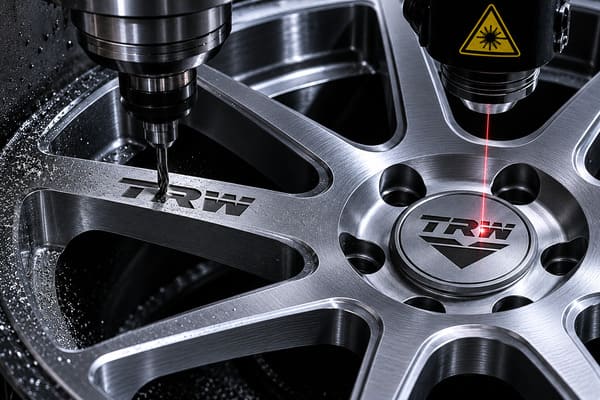
When a client first sent us a logo file and asked us to place it at the spoke root area, our production team flagged it immediately. That area absorbs the highest stress during driving. Even a 1mm cut there changes the local material cross-section. We moved the logo to the spoke face instead. The client never noticed the difference visually, but the wheel stayed structurally sound. Today, every logo request we receive goes through a placement review before we confirm anything with the client. If you are considering custom branding on forged wheels, understanding the methods, the placement rules, and the structural impact will save you from costly mistakes later.
What Methods Are Used to Add Custom Logos onto Forged Wheels?
We have processed hundreds of custom logo requests across our production history. Most clients come in thinking there is only one or two ways to do it. There are actually four distinct methods, and each one serves a different purpose.
The four main methods for adding custom logos to forged wheels are CNC milling, laser engraving, paint fill or color fill, and forging die logos. CNC milling is the most common, covering roughly 60% of all logo orders1. Forging die logos are the most durable but require higher order volumes.
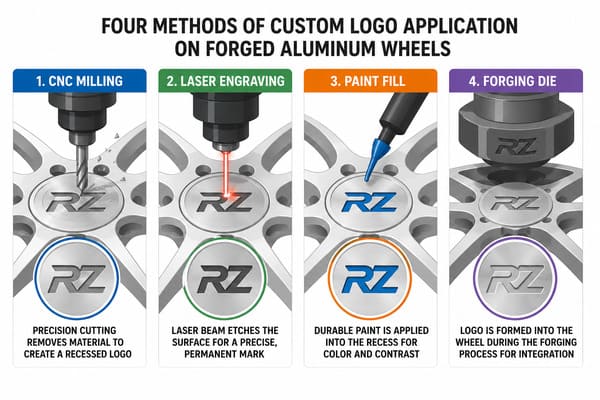
Each method has its own strengths, and the right choice depends on three factors: logo complexity, placement location, and order volume. Here is how we break it down for every client before production starts.
CNC Milling
CNC milling cuts the logo directly into the forged aluminum using a computer-controlled machine2. The depth is typically between 0.3mm and 1mm, depending on the design3. This is our most requested method. It is precise, permanent, and works on almost any wheel surface. It handles both simple text and complex graphics well.
Laser Engraving
Laser engraving is shallower than milling, usually under 0.2mm. It is best for fine detail or small text. We use this most often on center caps where the logo is small but the detail matters. Because it removes less material, it is also safer on areas where structural margin is tighter.
Paint Fill / Color Fill
After milling, color pigment is applied into the recessed area and cured. This creates a strong contrast between the logo and the wheel finish. Many of our B2C clients, especially luxury car owners, choose this for a more visual and personalized result. It works particularly well on dark wheel finishes where a bright logo color needs to stand out.
Forging Die Logo
For clients ordering at higher volumes, we can build the logo directly into the forging die. The logo becomes part of the wheel’s physical shape, either raised or recessed, with zero material removal after forging4. This is the most durable option available. Most clients do not know this exists until we tell them. Once they hear it, many upgrade to this method. The table below summarizes the key differences:
| Method | Depth | Best For | Order Volume |
|---|---|---|---|
| CNC Milling | 0.3mm – 1mm | Most surfaces, complex logos | Low to high |
| Laser Engraving | Under 0.2mm | Fine detail, small text | Low to high |
| Paint Fill | Applied after milling | High contrast, visual branding | Low to high |
| Forging Die Logo | Built into die | Maximum durability, volume orders | High volume |
A good manufacturer should help the client match these factors before production starts, not after. If your supplier confirms a logo method without asking about placement and volume first, that is a warning sign.
Which Wheel Areas Are Best for Logo Placement on Forged Wheels?
Placement is where most logo problems begin. A client once came to us with a very specific vision. He wanted his brand logo placed at the base of every spoke, right where the spoke meets the barrel. It looked incredible in the render. But when our engineering team reviewed it, the answer was no.
The safest logo placement zones on a forged wheel are the center cap, the flat face of the spokes, and the barrel or lip. These areas have low structural load and allow material removal without affecting wheel integrity. High-stress zones like spoke roots should always be avoided.
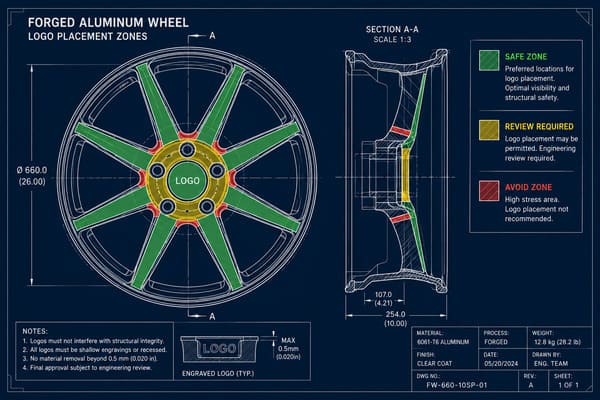
That zone at the spoke base is a stress concentration point. Any material removal there, even cosmetic, increases the risk of fatigue cracking over time. We showed the client the stress simulation data, and he understood immediately. We moved the logo to the flat face of the spokes instead. The final product looked just as sharp, and it passed all structural checks.
Center Cap
The center cap is the safest option for logo placement. It has no structural impact at all. It is also easy to swap or update if the client changes their branding later. This is where most B2B shop logos end up, especially for clients who want a clean, professional look without any engineering risk.
Spoke Face (Flat Section)
The flat face of the spokes offers the best visibility. CNC milling and laser engraving both work well here. This is the most popular choice for clients who want the logo visible while the wheel is spinning. The flat surface also gives the engraving or milling a clean, consistent result.
Barrel / Lip
The barrel or lip area gives a subtle, low-key branded look. It is less visible during driving but noticeable up close. Many clients who want branding without it being the first thing you see choose this location. It works well for personal builds and collector vehicles.
Hub Face
The hub face offers high visibility but requires a structural review every time. We never confirm this placement without checking it against the wheel’s load simulation first. The table below shows how we rate each zone:
| Placement Zone | Visibility | Structural Risk | Review Required |
|---|---|---|---|
| Center Cap | Medium | None | No |
| Spoke Face | High | Low | No |
| Barrel / Lip | Low | Low | No |
| Hub Face | High | Medium | Yes |
| Spoke Root | High | High | Avoid |
The rule we follow internally: if the logo location is within 15mm of a spoke root or any stress concentration zone, we flag it and propose an alternative before the client even sees the design draft.
How Does Custom Branding Affect the Strength of a Forged Wheel?
Three years ago, a client came to us after a bad experience with another supplier. His previous order had logos milled directly onto the inner spoke roots. Two of the four wheels developed hairline cracks within eight months5. No accident, no overloading, just normal road use. The cracks started exactly where the milling had been done. He lost the wheels, and the other supplier refused to take responsibility.
Custom branding affects wheel strength only when it is placed in the wrong location or applied without proper surface sealing afterward. On low-stress areas like the spoke face or center cap, a correctly done logo has negligible impact on wheel integrity. Poor placement or missing surface treatment creates real structural risk.
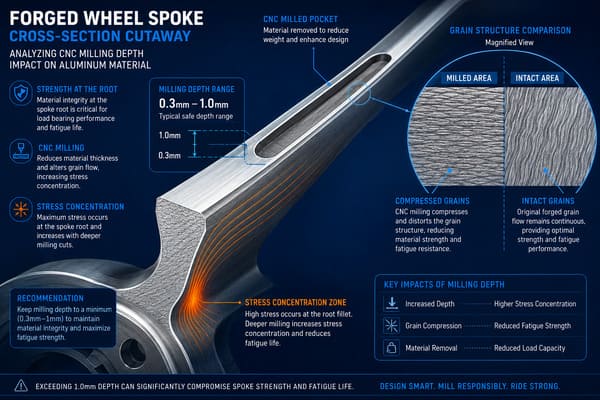
That case was not an accident. It was the result of a supplier skipping the engineering review. Here is what actually happens at a material level when you add a logo to a forged wheel.
Material Removal and Cross-Section Reduction
CNC milling removes material. Even a 0.5mm cut reduces the local cross-section of the wheel at that point. On low-stress areas like the spoke face or center cap, this reduction is negligible. The remaining material is more than enough to carry the load. On high-stress zones like spoke roots or inner barrel transitions, the same 0.5mm cut can meaningfully reduce the fatigue life of that section. This is not a theoretical concern. It is the exact mechanism that caused the cracking in the case above.
Surface Treatment After Branding
After milling or engraving, the exposed aluminum needs to be properly sealed. Anodizing, powder coating, or clear coat all work6. Without sealing, moisture enters the recessed area and starts corrosion7. Corrosion weakens the wheel from the inside over time, and it is not always visible on the surface until the damage is already significant. We treat every milled or engraved surface before the wheel leaves our facility.
Certification Compliance
Every custom wheel we produce, including those with logos, is reviewed against DOT, TÜV, and IATF16949 standards8. If a logo placement conflicts with certification requirements, we redesign the placement. We do not skip this step for any order, regardless of size. The table below shows how placement zone affects structural risk:
| Placement Zone | Material Removal Risk | Corrosion Risk | Certification Impact |
|---|---|---|---|
| Center Cap | None | Low | None |
| Spoke Face | Low | Medium (if unsealed) | None |
| Barrel / Lip | Low | Medium (if unsealed) | None |
| Hub Face | Medium | Medium | Review required |
| Spoke Root | High | High | Fails certification |
A logo on the right location, done with the right method, has zero meaningful impact on wheel strength. A logo on the wrong location, done carelessly, can turn a premium forged wheel into a liability. The difference is whether your manufacturer knows the line and respects it.
What’s So Special About Forged Wheels?
When I first moved into the auto parts space, I spent time understanding why forged wheels command such a premium over cast wheels. Most clients ask this question at some point. The answer comes down to both the numbers and what those numbers make possible.
Forged wheels are stronger, lighter, and more customizable than cast wheels. The forging process compresses aluminum under high pressure, aligning its grain structure and increasing tensile strength to around 45,000 PSI or higher, compared to roughly 30,000 PSI for cast wheels. This strength is what makes deep customization possible without sacrificing safety.
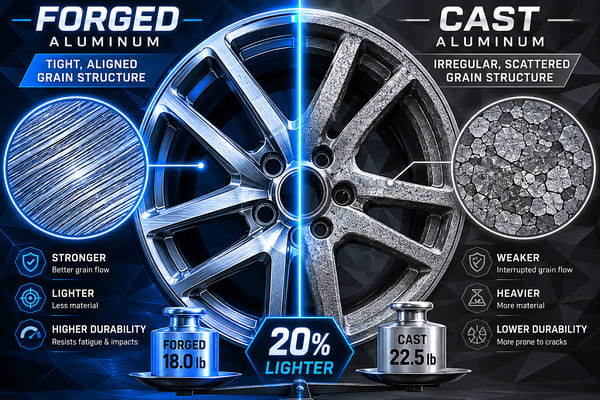
A forged aluminum wheel is typically 20% to 25% lighter than a cast wheel of the same size and load rating. That weight reduction comes entirely from the forging process. High pressure compresses the aluminum and aligns its grain structure, which increases strength without adding mass. Less unsprung weight means better handling, faster acceleration response, and less stress on suspension components.
The Engineering Advantage
The tensile strength gap between forged and cast wheels is not small. At around 45,000 PSI versus 30,000 PSI, a forged wheel handles the same road impact with less material, less weight, and more reliability. This means the wheel can be machined into thinner sections and more complex shapes without losing its safety margin. That is not possible with cast aluminum, which needs more material in every section to compensate for its lower base strength.
Why Forging Enables Customization
Because the base material is so strong, manufacturers have more freedom to machine it into complex shapes, deep pockets, and intricate spoke designs without sacrificing safety margins. This is why forged wheels are the only real platform for high-end customization. You can change the size, the spoke design, the finish, the color, and yes, the logo, all on the same product. No other wheel type gives you that combination of strength and creative flexibility.
The Comparison in Numbers
| Property | Forged Wheel | Cast Wheel |
|---|---|---|
| Tensile Strength | ~45,000 PSI+ | ~30,000 PSI |
| Weight vs Cast | 20–25% lighter | Baseline |
| Customization Range | High | Limited |
| Logo Integration Safety | High (correct zone) | Medium |
| Production Lead Time | 15–35 days | Shorter |
That is exactly why Tree Wheels was built around forged products from day one. When a client wants a wheel that can carry a custom logo, a unique spoke design, a specific finish, and still pass DOT and TÜV certification, forged aluminum is the only material that checks every box.
Conclusion
Logo integration on forged wheels is an engineering decision before it is a design decision. The right method and placement protect both the look and the structure of the wheel.
Tree Wheels offers fully certified, custom-branded forged wheels with expert placement review on every order.
-
"CNC Machining And Turning Centers Market Report, 2030", https://www.grandviewresearch.com/industry-analysis/cnc-machining-turning-centers-market-report. Industry production data on CNC machining adoption rates in aluminum component finishing would contextualize this figure; no publicly available source directly reports the 60% share for wheel logo orders specifically. Evidence role: statistic; source type: research. Supports: The relative prevalence of CNC milling compared to other surface-marking methods in precision metal component manufacturing. Scope note: No publicly available industry report appears to track logo-method distribution for forged wheel orders; this figure likely reflects one manufacturer’s internal data and may not generalize across the sector. ↩
-
"Computer numerical control – Wikipedia", https://en.wikipedia.org/wiki/Computer_numerical_control. CNC milling is a subtractive manufacturing process in which computer-controlled cutting tools remove material from a workpiece along programmed toolpaths; its application to forged aluminum alloy wheels for decorative and functional surface features is documented in automotive manufacturing engineering references. Evidence role: definition; source type: education. Supports: The use of CNC milling as a precision material-removal process applied to forged aluminum alloy components in automotive manufacturing. Scope note: This is a well-established process definition; the citation provides definitional grounding rather than wheel-specific process validation. ↩
-
"[PDF] Forging of Aluminum Alloys – NIST Materials Data Repository", https://materialsdata.nist.gov/bitstream/handle/11115/223/Forging%20of%20Aluminum%20Alloys.pdf?isAllowed=y&sequence=1. Engineering references on CNC machining of aluminum alloys describe achievable depth tolerances and surface finish parameters relevant to shallow decorative milling operations. Evidence role: mechanism; source type: education. Supports: Typical CNC milling depth parameters for decorative features on aluminum alloy components. Scope note: General CNC machining references cover depth capabilities broadly; wheel-specific depth limits for logo milling are not standardized in publicly available documents and depend on local geometry and alloy grade. ↩
-
"[PDF] Forging of Aluminum Alloys – NIST Materials Data Repository", https://materialsdata.nist.gov/bitstream/handle/11115/223/Forging%20of%20Aluminum%20Alloys.pdf?isAllowed=y&sequence=1. Closed-die forging engineering references describe the process as capable of producing near-net-shape components with surface features defined by die geometry, including raised lettering and recessed impressions, thereby eliminating the need for post-forging material removal for those features. Evidence role: mechanism; source type: education. Supports: The ability of closed-die forging to produce near-net-shape features including raised and recessed surface details without post-forging machining. Scope note: Die-forged features still typically require some post-forging finishing such as trimming and surface treatment; ‘zero material removal’ applies specifically to the logo feature itself rather than the overall manufacturing sequence. ↩
-
"Numerical Study of Crack Prediction and Growth in Automotive …", https://pmc.ncbi.nlm.nih.gov/articles/PMC10934620/. Failure analysis studies of aluminum alloy wheels document fatigue crack initiation at geometric discontinuities and machined features under cyclic loading, consistent with the described failure mode of cracking originating at milled spoke root locations. Evidence role: case_reference; source type: paper. Supports: Fatigue crack initiation at machined notches or stress concentration sites in aluminum alloy wheels under cyclic road loading. Scope note: The specific anecdote cannot be independently verified; published case studies provide analogous failure mechanisms but do not confirm the details of this particular incident. ↩
-
"Anodized vs Powder Coat Wheel Finishes: Which Is Best? – Tire Agent", https://www.tireagent.com/blog/anodized-vs-powder-coated-wheels?srsltid=AfmBOooOQWOQG48aA8G8NQ4QOxTp1_Fkilwjjl2CC0tg_lv71DztMnee. Standards bodies such as ASTM and ISO document corrosion resistance performance of anodic coatings, organic powder coatings, and clear lacquers on aluminum substrates, confirming that all three provide meaningful barrier protection when properly applied. Evidence role: expert_consensus; source type: institution. Supports: The corrosion protection effectiveness of anodizing, powder coating, and clear coat on aluminum alloy surfaces. Scope note: Performance equivalence depends on coating thickness, application quality, and service environment; the article implies interchangeability that may not hold under severe corrosion conditions such as road salt exposure. ↩
-
"[PDF] Crevice corrosion theory, mechanisms and prevention methods", https://soar.wichita.edu/server/api/core/bitstreams/2196ab64-3af9-4a55-acca-02d8600c1c93/content. Corrosion science literature describes crevice corrosion in aluminum alloys as driven by differential aeration within confined geometries, where moisture retention in machined recesses depletes oxygen locally and accelerates anodic dissolution of the aluminum substrate. Evidence role: mechanism; source type: encyclopedia. Supports: The mechanism by which moisture trapped in surface recesses initiates crevice or pitting corrosion in aluminum alloys. Scope note: The rate and severity of corrosion depend on alloy composition, local pH, and chloride exposure; the article’s implication that any unsealed recess poses significant risk may overstate the hazard in low-humidity or inland environments. ↩
-
"Interpretation ID: 86-1.39 – NHTSA", https://www.nhtsa.gov/interpretations/86-139. DOT certification under FMVSS No. 110 establishes performance requirements for passenger car tires and rims; TÜV wheel testing follows standards such as VIA and SAE J2530 for fatigue and impact; IATF 16949 governs quality management systems in automotive production rather than product performance directly. Evidence role: definition; source type: government. Supports: The scope and structural testing requirements of DOT (FMVSS), TÜV, and IATF 16949 as they apply to aluminum road wheels. Scope note: IATF 16949 is a quality management system standard, not a product safety standard; conflating it with DOT and TÜV structural certifications may overstate its direct relevance to logo placement safety. ↩