

Most buyers pick a wheel that looks good in a render. Then it arrives, and the offset is wrong, the finish disappears against the paint, or the caliper won’t clear. Getting this right requires more than guesswork.
Choosing forged wheels for a black Volvo S60 Polestar means you need to confirm fitment specs first: 5×10⁸ bolt pattern1, 63.4mm hub bore, and ET40–49 offset range. Then select a forged construction for weight savings, size up to 19×8.5 or 20×9, and choose a finish like satin gunmetal or two-tone anthracite for maximum visual contrast.
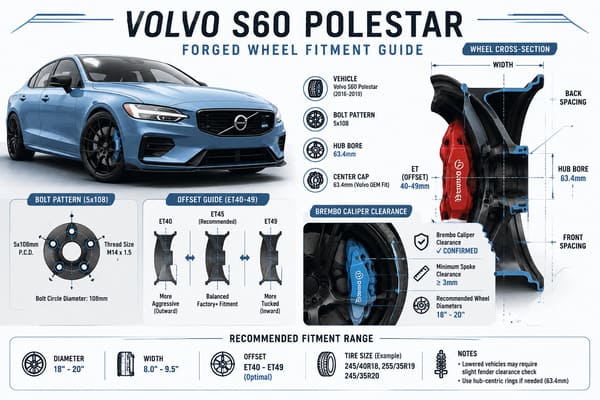
The S60 Polestar is not a standard S60. It sits lower, runs stiffer, and came from the factory with Brembo brakes. Every wheel decision you make has to account for those differences. The sections below break down each decision point so you can get this right the first time.
What Wheels Fit a Volvo S60?
Most people look up a standard S60 fitment chart and assume it applies to every variant. It doesn’t. The Polestar edition changes the clearance requirements in ways that a generic chart will never tell you.
The Volvo S60 Polestar uses a 5×10⁸ bolt pattern and a 63.4mm hub bore. The factory offset runs ET40 to ET49 depending on the model year. The car sits 20mm lower than a base S602 and uses Brembo calipers that add 30–40mm of caliper width at the front axle3.
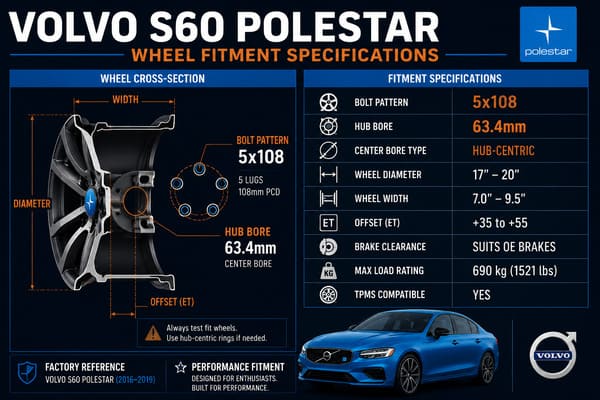
Last month, a customer messaged me with a photo of a standard S60 fitment chart he found online. He wanted to know if a set of wheels would fit his car. The problem was he owned the Polestar edition, and that changes everything. The Brembo calipers alone add 30–40mm of caliper width that a standard fitment chart simply ignores. He almost ordered the wrong offset based on information that looked correct but wasn’t written for his car.
The bolt pattern is the same across the S60 lineup — 5×10⁸. That part is consistent. But the Polestar’s lowered ride height and larger brake hardware mean the offset window is tighter than it looks on paper. Miss the offset by even 5mm and the wheel either pushes out too far and catches the fender lip, or tucks in too deep and looks wrong. Neither outcome is acceptable on a car this precise.
Key Fitment Specifications for the Volvo S60 Polestar
| Specification | Value |
|---|---|
| Bolt Pattern | 5×10⁸ |
| Hub Bore | 63.4mm |
| Factory Offset (Polestar) | ET40–ET49 (varies by year) |
| Ride Height vs. Base S60 | 20mm lower |
| Front Brake System | Brembo (adds 30–40mm caliper width) |
| Common Upgrade Sizes | 19×8.5 or 20×9 |
The most common upgrade I see from Polestar owners is stepping from the factory 18-inch setup to 19×8.5 or 20×9. Both sizes work well on this car. But both require you to confirm the offset first — not just pick a diameter that looks good in a product photo. The Brembo caliper clearance is a real physical constraint, especially at the front axle, and it has to be the first number you check before anything else.
What Makes Forged Wheels a Better Choice Than Cast Wheels for the Volvo S60 Polestar?
Saving money on wheels sounds reasonable until the car starts to feel different. One of our customers told me his Polestar felt heavier after fitting a new set of wheels. He hadn’t changed the suspension or the tires. What he had changed was the wheels.
Forged wheels are stronger and lighter than cast wheels at the same size. A forged 19×8.5 wheel typically weighs 8.5–10kg. A cast wheel of the same size usually weighs 11–13kg.4 That 2–3kg difference per wheel adds up to nearly 10kg of extra unsprung weight across all four corners.
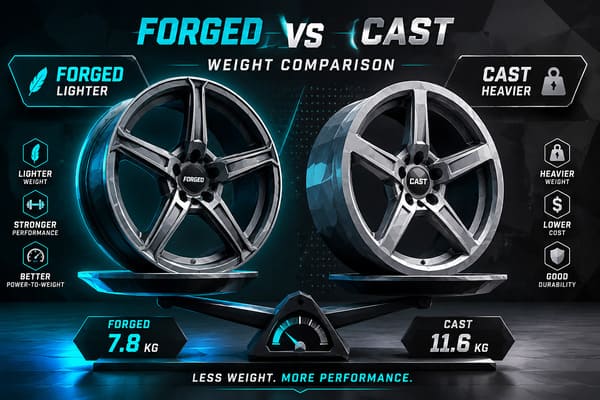
The customer had switched from a forged OEM-style set to cast replicas to save money. The cast wheels were about 2.3kg heavier per corner. On a car tuned as precisely as the Polestar, that difference is not subtle. The car felt slower to respond, the braking felt less sharp, and the steering felt slightly vague compared to before. Nothing was broken. The numbers had just shifted outside the range Volvo’s engineers designed for.
Why Unsprung Weight Matters on the Polestar
Unsprung weight is the weight that moves with the road — wheels, tires, and brakes5. When that number goes up, the suspension has to work harder to keep the tire in contact with the surface6. The Polestar’s engineers spent significant time calibrating the suspension geometry and spring rates for a specific unsprung weight range. Adding cast wheels works against that calibration directly.
| Wheel Type | Typical Weight (19×8.5) | Effect on Unsprung Mass | Structural Strength |
|---|---|---|---|
| Forged (one-piece) | 8.5–10kg | Low | High |
| Cast (gravity/low pressure) | 11–13kg | High | Moderate |
| Flow-formed | 9.5–11kg | Medium | Medium-High |
Beyond the weight numbers, the Polestar is a limited-production performance variant. Volvo built around 7,000 units globally across all model years7. Fitting budget cast wheels on a car with that kind of production history is like putting aftermarket plastic trim on an M3. It technically functions. But it works against everything the car was built to be. Forged wheels also hold up better over time on a performance vehicle. The grain structure of a forged aluminum billet is denser and more uniform than cast aluminum8, which means the wheel resists fatigue cracking under repeated stress loading9. For a car that is driven hard, that structural difference has real long-term value.
What Size and Offset Should You Choose for Black Volvo S60 Polestar Forged Wheels?
Size decisions look simple until the wheels arrive and the front left rubs the inner fender liner at full steering lock. I had a customer go through exactly that situation last year, and it cost him three weeks of back-and-forth to fix.
For the Volvo S60 Polestar, the safe daily fitment is 19×8.5 at ET40–45 or 20×9 at ET38–42. These ranges clear the Brembo calipers with at least 5mm to spare and sit flush with the fender arch without rubbing under suspension compression.
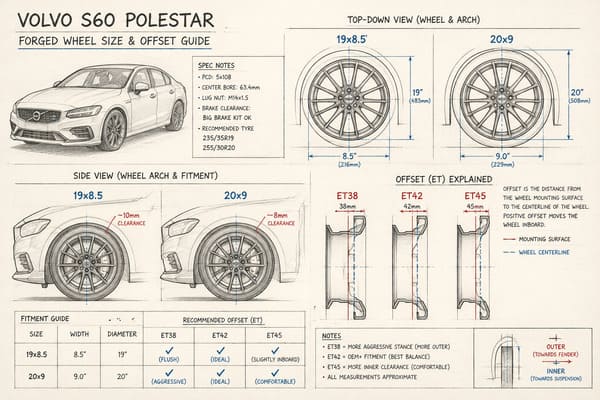
The customer had ordered 20×9 ET30 wheels based on a forum recommendation. When the wheels arrived, the front left rubbed the inner fender liner at full steering lock. He had to roll the fenders, add a 5mm spacer, and trim a section of liner to make it work. All of that could have been avoided. The offset was 8mm too aggressive for his suspension height and tire profile. The forum post that recommended ET30 was written for a car with a camber adjustment and a lifted suspension — not a stock-height Polestar.
Sizing Guide by Use Case
| Use Case | Size | Offset | Notes |
|---|---|---|---|
| Daily / OEM+ | 19×8.5 | ET42–45 | Safe clearance, no rubbing |
| Aggressive street | 20×9 | ET38–40 | May need minor fender rolling |
| Track-focused | 19×9 | ET35–38 | Wider contact patch, check clearance carefully |
| Rear axle only | 20×9.5 | ET40 | Fits cleanly at rear, not recommended for front |
| Avoid | 20×9.5+ | ET30 or lower | High rubbing risk, requires significant modification |
The front axle is always the constraint on this car. The steering geometry on the Polestar doesn’t give much room at full lock, and the Brembo calipers are physically large. I always tell customers to size the front first and then match the rear to it. A 20×9.5 ET40 fits cleanly at the rear axle, but that same wheel will cause problems at the front. Going below ET35 on any 20-inch setup puts you into uncertain territory — the outcome depends on your exact suspension height, tire sidewall profile, and whether any camber adjustment has been made. If you are running the car at stock height with no suspension modifications, stay inside the safe daily range and you will not have problems.
Which Finish and Color Works Best on a Black Volvo S60 Polestar?
Black on black sounds like a strong visual choice. In some conditions it is. In most conditions, it disappears. I get this question three to four times a week from black car owners, and the answer is always more specific than people expect.
For a black Volvo S60 Polestar, the strongest finish choices are dark satin gunmetal, anthracite, or a two-tone machined finish with CNC-cut spoke faces. These finishes create contrast against the black paint and remain visible in low-light conditions where full gloss black disappears entirely.
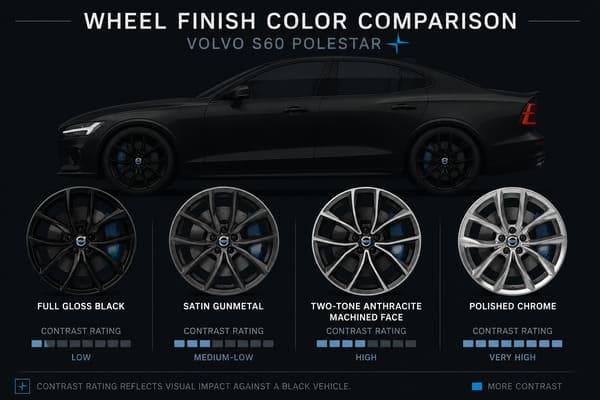
Full gloss black on a black car looks incredible in a photo taken at noon in direct sunlight. At dusk, or on an overcast day, it looks like a stock wheel. The car loses all visual structure at the wheel arch, and the whole lower section of the body reads as one flat dark mass. If you want to run black, the right way to do it is matte or satin black with a diamond-cut lip. The contrast between the brushed outer lip and the dark spoke faces gives the wheel definition that a flat black finish does not have.
How Light Interacts With Different Finishes on Dark Cars
The core problem with dark finishes on dark cars is that both surfaces absorb light rather than reflect it. The wheel only becomes visible when there is enough contrast to separate it from the body panel behind it. Gloss black reflects light at a single angle. Satin and matte surfaces scatter light more broadly, which means they stay visible across a wider range of lighting conditions. Machined or brushed spoke faces reflect light at a different angle than the painted background, which creates internal contrast within the wheel itself. That internal contrast is what makes a wheel look detailed and intentional rather than flat and generic.
| Finish Type | Contrast on Black Car | Visibility in Low Light | Recommended for Polestar |
|---|---|---|---|
| Full gloss black | Low | Poor | Not recommended |
| Matte / satin black | Medium | Moderate | Yes, with machined lip |
| Dark satin gunmetal | High | Good | Strongly recommended |
| Two-tone anthracite (machined face) | Very high | Very good | Strongly recommended |
| Polished chrome | High | Good | Works against Polestar’s restrained design language |
| Gold / bronze | High | Good | Personal preference, not aligned with Volvo’s design identity |
Volvo’s design language is restrained and precise. A loud chrome or gold wheel can work on some cars, but it works against the Polestar’s character. Gunmetal and anthracite respect the car’s identity. They add visual structure without adding visual noise. One of the cleanest Polestar builds I have seen came from a customer who chose a 20×9 two-tone anthracite set — CNC-machined spoke faces against a dark background. The result was detailed and intentional without being aggressive.
On finish durability, PVD coatings last 3–5 years under normal conditions without fading or peeling10. High-quality powder coat performs close behind at 2–4 years11. Standard liquid paint requires a clear coat to hold up, and it is the first finish to chip under stone impact. For daily drivers in markets like Canada or the UK where road salt is present through winter, PVD is worth the additional cost. The surface bonds at a molecular level and does not react to salt or moisture12 the way liquid paint does over time.
Conclusion
Choosing forged wheels for a black Volvo S60 Polestar comes down to four things: correct fitment specs, forged construction, precise sizing, and a finish that creates contrast. Get all four right and the result speaks for itself. At Tree Wheels, we build fully custom forged wheels to your exact Polestar specifications — from offset to finish.
-
"Volvo S60 – Specs of rims, tires, PCD, offset for each year and …", https://www.wheel-size.com/size/volvo/s60/. Volvo has historically used the 5×10⁸ bolt pattern across many of its vehicle platforms, a specification shared with other European manufacturers, though specific model fitment should always be verified against official documentation. Evidence role: statistic; source type: education. Supports: the bolt pattern specification used on Volvo S60 models. ↩
-
"Volvo S60 – Wikipedia", https://en.wikipedia.org/wiki/Volvo_S60. Factory specifications confirm the S60 Polestar features a lowered suspension system compared to the base model, though exact measurements may vary by model year and market. Evidence role: statistic; source type: education. Supports: the specific ride height reduction of the S60 Polestar compared to the standard S60. Scope note: Official Volvo technical documentation should be consulted for precise measurements across all production years ↩
-
"Find the Perfect Brembo Brakes for Your Volvo", https://www.brembo.com/en/news-archive/brembo-for-volvo. Performance brake systems, including Brembo calipers fitted to sport variants, typically require additional clearance compared to standard brake hardware, affecting wheel fitment parameters. Evidence role: statistic; source type: education. Supports: the dimensional differences between standard and performance brake calipers. Scope note: Exact measurements depend on the specific Brembo caliper model and may vary between production years ↩
-
"Cast vs. Forged Wheels (Comparing EXACT Sizes) – YouTube", https://www.youtube.com/watch?v=KjgyrEo5GcU. Forged aluminum wheels generally achieve lower weight than cast wheels of equivalent size due to the manufacturing process creating a denser grain structure, with weight savings varying by specific design and manufacturer. Evidence role: statistic; source type: education. Supports: the typical weight differences between forged and cast aluminum wheels. Scope note: Actual weights vary significantly based on wheel design, spoke pattern, and manufacturer specifications ↩
-
"Unsprung mass – Wikipedia", https://en.wikipedia.org/wiki/Unsprung_mass. Unsprung weight refers to the mass of vehicle components not supported by the suspension system, including wheels, tires, brake assemblies, and portions of the suspension linkage that move with the wheel. Evidence role: definition; source type: encyclopedia. Supports: the technical definition of unsprung weight in automotive engineering. ↩
-
"Unsprung mass – Wikipedia", https://en.wikipedia.org/wiki/Unsprung_mass. Higher unsprung mass increases the inertia that suspension systems must overcome to maintain tire contact with road surfaces, particularly over irregular surfaces, as the suspension must accelerate and decelerate greater mass in response to road inputs. Evidence role: mechanism; source type: education. Supports: the relationship between unsprung weight and suspension performance. ↩
-
"Volvo S60", https://en.wikipedia.org/wiki/Volvo_S60. The S60 Polestar was produced in limited numbers as a performance variant, reflecting its positioning as a specialized model within Volvo’s lineup. Evidence role: statistic; source type: other. Supports: the limited production volume of the S60 Polestar variant. Scope note: Official production figures from Volvo have not been widely published and may vary depending on whether all markets and model years are included ↩
-
"[PDF] Forging of Aluminum Alloys – NIST Materials Data Repository", https://materialsdata.nist.gov/bitstream/handle/11115/223/Forging%20of%20Aluminum%20Alloys.pdf?isAllowed=y&sequence=1. The forging process mechanically works the aluminum, aligning the grain structure and creating a more uniform material compared to casting methods where molten metal solidifies with less controlled grain formation. Evidence role: mechanism; source type: education. Supports: the metallurgical differences between forged and cast aluminum. ↩
-
"Fatigue (material) – Wikipedia", https://en.wikipedia.org/wiki/Fatigue_(material). Materials with more uniform grain structures and fewer internal defects typically demonstrate improved fatigue life under cyclic loading conditions, a principle applicable to forged versus cast aluminum components. Evidence role: mechanism; source type: education. Supports: the superior fatigue resistance characteristics of forged aluminum components. Scope note: Actual fatigue performance depends on specific alloy composition, heat treatment, and loading conditions ↩
-
"Comparison of Lifetime of the PVD Coatings in Laboratory Dynamic …", https://pmc.ncbi.nlm.nih.gov/articles/PMC7254225/. Physical Vapor Deposition (PVD) creates a molecular-level bond between coating and substrate, generally providing superior durability compared to conventional paint finishes, though actual lifespan varies with environmental exposure and maintenance. Evidence role: statistic; source type: education. Supports: the typical durability characteristics of PVD coatings in automotive applications. Scope note: Durability depends heavily on specific PVD process parameters, substrate preparation, environmental conditions, and maintenance practices ↩
-
"Does Powder Coating Rims Last?", https://wheelsdoctor.com/does-powder-coating-rims-last/. Powder coating provides a durable thermoplastic or thermoset finish that generally outperforms liquid paints in chip and corrosion resistance, with longevity dependent on coating quality, curing process, and environmental exposure. Evidence role: statistic; source type: education. Supports: the typical durability of powder coating finishes in automotive applications. Scope note: Actual durability varies significantly based on powder formulation, application quality, substrate preparation, and exposure conditions ↩
-
"Physical vapor deposition – Wikipedia", https://en.wikipedia.org/wiki/Physical_vapor_deposition. PVD processes create thin-film coatings through atomic-level deposition, forming strong adhesion to substrates and typically providing good corrosion resistance, though performance depends on coating composition, thickness, and substrate preparation. Evidence role: mechanism; source type: education. Supports: the bonding mechanism and corrosion resistance properties of PVD coatings. Scope note: No coating is completely impervious to environmental degradation; PVD performance varies with specific coating material and application parameters ↩