
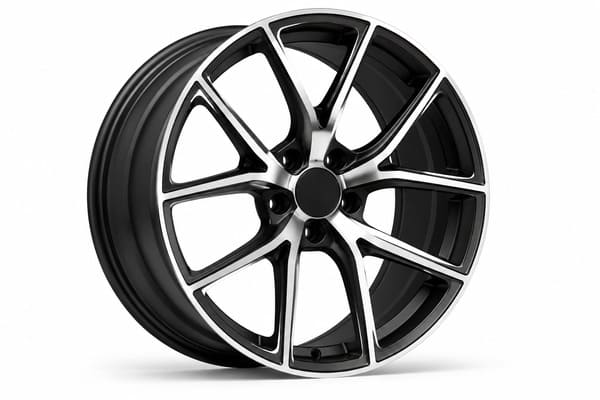
I still remember a client who wanted "a black and silver wheel." Simple enough — until we broke it down into three separate surface treatment processes on one wheel.
Two-tone and multi-color finishes on forged wheels are created by combining multiple surface treatment processes — such as powder coating, CNC bright-cutting, brushing, anodizing, or PVD — applied in a strict sequence on the same wheel. Each process targets a specific zone, and the order cannot be changed without risking damage to already-finished surfaces.
Most people assume a two-tone wheel is just two colors. It is not. It is two or more completely different finishing processes running on the same piece of forged aluminum — and managing that sequence without ruining what you already finished is where the real skill lives. In this article, I will walk you through exactly how we do it, what combinations work best, how long these finishes last, and whether two-tone powder coating is actually possible.
What Surface Treatment Methods Are Used to Create Two-Tone Forged Wheel Finishes?
One of our most requested finishes last year was a gloss black base with a CNC-machined bright-cut face. We processed over 200 sets with that combination in 2024 alone — and the production steps behind it are more involved than most clients expect.
The most common methods used to create two-tone forged wheel finishes include powder coating, CNC bright-cutting, liquid painting with vinyl masking, brushing plus anodizing, and PVD chrome on select zones1. These processes are applied in a fixed sequence, and each zone must be fully completed and protected before the next treatment begins.
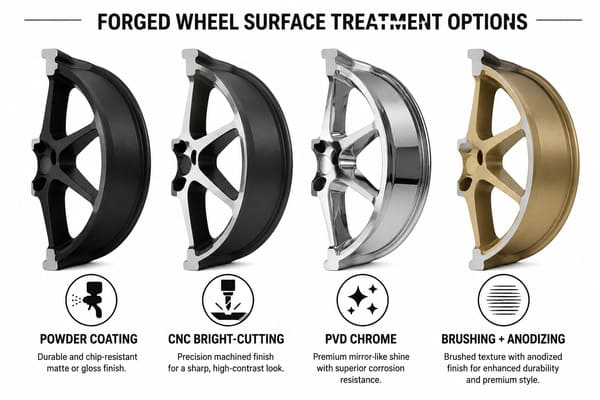
For the gloss black plus bright-cut combination, here is what actually happens on our production floor. The wheel is fully powder coated in gloss black first, then cured at 185°C for 20 minutes2. After that, it goes to the CNC machine, where the spoke faces are precisely cut — removing the black powder coat layer and exposing the raw forged aluminum underneath. That exposed aluminum has a natural mirror-like brightness. The contrast between the deep black and the bright aluminum face is exactly what clients are paying for.
Other Common Two-Tone Treatment Combinations
Beyond the black plus bright-cut finish, we regularly work with several other combinations in our facility.
| Treatment Combination | Typical Look | Common Application |
|---|---|---|
| Brushing + Anodizing | Satin metallic with color tint | Gold or black spoke accents |
| Multi-layer paint + vinyl masking | Soft contrast between two painted zones | Custom color matching for specific cars |
| PVD chrome face + matte painted barrel | High-gloss face, flat body | Luxury and show car builds |
| Powder coat + CNC bright-cut | Deep color base, mirror-bright face | Most popular all-around finish |
The key point I always share with new clients is this: a two-tone finish is not two colors sitting next to each other. It is two or more entirely different surface treatment processes applied to the same wheel. On forged aluminum specifically, the material’s density gives us a consistent, pore-free surface that holds each treatment layer cleanly and predictably. That is something cast wheels simply cannot match3 at the same level. Managing the sequence — and protecting each completed zone while the next one is being processed — is the real craft behind any quality multi-color wheel.
Which Color Combinations Work Best for Custom Two-Tone Forged Wheels?
A client once sent me a photo of his deep red Ferrari and asked me to "pick a wheel color that looks good." My answer was immediate: the car’s color is your starting point, not the wheel color.
The best two-tone forged wheel color combinations depend on the vehicle’s base color and the intended visual style. Gloss black with a bright-cut face is the most universally compatible option. Matte gunmetal with a polished lip works well on luxury sedans. Bronze or gold with black is dominant in the JDM and performance community4.
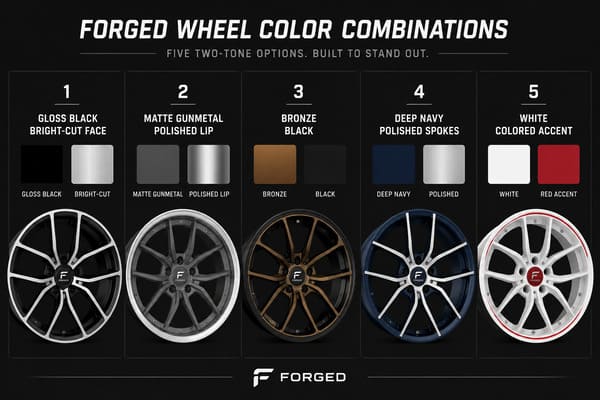
From the hundreds of custom orders we have handled, certain combinations come up again and again — and they do so because they work across a wide range of car colors and body styles. Here is how I break it down for clients when they come to us with a customization request.
Color Combination Guide by Vehicle Type and Market
| Color Combination | Works Best On | Popular Market |
|---|---|---|
| Gloss black + bright-cut face | White, grey, black, bright-colored cars | Universal — all markets |
| Matte gunmetal + polished lip | Silver, dark blue luxury sedans | USA, UK, Australia |
| Bronze or gold + black | Sports cars, lowered builds | JDM, performance community |
| Deep green or navy + polished spokes | European sports cars | Europe, UK |
| White or silver + colored accent spoke | Trucks, SUVs | USA market |
The one rule I apply without exception: the contrast between the two tones needs to be intentional and clear. If the two tones are too close to each other, the finish looks like a production defect rather than a design choice. If the contrast is too extreme, the wheel overwhelms the car rather than complementing it. Finding that balance is part of what we help clients work through when they submit their customization requests to us. We look at the car’s color, the intended use — daily driver, show car, track build — and the client’s reference images before we recommend a final combination. That process saves both sides a lot of back-and-forth later.
How Long Does a Multi-Color Finish Last on a Forged Wheel?
A client came back to us two years after buying a set of painted two-tone wheels — not from us, from another supplier — with peeling already starting at the edge between the two color zones. That edge is always the most vulnerable point in any multi-color finish.
A quality powder coat on a forged wheel lasts 5 to 7 years under normal road conditions5. CNC bright-cut faces sealed with clear coat maintain brightness for 4 to 6 years6. Painted finishes without proper primer and full clear coat layers can begin chipping or fading in as little as 2 to 3 years, especially in harsh climates.
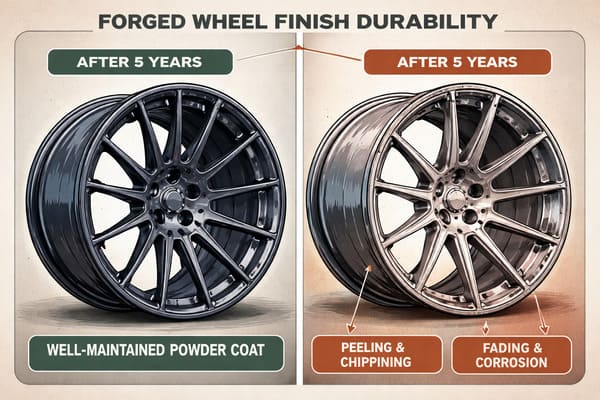
The edge between two color zones is where shortcuts in masking and surface preparation show up first. That is not a design flaw — it is a manufacturing quality issue. Here is how finish lifespan breaks down across the treatment types we use most often.
Finish Lifespan by Treatment Type and Climate Condition
| Finish Type | Expected Lifespan (Normal Conditions) | Risk Factors That Reduce Lifespan |
|---|---|---|
| Powder coat (single or two-tone) | 5–7 years | Road salt, physical impact at color edges |
| CNC bright-cut + clear coat | 4–6 years | UV exposure, improper sealing after machining |
| Liquid paint + primer + clear coat | 3–5 years | Thin primer, incomplete clear coat coverage |
| Liquid paint without full prep | 2–3 years | UV, moisture, temperature cycling |
Two of our key markets — the Middle East and Australia — have some of the harshest UV and heat conditions in the world. Clients in those regions need full clear coat coverage over every exposed surface, including the transition zone between two colors. We also see accelerated corrosion at color edges in northern US and Canadian markets during winter, where road salt is heavy. The real lesson from years of client feedback is straightforward7: the lifespan of a multi-color finish has less to do with which finish type you choose and more to do with how well the surface was prepared and how cleanly each treatment zone was sealed against the next. A well-executed powder coat will always outlast a poorly applied liquid paint, but a poorly applied powder coat will fail just as fast as any other shortcut finish.
Can You 2-Tone Powder Coat a Forged Wheel?
Yes, you can. But it took one failed batch early in our process development to teach us exactly how to do it right — and what goes wrong when you skip the details.
Yes, two-tone powder coating on forged wheels is possible. The correct process requires fully curing the first color, then masking with heat-resistant tape rated for at least 200°C8, and applying and curing the second color separately. On forged aluminum, even heat distribution during each cure cycle reduces warping risk compared to cast wheels.
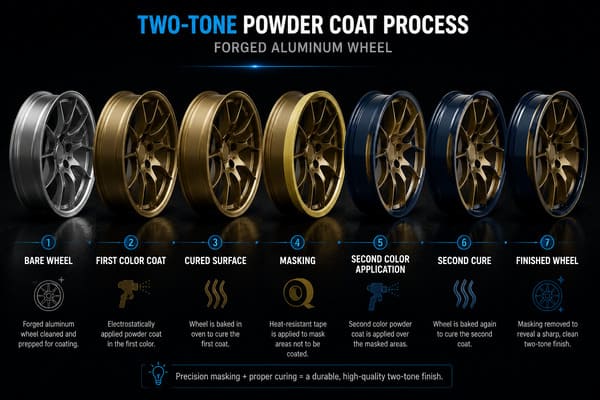
The first time we tried two-tone powder coating without proper heat management, the second cure cycle at 185°C caused micro-lifting at the edge of the first color on two out of eight wheels. That is a 25% defect rate on a single batch — completely unacceptable. Here is what the correct process looks like in our facility now.
Two-Tone Powder Coat Process: Step by Step
| Step | Action | Key Requirement |
|---|---|---|
| 1 | Apply and fully cure first color | 185°C for 20 minutes, full cure — no partial cure |
| 2 | Cool the wheel completely | Prevents tape adhesion failure from residual heat |
| 3 | Mask the first color zone | Heat-resistant tape rated for 200°C minimum |
| 4 | Apply second color powder coat | Even application, no overlap at masking edge |
| 5 | Cure second color | Same 185°C cycle, second full cure |
| 6 | Remove masking tape carefully | Clean pull to maintain sharp color edge |
| 7 | Inspect edge quality | Check for lifting, bleed, or residue at the transition line |
One important detail: powder coat does not give you the same sharp edge control that liquid paint does. The powder particles are larger, and without a clean, tight masking line, the edge between the two colors will look soft or uneven. On forged wheels specifically, the uniform density of the forged aluminum means heat distributes evenly across the wheel during each cure cycle. That reduces the risk of warping or uneven bonding — a real advantage over cast wheels, which have inconsistent internal density and can respond unevenly to repeated heat cycles9. We now run a test piece before every two-tone powder coat batch. Our defect rate on this finish type is currently under 2%10.
Conclusion
Two-tone and multi-color finishes on forged wheels are a combination of precise process sequencing, proper masking, and material quality — not just color choice. Getting any one of those wrong affects the final result. If you are looking for a manufacturer who handles every step of that process in-house and has the experience to back it up, Tree Wheels is ready to help you build exactly the wheel you have in mind.
-
"How PVD Coatings Are Transforming Automotive", https://www.kyocera-hardcoating.com/learning/pvd-transforming-auto/. Physical vapor deposition applies thin metallic or ceramic films through condensation of vaporized material onto a substrate in a vacuum chamber; selective application to specific zones on a component requires mechanical masking or fixturing to shield areas not intended for coating, a technique documented in surface engineering literature for decorative and functional PVD applications. Evidence role: mechanism; source type: research. Supports: Physical vapor deposition processes and the methods used to restrict deposition to defined surface zones on complex three-dimensional components. Scope note: Published literature on selective PVD for automotive wheel aesthetics specifically is limited; most technical sources address PVD masking in the context of tooling or precision components rather than decorative wheel finishing. ↩
-
"[PDF] Evaluation of the Effects of Powder Coating Cure Temperatures on …", https://digitalcommons.lmu.edu/cgi/viewcontent.cgi?referer=&httpsredir=1&article=1009&context=mech_fac. Powder coating cure parameters for aluminum substrates are governed by the coating chemistry; typical thermosetting polyester systems require oven temperatures in the range of 180–200°C for 15–20 minutes to achieve full cross-linking, as documented by coating standards bodies such as the Powder Coating Institute. Evidence role: general_support; source type: institution. Supports: Standard cure temperatures and dwell times for thermosetting powder coatings applied to aluminum substrates. Scope note: Exact cure specifications vary by powder formulation and manufacturer; the cited figures represent a common range rather than a universal standard. ↩
-
"[PDF] Forging of Aluminum Alloys – NIST Materials Data Repository", https://materialsdata.nist.gov/bitstream/handle/11115/223/Forging%20of%20Aluminum%20Alloys.pdf?isAllowed=y&sequence=1. Research in aluminum alloy processing confirms that the compressive deformation inherent in forging closes internal voids and refines grain structure, producing lower porosity than gravity or die casting; this microstructural difference affects surface preparation requirements and coating adhesion performance. Evidence role: mechanism; source type: paper. Supports: The forging process reduces internal porosity and refines grain structure in aluminum alloys compared to casting, resulting in a denser surface more suitable for coating adhesion. Scope note: Studies typically compare bulk mechanical properties; direct comparative data on coating adhesion between forged and cast aluminum wheel surfaces is less commonly reported in peer-reviewed literature. ↩
-
"In a sea of black and silver, bronze rims add a distinctive touch that …", https://www.facebook.com/performanceplustire/posts/why-bronze-rims-are-taking-over-the-automotive-scene-have-you-noticed-more-cars-/1247978350708126/. Bronze and gold wheel finishes have been widely observed as a recurring aesthetic choice in Japanese domestic market and performance car culture, reflected in enthusiast media coverage and aftermarket wheel manufacturer product lines; however, quantitative market share data for specific color preferences in this segment is not consistently published. Evidence role: general_support; source type: other. Supports: The prevalence of bronze and gold wheel finishes as a stylistic preference within the Japanese domestic market and broader performance car enthusiast community. Scope note: No peer-reviewed or government statistical source tracks wheel color preferences by automotive subculture; this claim is supported by qualitative industry observation rather than empirical market research. ↩
-
"Lifespan of powder coat – Facebook", https://www.facebook.com/groups/wtfoffroad/posts/2840275099661030/. Industry durability assessments for powder-coated aluminum automotive components generally cite service lives of several years under normal conditions, with degradation accelerated by UV exposure, road salt, and mechanical impact; specific figures vary by coating formulation, film thickness, and substrate preparation quality. Evidence role: statistic; source type: institution. Supports: Expected service life of powder coat finishes on automotive aluminum components under typical road exposure conditions. Scope note: Published lifespan figures are typically derived from accelerated weathering tests rather than longitudinal field studies, and real-world performance depends heavily on maintenance and environmental conditions. ↩
-
"Development of Car Coating Materials over the Past Decade for …", https://pmc.ncbi.nlm.nih.gov/articles/PMC12694507/. Clear coat systems applied over bare machined aluminum provide a barrier against oxidation and UV-induced discoloration; service life is influenced by coating thickness, UV stabilizer content, and the integrity of the seal at the boundary between the clear coat and any adjacent opaque finish layer. Evidence role: general_support; source type: research. Supports: The protective role of clear coat over machined aluminum surfaces and factors affecting its service life, including UV exposure and moisture ingress. Scope note: The 4–6 year figure cited in the article is not directly corroborated by a specific published study; the note reflects general principles of clear coat performance rather than wheel-specific longitudinal data. ↩
-
"[PDF] Impacts of Using Salt and Salt Brine for Roadway Deicing", https://apps.itd.idaho.gov/apps/research/Completed/RP231.pdf. Electrochemical studies of chloride-induced corrosion on coated aluminum demonstrate that coating edges and transition zones are preferential sites for delamination initiation, as chloride ions concentrate at discontinuities and undermine adhesion between the coating and the substrate. Evidence role: mechanism; source type: paper. Supports: Chloride ions from road salt penetrate coating discontinuities and promote galvanic or crevice corrosion at coating edges on aluminum substrates. Scope note: Most published studies examine flat panel specimens under laboratory salt-spray conditions; field performance on complex wheel geometries with multiple coating interfaces may differ. ↩
-
"Powder Coating Masking Tapes | Best High-Temp Tapes", https://www.echosupply.com/blog/which-tapes-to-use-during-powder-coating/?srsltid=AfmBOorg_mD5zdJZ9eCMubXqx3t4EQfbk8ZLnj15AQUM2LwnwU8i5eEY. Masking materials used in powder coating applications must withstand oven cure temperatures without adhesive breakdown or outgassing; suppliers and industry guidance documents specify that tapes used in standard thermosetting powder coat cycles should be rated for continuous exposure at or above the cure temperature, typically 180–200°C. Evidence role: general_support; source type: institution. Supports: Temperature resistance requirements for masking materials used during powder coat cure cycles to prevent adhesive failure or contamination of finished surfaces. Scope note: Specific temperature ratings vary by tape product and adhesive chemistry; the 200°C figure cited represents a conservative minimum rather than a universal industry-mandated threshold. ↩
-
"Thermal cycles behavior and microstructure of AZ31/SiC composite …", https://pmc.ncbi.nlm.nih.gov/articles/PMC9452533/. Casting processes for aluminum alloys are known to produce internal porosity and shrinkage defects that create localized density variations; under repeated thermal cycling, differential thermal expansion at pore boundaries can promote micro-cracking and surface deformation, effects documented in materials science literature on cast aluminum fatigue behavior. Evidence role: mechanism; source type: paper. Supports: Internal porosity and density variation in cast aluminum alloys and their effects on dimensional stability and coating adhesion under thermal cycling. Scope note: Published studies focus primarily on structural fatigue rather than coating adhesion outcomes specifically; the direct link between casting porosity and powder coat performance under repeated cure cycles is inferred rather than directly measured in most available literature. ↩
-
"Powder Coat Applications Final Report – epa nepis", https://nepis.epa.gov/Exe/ZyPURL.cgi?Dockey=P10120TC.TXT. Quality management frameworks applied to automotive surface finishing, including standards such as ISO 9001 and automotive-specific IATF 16949, establish defect reduction targets and process control requirements; industry benchmarking data for powder coating defect rates in automotive applications provides context for evaluating claimed production performance figures. Evidence role: general_support; source type: institution. Supports: Industry benchmarks or quality standards for acceptable defect rates in automotive powder coating operations, against which a sub-2% figure can be contextualized. Scope note: Publicly available industry-wide defect rate benchmarks for two-tone powder coating specifically are not standardly published; the 2% figure cited is an internal claim that cannot be independently verified without audit data. ↩