

Using the wrong wheel offset on a Ford Falcon XY GT is not just a fitment issue. It can destroy bearings, rub guards, and waste hundreds of dollars before the car moves an inch.
The factory offset for Ford Falcon XY GT wheels is approximately ET+13mm (13mm positive offset). The bolt pattern is 5×114.3mm, and the original wheel size is 14×6 inch.1 For modified fitments using wider wheels, the correct offset typically falls between ET-10 and ET+15, depending on wheel width and guard clearance.
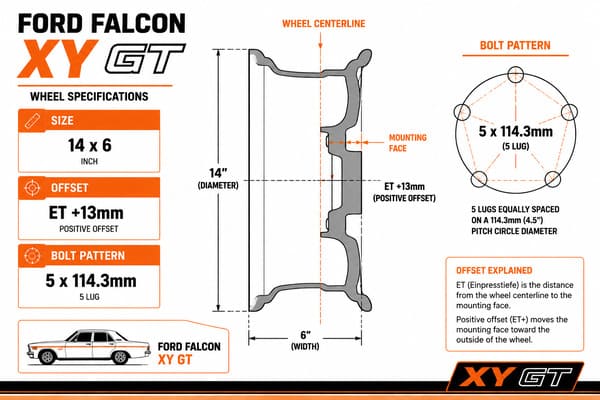
Getting the offset right before production is everything. A forged wheel cannot be re-offset after it is made.2 I have worked through dozens of XY GT fitment calculations with customers around the world, and the same mistakes come up every time. This article covers the numbers you need, the mistakes to avoid, and how to measure everything yourself in under five minutes.
What Happens If You Use the Wrong Offset on a Ford Falcon XY GT?
A wrong offset does not just look bad. It causes real mechanical damage and costs real money — sometimes before the car even leaves the workshop.
Using the wrong offset on a Ford Falcon XY GT can cause tyre rubbing on the inner suspension arm or diff housing, accelerated wheel bearing wear3, and guard contact under load. Even a 15mm offset error can make a fitment completely unusable on a car with original suspension geometry.
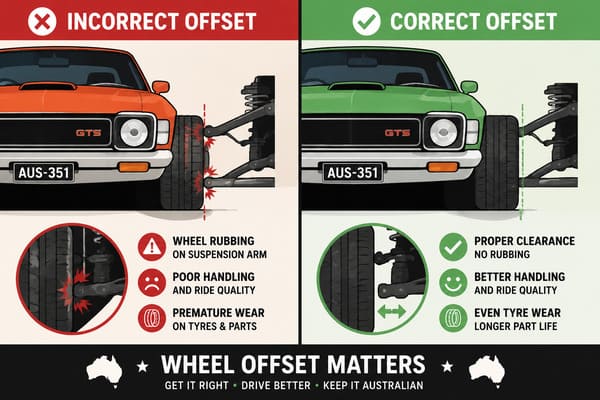
I once received an inquiry from a shop owner in Australia. He had already bought a set of aftermarket wheels for a customer’s XY GT — 17×8, ET+30 — without checking the offset first. When they mounted the wheels, the front tyres were rubbing the inner suspension arm at full lock. The rear was sitting awkwardly close to the diff housing. The wheels had to come off immediately.
Why ET+30 Failed on That 17×8 Setup
The shop owner lost the cost of tyres, mounting, and balancing — roughly AUD $600 in wasted labor and materials — before the wheels even touched the road properly. The root cause was simple: ET+30 pushed the wheel too far inward for a car with XY GT suspension geometry.
| Wheel Size | Wrong Offset Used | Correct Offset Range | Result |
|---|---|---|---|
| 17×8 | ET+30 | ET+10 to ET+15 | Rubbing on suspension arm and diff housing |
| 17×9 (rear) | ET+13 (factory ref) | ET-10 | Inner guard and diff clearance failure |
| 17×7.5 (front) | ET+25 | ET+5 | Contact with inner suspension components |
The XY GT was engineered around a 14×6 wheel at ET+13. When you move to a wider wheel, the barrel geometry changes completely. A wider wheel at the same offset places more of the tyre inward, directly into the path of suspension components. For a classic car with original suspension and tight guard tolerances, even a 15mm offset error can make a fitment completely unusable. This is why I ask every customer for their suspension setup, guard condition, and wheel width before I confirm any offset specification.
What Offset Are Ford Factory Wheels?
Many customers come to me with the factory offset number in hand, assuming it is the right starting point for any wheel upgrade. It is not — and that misunderstanding causes most of the fitment problems I see.
Ford Australia fitted the XY GT with 14×6 inch steel wheels at approximately ET+13mm offset. The bolt pattern is 5×114.3mm4 and the hub bore is 70.5mm5. These factory numbers only apply to the original 14×6 wheel size and 185/70R14 tyre fitment6.
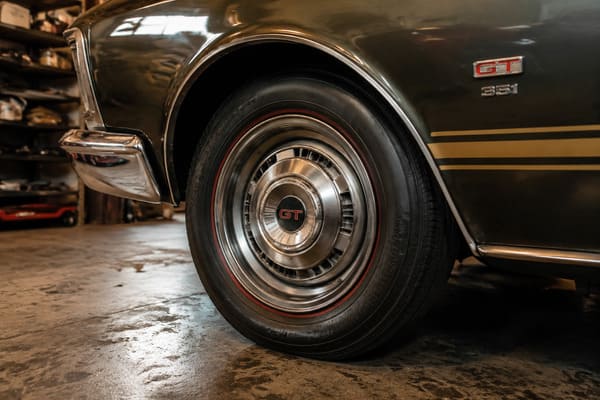
The issue I see most often is customers using these factory numbers as a direct reference when moving to a much wider aftermarket wheel. A 14×6 at ET+13 and a 17×9 at ET+13 do not produce the same fitment. The wider barrel changes the inner and outer clearance entirely.
How Barrel Width Changes Everything
I explain it to every customer the same way: every 1 inch of extra wheel width adds approximately 12.7mm to the barrel7. Here is what that looks like in practice:
| Factory Width | Upgraded Width | Width Increase | Extra Barrel to Account For |
|---|---|---|---|
| 6 inch | 7 inch | +1 inch | +12.7mm |
| 6 inch | 8 inch | +2 inch | +25.4mm |
| 6 inch | 9 inch | +3 inch | +38.1mm |
If you go from a 6-inch wide wheel to a 9-inch wide wheel and keep the same ET+13 offset, you are adding 38mm of extra barrel that has nowhere to go except into your suspension and inner guard. That extra barrel pushes inward unless you reduce the offset — or in some cases, go negative. I had a customer last year ordering a set of three-piece forged wheels for his XY GT restoration. He wanted a 17×9 rear and 17×7.5 front setup. We worked through the offset calculation together. The rear ended up at ET-10 and the front at ET+5. The fitment was clean, with 8mm clearance on the inner guard and 12mm on the outer. Those numbers came from proper calculation, not from copying the factory spec sheet.
How Do You Measure Wheel Offset on a Ford Falcon XY GT?
Most customers assume offset measurement requires specialist tools or a workshop. It does not. You can do it yourself in under five minutes with a tape measure and a flat floor.
To measure wheel offset, place the wheel face-down on a flat surface. Measure the total barrel width in millimeters and divide by two to find the centerline. Measure from the back of the mounting face to the centerline.8 If the mounting face is toward the street side of center, the offset is positive. If it is toward the brake side, the offset is negative.
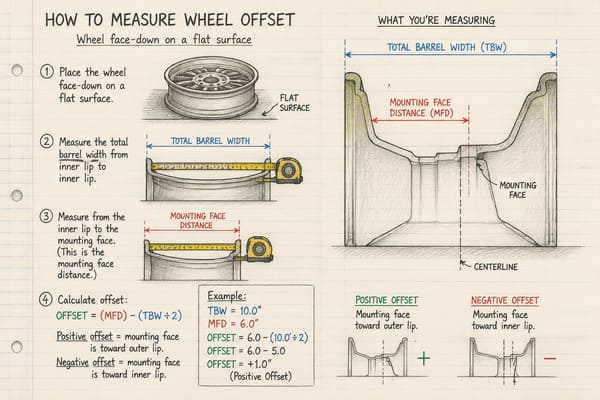
Here is exactly how I walk customers through the process step by step.
Step-by-Step Offset Measurement
Step 1: Place the wheel face-down on a flat, hard floor. Make sure the wheel is stable and not rocking.
Step 2: Measure the total barrel width from the outer lip to the inner lip. For an 8-inch wheel, this is approximately 203mm. Write this number down.
Step 3: Divide the total barrel width by two. For 203mm, the centerline is at 101.5mm.
Step 4: Measure from the back of the mounting face — the flat surface that contacts the hub — to the true centerline of the barrel.
Step 5: Compare the two numbers. If the mounting face measurement is greater than the centerline measurement, the offset is positive. If it is less, the offset is negative.
| Measurement | Example Value | What It Means |
|---|---|---|
| Total barrel width | 203mm (8 inch) | Full width of the wheel |
| Centerline | 101.5mm | Midpoint of the barrel |
| Mounting face to centerline | 111.5mm | Mounting face is 10mm toward street side |
| Calculated offset | ET+10 | Positive offset confirmed |
I had a customer measure his old wheels this way and discovered the previous owner had installed ET+25 wheels on a car set up for ET+10. That 15mm difference had been slowly wearing out his wheel bearings for two years. He had already replaced the bearings twice without knowing the root cause. One measurement, five minutes, and a tape measure gave him the answer that two mechanics had missed.
Is a 5mm Offset Difference OK?
This is one of the most common questions I receive. The short answer is: it depends on the car. For an XY GT, 5mm is not always a small number.
For a Ford Falcon XY GT with original suspension and stock guards, a 5mm offset difference can use up 25% to 33% of the total available tyre-to-guard clearance. On a car with only 15 to 20mm of clearance at full suspension travel, this margin is not a safe tolerance — it is the entire safety margin.
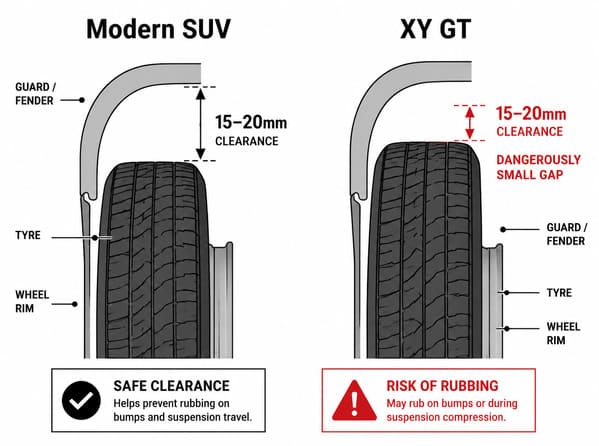
For most modern SUVs or sedans, a 5mm offset difference is generally fine. The guard clearances are generous, and the suspension geometry has enough tolerance to absorb minor variation.9 But the XY GT is a different situation.
Why 5mm Matters More on a Classic Car
The original guard clearance on a stock XY GT is tight — often only 15 to 20mm between the tyre sidewall and the inner guard lip at full suspension travel. Here is what a 5mm error actually represents in that context:
| Total Guard Clearance | Offset Error | Clearance Consumed | Risk Level |
|---|---|---|---|
| 20mm | 5mm | 25% | Moderate — borderline at full travel |
| 15mm | 5mm | 33% | High — contact likely on rough roads |
| 10mm | 5mm | 50% | Critical — contact almost certain |
I had a customer order a front wheel set at ET+20 when the correct specification was ET+15. At normal driving speeds on a smooth road, it looked fine. But during a hard left turn on a bumpy road, the tyre contacted the guard twice and left scuff marks on the inner lip. We remade the wheels at ET+15 and the problem was gone completely. Our production tolerance at Tree Wheels is ±1mm, precisely because 5mm is not always "just 5mm." On a classic car like the XY GT, it can be the difference between a clean fitment and a damaged guard.
Conclusion
Offset is not a minor detail on a Ford Falcon XY GT. It is the number that determines whether your wheels fit safely or fail completely. Get the calculation right before you order. Tree Wheels produces custom forged wheels with ±1mm tolerance — built to your exact specification, every time.
-
"Ford XY Falcon GT – Wikipedia", https://en.wikipedia.org/wiki/Ford_XY_Falcon_GT. Ford Falcon XY GT factory service documentation specifies the original wheel fitment as 14×6 inch steel wheels with a 5×114.3mm bolt pattern and approximately ET+13mm offset, as recorded in period workshop manuals and marque registries. Evidence role: definition; source type: other. Supports: The original factory wheel dimensions and offset for the Ford Falcon XY GT as issued by Ford Australia. Scope note: Factory specifications may vary by trim level or production year; a primary source such as the Ford Australia workshop manual or a recognised XY GT registry should be consulted to confirm exact figures. ↩
-
"Can a rim’s offset be changed? – Facebook", https://www.facebook.com/groups/cocarsandcoffee/posts/8287912464559109/. In forged wheel manufacturing, the offset is established during the forging and machining stages; once the mounting face is machined to a specific depth, the structural integrity of the forging means the offset cannot be repositioned without remanufacturing the wheel from a new blank. Evidence role: mechanism; source type: research. Supports: That the offset of a forged wheel is determined during the manufacturing process and cannot be altered post-production. Scope note: Wheel spacers and hub-centric adapters can effectively alter the functional offset of a finished wheel, though these are distinct from changing the wheel’s manufactured offset and introduce their own engineering considerations. ↩
-
"Scrub radius – Wikipedia", https://en.wikipedia.org/wiki/Scrub_radius. Automotive engineering literature establishes that wheel offset determines the scrub radius and the moment arm of lateral forces acting on the wheel hub; an offset that deviates significantly from the design specification increases bending loads on the wheel bearing, accelerating fatigue and wear. Evidence role: mechanism; source type: paper. Supports: The mechanical mechanism by which incorrect wheel offset increases lateral loading on wheel bearings, leading to premature wear. Scope note: The severity of bearing wear depends on the magnitude of the offset error, vehicle weight, and driving conditions; the article’s claim is directionally supported but the rate of wear is not quantified. ↩
-
"Ford Falcon (XY) – Wikipedia", https://en.wikipedia.org/wiki/Ford_Falcon_(XY). The Ford Falcon XY GT is consistently listed in automotive fitment references and wheel compatibility databases as using a 5×114.3mm (5×4.5 inch) bolt pattern, a specification shared across several Ford Australia models of the same era. Evidence role: definition; source type: other. Supports: The wheel bolt pattern (PCD) of the Ford Falcon XY GT as a factory specification. Scope note: Fitment database entries should be cross-referenced with the vehicle’s original workshop manual or a physical measurement, as data entry errors in third-party databases are possible. ↩
-
"Ford Falcon (XY) – Wikipedia", https://en.wikipedia.org/wiki/Ford_Falcon_(XY). The Ford Falcon XY GT hub bore is cited in fitment databases and marque-specific technical references as 70.5mm, a dimension critical for ensuring centrebore compatibility with aftermarket wheels. Evidence role: definition; source type: other. Supports: The hub bore diameter of the Ford Falcon XY GT as a factory specification. Scope note: Hub bore figures sourced from aftermarket fitment databases may reflect nominal rather than precisely measured values; verification against OEM documentation is advisable. ↩
-
"Ford Falcon (XY) – Wikipedia", https://en.wikipedia.org/wiki/Ford_Falcon_(XY). Period Ford Australia documentation and marque registries record the Ford Falcon XY GT as being factory-fitted with 185/70R14 tyres, a size that corresponds to the original 14×6 inch steel wheel specification. Evidence role: historical_context; source type: other. Supports: The original equipment tyre size fitted to the Ford Falcon XY GT by Ford Australia. Scope note: Tyre specifications may have varied across XY GT variants and model years; the GT HO and standard GT may have differed, and a factory build sheet or workshop manual should be consulted for variant-specific confirmation. ↩
-
"Wheel Offset and backspacing calculator – 1010Tires.com", https://www.1010tires.com/Tools/Wheel-Offset-Calculator?srsltid=AfmBOoqsazPhuwEIiB0F9MqXyKymxaEntayAPLOnDK0npmVifhph1hDc. The relationship between wheel width and barrel geometry follows directly from unit conversion: one inch equals 25.4mm, so each additional inch of wheel width increases total barrel depth by 25.4mm, adding approximately 12.7mm to each side of the centreline — a principle underlying standard wheel offset and backspacing calculations. Evidence role: mechanism; source type: education. Supports: The geometric relationship between wheel width in inches and barrel dimension in millimetres, and how this affects offset calculation. Scope note: This figure describes total barrel width change, not the distribution of that change between inner and outer barrel, which varies by wheel design. ↩
-
"How to measure your Wheel Offset / ET accurately – YouTube", https://www.youtube.com/watch?v=L19eoOX58R4. Wheel offset is defined by automotive standards bodies as the distance from the wheel’s centreline to the hub mounting face; the measurement procedure described — dividing total barrel width by two to establish the centreline, then measuring from the mounting face — is consistent with this definition and is the basis for offset values stamped on OEM and aftermarket wheels. Evidence role: definition; source type: institution. Supports: The standard definition of wheel offset and the geometric measurement method used to determine it. Scope note: DIY measurement accuracy depends on the flatness of the surface used and the precision of the measuring instrument; professional measurement with a dedicated offset gauge will yield more reliable results. ↩
-
"Wheel Offset Explained: Fitment, Handling & Clearance Guide", https://www.prioritytire.com/blog/wheel-offset-explained?srsltid=AfmBOorYXYiL_Qmux5Q-KqN2xQP4a8ogy4GmfWx1cewWu0lZ9oiIqHj2. Modern vehicle design standards and aftermarket fitment guidelines generally acknowledge that contemporary passenger cars and SUVs incorporate larger wheel arch clearances and more compliant suspension geometry than vehicles designed in the 1970s, providing greater tolerance for minor offset variation. Evidence role: general_support; source type: institution. Supports: That modern passenger vehicles are designed with greater wheel arch clearance tolerances than classic vehicles, making small offset variations less consequential. Scope note: No universal industry standard defines an acceptable offset tolerance range; the claim reflects general practitioner consensus rather than a codified specification. ↩