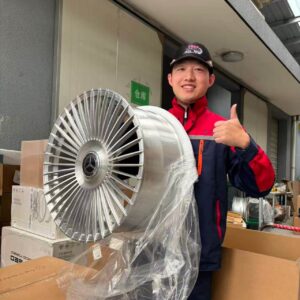

We had a customer — a shop owner from the United States — who placed his first order with us and asked us to apply ceramic coating to the wheels before shipping. During the pre-application surface inspection, we found that two of the wheels still had grease residue on the polished layer. The adhesion test failed. If we had applied the coating directly, it would have started to bubble and peel within three months. We reworked the entire pre-treatment process. It took one extra day. Six months later, when we followed up with the customer, the coating was still in perfect condition.
Ceramic coating application involves at least five steps: cleaning, degreasing, polishing, primer application, and curing. Every step is required. Skipping any one of them causes the steps that follow to fail. There are no shortcuts in this process.
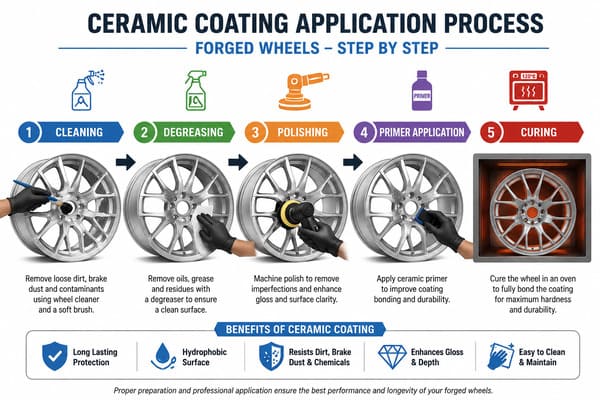
The application process is only half the story. The other half is knowing whether the coating is right for your wheels, what its real limitations are, how long it will actually last, and what it should cost. Each of these questions has a different answer depending on who is doing the work and how it is done. I will go through each one.
Is It Worth Getting Ceramic Coating on Wheels?
I get this question from customers often. My answer is always the same: start by looking at what your wheels are worth. If the number is low, the math does not work.
Ceramic coating is worth it when the wheel itself has real value. For forged wheels priced between $1,500 and $5,000 per set1, the coating adds protection at roughly 5% to 10% of the wheel’s cost. That is a reasonable investment. For a $200 cast wheel set, it is not.
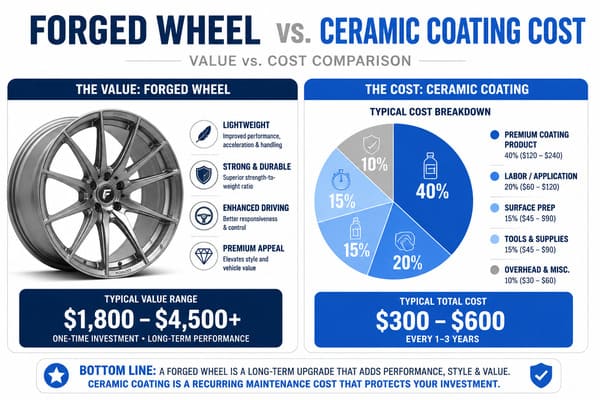
I have seen customers spend $150 on ceramic coating for a set of wheels that cost $200. I cannot support that logic. The coating does not increase the value of the wheel underneath it. It only protects what is already there. If what is already there is not worth protecting, the coating is wasted money.
The forged wheels we produce at Tree Wheels are priced based on size, design, and surface finish2. The table below gives a rough breakdown of how coating cost compares to wheel value across our typical order range.
| Wheel Set Price | Estimated Coating Cost | Coating as % of Wheel Cost |
|---|---|---|
| $1,500 | $75–$150 | 5%–10% |
| $3,000 | $150–$300 | 5%–10% |
| $5,000 | $250–$500 | 5%–10% |
The percentage stays consistent. What changes is the absolute number. For a B2B customer running a modification shop, this number matters because it affects how you price the final package to your end customer. We always give our wholesale clients a clear breakdown so they can explain the value of the coating without guessing. The coating is a finishing layer. It is not a substitute for quality in the wheel itself. Spend your money on the wheel first. The coating comes after.
What Is the Downside of Ceramic Coating?
The downside that most people miss is this: ceramic coating is very sensitive to the type of surface finish underneath it. The wrong coating product on the wrong finish causes visible problems that cannot be fixed without stripping and redoing the entire application.
The two main categories of ceramic coating — high-gloss and matte — behave very differently on different surfaces. Applying a high-gloss formula to a matte brushed finish will eliminate the matte effect entirely. Many application shops do not distinguish between the two product types.
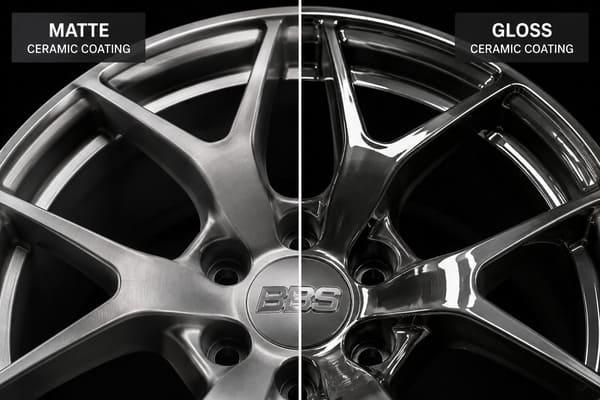
We had a customer who ordered a batch of matte brushed forged wheels from us. He found a local shop to apply the ceramic coating after delivery. When the job was done, the matte visual effect was completely gone. The surface looked semi-gloss. The customer was unhappy. But this was not a defect in the wheel or in the coating product itself. It was the wrong product type used for the surface.
Beyond finish compatibility, there is another limitation that rarely gets mentioned in sales conversations. Ceramic coating, once cured, reaches a hardness of 9H. That sounds like a strong selling point. It is also a real structural limitation.
| Property | What It Means in Practice |
|---|---|
| 9H hardness | Excellent scratch resistance on flat surfaces |
| Zero flexibility | Cannot bend or absorb vibration without stress |
| Micro-cracking | Edge cracking after 1–2 years of road use is normal |
| Surface sensitivity | Wrong prep or wrong product type causes visible failure |
Wheels absorb constant vibration during driving. A coating that cannot flex will eventually develop micro-cracks at its edges. This is a normal outcome after one to two years of use. It is not a product defect. But it is something a customer should know before they pay for the service. We tell our clients this directly. Most application shops do not.
How Long Does Ceramic Coating on Rims Last?
The application environment controls the outcome more than any other single factor. Temperature and humidity during the curing stage determine whether the coating bonds correctly at the molecular level. If the environment is wrong, the coating fails early — and the failure often looks like yellowing, flaking, or loss of gloss.
Ceramic coating applied in a controlled environment — 20 to 25 degrees Celsius, 50% to 60% relative humidity — can last three to five years3. The same product applied in an uncontrolled setting, such as an outdoor shop or a warm garage, typically shows visible aging within one to two years.
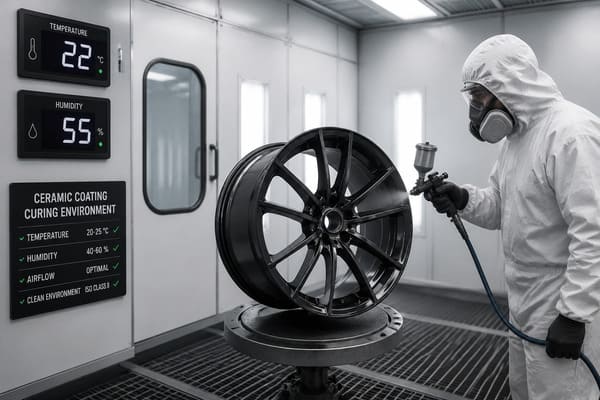
Our production facility maintains a dedicated spray booth with year-round temperature and humidity control. This is not for aesthetics. It is because the curing reaction for ceramic coatings is chemically sensitive to both variables4. A deviation of even five degrees during curing can create internal stress in the coating layer that becomes visible months later.
I had a customer in Australia who had a local shop reapply ceramic coating to a set of wheels we had supplied. Eight months later, he contacted us to report that the coating had turned yellow. After reviewing the details, we found that the shop had done the application on a day when the outdoor temperature exceeded 35 degrees Celsius. The coating had developed internal stress during the curing stage before it ever dried.
| Application Environment | Expected Coating Lifespan |
|---|---|
| Controlled booth (20–25°C, 50–60% RH) | 3–5 years |
| Standard indoor shop (uncontrolled) | 1–2 years |
| Outdoor or high-temperature setting | Under 1 year |
The environment accounts for more than 50% of how long the coating will last. The product brand matters. The application skill matters. But if the environment is wrong, neither of those things can save the result. When customers ask us about coating longevity, this is the first question we ask them back: where was it applied, and what were the conditions?
How Much Does Ceramic Wheel Polishing Cost?
The price of ceramic coating on wheels is often quoted as a single number. That single number hides what you are actually paying for — or not paying for. The correct way to read a coating quote is to separate the pre-treatment cost from the coating material cost.
Ceramic coating for wheels typically breaks down into two cost components: pre-treatment (polishing, degreasing, and primer) and the coating layer itself. Pre-treatment accounts for 40% to 60% of the total cost. Quotes that omit pre-treatment steps are not comparable to full-service quotes.
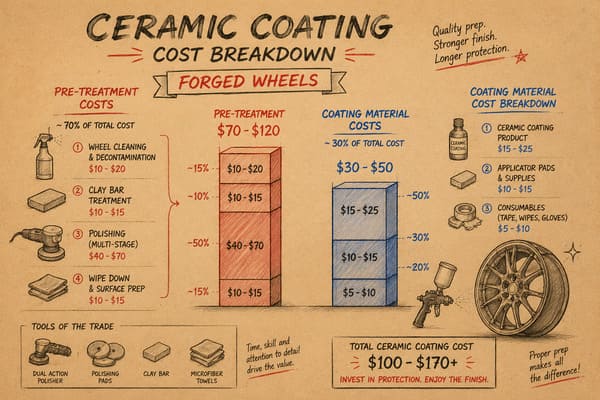
I have reviewed low-price coating quotes from the market. When I look at the line items, the pre-treatment is either missing entirely or listed as a single cleaning step. That is not pre-treatment. That is washing. A coating applied over a surface that has not been properly degreased, polished, and primed will fail the adhesion test within six months. The low price reflects the missing work, not a better deal.
Our MOQ is four wheels — one complete set for a single vehicle. This means the coating cost is spread across four wheels, which keeps the per-wheel cost manageable.
| Wheel Size / Finish Type | Estimated Coating Cost Per Wheel | Full Set (4 Wheels) |
|---|---|---|
| Standard size, solid color | $50–$80 | $200–$320 |
| Large size, brushed or matte | $100–$150 | $400–$600 |
| Custom multi-finish | $120–$150+ | $480–$600+ |
For B2B customers — modification shops, customization centers, and luxury car service providers — we provide a full cost breakdown in writing. This gives shop owners a clear number to work with when they explain the coating premium to their end customers. The goal is not to hide the cost. The goal is to make sure the customer understands what they are paying for and why each step in the process has a price attached to it.
Conclusion
Ceramic coating protects wheel finishes when it is applied correctly, on the right surface, in the right environment, with full pre-treatment included. The process cannot be shortened.
Tree Wheels supplies forged wheels with factory-applied ceramic coating — built on 20+ years of manufacturing experience, shipped directly to your door.
-
"How Much Do Wheels Cost in the US? 2026 Price Guide | LFI Wheels", https://lf-ind.com/blogs/news/us-forged-wheel-prices-custom-wheels-guide?srsltid=AfmBOoq_hBPWgR1VR19J63eF8OQx3F5zIHWOL-gyjDoCGB6hm9kAl3mO. Automotive aftermarket pricing data indicates that forged aluminum wheels, due to their manufacturing complexity and material properties, are priced substantially above cast equivalents, with performance and luxury-segment sets commonly retailing in the range of several hundred to several thousand dollars per wheel. Evidence role: statistic; source type: other. Supports: That aftermarket forged aluminum wheels command significantly higher prices than cast wheels, with premium sets falling in the multi-thousand-dollar range per set. Scope note: Pricing varies widely by brand, size, design, and market region; the $1,500–$5,000 range cited reflects the author’s product line and may not represent the full market distribution. ↩
-
"Top 5 Questions About Forged Wheels – 3030 Autosport", https://3030autosport.com/3030-custom-wheels-blog/top-5-questions-about-forged-wheels-3ac193/. Manufacturing cost analysis for forged aluminum components identifies raw material volume, die and tooling amortization, machining complexity, and surface finishing as the principal cost drivers; larger, more complex designs with premium surface treatments require greater material input and processing time, directly influencing unit price. Evidence role: general_support; source type: research. Supports: That forged aluminum wheel pricing reflects manufacturing inputs including material volume (size-dependent), tooling and design complexity, and post-machining surface finishing operations. Scope note: This cost structure is derived from general forged component manufacturing literature; specific pricing models for aftermarket forged wheels may incorporate additional factors such as brand positioning and market segmentation not captured in production cost analyses. ↩
-
"Development of Car Coating Materials over the Past Decade for …", https://pmc.ncbi.nlm.nih.gov/articles/PMC12694507/. Coating science literature establishes that sol-gel and silica-based coatings are sensitive to ambient temperature and relative humidity during cure, as these variables govern condensation reactions and network formation that determine final film integrity and service life. Evidence role: mechanism; source type: paper. Supports: That curing temperature and ambient humidity significantly affect the crosslinking and adhesion quality of ceramic or polymer-based coatings, influencing long-term durability. Scope note: The specific three-to-five-year lifespan figure is not independently verified in the cited literature; it represents a manufacturer estimate that would require controlled field testing to confirm. ↩
-
"General Properties and Specific Characteristics for Solar Cell … – PMC", https://pmc.ncbi.nlm.nih.gov/articles/PMC10253744/. Sol-gel chemistry literature describes the hydrolysis and polycondensation of alkoxysilane precursors as temperature- and humidity-dependent reactions; deviations from optimal conditions alter network density, porosity, and adhesion of the resulting silica film. Evidence role: mechanism; source type: paper. Supports: That sol-gel derived ceramic coatings cure through hydrolysis and condensation reactions that are rate-dependent on temperature and moisture availability. Scope note: The specific sensitivity thresholds cited in the article (e.g., five-degree deviation) are not directly sourced from published chemistry data and may reflect practical manufacturing experience rather than controlled experimental findings. ↩