

78.1mm shows up everywhere online as "the GTO hub bore." But that single number has already caused one of our customers a costly mistake — wrong wheels, wrong fit, wasted time.
78.1mm is only correct for classic-era GTOs from the 1960s and early 1970s.1 The 2004–2006 GTO uses a 70.3mm hub bore, not 78.1mm.2 The GTO name was used across three completely different platforms over three decades3, and each platform has its own specs.
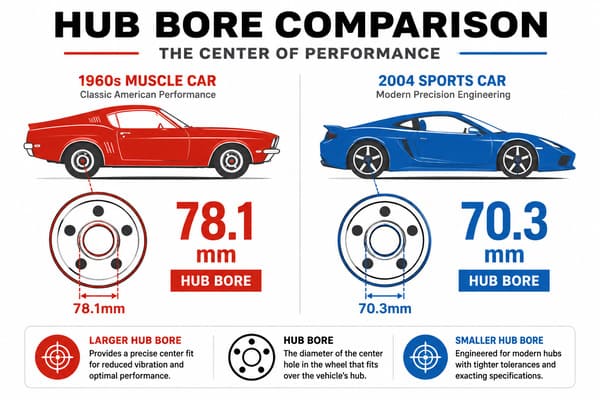
Last month, a customer ordered a set of forged wheels from us for a 2005 GTO. He used 78.1mm as the hub bore — a number he pulled from a forum. The wheels arrived and they were wrong by nearly 8mm. That mistake cost him extra time and a hub ring order on top of the wheel cost. As a wheel manufacturer, hub bore is one of the three numbers we always verify before we start machining. The other two are bolt pattern and offset. If even one of those numbers is wrong, the wheel either will not fit or will not be safe to drive. This article breaks down the correct specs for each GTO generation so you do not make the same mistake.
What Is the Bolt Pattern on a 1966 GTO?
If you are restoring a classic GTO, getting the bolt pattern wrong means your new wheels will not mount at all. This is not a small error — it is a complete non-starter.
The 1966 Pontiac GTO uses a 5×4.75 inch bolt pattern, which converts to 5×120.65mm.4 The hub bore is 78.1mm.5 These are the standard GM muscle car specs shared by the Camaro, Chevelle, and Nova from the mid-1960s through the late 1970s.6
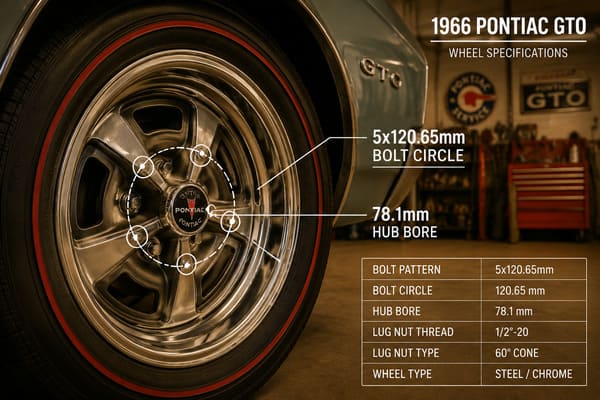
I had a customer last year who was restoring a 1966 GTO. He wanted a set of three-piece forged wheels that looked vintage but weighed under 20 lbs per corner. His original cast wheels were over 28 lbs each. We built him a set of three-piece forged wheels at 18.5 lbs each, using the correct 5×120.65mm bolt pattern and a 78.1mm hub bore. He told me the car felt completely different on the highway — less vibration, sharper steering response. The weight saving alone was nearly 40 lbs across all four corners. That is the real-world difference that correct specs and proper forging make together.
Classic GTO Wheel Specs at a Glance
| Spec | Value |
|---|---|
| Bolt Pattern | 5×4.75 in (5×120.65mm) |
| Hub Bore | 78.1mm |
| Platform | GM A-Body (rear-wheel drive) |
| Years | 1964–1974 |
| Shared With | Camaro, Chevelle, Nova, Firebird |
The 5×120.65mm bolt pattern was GM’s go-to spec for nearly every rear-wheel-drive performance car it built during this era. If you are ordering forged wheels for a classic GTO and a supplier quotes you 5×120mm instead of 5×120.65mm, that is a red flag. Those two patterns look almost identical on paper, but the 0.65mm difference means the bolts will not seat flush.7 On a performance build, that is a safety issue, not just a fit issue. When we machine wheels for classic GM applications, we always confirm whether the customer needs 5×120mm or 5×120.65mm before we touch the CNC. One phone call or one email at the start of the order prevents a full remachine later.
What Is the Bolt Pattern on a 2005 GTO Wheel?
Many people assume the 2005 GTO follows the same specs as the 1960s models because they share the same name. That assumption leads to the exact mistake I described at the start of this article.
The 2004–2006 Pontiac GTO uses a 5×120mm bolt pattern and a 70.3mm hub bore.8 This is not an American GM spec. The 2004–2006 GTO was built in Australia on the Holden Monaro platform9 and follows metric Australian and European standards.
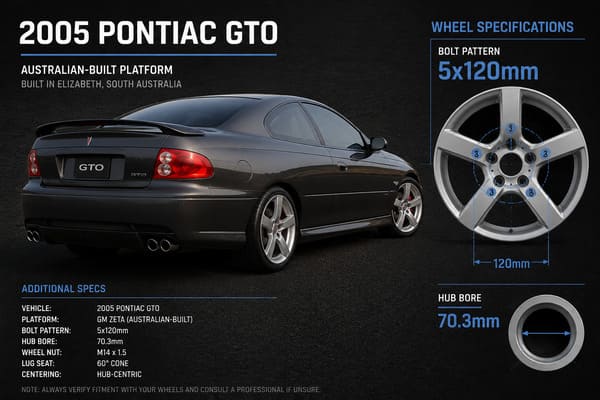
GM shipped the Holden Monaro to the United States as a rebadged GTO starting in 2004. Because the platform was Australian, the specs follow Australian and European metric standards, not classic American GM dimensions. I have seen customers try to fit 1960s-pattern wheels onto a 2005 GTO and vice versa, and neither works cleanly.
2005 GTO vs. 1966 GTO Wheel Specs Compared
| Spec | 1966 GTO | 2005 GTO |
|---|---|---|
| Bolt Pattern | 5×120.65mm | 5×120mm |
| Hub Bore | 78.1mm | 70.3mm |
| Platform | GM A-Body (USA) | Holden Monaro (Australia) |
| Drive Type | Rear-wheel drive | Rear-wheel drive |
| Origin | USA | Australia |
That 0.65mm difference between 5×120mm and 5×120.65mm sounds tiny. But it matters — bolts will not seat flush if you mix them up. When we get an order for a 2005 GTO, we enter 70.3mm into our CNC program, not 78.1mm. If a customer gives us the wrong number and we have already started machining, that is a remachining cost and a delay of at least 3 to 5 business days. Getting the hub bore right at the start saves everyone time and money. This is exactly why we always ask customers to confirm their model year and platform before we begin production — not because we doubt them, but because the GTO name alone is not enough information.
What Is the Bolt Pattern on a 2007 Pontiac GTO?
This question comes up more often than I expect. It usually comes from someone who saw a forum post or an online listing that had the year wrong.
There is no 2007 Pontiac GTO. GM ended GTO production after the 2006 model year.10 If you are looking for wheel specs for a "2007 GTO," the vehicle is most likely a 2005 or 2006 model. Use the 5×120mm bolt pattern and 70.3mm hub bore.
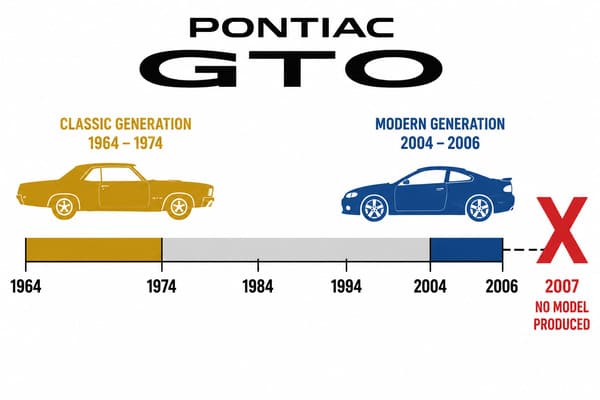
GTO sales dropped from around 13,000 units in 2004 to under 5,000 in 2006.11 GM pulled the plug after that. There were internal discussions and a few concept sketches that circulated online, but nothing was ever built or sold to the public.
Pontiac GTO Production Years and Specs by Generation
| Generation | Years | Bolt Pattern | Hub Bore | Platform |
|---|---|---|---|---|
| Classic GTO | 1964–1974 | 5×120.65mm | 78.1mm | GM A-Body (USA) |
| Modern GTO | 2004–2006 | 5×120mm | 70.3mm | Holden Monaro (Australia) |
| 2007 GTO | N/A | — | — | Never produced |
I get this question maybe once or twice a month. Every time, I ask the customer to send me a photo of the vehicle and the VIN. Nine times out of ten, it turns out to be a 2005 or 2006 model with a seller or poster who got the year wrong. The remaining cases are people asking about a concept that was never produced. As a supplier, I never quote specs for a vehicle I cannot verify. One wrong number can cause a full wheel set to be unusable. If you are unsure about your model year, the fastest way to confirm it is to check the VIN plate on the driver’s side door jamb. The 10th character of the VIN tells you the model year.12 For a 2005 GTO, that character is a "5." For a 2006, it is a "6." There is no "7" in any GTO VIN because no 2007 GTO was ever made.
How Do You Measure Hub Bore Size at Home?
Ordering forged wheels with the wrong hub bore is one of the most common and most avoidable mistakes we see. The good news is that you can confirm your hub bore at home in under five minutes.
Use a digital vernier caliper to measure the inner diameter of the center hole on your existing OEM wheel. Expand the outer jaws until they contact both sides of the bore firmly, then read the measurement. Do this three times and take the average. Most people get within 0.2mm of the real spec.
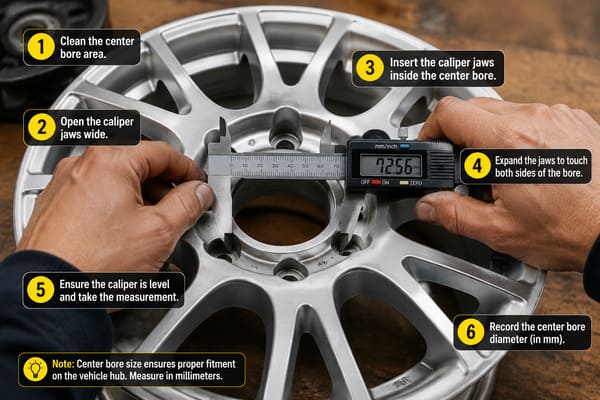
A decent digital caliper costs between $15 and $30 online. That is the most reliable tool for this job when you are working at home without workshop equipment.
Step-by-Step Hub Bore Measurement Guide
| Step | Action | Notes |
|---|---|---|
| 1 | Get a digital vernier caliper | $15–$30 online, 0.01mm resolution |
| 2 | Locate your OEM wheel | The center hole is what you measure |
| 3 | Place outer jaws inside the bore | Expand until both sides are contacted firmly |
| 4 | Read the measurement | Record the number |
| 5 | Repeat two more times | Take the average of all three readings |
| 6 | No OEM wheel available? | Measure the outer diameter of the hub flange on the vehicle instead |
If you no longer have your OEM wheel, you can measure the hub flange on the vehicle itself. That is the raised circular ring the wheel sits over. Measure the outer diameter of that ring. That number is your hub bore requirement. I always tell customers to complete this step before contacting us. Here is why: once we start CNC machining a forged wheel, the hub bore is one of the last dimensions we cut. Changing it mid-production adds at least 2 days to the timeline. In some cases, it means starting the piece over entirely. A $20 caliper and 5 minutes of your time can save you a week of waiting and a potential remachining fee. When you send us your specs, include the three individual readings, not just the average. That tells us how consistent your measurement was and helps us decide whether we need to ask for a second check before we begin production.
Conclusion
Hub bore and bolt pattern specs vary by GTO generation. Confirming the right numbers before ordering saves time, money, and frustration for everyone involved.
At Tree Wheels, we verify every spec before machining — because one wrong number should never ruin a perfect build.
-
"Service & Repair Manuals for 1966 Pontiac GTO for sale | eBay", https://www.ebay.com/b/Service-Repair-Manuals-for-1966-Pontiac-GTO/183721/bn_7062776035. A factory specification sheet or service manual should substantiate the classic GTO center-bore figure and distinguish it from later GTO applications; if the source covers only selected model years, it supports the claim only for those years. Evidence role: general_support; source type: other. Supports: Classic-era Pontiac GTO hub bore is 78.1mm, while that figure should not be applied to every GTO generation.. Scope note: The evidence may need to be year-specific because classic GTO wheel specifications can vary by wheel option and model year. ↩
-
"2004-2006 Pontiac GTO Service Manual – Free! – Mark Quitter Racing", https://markquitterracing.com/freeservicemanual/. A 2004–2006 Pontiac GTO service manual or wheel specification reference should support the 70.3 mm center-bore value and show that it differs from the classic 78.1 mm figure. Evidence role: general_support; source type: other. Supports: The 2004–2006 Pontiac GTO uses a 70.3mm hub bore rather than 78.1mm.. Scope note: The source should be checked for whether it reports hub bore for OEM wheels, vehicle hubs, or aftermarket fitment data. ↩
-
"Pontiac (automobile) – Wikipedia", https://en.wikipedia.org/wiki/Pontiac_(automobile). A historical reference on Pontiac GTO production should document the model’s use on multiple GM platforms across its 1960s–1970s and 2000s production periods; this supports the platform-history context rather than proving any individual wheel measurement. Evidence role: historical_context; source type: encyclopedia. Supports: The Pontiac GTO name appeared on different vehicle platforms across separate production eras.. Scope note: This supports the model-platform history, not the precise hub-bore or bolt-pattern specifications. ↩
-
"1966 GTO Service Manuals", https://www.opgi.com/gto/1966/books/service-manuals?srsltid=AfmBOoood97qGc7HZ36tweuYTbvujrPvs5qsMzffTFxEH3Ap0ng7NyOR. A Pontiac service specification or reliable historical vehicle specification source should verify the 5 × 4.75 inch bolt circle and its metric conversion to 120.65 mm. Evidence role: general_support; source type: other. Supports: The 1966 Pontiac GTO uses a 5×4.75 inch, or 5×120.65mm, bolt pattern.. Scope note: The source should specify the 1966 model year because wheel specifications may differ across GM models and years. ↩
-
"Wheel Spacers, Adapters & Hub Centric Rings for 1966 Pontiac GTO", https://www.ebay.com/b/Wheel-Spacers-Adapters-Hub-Centric-Rings-for-1966-Pontiac-GTO/122154/bn_7061192634. A factory or technical wheel specification source should corroborate the 78.1 mm center-bore value for the relevant classic Pontiac GTO application. Evidence role: general_support; source type: other. Supports: The 1966 Pontiac GTO hub bore is 78.1mm.. Scope note: Because the anchor appears in a 1966 GTO section, the citation should be limited to that year or clearly state the applicable classic-year range. ↩
-
"Which Vehicles Use The 5 x 4.75 Bolt Pattern On Their Wheels?", https://treewheels.com/which-vehicles-use-the-5-x-4-75-bolt-pattern-on-their-wheels/. A comparative GM vehicle specification source should show that several rear-wheel-drive GM performance models of the period used the 5 × 4.75 inch bolt circle; this provides contextual support and may not establish identical hub-bore values for every named model. Evidence role: historical_context; source type: other. Supports: Classic GTO wheel fitment specs were broadly shared with other GM rear-wheel-drive performance cars such as Camaro, Chevelle, and Nova.. Scope note: The source may support the shared bolt pattern more directly than the shared hub bore across all listed models. ↩
-
"Same thread size same but the seat angle and length are different …", https://www.reddit.com/r/AskMechanics/comments/107ued7/same_thread_size_same_but_the_seat_angle_and/. An engineering or wheel-fastener reference should explain that bolt-circle mismatch can prevent proper conical-seat alignment and clamping, supporting the mechanical reason that 5 × 120 mm and 5 × 120.65 mm should not be interchanged. Evidence role: mechanism; source type: paper. Supports: A 0.65mm bolt-circle mismatch can prevent wheel fasteners from seating correctly.. Scope note: The source may discuss bolt-pattern mismatch generally rather than this exact 0.65 mm Pontiac example. ↩
-
"2005 Pontiac GTO Service Repair Manual.pdf – Slideshare", https://www.slideshare.net/slideshow/2005-pontiac-gto-service-repair-manualpdf/260057025. A 2004–2006 Pontiac GTO factory service manual or technical specification source should verify the 5 × 120 mm bolt circle and 70.3 mm center-bore dimensions for the modern GTO. Evidence role: general_support; source type: other. Supports: The 2004–2006 Pontiac GTO uses a 5×120mm bolt pattern and a 70.3mm hub bore.. Scope note: The citation should distinguish vehicle-hub specifications from aftermarket wheel catalog data when possible. ↩
-
"Pontiac GTO – Wikipedia", https://en.wikipedia.org/wiki/Pontiac_GTO. A historical source on the 2004–2006 Pontiac GTO should document that it was based on the Holden Monaro and assembled in Australia, supporting the platform-origin claim. Evidence role: historical_context; source type: encyclopedia. Supports: The 2004–2006 Pontiac GTO was based on the Australian Holden Monaro platform.. Scope note: This supports the vehicle’s origin and platform, not by itself the exact wheel dimensions. ↩
-
"Pontiac GTO – Wikipedia", https://en.wikipedia.org/wiki/Pontiac_GTO. A production-history source should confirm that the revived Pontiac GTO was sold for model years 2004 through 2006 and that no 2007 production model was offered. Evidence role: historical_context; source type: encyclopedia. Supports: Pontiac did not produce a 2007 GTO, and production ended after the 2006 model year.. Scope note: The source may discuss North American sales years rather than all concept or proposed future variants. ↩
-
"Pontiac GTO – Wikipedia", https://en.wikipedia.org/wiki/Pontiac_GTO. An automotive sales database, industry report, or archived GM sales release should provide annual Pontiac GTO sales figures showing the decline from approximately 13,000 units in 2004 to fewer than 5,000 in 2006. Evidence role: statistic; source type: institution. Supports: Pontiac GTO sales declined from about 13,000 units in 2004 to under 5,000 in 2006.. Scope note: Sales figures can differ slightly depending on whether the source reports calendar-year sales, model-year sales, or deliveries. ↩
-
"VIN Decoder | NHTSA", https://www.nhtsa.gov/vin-decoder. A government VIN-decoding reference should explain that the tenth VIN position identifies model year under the standardized 17-character VIN system. Evidence role: definition; source type: government. Supports: The 10th character of a vehicle’s VIN identifies the model year.. Scope note: The model-year code values repeat over long cycles, so the code should be interpreted with vehicle context and production era. ↩