
Most people assume that cutting holes into a wheel makes it weaker. That assumption is wrong — but only under the right conditions. Here is what actually happens.
Weight reduction pockets are precisely machined cavities removed from low-stress zones of a forged wheel. When placed correctly on a properly forged aluminum blank, they can reduce wheel weight by 800g to 1.5kg while still passing TÜV impact testing1. The pocket location, forging quality, and alloy choice determine whether the result is safe or dangerous.
I remember a customer coming to us last year. He runs a modification shop in California, and his first question when he saw our pocketed wheel design was: "Are you sure these holes don’t make the wheel weaker?" That question comes up more than you’d think. The real engineering challenge isn’t cutting the pocket — it’s knowing exactly where not to cut. The sections below break down how we solve that problem on every build we produce.
What Are Weight Reduction Pockets in Forged Wheels?
Two wheels can share an identical spoke design and still differ by 1.4kg. Most customers don’t understand why until they look at the rear face. The difference is almost always in the pockets.
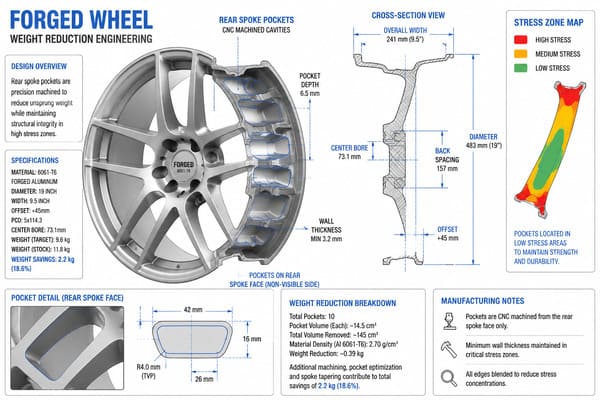
Weight reduction pockets are machined cavities cut into the rear face or spoke underside of a forged wheel after forging is complete2. They are not decorative. Each pocket removes aluminum from a specific low-stress section of the spoke — material that contributes almost nothing to load-bearing3 — while leaving all structural zones untouched.
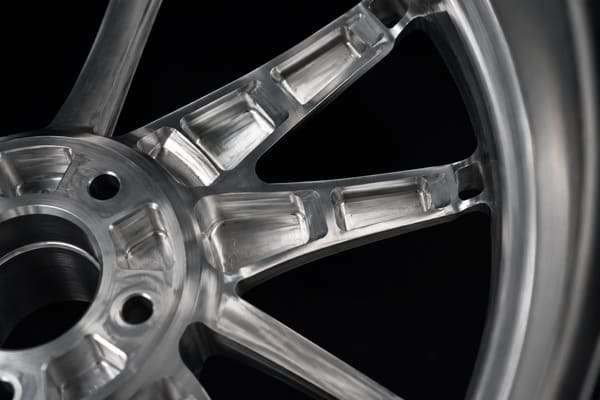
A few months ago, a customer asked me to explain why two wheels with identical spoke designs looked so different in weight — one was 8.2kg and the other was 9.6kg. The answer was entirely in the pockets. The lighter wheel had rear-face pockets machined into the low-stress sections of each spoke, removing approximately 1.4kg of aluminum that contributed almost nothing to load-bearing.
Every pocket has a single purpose: to strip mass from areas that do not handle stress, without touching the material that does. For street driving, this reduces unsprung weight and improves ride response4. For track use, lower rotational mass means faster acceleration and shorter braking distances5.
What separates a safe pocket from a dangerous one is a precise understanding of where stress lives inside a spinning, loaded wheel — and where it does not. To understand that, it helps to look at the forging process first.
Why Pocket Placement Is Not Arbitrary
Not every part of a wheel carries the same load. Stress concentrates at specific points during driving, and those points shift depending on the load condition.
| Wheel Zone | Stress Level | Pocket Allowed? |
|---|---|---|
| Spoke root (hub-to-spoke junction) | Very High | No |
| Hub bore edge | High | No |
| Inner barrel transition | High | No |
| Mid-spoke flat rear face | Low | Yes |
| Outer spoke underside (30%–70% of spoke length) | Low to Moderate | Yes (with calculation) |
| Rim flange area | Moderate | No |
The table above shows why pockets are always placed in the middle sections of spokes — never at the base, never near the rim. A pocket in the wrong zone doesn’t just reduce strength slightly. It can create a crack initiation point that fails under repeated impact loading6. This is why we never place pockets based on visual preference alone. Every cavity starts with an engineering calculation before any CNC program is written.
How Does the Forging Process Preserve Structural Integrity Around Pockets?
A cast wheel and a forged wheel can look identical from the outside. But remove the same amount of material from both, and you get very different results. One holds. One cracks.
The forging process aligns the internal grain structure of the aluminum along the shape of the wheel7 under 10,000 to 15,000 tons of press force8. This grain flow densifies the metal before any machining begins. The result is a blank that can tolerate aggressive pocket depths that would fracture a cast wheel in the same position.
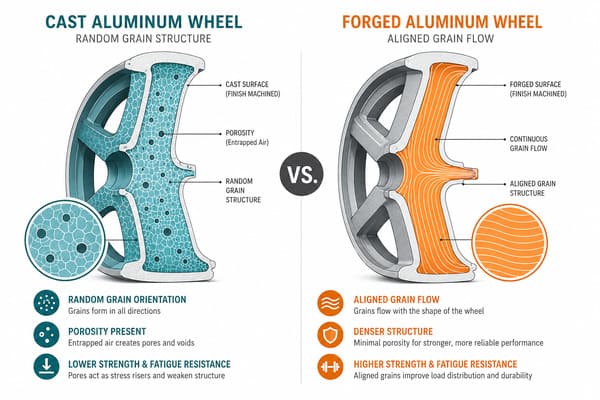
This is where our 20+ years of forging experience becomes directly relevant. When we forge an aluminum blank, the internal grain structure of the metal aligns along the shape of the wheel. This is called grain flow, and it is the fundamental reason forged wheels can tolerate pockets that would crack a cast wheel in the same position.
We had a motorsport client in Australia who needed a three-piece forged wheel at under 7.8kg for a track-only build. To hit that number, we needed aggressive rear-face pockets on the spokes — removing close to 1.8kg of material across the wheel. On a cast wheel, that level of material removal would have left dangerously thin walls around high-stress transition zones. On our forged 6061-T6 blank, the remaining pocket walls — some as thin as 6mm — still passed all required load tests.
The forging had already densified and strengthened the aluminum before the CNC machine ever touched it. The pockets didn’t create weak spots. They revealed how much structural reserve the forging process had built in.
What Grain Flow Actually Does to the Metal
Grain flow is not a marketing term. It describes a measurable physical change in the aluminum’s internal structure.
| Property | Cast Aluminum | Forged Aluminum (Post-Press) |
|---|---|---|
| Internal grain structure | Random, unaligned | Aligned along wheel geometry |
| Porosity (internal voids) | Present | Eliminated under press force |
| Fatigue resistance | Lower | Significantly higher |
| Minimum safe wall thickness around pockets | 10–12mm (typical) | 4–7mm (depending on alloy) |
| Response to impact loading | Brittle fracture risk | Plastic deformation before failure |
The numbers in the table explain why pocket depth limits are so different between cast and forged wheels. A forged blank has already been compressed and aligned. When we machine a pocket into it, the walls that remain are denser and more fatigue-resistant than the original material of a cast wheel9. This is the core reason we can offer aggressive weight savings without compromising the structural safety our customers depend on.
What Role Does Material Selection Play in Pocket Strength?
Choosing the wrong alloy for a pocketed wheel is one of the most common mistakes in custom wheel production. The alloy doesn’t just affect weight — it controls how thin the pocket walls can safely go.
Material choice directly determines how aggressively a wheel can be pocketed. 6061-T6 aluminum, with a tensile strength of around 310 MPa10, is standard for street and luxury builds. 7075-T6, reaching close to 500 MPa11, allows thinner pocket walls — sometimes 4 to 5mm — making it the correct choice for motorsport and maximum weight-reduction applications.
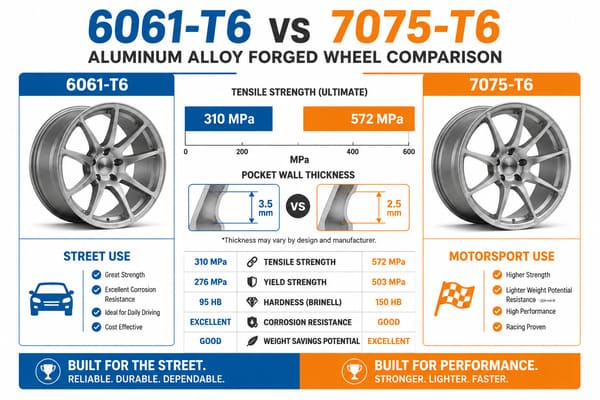
We work primarily with two alloys: 6061-T6 and 7075-T6. For most of our custom street and luxury car builds — the kind that go on high-end vehicles for customers in Dubai or the UK — 6061-T6 is our standard. It has a tensile strength of around 310 MPa after T6 heat treatment, excellent corrosion resistance, and enough toughness to absorb road impacts without cracking. For motorsport and track builds where the customer wants maximum weight reduction, we move to 7075-T6, which reaches tensile strength closer to 500 MPa.
Last year, a racing team contacted us needing wheels that were both lighter than their current set and stronger under lateral cornering loads. By switching their build from 6061-T6 to 7075-T6 and redesigning the pocket geometry, we cut 600g per wheel while actually improving their impact test results. The alloy is not just a material spec — it is the foundation that decides how far we can push pocket design without crossing into risk.
Alloy Comparison for Pocketed Forged Wheels
| Property | 6061-T6 | 7075-T6 |
|---|---|---|
| Tensile Strength | ~310 MPa | ~500 MPa |
| Corrosion Resistance | Excellent | Moderate (needs coating) |
| Minimum Safe Pocket Wall | 6–7mm | 4–5mm |
| Best Application | Street, luxury, daily use | Motorsport, track, max weight reduction |
| Weight Savings Potential | Moderate | High |
| Cost | Lower | Higher |
The choice between these two alloys is not just a technical decision — it is a conversation about how the customer plans to use the wheel. A daily driver in London doesn’t need 7075-T6. A track car running endurance laps in Australia might not be safe without it. We ask these questions before any design work begins, because the alloy selection shapes every pocket dimension that follows.
How Do Engineers Calculate Safe Pocket Depth and Placement?
Pocket design is not based on experience alone. Every dimension we cut into a wheel starts with a simulation, not a guess.
Safe pocket depth and placement are calculated using Finite Element Analysis (FEA)12. Engineers run the wheel model through simulated load scenarios — including radial load at 2.5 times rated capacity, lateral cornering force, and a 13-degree impact test — to generate a stress map. Pockets are placed only in low-stress zones identified by the simulation.
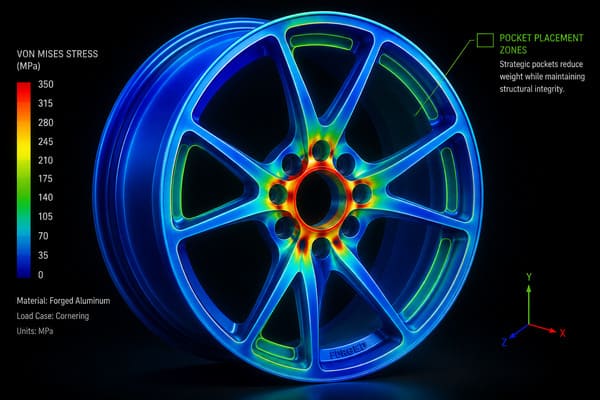
Every pocket in every wheel we produce starts with FEA — Finite Element Analysis. Before any CNC program is written, our engineers run the wheel model through simulated load scenarios: radial load at 2.5 times the wheel’s rated weight capacity, lateral cornering force, a 13-degree impact test at 338kg, and pothole-style shock inputs. The FEA output gives us a color-coded stress map. Red zones are high stress — spoke roots, hub bore edges, the inner barrel transition. These areas are never touched. Green and blue zones are where pockets go.
I remember one project where a customer wanted deeper pockets for aesthetics — he liked the aggressive shadow they created. Our FEA showed that going 2mm deeper than our standard calculation would put one pocket wall into a moderate-stress zone during a simulated pothole impact. We redesigned the pocket shape — wider and shallower instead of narrow and deep — and achieved the same visual effect while keeping every wall inside safe limits. That kind of back-and-forth between design intent and engineering reality is normal for us. It happens on almost every custom build.
FEA Load Scenarios and Pocket Design Parameters
| Test Scenario | Load Input | Purpose |
|---|---|---|
| Radial Load Test | 2.5× rated wheel capacity | Simulates vehicle weight under normal driving |
| Lateral Cornering Force | Side load at rated cornering G | Identifies stress at spoke sides and rim flange |
| 13-Degree Impact Test | 338kg drop weight | Replicates pothole or curb strike |
| Pothole Shock Input | Repeated vertical impact cycles | Tests fatigue resistance of pocket walls |
For a typical 19-inch one-piece forged wheel rated for a 700kg load, the safe pocket zones usually sit on the flat rear face of each spoke, between 30% and 70% of the spoke’s length from hub to rim. Pocket depth is then calculated based on the alloy’s minimum safe wall thickness under peak stress. For 6061-T6, we generally maintain a minimum remaining wall of 6 to 7mm. For 7075-T6, that can go down to 4mm. Every number has a reason. Nothing is cut by eye.
Conclusion
Weight reduction pockets work because of where they go, not just what they remove. Forging quality, alloy choice, and FEA-driven placement are what make the difference between a lighter wheel and a dangerous one. If you are looking for custom forged wheels built with this level of engineering precision, Tree Wheels delivers exactly that — from design sketch to your door.
-
"Numerical simulation on 90° impact test of aluminium alloy wheel …", https://pmc.ncbi.nlm.nih.gov/articles/PMC11549285/. A wheel-testing standard or TÜV documentation can support that wheels are evaluated through prescribed impact tests, while engineering or case-study data would be needed to substantiate the stated 800 g to 1.5 kg mass reduction range. Evidence role: case_reference; source type: institution. Supports: Weight reduction pockets can reduce forged-wheel mass by 800 g to 1.5 kg while still passing TÜV impact testing.. Scope note: The impact-test standard would support the testing framework, but it would not independently verify the article’s specific weight-savings range without product-specific test data. ↩
-
"Forgeline Racing Wheels Exclusively Machined on Haas CNC Mills …", https://www.youtube.com/watch?v=arLp7YMDBp0. A technical source on forged-wheel manufacturing can support that post-forging CNC machining is used to form rear-face or spoke-underside cavities in aluminum wheel blanks. Evidence role: definition; source type: education. Supports: Weight reduction pockets are machined cavities cut into the rear face or spoke underside of a forged wheel after forging is complete.. Scope note: Such a source would define the manufacturing practice generally, not confirm the exact geometry used by the article’s manufacturer. ↩
-
"(PDF) Analysis on Wheel Spoke With Aluminum Composite Materials", https://www.academia.edu/44830604/Analysis_on_Wheel_Spoke_With_Aluminum_Composite_Materials. Finite-element studies of automotive wheels can support that stress is unevenly distributed and that some spoke or rear-face regions carry relatively low stress under specified load cases. Evidence role: mechanism; source type: paper. Supports: Certain material in a forged wheel can be removed from low-stress sections because it contributes little to load-bearing.. Scope note: FEA evidence would support the concept of low-stress regions, but the phrase “almost nothing” is design-specific and should be treated as approximate. ↩
-
"Unsprung mass", https://en.wikipedia.org/wiki/Unsprung_mass. Vehicle-dynamics literature supports that reducing unsprung mass can improve suspension response and wheel control over road inputs, which is consistent with the article’s statement about ride response. Evidence role: expert_consensus; source type: education. Supports: Reducing wheel mass reduces unsprung weight and can improve ride response.. Scope note: The magnitude of improvement depends on suspension design, tire properties, vehicle mass, and road conditions. ↩
-
"Accelerating and braking – Dynamics", https://dynref.engr.illinois.edu/ava.html. Basic rotational dynamics and vehicle-dynamics sources support that reducing rotating inertia lowers the torque or braking work required to change wheel speed, although real acceleration and stopping-distance changes depend on the whole vehicle system. Evidence role: mechanism; source type: education. Supports: Lower wheel rotational mass can contribute to faster acceleration and shorter braking distances.. Scope note: This is a physics-based mechanism, not direct proof that a given pocketed wheel will measurably shorten braking distance in road tests. ↩
-
"Crack propagation analysis and fatigue life assessment of high …", https://pmc.ncbi.nlm.nih.gov/articles/PMC10477241/. Materials-fatigue references support that geometric discontinuities and stress concentrations can initiate cracks that grow under cyclic or repeated impact loading. Evidence role: mechanism; source type: education. Supports: An incorrectly placed wheel pocket can create a crack-initiation point under repeated loading.. Scope note: The source would establish the fatigue mechanism generally, not prove that any particular pocket geometry will fail. ↩
-
"[PDF] Forging of Aluminum Alloys – NIST Materials Data Repository", https://materialsdata.nist.gov/bitstream/handle/11115/223/Forging%20of%20Aluminum%20Alloys.pdf. Forging metallurgy sources support that plastic deformation during forging can produce directional grain flow aligned with the forged geometry, improving directional mechanical properties. Evidence role: mechanism; source type: education. Supports: Forging aligns the internal grain structure of aluminum along the shape of the wheel.. Scope note: The exact grain-flow pattern depends on die design, deformation route, temperature, and subsequent heat treatment. ↩
-
"800 tons Forging Press for Forged Wheels – Taitian Hydraulic Press", https://www.taitianpress.com/product/800-tons-forging-press-for-forged-wheels/. Industry or institutional descriptions of forged-wheel production can document that large hydraulic forging presses, often rated in thousands of tons, are used to form aluminum wheel blanks. Evidence role: historical_context; source type: institution. Supports: Forged aluminum wheels may be formed under press forces in the 10,000 to 15,000 ton range.. Scope note: A general source can establish the scale of forging presses, but the 10,000 to 15,000 ton range must match the specific process being described. ↩
-
"Effect of Forging Parameters on Low Cycle Fatigue Behaviour of Al …", https://pmc.ncbi.nlm.nih.gov/articles/PMC3835612/. Comparative studies of cast and forged aluminum alloys support that forging generally reduces casting defects and can improve fatigue performance relative to cast material of comparable composition. Evidence role: expert_consensus; source type: paper. Supports: Forged aluminum can be denser and more fatigue-resistant than cast aluminum.. Scope note: The comparison depends on alloy, heat treatment, casting quality, forging ratio, and component geometry. ↩
-
"Aluminum 6061-T6 – ASM Material Data Sheet – MatWeb", https://asm.matweb.com/search/specificmaterial.asp?bassnum=ma6061t6. Materials datasheets for 6061-T6 aluminum list typical ultimate tensile strength values near 310 MPa, supporting the article’s stated approximate strength. Evidence role: statistic; source type: research. Supports: 6061-T6 aluminum has a tensile strength of around 310 MPa.. Scope note: Published values vary with product form, standard, thickness, and test method. ↩
-
"7075 aluminium alloy – Wikipedia", https://en.wikipedia.org/wiki/7075_aluminium_alloy. Materials datasheets for 7075-T6 aluminum report ultimate tensile strengths around 500 MPa or higher, supporting the approximate value stated in the article. Evidence role: statistic; source type: research. Supports: 7075-T6 aluminum reaches tensile strength close to 500 MPa.. Scope note: Exact strength depends on product form, temper specification, thickness, and testing standard. ↩
-
"1.6 Outline of the finite element analysis process: structural analysis", https://www.open.edu/openlearn/science-maths-technology/introduction-finite-element-analysis/content-section-1.6. Engineering literature defines finite element analysis as a numerical method for estimating stress, strain, and deformation in complex structures, supporting its use in wheel design evaluation. Evidence role: definition; source type: education. Supports: Safe pocket depth and placement are calculated using Finite Element Analysis.. Scope note: A general FEA source explains the method but does not validate the accuracy of any particular wheel model without boundary-condition and mesh details. ↩