

Last month, a customer from Texas reached out to me. He had ordered 18×9 wheels from another supplier, and they rubbed at full lock. His supplier had never asked for backspacing specs.
Fitting 18×9 wheels on a 1969 Dodge Charger without rubbing is possible — but only if you get three numbers right: backspacing, offset, and tire width1. The front wheel well gives roughly 10.5 inches of clearance from the hub face to the inner fender2, and even 3mm of wrong offset3 can turn a clean build into a rubbing problem.
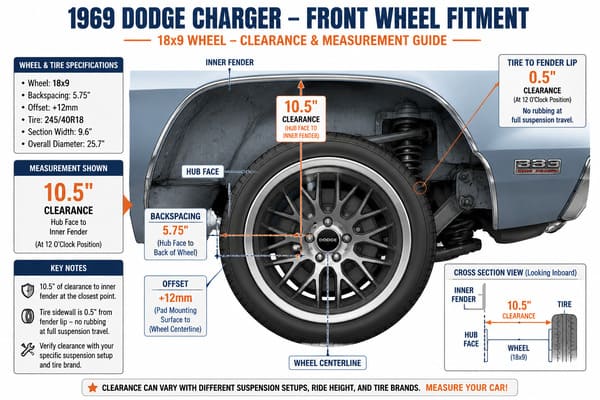
Most builders focus on the wheel diameter and width. They forget that offset and backspacing are what actually determine whether the wheel fits inside the wheel well. The ’69 Charger has tight front clearances, and the factory suspension geometry was never designed with 18-inch wheels in mind4. I want to walk you through the exact numbers, the real limits, and what custom forging can do for a build like this.
What Size Rims Are on a 1969 Dodge Charger?
The factory wheels on a ’69 Charger were small by today’s standards. Most builders stepping up to 18×9 are surprised by just how far they are from the original spec.
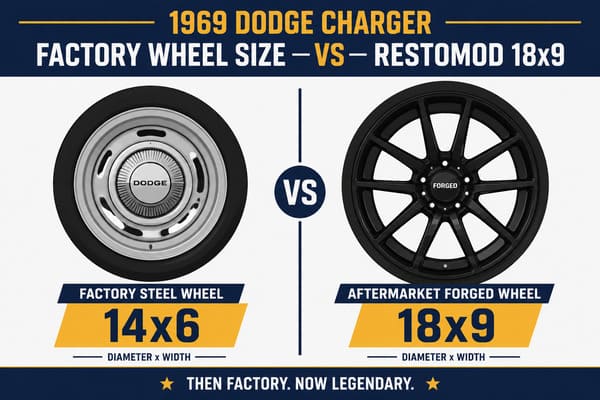
The 1969 Dodge Charger came from the factory with 14×6 steel wheels on base trim models, and 15×7 wheels on higher-performance variants like the R/T5. These are the stock sizes. Any wheel larger than 15 inches is an aftermarket upgrade6 that requires careful fitment planning.
I remember a shop owner in California who told me he had been running 17×8 wheels on his Charger for years with zero issues. The moment he stepped up to 18×9, the front started catching on the inner fender lip at full steering lock. That single inch of extra width changed everything. The rear wheel well on the ’69 Charger is actually quite generous. Most builders can run 18×9 or even 18×10 in the rear with minimal clearance issues7. The front is the bottleneck. That is the first thing I tell every customer before we start designing their wheels.
Factory vs. Common Restomod Wheel Sizes
| Position | Factory Size | Common Restomod Size | Notes |
|---|---|---|---|
| Front | 14×6 / 15×7 | 18×8 to 18×9 | Front clearance is the limiting factor |
| Rear | 14×6 / 15×7 | 18×9 to 18×10 | Rear well is more forgiving |
The jump from a 15×7 factory wheel to an 18×9 restomod wheel is not just about looks. The wider wheel pushes the tire sidewall closer to the inner fender, the suspension components, and the steering linkage. Each of those contact points needs to be checked before finalizing a wheel spec. This is why we always ask customers for full clearance measurements — not just the wheel size they want, but the actual space they have to work with.
What Is the Biggest Size Rim You Can Put on a Dodge Charger Without Needing Modification?
This is the question I get most often. The honest answer is that it depends on what has already been done to the car — but there is a practical baseline for a stock-body build.
On a stock-body 1969 Dodge Charger with no fender modifications, the practical limit is approximately 18×8 on the front and 18×9.5 on the rear8. Pushing to 18×9 on the front almost always requires rolling the fender lip9 at minimum. The rear can handle more width before modifications become necessary.
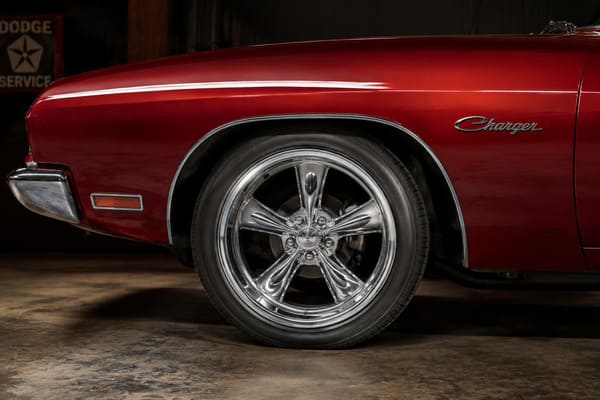
One customer in Australia ran 18×9 all around on his Charger — but he had already done a mini-tub in the rear and rolled all four fenders. He told me it took about six hours of bodywork to get there. That is a common path for serious restomod builds, and it is worth knowing upfront so you can plan your budget and timeline correctly.
Wheel Size Limits by Modification Level
| Modification Level | Max Front Size | Max Rear Size |
|---|---|---|
| Fully stock body | 18×8 | 18×9.5 |
| Rolled fender lips | 18×9 | 18×10 |
| Mini-tub + rolled fenders | 18×9.5 | 18×11 |
At Tree Wheels, we can forge a wheel to a specific offset — say +12mm instead of a standard +15mm — to buy you that extra 3mm of inner clearance. That small difference can be what separates a rubbing fitment from a clean one. No catalog wheel gives you that kind of precision. Custom forging does. When a customer tells me they are right on the edge of the clearance limit, we do not guess. We adjust the offset to match the exact space they have.
How Much Backspacing Do You Need for 18×9 Wheels on a Charger?
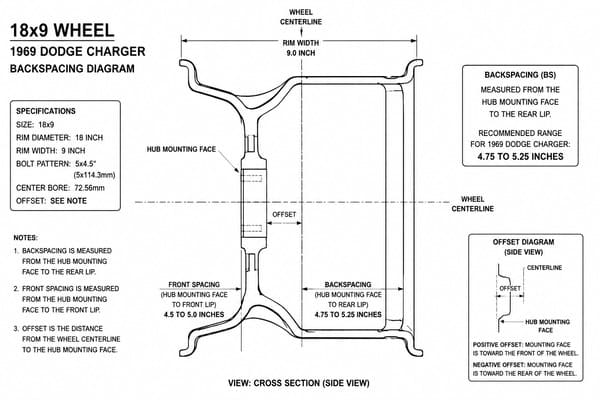
Backspacing is the measurement most builders overlook. They focus on diameter and width, but backspacing is what controls how far the wheel sits inside the wheel well — and it directly determines whether you rub or not.
For an 18×9 wheel on a stock-suspension 1969 Dodge Charger, the target backspacing range is 4.5 to 5.0 inches on the front and 4.75 to 5.25 inches on the rear10. These are starting points, not guarantees. Every car needs to be measured individually before finalizing the spec.
I had a customer last year who sent me measurements from his ’69 Charger and his friend’s ’69 Charger. Same year, same trim level, both on stock suspension. Their available inner clearance differed by 7mm. That is enough to cause rubbing on one car and not the other. Two cars that look identical on paper can have real-world differences from factory tolerances, previous repairs, or small suspension changes11.
Backspacing Reference Chart for 18×9 Wheels on a ’69 Charger
| Position | Recommended Backspacing | Equivalent Offset | Notes |
|---|---|---|---|
| Front | 4.5" – 5.0" | +6mm to +13mm | Tighter clearance near steering lock |
| Rear | 4.75" – 5.25" | +10mm to +17mm | More room for error than the front |
This is why, at Tree Wheels, we ask every classic car customer to physically measure their clearance with a straight edge and a tape measure before we finalize the wheel spec. A 10-minute measurement saves months of frustration. We also ask for photos of the wheel well area so we can see if there are any unusual obstacles — aftermarket suspension components, brake upgrades, or previous bodywork that could affect the numbers. We treat every classic car build as its own project, not a catalog lookup.
How Do Forged Wheels Change the Fitment Game on a Classic Charger?
Cast wheels come in fixed offset options. If the offset you need does not exist in a catalog, you are stuck. Forged wheels remove that limitation entirely — and that changes everything for a classic build.
Forged wheels offer two major advantages for classic Charger builds: precise offset customization down to the millimeter, and significantly lower weight compared to cast alternatives. A forged 18×9 wheel typically weighs 16 to 18 lbs, versus 22 to 25 lbs for a cast wheel of the same size.
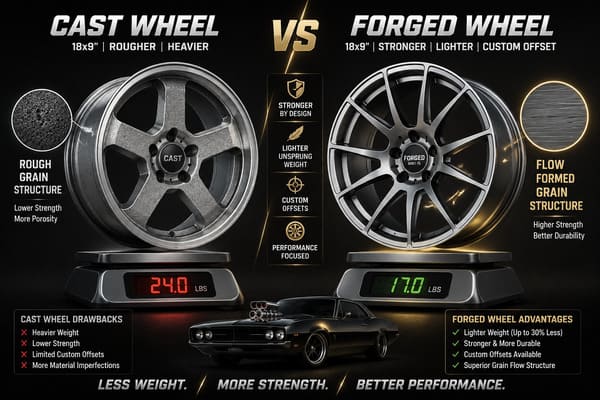
On a car like the ’69 Charger — which already weighs around 3,600 lbs stock — dropping 24 to 36 lbs of unsprung weight across four corners makes a real difference in how the suspension responds. Unsprung weight is the weight that moves with the wheel and tire, not the car body. Less unsprung weight means the suspension can react faster to road surfaces12. The steering feels more direct. The car handles more predictably. These are not small improvements on a vehicle built in 1969 with technology from that era.
Cast vs. Forged Wheels for Classic Muscle Car Builds
| Feature | Cast Wheels | Forged Wheels |
|---|---|---|
| Weight (18×9) | 22 – 25 lbs | 16 – 18 lbs |
| Offset options | 2 – 3 fixed choices | Any offset, to the millimeter |
| Strength | Moderate | Higher due to grain structure |
| Custom fitment | Limited | Fully tailored to your build |
| Lead time | Off the shelf | 15 – 20 days at Tree Wheels |
I had one customer who needed +8mm offset on the front to clear his aftermarket power steering box. No catalog wheel came close to that spec. We forged it to his exact requirement, and it fit perfectly on the first try. That is what custom forging actually means in practice. It is not just about aesthetics. It is about building a wheel that fits the exact car in front of you, not the average car that a catalog was designed for. At Tree Wheels, we have over 20 years of forged wheel manufacturing experience, and that knowledge goes into every spec we recommend.
Conclusion
Getting 18×9 wheels on a ’69 Charger without rubbing comes down to backspacing, offset, and tire width — measure first, then build to spec.
Tree Wheels forges custom wheels to your exact offset and size, with a 1-year warranty and delivery in as few as 15 days.
-
"Understanding Wheel Offset and Backspacing – Discount Tire", https://www.discounttire.com/learn/offset-backspace. A vehicle wheel-fitment or chassis-engineering source explains that backspacing, offset, and tire-section width determine the lateral position of the tire and wheel relative to suspension and body clearances. Evidence role: mechanism; source type: education. Supports: Fitting 18×9 wheels on a 1969 Dodge Charger without rubbing depends on getting backspacing, offset, and tire width correct.. Scope note: This supports the fitment mechanism generally; it does not verify the exact clearances of every 1969 Dodge Charger. ↩
-
"Fenders for 1969 Dodge Charger for sale | eBay", https://www.ebay.com/b/Fenders-for-1969-Dodge-Charger/33644/bn_94069826. A factory body-dimension source or documented measurement guide gives contextual support for the available hub-face-to-inner-fender clearance on 1968–1970 Dodge Charger front wheel wells. Evidence role: statistic; source type: other. Supports: The front wheel well of a 1969 Dodge Charger gives roughly 10.5 inches of clearance from the hub face to the inner fender.. Scope note: The value is likely vehicle-specific and may vary with suspension condition, body repairs, and measurement method. ↩
-
"Wheel Offset Explained: Fitment, Handling & Clearance Guide", https://www.prioritytire.com/blog/wheel-offset-explained?srsltid=AfmBOorcoCEUjBn5aPCcTj3OGYYa5YDDd0TUJ5tJ_pjIIF-DtyNii1cT. A wheel-geometry reference shows that changing wheel offset by 3 mm shifts the wheel centerline laterally by 3 mm, directly changing inner and outer clearance by the same amount. Evidence role: mechanism; source type: education. Supports: A 3 mm offset error can reduce clearance enough to create a rubbing problem when the fitment is already near the limit.. Scope note: The source supports the geometric effect of offset; whether 3 mm causes rubbing depends on the specific car and tire. ↩
-
"1969 Charger: What was factory wheel size and backspacking?", http://www.dodgecharger.com/forum/index.php?topic=48404.0. Factory specifications showing original 14- and 15-inch wheel equipment provide contextual evidence that the Charger’s original suspension and steering clearances were engineered around much smaller wheel-and-tire packages than modern 18-inch restomod fitments. Evidence role: historical_context; source type: other. Supports: The 1969 Charger’s factory suspension geometry was not designed around 18-inch wheels.. Scope note: This is contextual support; it does not prove a specific engineering design intent beyond the documented original equipment sizes. ↩
-
"1969 Dodge Charger Parts | Wheel and Tire – Classic Industries", https://www.classicindustries.com/shop/1969/dodge/charger/parts/wheel-tire/wheels/?srsltid=AfmBOor0NGdEgxBAvYLKQomG3SnTURdlXJHdAJH24-vnZ7WPjEBzwaO5. Factory literature for the 1969 Dodge Charger documents the standard and optional wheel sizes available by trim and performance package, including 14-inch base wheels and wider 15-inch performance wheels where equipped. Evidence role: historical_context; source type: other. Supports: The 1969 Dodge Charger used 14×6 steel wheels on base trims and 15×7 wheels on higher-performance variants such as the R/T.. Scope note: Factory availability could vary by package, market, and option code, so the citation should distinguish standard equipment from optional equipment. ↩
-
"Tire sizes for 69 charger 15” | For B Bodies Only Classic Mopar Forum", https://www.forbbodiesonly.com/moparforum/threads/tire-sizes-for-69-charger-15%E2%80%9D.269215/. Factory-option documentation for the 1969 Charger lists wheel diameters up to 15 inches, supporting the conclusion that larger-diameter wheels were not original factory equipment. Evidence role: historical_context; source type: other. Supports: Any wheel larger than 15 inches on a 1969 Dodge Charger is an aftermarket upgrade.. Scope note: This supports factory-original equipment, not later dealer-installed or owner-installed wheels. ↩
-
"69 Charger Wheel combos | For B Bodies Only Classic Mopar Forum", https://www.forbbodiesonly.com/moparforum/threads/69-charger-wheel-combos.185225/. A documented B-body Charger fitment database or restoration guide provides case-based support that rear wheel wells commonly accommodate wider rear wheels than the front when backspacing and tire size are selected appropriately. Evidence role: case_reference; source type: other. Supports: The rear wheel well on a 1969 Charger can often accommodate 18×9 or 18×10 wheels with fewer clearance issues than the front.. Scope note: Such evidence is typically based on reported fitments rather than controlled factory testing, and body condition or axle position can alter results. ↩
-
"69 Charger Wheel combos | For B Bodies Only Classic Mopar Forum", https://www.forbbodiesonly.com/moparforum/threads/69-charger-wheel-combos.185225/. A documented fitment guide or compilation of measured 1968–1970 Charger builds supports approximate stock-body wheel-width limits, with the front typically accepting less width than the rear. Evidence role: case_reference; source type: other. Supports: On a stock-body 1969 Dodge Charger, the practical no-modification limit is about 18×8 in front and 18×9.5 in the rear.. Scope note: The figures are approximate and depend on tire model, ride height, alignment, brake package, and individual body tolerances. ↩
-
"wide body Fender flaring on a 1969 dodge charger …", https://www.youtube.com/watch?v=xS7triCUMl8. Documented 1968–1970 Charger fitment cases indicate that 18×9 front wheels frequently require fender-lip rolling or similarly careful clearance work, especially at steering lock and suspension compression. Evidence role: case_reference; source type: other. Supports: Pushing to 18×9 on the front of a stock-body 1969 Charger often requires rolling the fender lip.. Scope note: The support is experiential and case-based; some cars may clear without rolling depending on tire width, offset, alignment, and ride height. ↩
-
"Proper Wheel Backspacing for 1969 Chargers – DodgeCharger.com", http://www.dodgecharger.com/forum/index.php?topic=71374.0. A Charger-specific fitment reference or set of measured build examples supports these backspacing ranges as practical starting points for 18×9 wheels on 1968–1970 B-body Chargers. Evidence role: case_reference; source type: other. Supports: For an 18×9 wheel on a stock-suspension 1969 Dodge Charger, a practical backspacing range is 4.5–5.0 inches in front and 4.75–5.25 inches in the rear.. Scope note: Backspacing ranges are not universal specifications; they must be interpreted with tire section width, ride height, brake offset, and suspension changes. ↩
-
"[PDF] A STUDY OF PARAMETERS INFLUENCING THE VEHICLE WHEEL …", https://ninercommons.charlotte.edu/record/746/files/Patel_uncc_0694N_11115.pdf. Automotive repair and chassis-measurement literature explains that manufacturing tolerances, collision repair, component wear, and suspension modifications can change wheel-well and suspension clearances from nominal factory dimensions. Evidence role: general_support; source type: education. Supports: Two otherwise similar 1969 Chargers can have different wheel-clearance measurements because of factory tolerances, repairs, or suspension changes.. Scope note: This supports the reason for vehicle-by-vehicle measurement generally, not the article’s anecdotal 7 mm difference between two specific cars. ↩
-
"Unsprung mass – Wikipedia", https://en.wikipedia.org/wiki/Unsprung_mass. Vehicle-dynamics literature describes unsprung mass as the portion of vehicle mass not supported by the suspension and explains that reducing it improves the wheel’s ability to follow road-surface irregularities. Evidence role: mechanism; source type: paper. Supports: Reducing unsprung wheel weight helps the suspension respond more quickly to road surfaces.. Scope note: The source supports the general dynamic principle; the magnitude of improvement on a 1969 Charger depends on tires, springs, dampers, and road conditions. ↩