

We once received an order for a one-piece forged wheel with a concave depth of 120mm. When the drawings arrived, our engineer went quiet for about 30 seconds. Not because it was impossible, but because he immediately saw that the wall thickness at the spoke roots would fall below the critical minimum1.
Ultra-concave wheel designs create machining challenges that standard wheels never face. The core issues include severe tool access restrictions2, internal stress release during deep cutting, and a steep rise in both material waste and machining time. These factors combine to push cost and lead time far beyond what most customers expect.
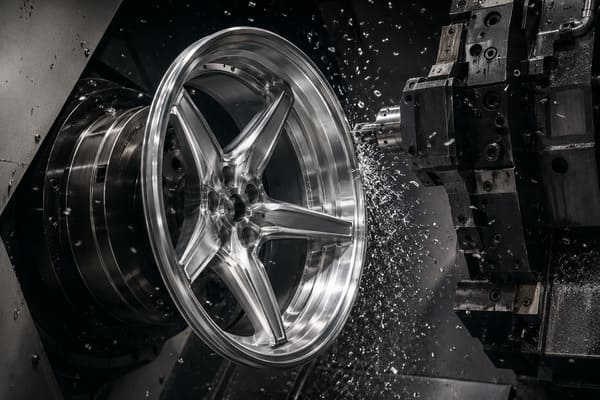
We did finish that 120mm wheel. But we revised the process plan three times, and the CNC time stretched from an estimated 4 hours to nearly 8. The real challenge in ultra-concave design has never been the shape itself. It is finding the line between extreme aesthetics and structural safety — a line that no standard or specification will draw for you.
Why Are Ultra-Concave Wheels Harder to Machine Than Standard Designs?
Standard wheel CNC work happens in open space. The tool moves freely in and out. Ultra-concave designs change that completely.
When the concave depth exceeds 80mm, the effective tool working angle compresses from a normal ±45° down to less than ±15°. This forces the use of longer, narrower cutting tools, which increases vibration, reduces cutting stability3, and makes precision far harder to maintain throughout the entire process.
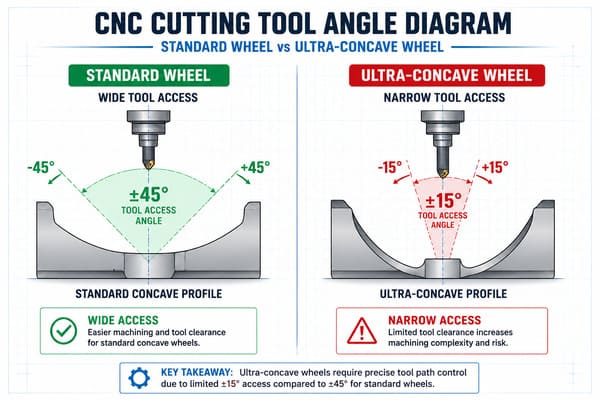
The geometry problem is only one part of the difficulty. Forged aluminum carries internal stress from the forging process itself.4 During deep cutting, that stress releases slowly and causes slight deformation.5 We had one production batch where every wheel measured perfectly after machining. Then, 24 hours later, the center area showed a 0.08mm springback deformation. That number sounds small. But it creates a visible asymmetry in the spokes that any experienced eye will catch immediately.
How We Respond to These Challenges in Production
Our current standard process for ultra-concave wheels uses staged cutting with intermediate aging treatment between stages6. This allows internal stress to release in a controlled way before the next cut begins. The trade-off is real.
| Process Factor | Standard Wheel | Ultra-Concave Wheel |
|---|---|---|
| Effective Tool Angle | ±45° | Less than ±15° |
| Stress Deformation Risk | Low | High |
| Machining Stages | 1–2 | 3–4 |
| Added Time per Piece | Baseline | +35% or more |
| Post-Cut Stabilization | Not required | Required (12–24 hrs) |
This staged approach adds roughly 35% to the per-piece machining time. That is why ultra-concave wheel quotes often come back higher than customers expect. The premium is not in the design. It is in the process discipline required to hold that design to tolerance.
What Makes a Wheel More Concave?
Customers sometimes ask us: can we add 20mm more depth to an existing design? The answer is yes. But there are three things they need to accept first.
Making a wheel more concave requires a heavier forging blank, more CNC material removal, and longer lead time7. Adding just 20mm of depth can increase blank weight by 8–12%, drop material utilization from around 55% to below 40%8, and extend the production schedule by 3 to 5 days.
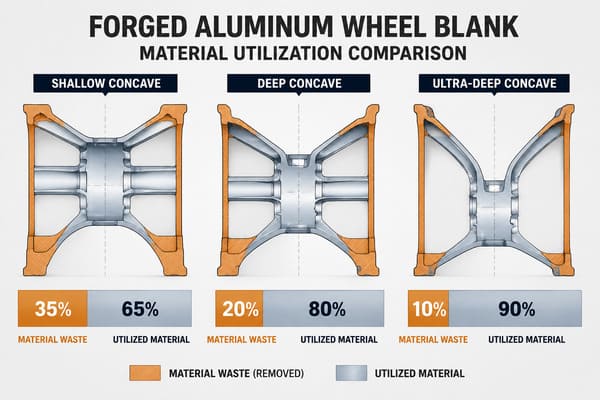
One customer asked me directly: is 20mm worth it? I told him that on a finished car, 20mm of extra depth is very noticeable. The visual difference is real. But the cost does not increase in a straight line. It jumps.
The Manufacturing Paradox of Going Deeper
This is the part that surprises most people outside the industry. To make a wheel more concave, you start with a heavier blank. You then cut away more material than you would for a shallower design. The finished wheel ends up lighter than the blank — but the blank itself was heavier than it needed to be for a standard design.
| Design Depth | Blank Weight Increase | Material Utilization | Estimated Extra Lead Time |
|---|---|---|---|
| Standard (≤60mm) | Baseline | ~55% | Baseline |
| Deep (60–90mm) | +5–8% | ~48% | +1–2 days |
| Ultra-Deep (90–120mm+) | +8–12% | Below 40% | +3–5 days |
You invest in heavier raw material. You produce more waste. You get a lighter finished product. This paradox is the real reason ultra-concave wheels carry a higher price. It is not a margin decision. It is a cost reality that runs through every step of the process.
Are Forged Wheels Milled?
Many customers think they are buying "forging" when they order a forged wheel. Forging is only the starting point.
Yes, forged wheels are milled. CNC milling is what gives a forged wheel its final shape, dimensions, and surface quality.9 Forging creates the dense internal grain structure.10 Milling creates everything you see. Both processes are required, but milling is what determines the quality ceiling of an ultra-concave forged wheel.
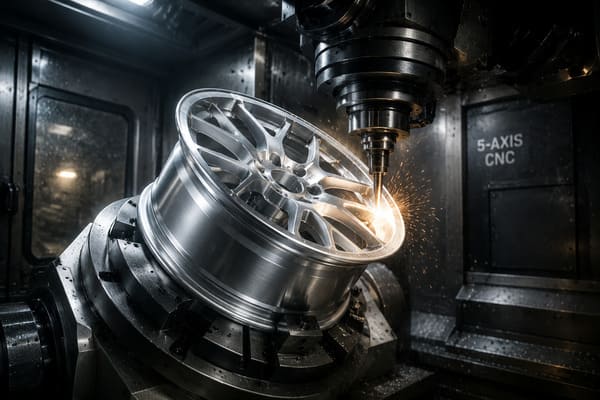
The forging step is fast. A forged blank can be formed in under 5 minutes. A standard wheel design then needs 3 to 4 hours of CNC work. An ultra-concave design easily goes past 6 hours. The most complex single piece we have machined took 9 hours of milling time.
Why Milling Matters More for Ultra-Concave Designs
For standard wheels, forging quality has a large influence on the final result because the CNC work is relatively straightforward. For ultra-concave designs, the relationship shifts. The milling process carries more of the responsibility because the geometry is far more demanding11.
| Process | Time Required | What It Controls |
|---|---|---|
| Forging | Under 5 minutes | Internal density, grain structure |
| CNC Milling (Standard) | 3–4 hours | Shape, dimensions, surface finish |
| CNC Milling (Ultra-Concave) | 6–9+ hours | All of the above, plus structural integrity at depth |
A poor forging blank will limit what milling can achieve. But a poorly executed milling process on an ultra-concave design will produce a wheel that either fails inspection or fails in service. When customers ask us where we invest the most care in production, the answer for ultra-concave work is always the same: the milling floor.
What Are the Future Trends in Wheel Technology?
Over the past two years, the share of custom requests we receive with a concave depth above 100mm has grown from under 10% to nearly 30%. Customer aesthetics are moving fast toward the extreme end. Manufacturing capability is not keeping pace at the same speed.
The future of ultra-concave wheel technology will be shaped by topology optimization software12 and the return of three-piece wheel construction. These two developments will allow deeper concave designs to be produced with better structural control and significantly lower machining time than current one-piece methods allow.

Right now, a lot of ultra-concave design decisions still rely on engineering experience. An engineer looks at a drawing and makes a judgment call about whether the wall thickness at a given depth is safe. That is not a bad process, but it has limits.
Two Changes That Will Reshape Ultra-Concave Production
The first is topology optimization software. This technology calculates the theoretical maximum concave depth for a given spoke geometry and load requirement automatically. It removes guesswork from the design stage and creates a clear, data-backed boundary between what is structurally safe and what is not.
The second is the return of three-piece wheel construction. Our own production data shows that for the same concave depth, a three-piece design requires roughly 40% less CNC time than a one-piece design. The reason is simple: each component is machined separately. Tool access restrictions disappear because there is no deep cavity to work inside.
| Construction Type | CNC Time (Ultra-Concave) | Tool Access | Structural Risk at Depth |
|---|---|---|---|
| One-Piece | 6–9+ hours | Severely restricted | High |
| Two-Piece | 4–6 hours | Partially restricted | Moderate |
| Three-Piece | 3–5 hours | Fully open | Low |
I do not think the future of ultra-concave wheels is more extreme one-piece designs. I think it is smarter three-piece designs, paired with software that tells engineers exactly how far they can push the geometry before the structure starts to compromise.
Conclusion
Ultra-concave wheel machining demands process discipline, material investment, and engineering judgment that standard designs never require. The deeper the design, the higher the cost and the longer the timeline. At Tree Wheels, we bring 20+ years of forged wheel manufacturing experience to every ultra-concave project — from 3D design to your door.
-
"Design and fatigue analysis of an aluminium alloy aerodynamic wheel", https://www.academia.edu/95480152/Design_and_fatigue_analysis_of_an_aluminium_alloy_aerodynamic_wheel. Finite-element and fatigue studies of automotive wheels commonly identify spoke roots and hub-spoke transitions as high-stress regions, supporting the need to preserve adequate section thickness in these areas. Evidence role: mechanism; source type: paper. Supports: Insufficient wall thickness at spoke roots can create a structural safety problem in ultra-concave wheel designs.. Scope note: Such studies support the structural concern but usually do not define a universal minimum wall thickness for every wheel geometry and alloy. ↩
-
"[PDF] Fundamentals of CNC Machining – HAAS Technical Education Center", https://haastech.tamu.edu/wp-content/uploads/sites/5/2016/05/Autodesk_CNCBOOK.pdf. Machining-accessibility literature on multi-axis CNC machining describes deep cavities and steep surfaces as limiting feasible tool orientations, supporting the claim that concave geometries can restrict tool access. Evidence role: mechanism; source type: paper. Supports: Ultra-concave wheel geometry creates tool access restrictions that are not present in more open wheel designs.. Scope note: The evidence is likely to address general CNC accessibility rather than ultra-concave wheels specifically. ↩
-
"Techniques for the Use of Long Slender End Mills in High-speed …", https://impact.ornl.gov/en/publications/techniques-for-the-use-of-long-slender-end-mills-in-high-speed-mi/. Machining-dynamics research shows that increased tool overhang and reduced tool stiffness raise the likelihood of chatter and dimensional error, supporting the link between long slender tools and reduced cutting stability. Evidence role: mechanism; source type: paper. Supports: Using longer, narrower cutting tools increases vibration and makes precision harder to maintain.. Scope note: The source would support the machining principle, not the article’s specific tool-angle values. ↩
-
"[PDF] Optimizing the Compression Stress Relief Process for 7050AL …", https://digitalcommons.lmu.edu/cgi/viewcontent.cgi?article=1047&context=mech_fac. Materials-processing literature documents that aluminum forging can introduce residual stresses through plastic deformation and nonuniform cooling, supporting the statement that forged aluminum may contain internal stress. Evidence role: mechanism; source type: paper. Supports: Forged aluminum can retain internal stresses from the forging process.. Scope note: Residual-stress magnitude depends on alloy, forging temperature, cooling rate, and subsequent heat treatment. ↩
-
"Influence of Material Removal Strategy on Machining … – PMC", https://pmc.ncbi.nlm.nih.gov/articles/PMC10004076/. Studies of machining-induced distortion in aluminum components report that material removal can rebalance residual stresses and cause dimensional deformation, supporting the mechanism described for deep cutting. Evidence role: mechanism; source type: paper. Supports: Deep machining can release residual stresses and cause slight deformation in forged aluminum parts.. Scope note: The evidence would support the general phenomenon of stress-release distortion, not the specific 0.08 mm deformation example. ↩
-
"Overcoming residual stresses and machining distortion in the …", https://digital.library.unt.edu/ark:/67531/metadc900779/. Research on residual-stress relief in aluminum alloys indicates that staged machining and thermal aging or stress-relief treatments can reduce distortion by allowing stresses to redistribute before final cuts. Evidence role: mechanism; source type: paper. Supports: Staged cutting with intermediate aging can help control residual-stress deformation during machining.. Scope note: The source may support the method in aluminum machining generally rather than in forged wheel production specifically. ↩
-
"[PDF] A hybrid additive and subtractive manufacturing approach for multi …", https://www.imse.iastate.edu/files/2021/03/WeflenEric-thesis.pdf. Manufacturing literature on subtractive machining and forged preforms explains that more complex final geometries often require larger starting stock and greater material removal, which increases processing time. Evidence role: general_support; source type: education. Supports: Increasing concave depth can require a heavier blank, more material removal, and longer manufacturing time.. Scope note: This supports the manufacturing logic but not the article’s exact percentages or lead-time estimates. ↩
-
"A decision-support model for selecting additive manufacturing …", https://pmc.ncbi.nlm.nih.gov/articles/PMC6750031/. Sources on buy-to-fly ratio and material utilization in subtractive manufacturing document that machining from large billets or forgings can yield low material-utilization rates, providing context for the article’s reported utilization decline. Evidence role: statistic; source type: research. Supports: Ultra-deep concave wheel machining can reduce material utilization substantially because more of the blank is cut away.. Scope note: External sources may provide comparable utilization ranges but are unlikely to verify the article’s exact wheel-specific figures. ↩
-
"Comparative Study about Dimensional Accuracy and Surface Finish …", https://pmc.ncbi.nlm.nih.gov/articles/PMC9960791/. Manufacturing references describe CNC milling as a subtractive process used to generate precise geometry, dimensional accuracy, and machined surface finish, supporting its role in finishing forged wheel blanks. Evidence role: definition; source type: education. Supports: CNC milling determines the final geometry, dimensions, and surface finish of a forged wheel after forging.. Scope note: The source would define CNC milling generally and may not discuss wheel manufacturing specifically. ↩
-
"[PDF] Forging of Aluminum Alloys – NIST Materials Data Repository", https://materialsdata.nist.gov/bitstream/handle/11115/223/Forging%20of%20Aluminum%20Alloys.pdf. Metallurgical references on forging state that plastic deformation refines and orients grain flow, often improving density and mechanical properties compared with cast structures. Evidence role: definition; source type: encyclopedia. Supports: Forging contributes to the internal grain structure and mechanical properties of an aluminum wheel blank.. Scope note: The degree of densification and grain refinement depends on alloy, forging temperature, reduction ratio, and heat treatment. ↩
-
"Experimental Investigation of the Influence of Milling Conditions on …", https://pmc.ncbi.nlm.nih.gov/articles/PMC11857309/. Research on machining complex thin-walled or deeply featured components shows that tool accessibility, vibration, and residual-stress distortion make the machining stage decisive for dimensional accuracy and structural compliance. Evidence role: expert_consensus; source type: paper. Supports: For ultra-concave designs, milling quality becomes especially important because complex geometry increases machining difficulty.. Scope note: This evidence would support the general manufacturing risk of complex geometries, not rank forging versus milling for every wheel design. ↩
-
"Probabilistic combination of loads in topology optimization designs …", https://arxiv.org/html/2503.19807v1. Topology-optimization literature describes computational methods that distribute material within a design space under load and constraint conditions, supporting its relevance to structural wheel design decisions. Evidence role: definition; source type: paper. Supports: Topology optimization software can help define structurally efficient geometry for deeper concave wheel designs.. Scope note: Topology optimization can guide structural layout, but final wheel safety still requires material data, manufacturability checks, and physical validation tests. ↩