

I take calls and messages from wheel buyers almost every day. Nine out of ten times, when someone says "I want black rims," their next question is: "Which black looks the best?" I’ve learned this is the wrong question. The right question is: "Which black finish fits how I actually use my car?" I’ve seen too many customers pay premium prices for custom forged wheels and then regret their finish choice within six months — not because it looked wrong, but because it created a maintenance burden they didn’t anticipate. This article walks you through the practical differences between gloss, matte, and satin black finishes so you choose the right one before you order.
Gloss black delivers a mirror-like shine with high visual impact but shows fingerprints, water spots, and brake dust immediately. Matte black absorbs light for an aggressive flat look but requires careful cleaning to avoid damaging the finish. Satin black sits between the two — offering a soft sheen with better day-to-day forgiveness. Your maintenance commitment and use case should drive your decision, not just how the finish looks in product photos.
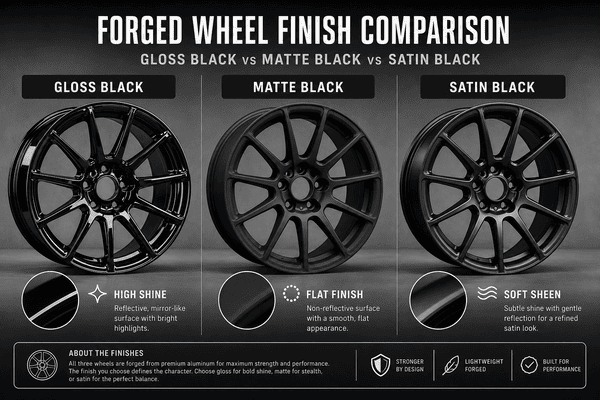
Most buyers start by comparing how each finish looks in photos. That comparison matters, but it’s the least important variable for long-term satisfaction. What matters more: how often you wash your car, where you drive, and how carefully you maintain your wheels. In the sections below, I break down each finish with the practical context buyers consistently underestimate. I’ll also give you a straightforward decision framework so you can match finish to scenario before you commit.
What Does Gloss Black Look Like and Why Do Buyers Choose It?
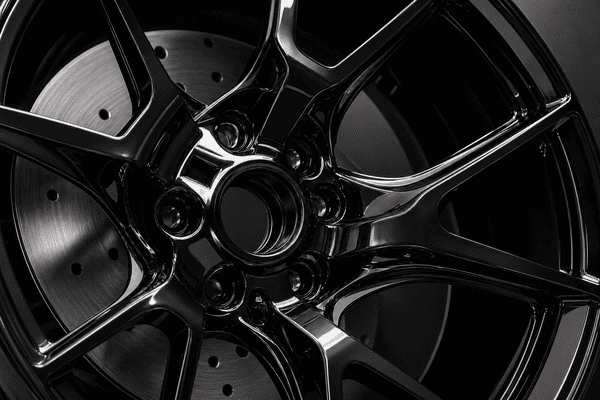
Buyers choosing gloss black are usually drawn to its depth and shine. Gloss black reflects light like a mirror, creating visual depth that makes the wheel design stand out. When clean, it delivers the highest visual impact of all three finishes.
Gloss black uses a clear coat over the black base layer, giving it a reflective, high-shine surface. This finish creates depth and contrast, especially in direct light. Buyers choose gloss black for show cars, luxury builds, or any application where maximum visual impact matters more than daily practicality.
Why Gloss Black Creates the Highest Maintenance Commitment
Gloss black finishes reveal every imperfection the moment it lands. Fingerprints from installation, water spots after rain, and brake dust from normal driving all show up clearly on the reflective surface. If you drive your car daily and don’t wash your wheels weekly, gloss black will look dirty more often than clean.
The clear coat does provide durability advantages — it protects the black base layer from UV exposure, light scratches, and most chemicals1. A quality gloss clear coat is generally more resistant to environmental damage than unprotected matte or satin finishes2. But that durability only matters if you’re willing to maintain the appearance. A scratch-resistant wheel that looks perpetually dusty doesn’t deliver the visual payoff you paid for.
Maintenance Requirements for Gloss Black
- Frequent washing: Weekly washing minimum if you want the finish to look its best
- Detailing products: Works well with standard car wash soap, wheel cleaners, and wax
- Scratch visibility: Light scratches show more clearly on reflective surfaces
- Chemical resistance: Clear coat generally resists most standard automotive chemicals
I’ve had customers tell me they love the look of gloss black in photos but regret it three months later because they don’t have time to keep it clean. If you park your car in a garage and drive it selectively, gloss black delivers. If you daily drive through road salt, construction zones, or heavy brake dust environments, expect constant upkeep.
When Gloss Black Is the Right Choice
Gloss black works best for show cars, garage-kept vehicles, or builds where appearance is the top priority and you’re committed to regular detailing. It’s also the better choice for buyers who already have a detailing routine and don’t mind adding wheels to that process. If you take pride in keeping your car spotless, gloss black rewards that effort with maximum visual depth.
What Does Matte Black Look Like and Why Do Buyers Choose It?
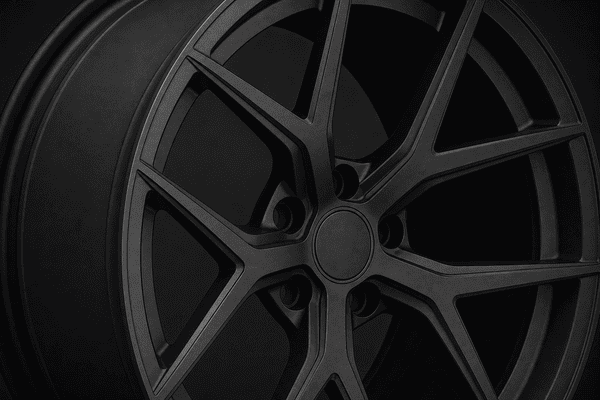
Matte black is the opposite of gloss — it absorbs light instead of reflecting it. The finish is completely flat with no shine. It creates an aggressive, stealthy aesthetic that many performance and off-road builds prioritize.
Matte black eliminates surface reflection, creating a flat, non-reflective appearance. Buyers choose matte black for the aggressive look it delivers — especially popular in racing, off-road, and performance applications where stealth aesthetics match the vehicle’s purpose.
The Maintenance Misconception Around Matte Black
Most buyers believe matte black is harder to maintain. That’s half true. Matte finishes hide light dust and brake residue better day-to-day than gloss — you won’t see every fingerprint or water spot immediately. The problem is that matte finishes are more sensitive to how you clean them. Using the wrong products or scrubbing too hard can create shiny spots, streaks, or permanent damage to the finish.
Standard wheel cleaners, especially acidic ones, can strip or alter matte coatings3. Waxes and polishes designed for gloss finishes will create uneven sheen on matte surfaces4. You need matte-specific cleaning products and a gentler approach. If you’re the type of person who grabs whatever spray bottle is in the garage, matte black will frustrate you.
Maintenance Requirements for Matte Black
- Specialized products: Requires matte-specific cleaners — standard wheel soap or degreasers can damage the finish
- Gentle cleaning: No abrasive brushes or scrubbing — use soft microfiber cloths
- No waxing or polishing: Traditional shine products create uneven glossy spots
- Lower day-to-day visibility: Hides light dust and brake residue better than gloss
Durability Concerns with Matte Black Finishes
Durability for matte black depends entirely on whether the finish includes a protective clear coat. Some manufacturers apply a matte clear coat over the black base, which significantly improves chemical and UV resistance. Others use raw powder coat with no top layer — those finishes are more vulnerable to road salt, aggressive brake cleaners, and environmental wear5.
When evaluating matte black wheels, ask the manufacturer what protective layer the finish includes. A matte clear coat offers similar durability to gloss while maintaining the flat appearance. Raw matte powder coat without protection will degrade faster, especially in harsh climates. This is one area where quality matters more than finish type.
When Matte Black Is the Right Choice
Matte black works well for track cars, off-road builds, or performance applications where the aggressive aesthetic matches the vehicle’s purpose. It’s also the right choice if you want a stealthy look and you’re willing to invest in the right cleaning products and techniques. Buyers who value appearance over convenience — and who maintain their wheels correctly — find matte black delivers exactly what they want.
If you drive daily, park outside, and use your car in winter conditions with road salt, I’d steer you toward satin instead. Matte black in those conditions requires more careful upkeep than most buyers are prepared to commit to.
What Does Satin Black Look Like and Why Do Buyers Choose It?
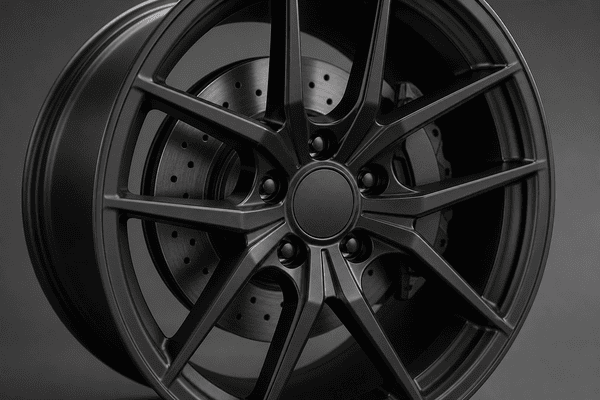
Satin black sits between gloss and matte. It has a soft sheen — enough to reflect some light without the mirror finish of gloss. The result is a finish that looks refined without being high-maintenance.
Satin black offers a low-sheen finish with subtle light reflection. It bridges the gap between gloss and matte, delivering visual interest without high maintenance. Buyers choose satin black when they want a premium appearance with better day-to-day practicality than gloss.
Why Satin Black Is the Most Forgiving Finish
Satin black hides imperfections better than gloss without the cleaning restrictions of matte. Light dust, fingerprints, and water spots are less visible than on gloss black. At the same time, satin finishes typically use a clear coat similar to gloss, which means you can clean them with standard automotive products without worrying about damaging the finish.
This combination makes satin black the most forgiving option for daily drivers. You get a refined appearance without the constant upkeep gloss requires, and you don’t need specialized products like matte demands. For buyers who want their wheels to look good most of the time without weekly detailing, satin delivers the best balance.
Maintenance Requirements for Satin Black
- Standard products work: Compatible with regular car wash soap and wheel cleaners
- Moderate cleaning frequency: Bi-weekly washing keeps the finish looking good
- Better dirt hiding: Light dust and brake residue less visible than on gloss
- Clear coat protection: Most satin finishes include a protective top layer
Durability of Satin Black Finishes
Satin black finishes generally include a clear coat, which provides similar scratch and UV resistance to gloss. The lower sheen means light scratches are slightly less visible than on high-gloss surfaces, but the durability characteristics are comparable. Road salt, brake dust, and environmental chemicals affect satin finishes similarly to gloss — the clear coat provides protection, and standard cleaning maintains it.
One advantage satin has over both gloss and matte: it’s more forgiving when you make cleaning mistakes. If you accidentally use a product that’s too harsh, satin won’t show streaks or shiny spots the way matte does. If you miss a weekly wash, it won’t look as obviously dirty as gloss.
When Satin Black Is the Right Choice
Satin black is the best default choice for most buyers. It works for daily drivers, cars parked outside, and builds where you want a premium look without premium maintenance. If you’re unsure which finish fits your use case, satin black is the safest bet.
I recommend satin black to buyers who drive year-round, who wash their cars every couple of weeks (not every week), and who want wheels that look consistently good without constant attention. It’s also the right choice for buyers who live in climates with road salt, heavy rain, or dusty conditions — satin hides the mess better than gloss without the cleaning restrictions of matte.
How Do These Finishes Compare in Real-World Use?
The visual difference between gloss, matte, and satin is obvious when you see them side by side. But the practical difference only becomes clear after months of ownership. Here’s how each finish performs in the variables that actually affect long-term satisfaction.
Maintenance Comparison
| Finish | Cleaning Frequency | Product Requirements | Day-to-Day Appearance | Forgiveness Level |
|---|---|---|---|---|
| Gloss Black | Weekly minimum | Standard products work | Shows every imperfection | Low — constant upkeep needed |
| Matte Black | Bi-weekly if careful | Requires matte-specific cleaners | Hides light dust well | Low — wrong products damage finish |
| Satin Black | Bi-weekly | Standard products work | Stays clean-looking longer | High — handles mistakes well |
The maintenance comparison reveals why buyers often regret gloss black on daily drivers and matte black when they don’t have the right products. Satin black accommodates real-world use better than the other two.
Durability Comparison
Durability depends more on whether the finish includes a protective clear coat than on the finish type itself. Here’s the breakdown:
- Gloss black with clear coat: High durability — resists UV, scratches, and most chemicals
- Satin black with clear coat: Similar durability to gloss — slightly better scratch concealment due to lower sheen
- Matte black with matte clear coat: Comparable durability to gloss and satin, but requires correct cleaning to maintain
- Matte black without clear coat: Lower durability — more vulnerable to road salt, chemicals, and UV damage
If you’re comparing finishes, ask the manufacturer whether the matte option includes a protective top layer. That single variable matters more than the finish appearance.
Visual Impact vs. Practicality
Gloss black delivers the highest visual impact when clean, but that impact disappears quickly in daily use. Matte black creates the most aggressive aesthetic but demands careful maintenance. Satin black sacrifices a small amount of visual drama for significant practical benefits.
Most buyers overweight visual impact and underweight practicality when choosing. The finish that looks best in product photos isn’t always the finish that performs best on your car six months later.
Which Black Finish Should You Choose Based on Your Use Case?
Instead of choosing based on appearance alone, match the finish to how you actually use your vehicle. Here’s a straightforward decision framework:
Daily Driver (Year-Round Use, Outdoor Parking)
Recommended finish: Satin black
You need a finish that hides dirt, works with standard cleaning products, and doesn’t require weekly detailing. Satin black delivers premium appearance with practical maintenance.
Show Car or Garage-Kept Vehicle
Recommended finish: Gloss black
If you prioritize maximum visual impact and you maintain your car regularly, gloss black rewards that effort. The high-maintenance commitment is manageable when the car isn’t exposed to daily road conditions.
Track Car or Performance Build
Recommended finish: Matte black or satin black
Both work well depending on your aesthetic preference. Matte delivers the most aggressive look if you’re prepared to clean it correctly. Satin offers similar stealth aesthetics with easier upkeep.
Off-Road or Harsh Climate Use
Recommended finish: Satin black (with verified clear coat)
Off-road and winter driving expose wheels to mud, salt, and debris. Satin hides the mess better than gloss and doesn’t require matte-specific cleaning products when you need to scrub hard. Confirm the finish includes a durable clear coat before ordering.
Luxury or High-End Build
Recommended finish: Gloss black or satin black
Both finishes suit luxury applications. Choose gloss if you want maximum depth and shine and you’re committed to weekly detailing. Choose satin if you want refined appearance with better day-to-day practicality.
What About Color Matching and Future Refinishing?
One variable buyers often forget: what happens if you damage a wheel and need to refinish it? Matching black finishes later can be surprisingly difficult6.
Gloss black is the easiest to match because the clear coat creates a consistent sheen. Satin black is moderately challenging — slight variations in sheen level can be visible. Matte black is the hardest to match perfectly, especially if the original finish has aged or faded7.
If you’re ordering a set of four wheels and you’re concerned about potential future damage, consider ordering a fifth wheel as a spare. This guarantees exact finish matching if you need to replace one later. For high-end custom builds, this is standard practice.
Can You Change the Finish Later?
Yes, but it requires professional refinishing. Most powder coat shops can strip and recoat wheels in a different finish. The process typically costs $100–150 per wheel depending on the complexity and whether any surface repair is needed first8.
Buyers sometimes ask whether they can "convert" gloss to matte or vice versa. Technically yes, but if you’re already uncertain about your finish choice, that’s a signal to reconsider before ordering. Paying to refinish wheels later doubles your cost and creates downtime while the work is completed.
If you’re torn between two finishes, I usually suggest ordering satin. It’s easier to live with long-term, and if you later decide you want more visual drama, refinishing to gloss is straightforward.
Frequently Asked Questions
Does matte black scratch more easily than gloss black?
No — scratch resistance depends on the clear coat, not the finish type. Matte black with a protective matte clear coat is just as scratch-resistant as gloss black with a standard clear coat. The difference is that scratches are often more visible on gloss finishes because of the reflective surface.
Can I use regular wheel cleaner on satin black wheels?
Yes. Satin black finishes typically include a clear coat compatible with standard automotive wheel cleaners. Avoid highly acidic or abrasive products regardless of finish type, but satin black doesn’t require specialized matte-specific cleaners the way matte black does.
Which black finish hides brake dust the best?
Matte black and satin black both hide brake dust better than gloss black. Matte is slightly better at hiding dust day-to-day, but it’s harder to clean thoroughly when you do wash. Satin offers the best practical balance — it hides dust reasonably well and cleans easily with standard products.
Will satin black fade over time?
High-quality satin black finishes with UV-resistant clear coats should not fade significantly under normal use9. Exposure to harsh chemicals, road salt, and prolonged direct sunlight without washing can degrade any finish over time10. Regular cleaning and occasional application of wheel sealant extends finish life regardless of type11.
Can I wax or polish matte black wheels?
No. Waxes and polishes create shine, which defeats the purpose of a matte finish and can create uneven glossy spots. Use matte-specific detailing sprays designed to clean and protect without adding sheen.
Conclusion
The difference between gloss, matte, and satin black is more than cosmetic — it’s a maintenance commitment and a durability trade-off. Gloss black delivers maximum visual impact but demands weekly cleaning. Matte black creates aggressive stealth aesthetics but requires careful product selection and technique. Satin black offers refined appearance with the best day-to-day practicality for most buyers.
Your use case should drive your decision, not just how the finish looks in photos. Daily drivers benefit from satin black’s forgiveness. Show cars and garage-kept builds can justify gloss black’s high-maintenance shine. Performance and off-road applications match well with matte black’s aggressive aesthetic — if you’re prepared to maintain it correctly.
At Tree Wheels, we manufacture all three finishes with the same quality standards and protective clear coats. We ask every customer about their use case before recommending a finish because we’ve seen too many buyers regret choices made on appearance alone. If you’re ready to order custom forged wheels and you’re still unsure which black finish fits your build, reach out. We’ll walk you through the decision based on how you actually use your car — not just how you want it to look.
-
"Why Sunlight is the Most Destructive to Automotive Materials", https://www.mgaresearch.com/blog/why-sunlight-is-the-most-destructive-to-automotive-materials. Automotive clear coat formulations typically incorporate benzotriazole UV absorbers and hindered amine light stabilizers (HALS) that absorb and dissipate UV radiation before it reaches the pigmented base coat, substantially extending color retention and gloss stability compared to unprotected pigment layers. Evidence role: mechanism; source type: research. Supports: That automotive clear coats incorporate UV-absorbing compounds and radical scavengers that prevent photodegradation of underlying pigmented base coat layers. Scope note: Performance varies significantly by formulation quality and coating thickness; aftermarket wheel coatings may not meet OEM automotive paint specifications, and published data on OEM systems may not directly apply. ↩
-
"Development of Car Coating Materials over the Past Decade …", https://pmc.ncbi.nlm.nih.gov/articles/PMC12694507/. Studies on automotive coating systems indicate that clear coat layers containing UV absorbers and HALS (hindered amine light stabilizers) significantly reduce photodegradation of underlying pigment layers; uncoated or raw powder coat surfaces lack this protective mechanism and degrade faster under UV and chemical exposure. Evidence role: mechanism; source type: research. Supports: That gloss clear coats with UV-stabilizing additives provide measurable protection against environmental degradation compared to uncoated or minimally coated surfaces. Scope note: Most published research addresses OEM automotive paint systems rather than aftermarket wheel coatings specifically; direct comparisons between gloss and matte clear coat formulations are less commonly documented in open literature. ↩
-
"What Types of Finishes Can Be Applied to Forged Wheels?", https://treewheels.com/what-types-of-finishes-can-be-applied-to-forged-wheels/. Research on polymer coating degradation demonstrates that low-pH solutions can hydrolyze ester linkages in polyester-based powder coatings and clear coats, potentially altering surface roughness and light-scattering properties that define matte appearance. Evidence role: mechanism; source type: research. Supports: That acidic cleaning agents can chemically attack polymer-based coatings, altering surface texture and sheen through hydrolysis or etching of the binder matrix. Scope note: Published studies typically examine industrial coatings under controlled laboratory conditions; real-world effects on consumer wheel finishes may vary depending on coating formulation, concentration, and exposure duration. ↩
-
"Can You Wax Matte Paint? Read Before You Try", https://www.drbeasleys.com/blog/2012/05/19/why-you-cant-wax-matte-paint-finishes?srsltid=AYCX9vKL29Sd6BQbOSuD7h1-HANz7SPTVIR5nXgL3B515zCClNUX2DAH. Matte finishes achieve their low-gloss appearance through controlled surface micro-roughness that scatters incident light diffusely; application of wax or polish deposits a thin film that partially fills these micro-texture features, locally reducing light scattering and producing visible variation in sheen across the treated surface. Evidence role: mechanism; source type: research. Supports: That wax and polish products fill the microscopic surface irregularities that create matte light-scattering properties, resulting in localized increases in surface reflectance. Scope note: The degree of sheen alteration depends on wax formulation, application method, and the specific micro-texture profile of the matte coating; no standardized test data comparing specific product interactions with matte wheel coatings was identified. ↩
-
"What Types of Finishes Can Be Applied to Forged Wheels?", https://treewheels.com/what-types-of-finishes-can-be-applied-to-forged-wheels/. Electrochemical studies of coated aluminum and steel substrates exposed to chloride-containing solutions demonstrate that salt ingress through micro-defects in powder coat layers promotes underfilm corrosion and adhesion loss, with uncoated or single-layer finishes showing significantly faster degradation than multi-layer systems with sealed top coats. Evidence role: mechanism; source type: research. Supports: That chloride ions from road deicing salts penetrate coating defects and initiate electrochemical corrosion of underlying metal substrates, accelerating finish degradation on unprotected surfaces. Scope note: Laboratory salt-spray test conditions may not precisely replicate the intermittent wet-dry cycling of real-world road salt exposure; degradation rates vary with coating thickness, substrate preparation, and alloy composition. ↩
-
"Ageing", https://en.wikipedia.org/wiki/Ageing. Color science literature identifies metamerism — where two surfaces appear matched under one light source but differ under another — as a persistent challenge in automotive refinishing; additionally, pigment and binder aging alter spectral reflectance over time, meaning a new coating applied to match an aged finish will diverge in appearance as the new coating weathers to a different state. Evidence role: mechanism; source type: research. Supports: That automotive finish matching is complicated by metamerism, coating aging, and batch-to-batch pigment variation, making exact replication of aged finishes technically difficult. Scope note: Published research on metamerism and color matching focuses primarily on OEM automotive body paint rather than wheel powder coat or clear coat systems specifically; the principles are applicable but direct empirical data on wheel finish matching difficulty is limited. ↩
-
"How to Match Wheels with a Green Lamborghini Aventador?", https://treewheels.com/how-to-match-wheels-with-a-green-lamborghini-aventador/. The visual appearance of matte coatings is governed by surface micro-roughness parameters (Ra, Rz) that scatter light diffusely; small variations in these parameters — arising from batch differences in matting agent concentration, application conditions, or surface aging — produce perceptible gloss level differences that are more difficult to control and replicate than the specular reflectance of gloss clear coats. Evidence role: mechanism; source type: research. Supports: That matte finish appearance is highly sensitive to micro-texture variation, making consistent replication across batches or after aging more difficult than for gloss finishes where sheen is determined primarily by clear coat chemistry. Scope note: Quantitative data on matte coating batch-to-batch variation in wheel finishing applications is not widely published; the cited mechanism is drawn from general coating science literature and may not reflect specific manufacturing tolerances of individual wheel producers. ↩
-
"Can Forged Wheels Be Repaired If Damaged?", https://treewheels.com/can-forged-wheels-be-repaired-if-damaged/. Consumer automotive service pricing aggregators and industry cost guides report wheel powder coating services typically ranging from approximately $75 to $200 per wheel depending on wheel size, finish complexity, and geographic market, with the midrange of $100–150 representing common pricing for standard passenger vehicle wheels. Evidence role: statistic; source type: other. Supports: That professional powder coat refinishing of automotive wheels falls within a defined price range per wheel in the US market. Scope note: Pricing varies substantially by region, shop overhead, wheel condition, and finish type; the cited range reflects a general market estimate rather than a controlled pricing study and may not reflect current costs in all markets. ↩
-
"Accelerated Weathering Testing: QUV, Xenon & Colour Fade", https://infinitalab.com/blog/accelerated-weathering-testing/?srsltid=AYCX9vKLpFEW04cAA3XCjcMO9tBmpuyfzLCgrxp0S9qfduNQbIWv65Ux. ASTM and SAE accelerated weathering standards (e.g., ASTM G154, SAE J2527) are used to evaluate automotive coating fade resistance by simulating UV exposure and moisture cycling; coatings incorporating UV absorbers and HALS consistently show lower color delta-E values and reduced gloss loss compared to unstabilized formulations under equivalent test conditions. Evidence role: general_support; source type: institution. Supports: That automotive coatings formulated with UV stabilizers demonstrate measurable resistance to color shift and gloss loss under standardized accelerated weathering conditions. Scope note: Accelerated weathering test results are proxies for real-world performance; actual fade rates depend on geographic UV index, washing frequency, and specific coating formulation, which vary across aftermarket wheel manufacturers. ↩
-
"Photodegradation and photostabilization of polymers … – PMC", https://pmc.ncbi.nlm.nih.gov/articles/PMC4320144/. UV-induced photodegradation of polymer coatings proceeds through radical chain reactions initiated by absorption of UV photons, causing scission of polymer backbone bonds and oxidation of binder components; visible effects include chalking (surface powdering from pigment exposure), gloss reduction, and color shift, with degradation rate proportional to UV dose and inversely related to stabilizer concentration. Evidence role: mechanism; source type: research. Supports: That UV radiation initiates photochemical chain reactions in polymer coating binders, leading to chain scission, crosslink density reduction, and surface chalking or gloss loss over time. Scope note: Degradation rates are highly dependent on coating formulation, film thickness, and cumulative UV exposure; published kinetic data typically derives from controlled laboratory studies rather than field measurements on aftermarket wheel coatings. ↩
-
"Development of Car Coating Materials over the Past Decade …", https://pmc.ncbi.nlm.nih.gov/articles/PMC12694507/. Polymer and silicone-based automotive sealants function by forming a thin cross-linked film over the clear coat surface that provides a sacrificial barrier against UV radiation, acidic contaminants, and water-borne deposits; the sealant layer absorbs environmental insults before they reach the clear coat, with periodic reapplication restoring barrier properties as the sealant layer degrades. Evidence role: mechanism; source type: research. Supports: That polymer-based sealants applied over automotive clear coats form a sacrificial protective layer that reduces UV transmission, water intrusion, and chemical contact with the underlying coating. Scope note: Quantitative durability data for wheel-specific sealant products is largely proprietary or derived from manufacturer testing rather than independent peer-reviewed studies; protective benefit varies with sealant formulation, application technique, and environmental conditions. ↩