
Getting the bolt pattern wrong does not just mean the wheel does not fit. It means the whole order is wasted, the customer is unhappy, and you are scrambling to fix a problem that should never have happened.
The 5×112 bolt pattern means five lug holes arranged on a circle with a 112mm diameter. It is a standard used by most European luxury car brands, including Mercedes-Benz, Audi, and Volkswagen. If a wheel is made to any other spec, it will not fit these vehicles correctly, no matter how close the number looks.
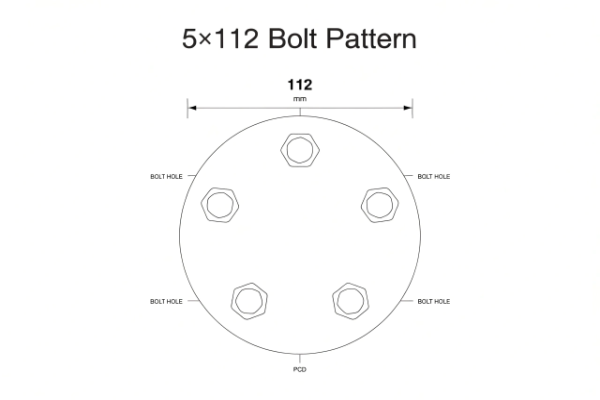
I want to be straightforward about something before we go further. Bolt pattern is a purely technical spec. There is no room for interpretation, and there is no such thing as "close enough." In this article, I will walk you through what 5×112 means, which vehicles use it, how it compares to other patterns, and what you should check before placing a wheel order. I will also share a real mistake we made in our own factory, because I think it is the most honest way to show you why this spec matters.
Which Vehicles Use the 5×112 Bolt Pattern?
If you work with European cars, you already know this pattern well. But if you are expanding your shop inventory or sourcing wheels for a new client, it is worth knowing exactly which brands and models fall under this spec.
The 5×112 bolt pattern is used by most major European car brands. This includes Mercedes-Benz, Audi, Volkswagen, Porsche (select models), BMW (select models), and SEAT. It covers a wide range of vehicle types, from sedans and SUVs to high-performance and luxury models.

The list below gives you a clearer picture of the most common vehicles using this pattern.
Common Vehicles by Brand
| Brand | Common Models |
|---|---|
| Mercedes-Benz | C-Class, E-Class, S-Class, GLC, GLE |
| Audi | A4, A6, A8, Q5, Q7, Q8 |
| Volkswagen | Golf, Passat, Tiguan, Touareg |
| Porsche | Cayenne (older gen), Panamera (select) |
| SEAT | Leon, Ateca |
These vehicles represent a large share of the luxury and premium modification market. If your clients drive European cars, they are very likely already asking about 5×112 wheels. Knowing this spec inside out is not optional for a serious dealer or modification shop. It is a basic requirement.
One thing I always tell my team: knowing the spec is one thing, but knowing why the spec exists is what separates a professional from someone who just reads the catalog. The 5×112 pattern exists because these vehicles were engineered with specific load tolerances, hub diameters, and brake clearance requirements. The bolt pattern is not just a mounting point. It is the connection between the wheel and the entire suspension and braking system of the car.
What Is the Difference Between 5×112 and 5×114.3 Bolt Patterns?
This is one of the most common questions I get from dealers, and I will be honest: the confusion is understandable on the surface, but it should not exist in practice.
5×112 and 5×114.3 both have five lug holes, but the pitch circle diameter is different. 5×112 is used mainly by European brands. 5×114.3 is used mainly by Japanese and American brands such as Toyota, Honda, Ford, and Nissan. These two patterns are not interchangeable.
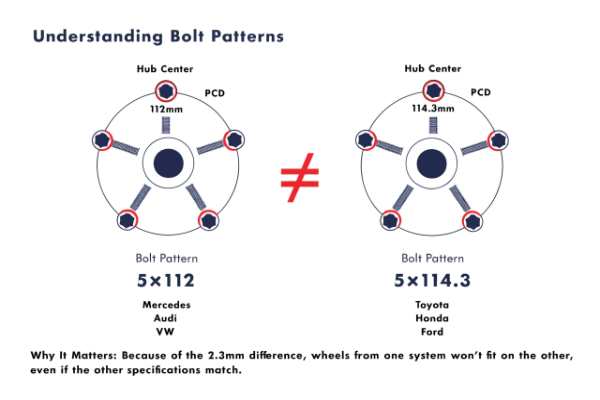
I like to explain it this way: 5×112 and 5×114.3 are like apples and pears. They look similar. They are both round. But they are completely different things. You do not eat an apple and call it a pear, and you do not put a 5×114.3 wheel on a car that needs 5×112.
Key Differences at a Glance
| Spec | 5×112 | 5×114.3 |
|---|---|---|
| Number of lugs | 5 | 5 |
| Pitch circle diameter | 112mm | 114.3mm |
| Common brands | Mercedes, Audi, VW, Porsche | Toyota, Honda, Ford, Nissan |
| Common markets | Europe | Japan, USA |
| Interchangeable? | No | No |
The 1.3mm difference sounds small. But in precision manufacturing, 1.3mm is enormous. I know this not just from theory, but from a real mistake we made in our own factory. A US client ordered 5×112 forged wheels. Due to a miscommunication between our sales team and our engineering team, the wheels were machined to 5×114.3. Our quality inspection team caught the error before the order shipped. We immediately arranged rush production to remake the correct wheels and delivered them on schedule.
Could we have used a wheel adapter to fix the problem? Yes. Adapters exist for this reason. But an adapter is a workaround, not a solution. It adds an extra component to the wheel assembly, and it will never perform as well as a wheel made to the correct spec from the start. That is a compromise I am not willing to pass on to a client. So we remade the wheels.
That experience reinforced something I already believed: this industry requires extreme care. Not just from the CNC machines, but from every person who touches the order.
Why Does Proper Bolt Pattern Fitment Matter for Safety and Performance?
Some dealers treat bolt pattern as a checkbox. I treat it as the foundation of the entire wheel order. Here is why.
A correct bolt pattern ensures the wheel sits flush and centered on the hub. A wrong bolt pattern creates uneven load distribution, which leads to vibration, premature wear on bearings and studs, and in serious cases, wheel detachment while driving. There is no safe workaround for a fundamentally incorrect fitment.
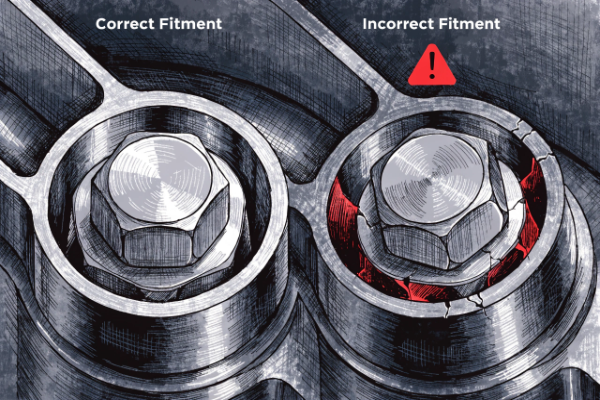
When a wheel is mounted with the wrong bolt pattern, even if it is physically forced onto the hub, the stress points shift. The lug nuts are no longer carrying the load evenly. Over time, this causes micro-fractures in the studs, accelerated wear in the wheel bearing, and vibration that the driver may not even notice until something fails.
What Goes Wrong With Incorrect Fitment
| Issue | Cause | Consequence |
|---|---|---|
| Vibration at speed | Uneven seating on hub | Driver discomfort, instability |
| Stud wear | Off-center load distribution | Stud failure over time |
| Bearing damage | Lateral stress on hub | Costly bearing replacement |
| Wheel detachment | Complete fitment failure | Serious accident risk |
I want to say something directly to dealers reading this. If you are buying wheels for your clients, you are responsible for what goes on their cars. A wrong bolt pattern wheel does not just come back as a return. It comes back as a liability. Our job as a manufacturer is to produce the correct spec. Your job as a dealer is to verify the spec before ordering. Both sides of this equation have to be right.
This is also why I believe in keeping our quality inspection team completely independent from our production team. They answer to no one except the quality standard. And when they catch a problem, we do not punish them. We reward them. That incentive structure matters enormously. It means our QC team has a real reason to find errors, not hide them. For a dealer, that means every order that ships from our facility has been reviewed by people who are motivated to get it right.
What Should Dealers Verify Before Buying 5×112 Wheels?
Ordering wheels without a full verification checklist is how mistakes happen. I have seen it from the supplier side, and I am sure you have seen it from the buyer side too.
Before ordering 5×112 wheels, dealers should verify the bolt pattern, center bore diameter, offset (ET), load rating, and surface treatment compatibility with the target vehicle. Confirming all five specs with the supplier before production starts is the best way to avoid costly fitment errors.
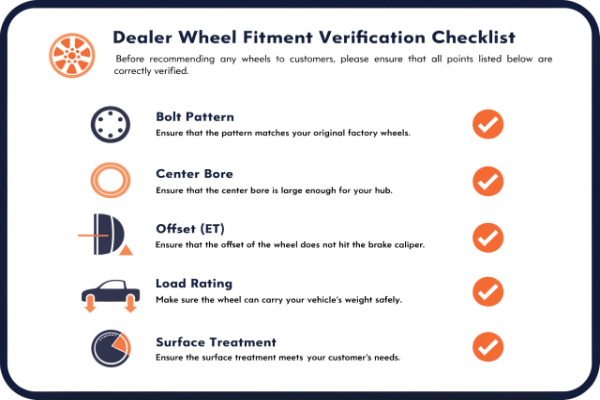
Let me break each of these down clearly.
Pre-Order Verification Checklist for Dealers
| Spec to Verify | Why It Matters | How to Confirm |
|---|---|---|
| Bolt pattern (5×112) | Determines physical fitment to hub | Check vehicle spec sheet or OEM data |
| Center bore | Ensures wheel sits centered on hub | Match to vehicle hub diameter exactly |
| Offset (ET value) | Controls wheel position inside arch | Check OEM offset and desired fitment |
| Load rating | Ensures wheel handles vehicle weight | Confirm with supplier before production |
| Surface treatment | Must survive driving conditions | Discuss finish and coating options |
The CNC machines we use are precise to a level where mechanical error is almost zero. I have seen our machines hold tolerances that would be impossible by hand. But machines only execute what humans input. If a salesperson writes down the wrong spec, the machine will produce the wrong part with perfect precision. The machine is not wrong. The person was wrong.
This is exactly what happened in our 5×112 vs 5×114.3 case. The machine did its job perfectly. The error was human. So when I say dealers need to verify specs, I am not being defensive about our process. I am acknowledging a reality that applies to every manufacturer in this industry. Errors happen on the human side. The best protection against them is a clear, confirmed spec before any cutting begins.
At Tree Wheels, we support dealers through this process by providing design sketches and 3D models before production starts. This gives you a chance to review the exact spec visually before the first piece of metal is touched. We also carry ISO9001, DOT, TÜV, and IATF16949 certifications, because we know that when something goes on a car at speed, it has to be right.
Conclusion
Bolt pattern is a technical spec with zero tolerance for error. Know your vehicle, verify your order, and work with a supplier who backs quality with real process. Tree Wheels delivers certified, custom forged wheels built to your exact spec, every time.