

Buying forged wheels without understanding T6 heat treatment is like buying a suit without checking the stitching. The label looks right, but the quality underneath can be completely different.
T6 heat treatment is a two-step process — solution heat treatment followed by artificial aging — that significantly increases the strength and hardness of aluminum alloys like 6061.1 For forged wheels, T6 is the standard because it delivers the best balance of tensile strength, hardness, and fatigue resistance.
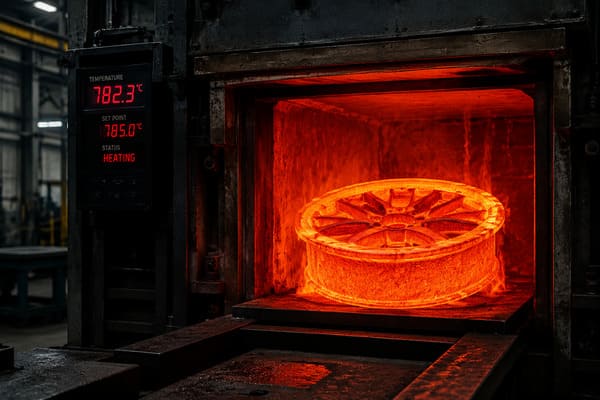
We have been producing forged wheels for over 20 years. In that time, T6 heat treatment has come up in nearly every serious conversation with buyers, engineers, and shop owners. Most people know the term. Far fewer understand what it actually means in production — and what happens when it goes wrong.
What Is T6 Heat Treatment?
Most suppliers will tell you T6 is a standard process. What they will not tell you is how little room for error it actually allows.
T6 heat treatment consists of two stages: solution heat treatment, where the alloy is heated to a precise temperature to dissolve alloying elements into a solid solution, followed by artificial aging, where the material is held at a lower temperature to allow controlled precipitation hardening. Both stages require tight control of temperature and time.2
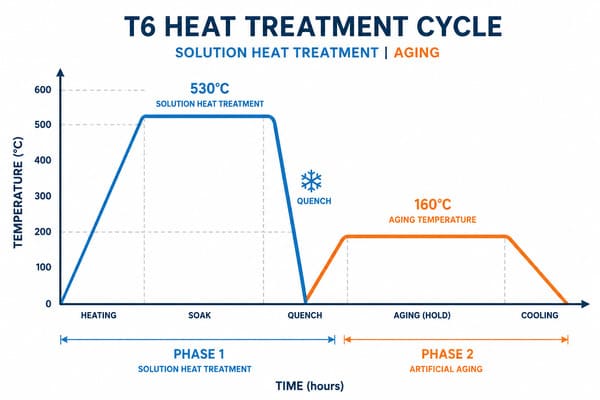
T6 is not a single step. It is a precision curve. The solution treatment temperature window for 6061 aluminum is only ±5°C.3 If the aging time is off by two hours, the hardness value can drop from 95HB to 80HB.4 That is not a minor variation — it is a structural failure waiting to happen.
I want to share something that happened in our early production. One batch of wheels came out of the aging furnace looking completely normal. No visible defects. No obvious problems. But when we ran hardness checks, the numbers were wrong across the entire batch. We traced the problem back to a thermocouple sensor in the aging furnace that had drifted over time. The actual furnace temperature was 8°C lower than the set point. The entire batch failed our hardness standard and had to be scrapped. That batch cost us close to 60,000 RMB.
After that, we made furnace sensor calibration a mandatory quarterly procedure. It is now written into our SOP. That experience taught us something we now say to every customer who asks about our quality control: real T6 is bought with equipment precision and process discipline, not by checking a box on a report.
Why Temperature Control Matters More Than Most People Think
| Parameter | Acceptable Range | Risk if Out of Range |
|---|---|---|
| Solution treatment temperature | ±5°C | Incomplete dissolution, low strength |
| Solution treatment time | Per alloy thickness | Under-treatment or grain coarsening |
| Aging temperature | ±5°C | Under-aging or over-aging |
| Aging time | ±1–2 hours | Hardness drop of 10–15 HB |
Every variable in this table interacts with the others. A furnace that is slightly cold during solution treatment cannot be corrected by extending aging time. The process does not work that way. Each stage must be correct on its own terms.
Is 6061-T6 Aluminum Forged?
Many buyers see "6061-T6" on a spec sheet and assume the wheels are equivalent. They are not.
6061-T6 is an aluminum alloy designation combined with a heat treatment temper.5 The alloy can be cast or forged.6 However, forged 6061-T6 and cast 6061-T6 have very different internal structures and mechanical properties. The forging process aligns the grain structure under high pressure, which casting cannot replicate, regardless of heat treatment.7
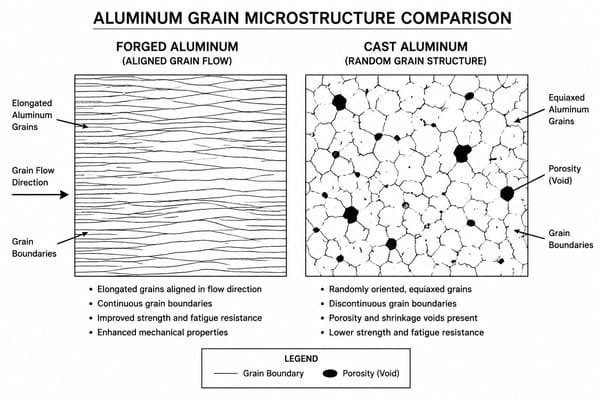
Cast aluminum parts have internal porosity and randomly oriented grains.8 T6 heat treatment improves their hardness and strength, but it cannot change the fundamental structure that casting creates. Forged aluminum starts from a different point entirely. High-pressure forming aligns the grain flow along the direction of stress. That alignment is built into the material before heat treatment even begins.
We have run comparative tests on this directly. The results are consistent:
Forged vs. Cast 6061-T6: Mechanical Property Comparison
| Property | Forged 6061-T6 | Cast 6061-T6 | Difference |
|---|---|---|---|
| Tensile Strength | 310+ MPa | ~200 MPa | ~35% higher |
| Yield Strength | 276 MPa | ~180 MPa | ~35% higher |
| Internal Porosity | Minimal | Present | Structural risk in cast |
| Grain Orientation | Aligned to stress | Random | Critical for fatigue life |
The same material designation. A 35% difference in tensile strength.9 That gap does not come from the alloy — it comes from the manufacturing process. When a supplier quotes you "6061-T6 forged wheels," the word "forged" is doing as much work as "T6." Both matter. Neither can substitute for the other.
This is why we only produce forged wheels. Not because casting is always wrong for every application, but because for high-performance wheels that carry real loads at real speeds, the structural starting point of a forging is not something we are willing to give up.
What Is the Difference Between T6 and T651?
T651 looks identical to T6 on a finished wheel. That is exactly what makes it easy to skip — and exactly why skipping it is a mistake.
T651 is a variation of T6 that adds a controlled stretching step after solution heat treatment.10 This step relieves internal residual stresses that build up during quenching.11 T6 does not include this step. For thick-section forgings like wheel blanks, T651 provides better dimensional stability and lower risk of stress-related cracking under cyclic loading.12
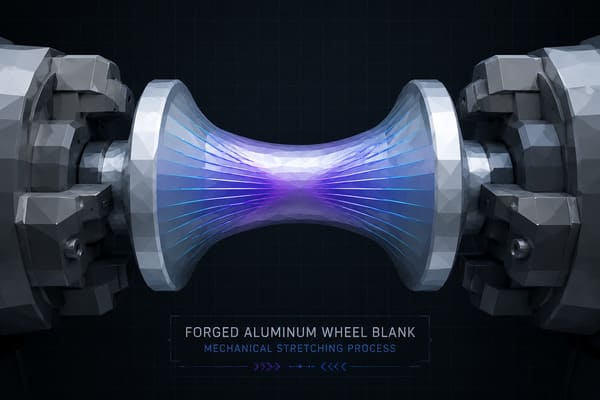
The extra stretching step in T651 adds roughly 5% to 8% to production cost. On a finished wheel, you cannot see the difference. The surface looks the same. The weight is the same. The dimensions are the same. The difference is entirely internal — and it only becomes visible under conditions that most buyers never anticipate during the purchase decision.
We had a customer who ordered a batch of forged wheels machined from thick blanks. During price negotiation, they chose T6 over T651 to reduce cost. The wheels performed normally for about eight months. Then two of them developed small cracks at the spoke roots. We investigated and confirmed the cause: residual stress releasing under long-term cyclic loading. The customer replaced the entire batch with T651 specification.
T6 vs. T651: When Does It Matter?
| Factor | T6 | T651 |
|---|---|---|
| Residual stress relief | No | Yes (controlled stretching) |
| Cost difference | Baseline | +5–8% |
| Risk in thin sections | Low | Low |
| Risk in thick forgings | Moderate | Significantly reduced |
| Visible difference on finished part | None | None |
| Recommended for wheel blanks | Acceptable for thin profiles | Strongly recommended for thick blanks |
Residual stress does not cause problems on day one. It does not cause problems on day 100. But it will find you after 500 hard braking events, or one particularly bad pothole at the wrong speed. The cost of upgrading to T651 during production is small. The cost of a field failure is not.
For any wheel produced from thick forging stock, our standard recommendation is T651. We do not present this as an optional upgrade. We present it as the correct specification for the application.
What Is the Difference Between T6 and T7 Heat Treatment?
T7 sounds like an improvement over T6. In some applications, it is. For wheels, it is the wrong trade.
T7 is an over-aging temper that improves corrosion resistance by approximately 20% compared to T6. However, it reduces yield strength from approximately 276 MPa to around 240 MPa — a drop of nearly 13%. For structural components like wheels that must resist sudden high loads, this strength reduction is a meaningful safety concern.
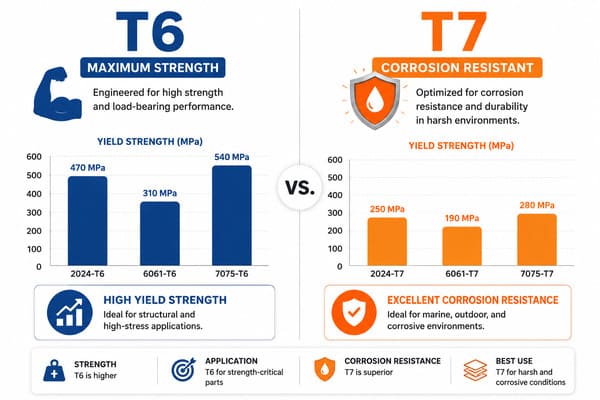
A 13% reduction in yield strength does not sound dramatic until you think about what yield strength actually controls. Yield strength is the point at which a material stops recovering and starts permanently deforming. For a wheel, that moment happens during emergency braking, during a hard curb strike, during any sudden load that exceeds normal operating conditions. A wheel that yields under those conditions does not just get scratched — it changes shape in ways that affect handling and safety.
We had a customer operating in Dubai’s desert climate who asked whether we could use T7 to improve corrosion resistance. It was a reasonable question. The environment there is genuinely harsh. My answer was direct: the wheel surface has coating protection, and corrosion is not the primary risk in that application. The real risk is the instantaneous load during emergency braking on a hot road at high speed. T7 is appropriate for aircraft skin panels, where corrosion resistance is critical and the load profile is different. It is not appropriate for a wheel that someone is braking hard every single day.
T6 vs. T7: Property Trade-Off Summary
| Property | T6 | T7 |
|---|---|---|
| Yield Strength | ~276 MPa | ~240 MPa |
| Strength Reduction | Baseline | ~13% lower |
| Corrosion Resistance | Baseline | ~20% better |
| Typical Application | Structural components | Corrosion-critical panels |
| Recommended for wheels | Yes | No |
Our position on this has never changed. Wheels use T6. That is not a conservative default — it is a decision based on the actual mechanical demands of the application. Better corrosion resistance means nothing if the wheel deforms under load.
Conclusion
T6 heat treatment is the foundation of forged wheel performance. Process precision, material structure, stress relief, and temper selection all determine whether a wheel is truly safe under load. At Tree Wheels, every forged wheel we produce is built on 20+ years of manufacturing discipline — because your safety depends on what happens inside the metal, not just what’s printed on the label.
-
"[PDF] Aluminum Alloy AA-6061 and RSA-6061 Heat Treatment for Large …", https://digitalcommons.usu.edu/cgi/viewcontent.cgi?article=1101&context=sdl_pubs. The source defines the T6 temper as solution heat treatment followed by artificial aging and reports the associated strengthening response in precipitation-hardenable aluminum alloys such as 6061. Evidence role: definition; source type: institution. Supports: T6 treatment consists of solution heat treatment and artificial aging and increases strength and hardness in 6061 aluminum.. ↩
-
"[PDF] Precipitation hardening", https://users.mrl.illinois.edu/cahill/308/precipitation.pdf. The source explains that solution treatment and artificial aging outcomes in precipitation-hardenable aluminum alloys depend on specified time-temperature conditions, supporting the need for process control. Evidence role: mechanism; source type: education. Supports: Solution heat treatment and artificial aging require close control of temperature and time.. Scope note: The source may support the general metallurgical mechanism rather than the exact tolerances used by a specific wheel manufacturer. ↩
-
"[PDF] Process Specification for the Heat Treatment of Aluminum Alloys", https://www.nasa.gov/wp-content/uploads/2023/03/prc-2002-current.pdf. The source provides recommended solution heat-treatment temperature ranges for 6061 aluminum, allowing the stated narrow process window to be evaluated against published practice. Evidence role: statistic; source type: institution. Supports: 6061 aluminum solution heat treatment uses a narrow temperature window on the order of a few degrees Celsius.. Scope note: Published ranges may vary by product form, thickness, furnace class, and governing specification; they may not exactly match a single manufacturer’s ±5°C control limit. ↩
-
"Structural And Mechanical Response of Artificially Aged Aluminum …", http://ui.adsabs.harvard.edu/abs/2021StMat..53..502A/abstract. The source reports the dependence of 6061 aluminum hardness on artificial-aging time and temperature, providing context for the magnitude of hardness loss caused by under-aging or over-aging. Evidence role: statistic; source type: paper. Supports: Aging-time deviations can substantially reduce Brinell hardness in 6061 aluminum.. Scope note: The exact 95 HB to 80 HB change may depend on alloy chemistry, prior working, section size, and aging temperature, so a study may support the trend rather than the exact production value. ↩
-
"Aluminum Alloys and Their Classification – Properties of Materials", https://www.ae.msstate.edu/vlsm/materials/alloys/aluminum.htm. The source identifies 6061 as an aluminum alloy designation and T6 as a temper designation, supporting the distinction between composition and heat-treatment condition. Evidence role: definition; source type: institution. Supports: 6061-T6 combines an alloy designation with a heat-treatment temper designation.. ↩
-
"[PDF] Aluminum Metallurgy – Mechanical & Aerospace Engineering", https://web.mae.ufl.edu/designlab/Online%20Resources_files/Omega%20Research%20Aluminum%20Metallurgy%20Info.pdf. The source documents that aluminum alloys can be processed by casting or forging routes and that product form is distinct from alloy-temper designation. Evidence role: definition; source type: education. Supports: An alloy-temper label does not by itself specify whether a part was cast or forged.. Scope note: Some 6061 compositions and product specifications are more commonly associated with wrought products; the source may support the broader distinction between alloy designation and manufacturing process rather than all commercial wheel practices. ↩
-
"Influence of the Grain-Flow Orientation after Hot Forging Process …", https://preserve.lehigh.edu/lehigh-scholarship/faculty-and-staff-publications/faculty-publications/influence-grain-flow. The source explains that forging deforms metal to produce directional grain flow, whereas casting solidifies from the melt and does not create the same wrought grain-flow pattern. Evidence role: mechanism; source type: education. Supports: Forging can produce directional grain flow that differs from cast microstructure.. Scope note: The degree and usefulness of grain-flow alignment depend on forging design, reduction ratio, and subsequent machining. ↩
-
"[PDF] Prediction of porosity characteristics of aluminium castings based on …", https://beckermann.lab.uiowa.edu/sites/beckermann.lab.uiowa.edu/files/2023-10/PorosityCT.pdf. The source describes porosity as a common casting defect and explains that cast metals solidify into microstructures that differ from the directional grain flow produced by wrought processing. Evidence role: mechanism; source type: education. Supports: Cast aluminum parts may contain porosity and generally lack forged directional grain flow.. Scope note: Porosity level and grain morphology vary with casting method, alloy, melt quality, and process control; the claim should not imply every casting has the same defect severity. ↩
-
"6061 aluminium alloy – Wikipedia", https://en.wikipedia.org/wiki/6061_aluminium_alloy. The source provides comparative mechanical-property data for cast and forged or wrought 6061-T6 aluminum, enabling assessment of the claimed tensile-strength difference between manufacturing routes. Evidence role: statistic; source type: institution. Supports: Forged or wrought 6061-T6 can have substantially higher tensile strength than cast 6061-T6.. Scope note: Mechanical properties depend on product form, heat treatment, test direction, and casting quality; a source may support a representative difference rather than a universal 35% value. ↩
-
"[PDF] Understanding the Aluminum Temper Designation System", https://materialsdata.nist.gov/bitstream/handle/11115/186/Understanding%20Temper%20Designation.pdf?sequence=3&isAllowed=y. The source defines the T651 temper as solution heat treated, stress relieved by controlled stretching, and artificially aged, distinguishing it from T6. Evidence role: definition; source type: institution. Supports: T651 differs from T6 by including a controlled stretching stress-relief step.. ↩
-
"Quenched Residual Stress Reduction in Pentagon-Curved … – PMC", https://pmc.ncbi.nlm.nih.gov/articles/PMC10489121/. The source explains that quenching aluminum alloys can introduce residual stresses and that stretching is used as a stress-relief method for T651-type tempers. Evidence role: mechanism; source type: paper. Supports: Controlled stretching after quenching reduces residual stresses in heat-treated aluminum products.. Scope note: Residual-stress magnitude depends on section thickness, quench rate, geometry, and stretching practice. ↩
-
"Through-thickness microstructure and residual stress distributions in …", https://impact.ornl.gov/en/publications/through-thickness-microstructure-and-residual-stress-distribution/. The source discusses residual stress in thick aluminum sections and the role of stress-relief stretching in improving dimensional stability and reducing stress-related failure risk. Evidence role: general_support; source type: paper. Supports: T651 stress relief is beneficial for thick aluminum forgings because it improves dimensional stability and reduces residual-stress risk.. Scope note: Direct evidence for forged wheel blanks specifically may be limited; the source may support the broader behavior of thick heat-treated aluminum sections under machining or service loads. ↩