

PCD is one of the most critical numbers in any custom wheel order. Get it wrong, and the wheels simply will not fit — no matter how perfect everything else looks.
PCD stands for Pitch Circle Diameter. It is the diameter of an imaginary circle that passes through the center of each wheel bolt hole. You express it as a combination of bolt count and diameter, such as 5×114.3. This number tells you whether a wheel will physically mount onto a vehicle.
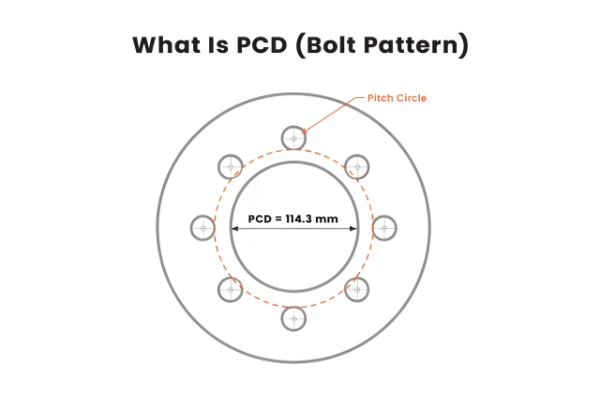
At Tree Wheels, we deal with PCD data every single day. It comes up in every order, every design review, and every fitment check. It is not a complicated concept, but it is the one number that can make or break an entire order. The rest of this article breaks down everything you need to know about PCD — from how to find yours, to how to measure it, to why the name you use for it depends on where you live.
How Do I Know My PCD Size?
If you are planning a custom wheel order and you are not sure about your PCD, you are not alone. Most customers either already have the number, or they know their vehicle model and expect us to look it up.
There are two ways to get your PCD. You can provide the number directly, or you can give us your vehicle make, model, and year and we will cross-check it against our database. Both approaches work. But the most reliable approach is always to provide the confirmed number directly.
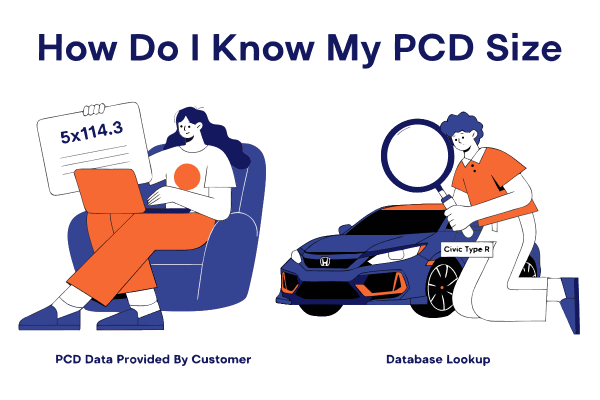
The real risk in PCD is not that customers do not understand what it means. The real risk is a typo, a misread, or a number copied from the wrong source. We see this more often than you might expect.
This is why our design team runs a cross-verification step at the drawing stage. We take the PCD number a customer provides and compare it against the vehicle database. If the two do not match, we stop and contact the customer before anything goes into production.
Why This Step Matters More Than It Looks
This verification step is small. It takes a few minutes. But it has saved real money — for us and for our customers — more times than we can count.
| Scenario | What Happens Without Verification | What Happens With Verification |
|---|---|---|
| Customer provides correct PCD | Production proceeds normally | Production proceeds normally |
| Customer provides wrong PCD (typo) | Wheels are produced, wheels do not fit, order fails | Error is caught before production starts |
| PCD data conflicts with vehicle database | No flag is raised | We contact customer to confirm before cutting |
The cost of a production error on forged wheels is not small. Forged wheels are not stamped out of sheet metal. They are machined from solid billet. If a wheel is produced with the wrong bolt pattern, it cannot be corrected after the fact. The wheel has to be scrapped. This is why we treat PCD verification as a non-negotiable step in our process, not an optional courtesy.
If you are placing an order with us and you are even slightly uncertain about your PCD, tell us. We would rather spend ten minutes confirming the number than both of us deal with the consequences of getting it wrong.
What Is 5×114.3 PCD in Inches?
5×114.3 is one of the most common specifications we work with. It is a dominant fitment across Japanese and Korean vehicles, and it appears at high volume across our key markets — the United States, Australia, and the Middle East.
5×114.3 means 5 bolt holes arranged on a circle with a diameter of 114.3 millimeters. In inches, 114.3mm equals exactly 4.5 inches, which is why this spec is sometimes written as 5×4.5 in American markets. Both refer to the same physical measurement.
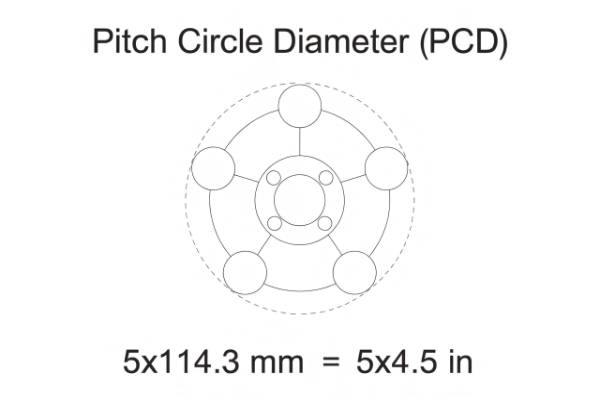
I want to be direct about something here. The unit conversion itself — from millimeters to inches — does not carry much practical value for most customers. What matters is that your number is accurate, not which unit system it is expressed in.
Why Mixing Units Creates Problems
In our experience, unit confusion is one of the most common sources of order errors. A customer in the US writes "5×4.5" and a customer in Australia writes "5×114.3" — they mean the same thing, but if our team does not catch the format difference, it can create unnecessary delays and back-and-forth communication.
| Metric Expression | Imperial Equivalent | Common In |
|---|---|---|
| 5×114.3 mm | 5×4.5 in | Japan, Korea, Australia, Middle East |
| 5×120 mm | 5×4.72 in | Europe, BMW, GM platforms |
| 6×139.7 mm | 6×5.5 in | Trucks, 4WD vehicles, North America |
| 4×100 mm | 4×3.94 in | Small passenger cars, Europe |
At Tree Wheels, we use millimeters as our standard across all orders and all markets. This is a deliberate choice. It removes ambiguity. When every specification is expressed in the same unit system, there is one less variable that can go wrong between the customer’s intent and what gets machined.
If you know your bolt pattern in inches, that is fine — just tell us, and we will convert it. But if you are gathering your own measurements, work in millimeters. It keeps everything cleaner.
How to Tell What Size Bolt Pattern a Rim Is?
Sometimes a customer comes to us without any documentation on their current wheels. They have an aftermarket rim, an older vehicle, or a set of wheels with no visible markings. In that case, they need to measure the bolt pattern themselves.
To measure a bolt pattern, count the number of bolt holes first. Then measure the distance between bolt hole centers. For even-numbered holes (4, 6, 8), measure straight across from center to center of two opposite holes. For 5-bolt wheels, use a specific formula because no two holes sit directly opposite each other.
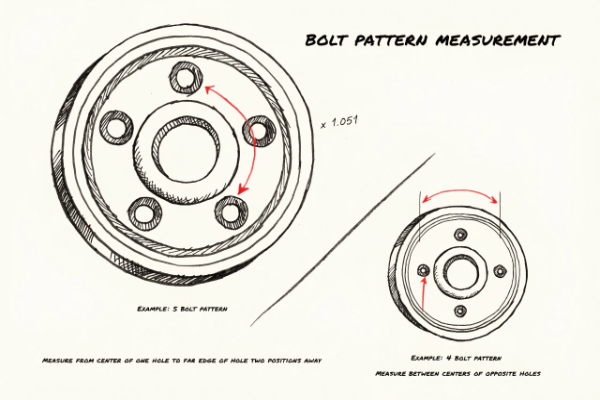
The method changes depending on how many bolt holes the wheel has. This is the part most people get wrong.
Measurement Method by Bolt Count
For a 4-bolt or 6-bolt wheel, the process is straightforward. Two bolt holes will sit directly across from each other. Measure from the center of one hole to the center of the hole directly opposite. That distance is your PCD.
For a 5-bolt wheel, there is no hole directly opposite any given hole. You need to use a formula.
5-bolt PCD formula:
Measure from the center of one bolt hole to the far edge of the hole that is two positions away (skipping one hole). Multiply that measurement by 1.051.
| Bolt Count | Measurement Method | Notes |
|---|---|---|
| 4-bolt | Center-to-center of opposite holes | Direct measurement, straightforward |
| 5-bolt | Center to far edge of hole two positions away × 1.051 | Formula required, easy to get wrong |
| 6-bolt | Center-to-center of opposite holes | Direct measurement, same as 4-bolt logic |
| 8-bolt | Center-to-center of opposite holes | Direct measurement, same logic |
A vernier caliper gives you the most accurate result. But this measurement requires the wheel to be removed from the vehicle. That is a professional operation. If you are not experienced with wheel removal, we strongly recommend going to a local workshop and having a technician take the measurement for you. A small shop visit now is much less costly than a production error later.
Once you have the number, cross-check it against the vehicle manufacturer’s spec sheet if you can. If the two match, you can submit that number with confidence.
Is PCD the Same as Stud Pattern?
Yes. PCD and stud pattern refer to the same thing. This question comes up because our customers come from different countries, and different markets use different terms for the same measurement.
PCD (Pitch Circle Diameter), bolt pattern, and stud pattern all describe the same specification: the number of wheel bolts and the diameter of the circle they sit on. The term used depends on the region. "Bolt pattern" is most common in the US. "Stud pattern" is preferred in Australia and the UK. "PCD" is the standard technical term used across the industry globally.
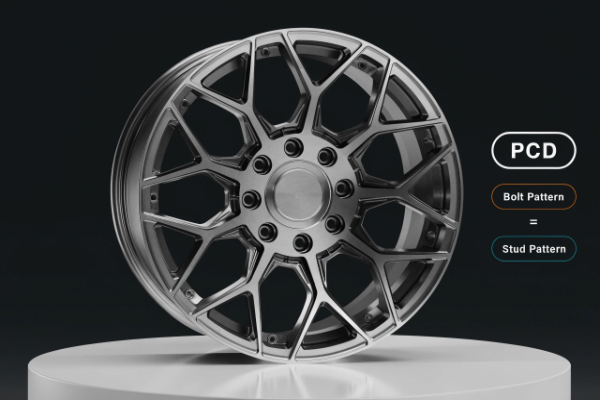
We serve customers across the United States, Canada, Australia, the UK, and the Middle East. In practice, this means we regularly receive inquiries where the same data point is described using three different terms within the same week. Without a clear understanding that these terms are interchangeable, that creates real friction — delays in order confirmation, extra back-and-forth, and occasionally, genuine confusion about whether two customers are asking for the same spec.
Why Terminology Matters Across Markets
Understanding this naming difference is not just trivia. It has a direct impact on how efficiently an order moves from inquiry to production.
| Term | Most Common Region | Context |
|---|---|---|
| PCD (Pitch Circle Diameter) | Global / Technical | Industry standard, used in engineering and manufacturing |
| Bolt Pattern | United States, Canada | Consumer-facing, widely understood in North American aftermarket |
| Stud Pattern | Australia, United Kingdom | Consumer-facing, standard usage in these markets |
When a customer from Sydney writes "stud pattern 5×114.3" and a customer from Los Angeles writes "bolt pattern 5×4.5," they are asking for the same wheel. Our team recognizes this immediately. But customers who are sourcing from multiple suppliers — especially suppliers who only operate in one market — may run into confusion when the terms do not match.
If you are ever unsure which term to use when placing an order with us, do not worry about it. Use whatever term feels natural to you. What we need from you is the number, not the label. A clear, accurate spec in any terminology is all we need to move forward.
Conclusion
PCD is a simple number, but it controls everything about wheel fitment. Know yours, verify it, and express it clearly — that is all it takes. Tree Wheels offers fully customized forged wheels with expert fitment support for every order.