
Most buyers look at wheel design, finish, and price. They skip the material spec entirely. That is a mistake that can cost you more than money.
6061-T6 aluminum is an aluminum alloy where "6061" defines the exact composition of magnesium and silicon, and "T6" defines the heat treatment process applied after forging. Together, they determine the wheel’s real-world strength, weight, and durability — not just its label.
Most articles about 6061-T6 stop at the numbers. I want to take a different angle. The name itself is a promise — a two-part promise about material composition and manufacturing process. When a supplier tells you they use 6061-T6, you are actually asking two separate questions at once: did they get the alloy right, and did they complete the heat treatment correctly? A factory that buys 6061 aluminum but skips or shortens the T6 heat treatment step will still call the wheel "6061-T6." But the actual strength may be 30% lower than the spec promises. This article will help you understand the material — and more importantly, use it to screen your suppliers.
What exactly is 6061-T6 aluminum, and why do wheel manufacturers use it?
Many wheel buyers assume the strongest aluminum makes the best wheel. That assumption leads to the wrong choice every time.
6061-T6 is not the hardest aluminum alloy available, but it is the most suitable for wheel manufacturing. It sits at the ideal balance point between strength and toughness — hard enough to hold precise forged geometry, flexible enough to absorb road impact without fracturing. That balance is what makes it the industry standard.
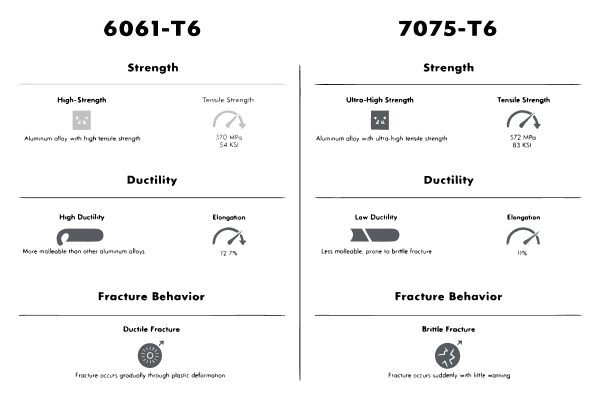
A common question we hear is: why not use 7075 aluminum? It is stronger than 6061 on paper. The answer is that 7075 has significantly lower ductility. When it takes a sharp impact — a pothole, a curb hit, a sudden load — it tends to crack rather than bend. A wheel that cracks without warning is a safety failure. A wheel that bends gives the driver a chance to react. For a wheel application, you do not want the hardest material. You want a material that is strong enough, and smart enough to fail slowly.
| Property | 6061-T6 | 7075-T6 |
|---|---|---|
| Tensile Strength | ~310 MPa | ~570 MPa |
| Yield Strength | ~276 MPa | ~503 MPa |
| Elongation (ductility) | ~12% | ~11% |
| Fracture Behavior | Bends under overload | Cracks under overload |
| Typical Wheel Use | Industry standard | Aerospace, not wheels |
6061-T6 is not chosen because it is the most expensive or the most impressive-sounding alloy. It is chosen because it is the most predictable material under real road conditions. At our facility, with over 20 years of forged wheel production experience, we use 6061-T6 because we know exactly how it will behave at every wall thickness and every spoke geometry. That predictability is what allows our engineers to design with confidence, not just caution.
How does 6061-T6 aluminum affect the strength and weight of your wheels?
Every supplier claims their forged wheels are lighter. But lighter is not an accident — and not every supplier earns that weight reduction honestly.
6061-T6 allows engineers to calculate the precise load-bearing capacity at each section of the wheel. This means material can be intentionally removed — deeper spokes, thinner inner walls, controlled cross-sections — without sacrificing structural integrity. The weight reduction is engineered, not incidental.
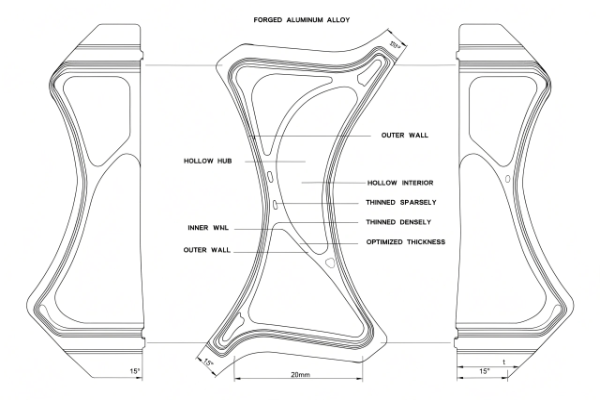
Most comparison articles will tell you that a forged wheel is X kilograms lighter than a cast wheel. That number is real, but it misses the more important point. The weight reduction in a well-designed 6061-T6 forged wheel is not a byproduct of the process. It is the goal that drives every design decision from the start.
Why "actively lightweight" is different from "accidentally lighter"
When our engineers design a forged wheel in 6061-T6, they begin with the known performance boundaries of the material. They know the tensile strength, the yield strength, and the fatigue behavior at specific thicknesses. That knowledge gives them permission to remove material where it is not needed, and keep material precisely where it is.
A manufacturer who does not fully understand the performance parameters of 6061-T6 cannot do this. They are forced to add extra wall thickness everywhere, as a safety buffer, because they cannot calculate where the real limit is. The result is a wheel that is heavier than it needs to be and wastes material in every unit produced.
| Design Approach | Material Knowledge Required | Result |
|---|---|---|
| Conservative (unknown limits) | Low — use extra material "just in case" | Heavier wheel, wasted material |
| Engineered (known limits) | High — remove material where safe | Lighter wheel, optimized strength |
| Active lightweighting | Full 6061-T6 property mastery | Best strength-to-weight ratio |
This is why buying a forged wheel from a supplier with deep 6061-T6 manufacturing experience produces a fundamentally different product — not just a slightly better one. The material and the design competence have to exist together.
Why do forged wheels made from 6061-T6 aluminum last longer than cast wheels?
When cast wheels fail, the failure is usually a surprise. That surprise is the most dangerous part.
6061-T6 forged wheels outlast cast wheels not just because of higher strength, but because of how they fail. Forged grain structure under 6061-T6 produces gradual, visible fatigue progression. Cast wheels often fail suddenly due to internal porosity. The difference in failure mode is as important as the difference in lifespan.
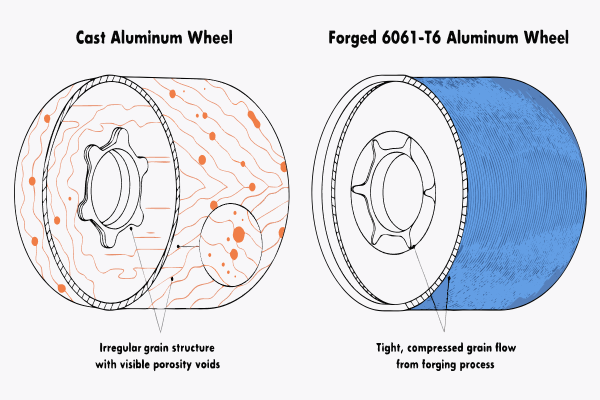
Cast wheels and forged wheels do not wear out the same way. Cast wheels typically die suddenly. Internal gas pockets — unavoidable in the casting process — can expand into cracks after a significant impact. From the outside, the wheel looks normal. Then it fails without warning. Forged 6061-T6 wheels age gradually. Fatigue accumulates over time, but the progression is visible. A careful inspection will catch early deformation before it becomes a safety event.
Understanding the failure modes side by side
When I talk with modification shop owners and managers about wheel failures they have seen, I ask one specific question: how many of those failures gave you no warning at all? The answer almost always points to cast components. The shop owners who have switched their customers to forged wheels consistently report that failure events become detectable earlier — a slight wobble, a visible stress mark — rather than catastrophic.
| Failure Characteristic | Cast Wheel | 6061-T6 Forged Wheel |
|---|---|---|
| Internal defects | Gas porosity common | Eliminated by forging pressure |
| Failure progression | Sudden, no visible warning | Gradual, detectable early |
| Post-impact behavior | Crack propagation from voids | Controlled deformation |
| Inspection detectability | Low — internal cracks invisible | Higher — surface changes visible |
| Safety window before failure | Very short or none | Measurable warning period |
This is what we mean when we say a forged 6061-T6 wheel "fails more politely." It does not mean the wheel will never fail. It means that when it does reach its limit, it gives the driver time and information. At highway speeds, that window is not a small detail. It is the difference between a manageable situation and a fatal one.
Does the aluminum grade really matter when you are choosing a set of wheels?
Yes — but it is not the only thing that matters. Knowing the alloy name is just the beginning of the right question.
Aluminum grade matters, but it is one of three variables that together determine actual wheel quality. The other two are forging pressure parameters and whether T6 heat treatment was executed correctly. All three must be right. If any one is missing, the material label becomes a marketing label, not a performance guarantee.
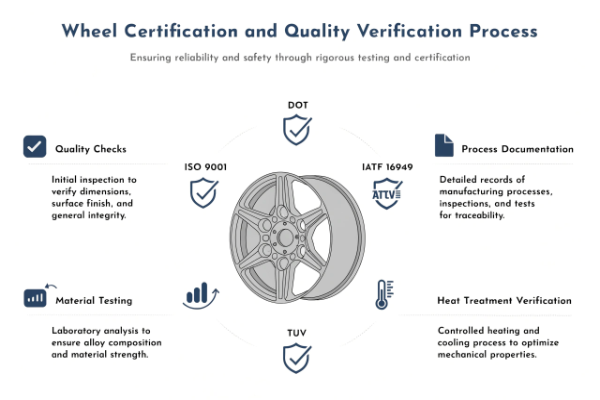
When a buyer asks me whether the aluminum grade matters, I redirect them to a more useful question: can this supplier prove all three variables were done correctly? The alloy spec, the forging pressure, and the heat treatment are all invisible in the finished product. You cannot see them by looking at the wheel. That is exactly why third-party certification exists.
A practical framework for evaluating suppliers
ISO 9001, DOT, TÜV, and IATF 16949 certifications are not decorations on a spec sheet. Each one represents an external audit of manufacturing processes. When a supplier holds all four, a third party has already checked whether the process — not just the material order — was executed to standard. That is the closest you can get to verifying those three variables without being in the factory yourself.
| Variable | What to Ask the Supplier | How Certification Helps |
|---|---|---|
| Alloy composition (6061) | Can you provide material test reports? | ISO 9001 requires documented material traceability |
| Forging pressure parameters | What tonnage is used in your forging process? | IATF 16949 covers process control documentation |
| T6 heat treatment execution | What are your heat treatment temperature and time specs? | TÜV and DOT testing validates real mechanical properties |
A supplier who can answer all three questions with documentation, and who holds recognized certifications, is a supplier who has done more than buy the right aluminum. They have built a process that consistently delivers what the label says. That is the standard we hold ourselves to at Tree Wheels — because the name 6061-T6 should mean the same thing every time, on every wheel, for every customer.
Conclusion
6061-T6 is not just a material code. It is a two-part promise about composition and process. When both are kept, you get a wheel that is strong, light, and honest about how it ages. Tree Wheels — where every forged wheel is built on 20 years of expertise, certified quality, and sincerity above all.