
Most car owners obsess over how a wheel looks. They never check whether it can actually handle the weight of their vehicle. That gap in knowledge is dangerous.
Load ratings tell you the maximum weight a single wheel is engineered to carry safely. Most drivers skip this spec entirely. But it directly determines whether your wheel holds up under real driving conditions — or fails. Matching your wheel’s load rating to your vehicle type is not optional. It is a basic safety requirement.
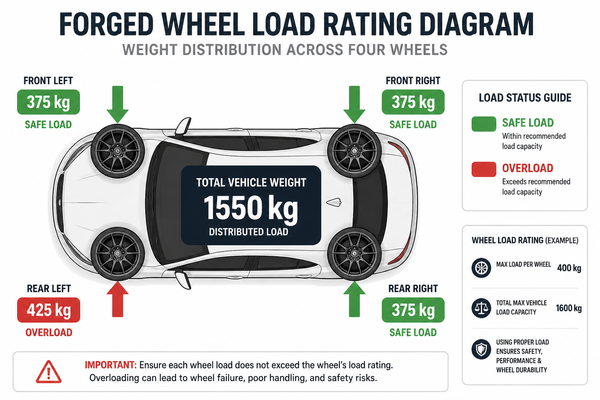
From my experience working with forged wheel manufacturing, I see this mistake constantly. Customers pick a wheel based on finish and spoke design. They ask about load rating as an afterthought — if they ask at all. This article breaks down what load ratings actually mean, how they are calculated, and what happens when you get them wrong.
What Should My Wheel Load Rating Be?
Most people think this is a complicated question. It is not. But it does require one step that most buyers skip entirely — actually looking up their vehicle type before choosing a wheel.
For most vehicles, the answer falls into three clear categories: passenger cars require a minimum of 750 kg per wheel, SUVs require 950 kg, and off-road vehicles require 1,200 kg. Your wheel’s load rating must meet or exceed the standard for your vehicle type. Going higher is fine. Going lower is not.
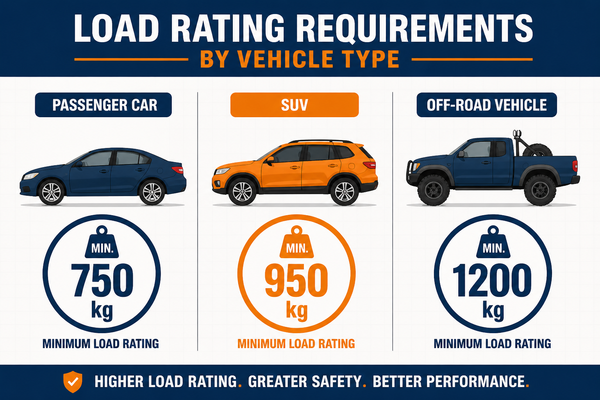
I always tell customers the same thing: your wheel’s load rating is the floor, not the ceiling. A higher rating than required adds a safety buffer. A lower rating puts you below the minimum threshold your vehicle demands. These three numbers — 750, 950, and 1,200 kg — come directly from real vehicle weight data, not from guesswork.
Why These Three Numbers Matter
The reason passenger cars, SUVs, and off-road vehicles each have a different standard is straightforward. Their weight profiles are fundamentally different, and the forces transferred to each wheel during driving are different as a result.
| Vehicle Type | Minimum Load Rating Per Wheel |
|---|---|
| Passenger Car | 750 kg |
| SUV | 950 kg |
| Off-Road Vehicle | 1,200 kg |
A passenger car distributes less total weight across four wheels than an SUV does. An off-road vehicle adds the extra demand of rough terrain impact loads on top of its base weight. The minimum load rating for each category reflects the realistic worst-case load that a single wheel must survive. If your wheel is rated below that number, it was not built for your vehicle — regardless of how it looks.
What Is a Wheel Load Rating and How Is It Measured?
A load rating sounds like a marketing number. It is not. It is an engineering specification, and it starts with a formula — not a guess.
A wheel load rating is the maximum static weight a single wheel is designed and tested to carry safely. It is calculated from vehicle curb weight and passenger load, then rounded up to the nearest standard engineering tier. The standard tiers are: 690, 725, 750, 800, 850, 950, 1,000, 1,100, and 1,200 kg.
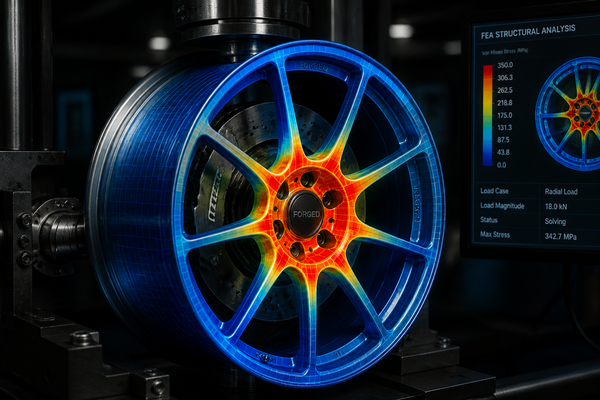
Here is how we actually calculate it at our factory. We start with the vehicle type — passenger car or SUV — because the weight profile is different from the start. Then we apply this formula:
(Number of passengers × 100 kg × 1.3 + Curb weight) ÷ 4
That gives us a baseline load figure per wheel. We then round up to the next standard tier. If the formula gives us 860 kg, we design the wheel to a 950 kg rating — never 850 kg. We always go up.
From Formula to Finished Wheel
Once the target load rating is set, the process does not stop at calculation. We run FEA — Finite Element Analysis — structural simulations before any physical production begins. But here is the part most people do not know: we do not test at the rated load. We test at rated load × 1.1 as the maximum load input.
| Rated Load | FEA Test Load | Safety Buffer |
|---|---|---|
| 750 kg | 825 kg | +75 kg |
| 950 kg | 1,045 kg | +95 kg |
| 1,200 kg | 1,320 kg | +120 kg |
So a 950 kg rated wheel is stress-tested at 1,045 kg before we sign off on the design. The drawing still shows the official rated load. Internally, we have already proven the wheel can handle more. That gap is not an accident. It is a deliberate safety margin built into every wheel we produce. This is what separates a properly engineered forged wheel from one that is simply stamped with a number.
How Does Load Rating Affect Your Vehicle’s Safety on the Road?
A wheel operating near its load limit does not just risk snapping. The danger is more gradual — and harder to notice until it is too late.
Load rating directly affects how a wheel performs under dynamic stress — cornering, hard braking, and impact from potholes. A wheel used at or beyond its rated capacity will deform microscopically over time, develop fatigue cracks, and eventually fail. It will rarely give you a visible warning before it does.
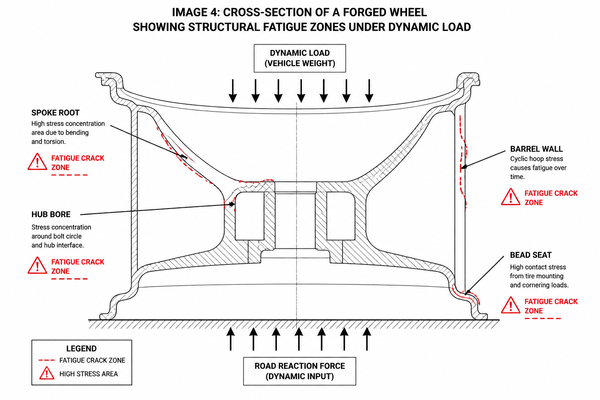
I want to be direct here. A beautiful wheel that is underrated for your vehicle is not a wheel. It is a liability. The safety implications are especially serious for heavier vehicles — trucks, loaded SUVs, and performance cars with heavy brake systems. These vehicles put more constant stress on each wheel, and that stress compounds over thousands of kilometers.
Dynamic Load vs. Static Load: Why the Difference Matters
The load rating on a wheel is based on static load — the weight the wheel carries when the car is sitting still. But a moving vehicle creates forces that are much larger than static weight alone.
| Driving Condition | Load Multiplier (Approximate) |
|---|---|
| Straight highway driving | 1.0× to 1.2× |
| Hard cornering | 1.5× to 2.0× |
| Pothole impact at speed | 2.5× to 4.0× |
| Combined braking + cornering | 2.0× to 3.0× |
This is why the 1.1× safety margin we build into our FEA testing matters. A wheel rated at 950 kg and tested to 1,045 kg has a built-in buffer for real-world dynamic loads. A wheel that only just meets the rated load with no margin has no room left for the forces that happen every day in real driving. The load rating is not a theoretical ceiling. It is the minimum engineering threshold your wheel must clear before it can safely carry your vehicle.
What Happens If You Choose a Wheel With the Wrong Load Rating?
Most people picture a wheel shattering dramatically. That is the extreme case. The more common outcome is slower, quieter, and harder to catch.
Choosing a wheel with an insufficient load rating leads to progressive structural fatigue. The wheel deforms gradually, the bead seal weakens, and you experience slow leaks, uneven tire wear, and unpredictable handling. This process often ends in a sudden blowout or wheel separation — with no warning before it happens.
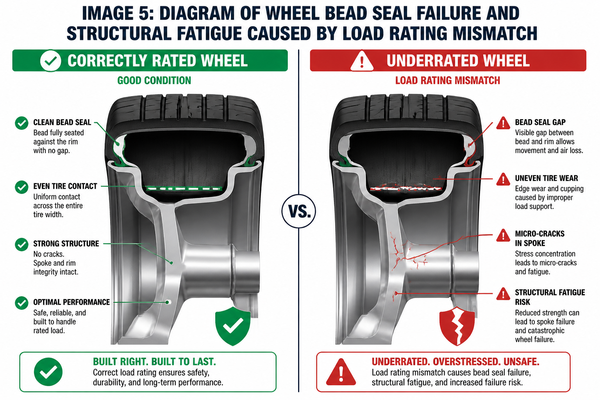
I raise this not to scare anyone, but because I think every wheel buyer deserves to know what the actual failure chain looks like. It does not start with a bang. It starts with a slow tire leak you cannot explain. Then slightly uneven wear on one side. Then a handling characteristic that feels slightly off. By the time something dramatic happens, the damage has been building for months.
The Legal and Insurance Risk Nobody Mentions
There is a dimension to this that almost nobody in the aftermarket wheel industry talks about openly. If you are in an accident and investigators determine that your aftermarket wheels were not rated for your vehicle’s weight, the consequences go beyond the accident itself.
| Risk Area | Potential Consequence |
|---|---|
| Insurance claim | Claim may be denied due to non-compliant parts |
| Legal liability | You may be found responsible for the accident |
| Vehicle inspection | Underrated wheels may result in a failed roadworthy check |
| Resale value | Undocumented aftermarket modifications can reduce vehicle value |
Insurance companies and accident investigators do look at aftermarket modifications. A wheel that does not meet the rated load for your vehicle class is a non-compliant modification. That single fact can shift legal and financial liability entirely onto you. I am not saying this to discourage customization. I am saying it because choosing the right load rating from the start costs nothing extra — and it eliminates this risk entirely. At Tree Wheels, every wheel we produce carries a documented load rating that meets or exceeds the standard for its intended vehicle class. That documentation is not just paperwork. It is protection for our customers.
Conclusion
Load rating is not a minor detail. It is the spec that determines whether your wheel is safe for your vehicle — and ignoring it has real consequences, on the road and legally. Tree Wheels builds every forged wheel to certified load standards, so your customization never comes at the cost of safety.