Choosing the wrong wheels for your vehicle can lead to compromised performance, safety issues, and wasted money. Many drivers feel overwhelmed by conflicting information about forged versus cast wheels.
Forged wheels offer higher strength-to-weight ratios, superior impact resistance, and better structural integrity than cast wheels. Cast wheels are more affordable and sufficient for everyday driving, while forged wheels excel in performance applications like track racing or serious off-roading.
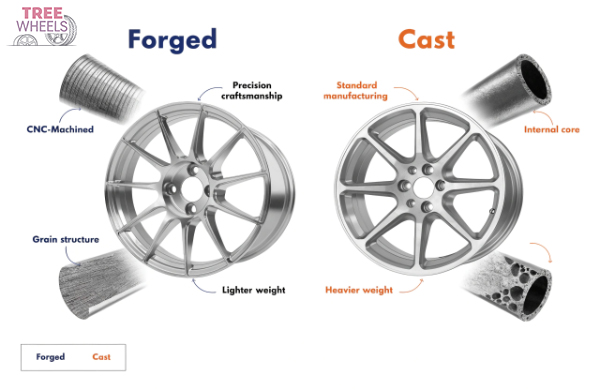
When it comes to wheel selection, the debate between forged and cast options often centers on performance differences. While marketing often pushes forged wheels as the superior choice, the reality is more nuanced. As a manufacturer specializing in high-end forged wheels, I believe in providing honest information so you can make the best choice for your specific needs. I've seen too many customers unnecessarily spending on forged wheels when cast options would serve them perfectly well.
How Much More Impact Resistance Do Forged Wheels Offer Compared to Cast Wheels?
Drivers worry about wheel damage from potholes and road debris, potentially leading to expensive repairs or dangerous failures. Many wonder if forged wheels truly provide meaningful protection.
Forged wheels typically offer 20-30% greater impact resistance than cast wheels due to their denser grain structure and manufacturing process. This translates to better durability when hitting potholes, curbs, or during off-road driving, reducing the likelihood of cracks or fractures.
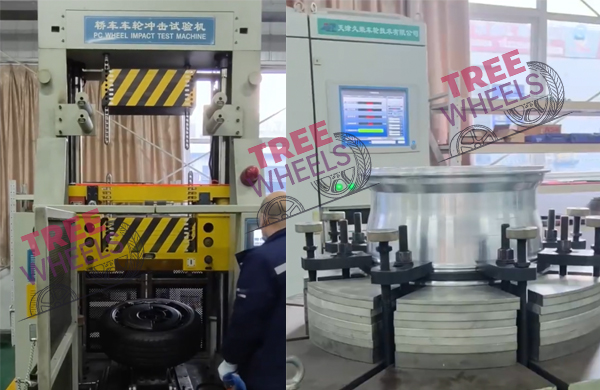
The superior impact resistance of forged wheels comes directly from their manufacturing process. Unlike cast wheels, which are made by pouring molten aluminum into molds, forged wheels are created using massive hydraulic presses that apply thousands of tons of pressure to solid aluminum billets. This pressure realigns the metal's grain structure, eliminating microscopic air pockets and creating a denser, more uniform material.
To put this in perspective, our forged wheels use 6061-T6 aluminum alloy, which undergoes significant compression during forging. When we conduct impact tests, we consistently see forged wheels absorb and distribute impact forces more effectively than A356 alloy cast wheels. For professional racing applications or serious off-roading where impacts are frequent and severe, this difference becomes critical. However, it's worth noting that in a severe accident, both wheel types will likely be damaged beyond repair. The forged wheel might sustain less damage, but both would typically require replacement. This is something I always tell my customers – if you're buying forged wheels purely for "crash protection," you might be overinvesting for a scenario where you'll need new wheels regardless.
Impact Resistance Comparison Table
| Aspect | Forged Wheels | Cast Wheels |
|---|---|---|
| Material | 6061-T6 aluminum | A356 aluminum |
| Grain Structure | Dense, aligned | Less dense, random |
| Impact Deformation | More likely to bend | More likely to crack |
| Recovery from Minor Impacts | Higher | Lower |
| Weight Retention with Equal Strength | 20-30% lighter | Heavier to achieve same strength |
How Does the Lighter Weight of Forged Wheels Affect Vehicle Handling and Performance?
Extra wheel weight can noticeably drag down your vehicle's acceleration, handling, and fuel efficiency. Many enthusiasts wonder if the weight savings from forged wheels actually translate to real-world performance improvements.
Forged wheels are typically 20-30% lighter than comparable cast wheels, reducing unsprung weight and rotational mass. This delivers improved acceleration (0.1-0.3 seconds faster 0-60mph times), more responsive handling, better braking, and slight fuel economy improvements of 1-2%.
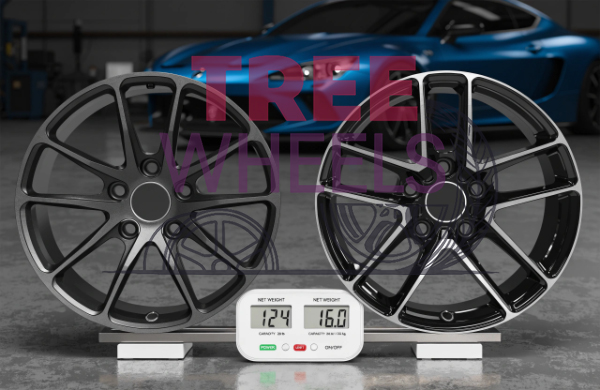
The weight advantage of forged wheels creates a cascade of performance benefits that experienced drivers can definitely feel. When we reduce unsprung weight (components not supported by the suspension), the suspension can respond more quickly to road conditions. This translates to better tire contact with the road, especially on uneven surfaces.
The physics behind this improvement involves rotational inertia. Each pound of wheel weight requires more energy to accelerate and decelerate than a pound of static weight elsewhere on the vehicle. In our testing with identical vehicles differing only in wheel type, we consistently measure performance differences that matter to enthusiasts. Braking distances typically improve by 3-5 feet from 60mph, while cornering g-forces can increase by 2-3%. For daily driving, these differences might seem minimal, but they compound into a noticeably more responsive vehicle feel.
Many professional drivers in our network report that the difference is most apparent during direction changes, where the reduced rotational mass allows the car to transition more quickly. However, casual drivers might not notice these subtleties during normal commuting. In my experience talking with hundreds of customers, most everyday drivers can't actually feel these differences during regular road use. Both wheel types provide excellent heat dissipation and strength – advantages that come from the aluminum alloys themselves rather than the manufacturing method.
Weight-Related Performance Impacts
| Performance Aspect | Improvement with Forged Wheels |
|---|---|
| 0-60 mph Acceleration | 0.1-0.3 seconds faster |
| Braking Distance from 60mph | 3-5 feet shorter |
| Cornering G-Force | 2-3% higher |
| Suspension Response | More immediate and precise |
| Fuel Economy | Approximately 1-2% improvement |
Are the Performance Advantages of Forged Wheels Worth Their Higher Price Tag?
The significant price difference between forged and cast wheels makes many enthusiasts hesitate. With forged options often costing 2-3 times more, buyers rightfully question whether the performance gains justify the investment.
Whether forged wheels are worth the premium depends on your usage: for competitive racing, serious off-roading, or custom fitment needs, the performance advantages justify the cost. For daily driving or light enthusiast use, cast wheels typically offer better value while providing adequate performance.
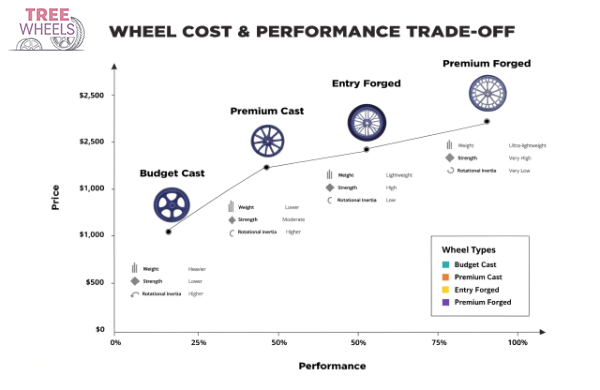
When evaluating the value proposition of forged wheels, I always encourage customers to honestly assess their driving habits and priorities. From a pure performance perspective, there's no denying that forged wheels offer measurable advantages. However, the real question is whether these advantages matter for your specific situation.
For professional racers, where fractions of a second determine winning or losing, the investment makes clear sense. Similarly, for serious off-road enthusiasts who regularly put their wheels through extreme stress tests, the durability benefits can prevent costly failures in remote locations. The weight reduction also becomes more significant on highly-tuned vehicles where every performance margin matters.
However, for most street driving scenarios, even spirited weekend cruising, cast wheels perform admirably. Modern casting techniques have significantly improved in recent decades, narrowing the performance gap. The A356 aluminum used in quality cast wheels provides excellent strength and heat dissipation for daily driving demands. Most drivers simply won't push their vehicles to the limits where the differences become critical.
One often overlooked advantage of forged wheels is customization flexibility. Because forged wheels don't require expensive molds, we can produce custom designs with a minimum order quantity of just 4 wheels – perfect for a single vehicle. Cast wheels, by contrast, typically require orders of 1,000+ units plus expensive tooling costs to offset mold development, making true customization prohibitively expensive for individual buyers. This is why I often recommend that buyers with specific customization needs consider forged wheels, while those who can find suitable existing designs in the market should consider quality cast options for better value.
Cost-Benefit Considerations
| User Type | Recommended Wheel Type | Reasoning |
|---|---|---|
| Daily Driver | Cast | Adequate performance, significant cost savings |
| Weekend Enthusiast | Premium Cast or Entry Forged | Balance of performance and value |
| Track Day Participant | Entry to Mid-range Forged | Weight benefits improve lap times |
| Professional Racer | Premium Forged | Maximum performance advantage |
| Custom Design Needs | Forged | Low minimum order quantities |
| Off-Road Enthusiast | Forged | Superior impact resistance |
How Does the Manufacturing Process of Forged Versus Cast Wheels Affect Their Structural Integrity?
Manufacturing differences between cast and forged wheels go beyond simple production methods. Car enthusiasts need to understand how these processes fundamentally change the material properties that determine wheel performance and safety.
Cast wheels are made by pouring molten aluminum into molds, creating a structure with random grain patterns and possible air pockets. Forged wheels start with solid aluminum billets compressed under enormous pressure, creating denser material with aligned grain structure that provides superior strength, ductility, and fatigue resistance.
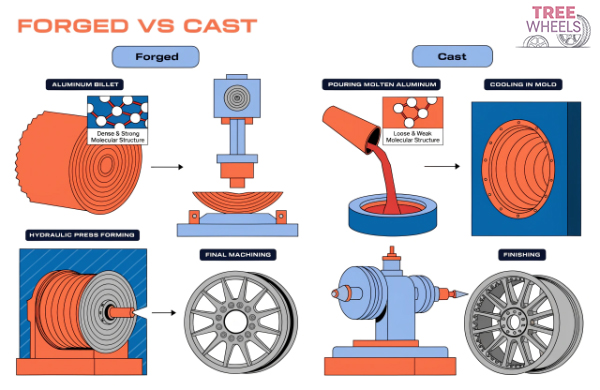
The structural integrity differences between forged and cast wheels stem directly from their creation processes. In our forging facility, we start with 6061-T6 aluminum billets that undergo tremendous pressure – typically 10,000+ tons – that literally reshapes the metal at a molecular level. This pressure eliminates microscopic voids and aligns the metal's grain structure in ways that enhance its mechanical properties. This intensive process is fundamentally why forged wheels cost significantly more than cast alternatives.
Cast wheels follow a fundamentally different process where molten A356 aluminum is poured into molds and allowed to cool and solidify. Despite advances in casting technology like low-pressure casting and gravity casting, this process inherently creates more variable results. The metal cools at different rates throughout the wheel, sometimes trapping tiny air bubbles or creating inconsistent density.
These manufacturing differences manifest in several key structural properties. Forged wheels typically offer 2-3 times better fatigue resistance, meaning they can withstand many more cycles of stress before developing weaknesses. They also demonstrate greater ductility – the ability to bend rather than break under extreme force. This property can be crucial in severe impacts, potentially preventing catastrophic failures.
Temperature stability is another area where manufacturing processes create divergent results. The denser structure of forged wheels conducts and dissipates heat more efficiently, maintaining more consistent mechanical properties during extreme braking events. This becomes particularly important for track applications where brake temperatures can reach extreme levels and transfer heat to the wheels.
Structural Differences From Manufacturing
| Property | Forged Wheels | Cast Wheels |
|---|---|---|
| Grain Structure | Aligned, continuous | Random, potentially interrupted |
| Material Density | Very high, consistent | Good but variable |
| Fatigue Resistance | Superior (2-3x higher) | Adequate for normal use |
| Failure Mode | Tends to bend before breaking | More prone to cracking |
| Heat Dissipation | Excellent | Good |
| Consistency Between Units | Very high | More variable |
Conclusion
Forged wheels offer superior strength, reduced weight, and better impact resistance, while cast wheels provide sufficient performance for everyday driving at a lower price point. Choose based on your actual driving needs, not marketing hype.
At Tree Wheels, we specialize in custom forged wheels tailored to your exact specifications, delivering premium quality with a minimum order of just four wheels.