
Every day, I see wheel shops selling "forged wheels" without explaining what actually makes them forged. Most customers pay premium prices but never understand the engineering inside.
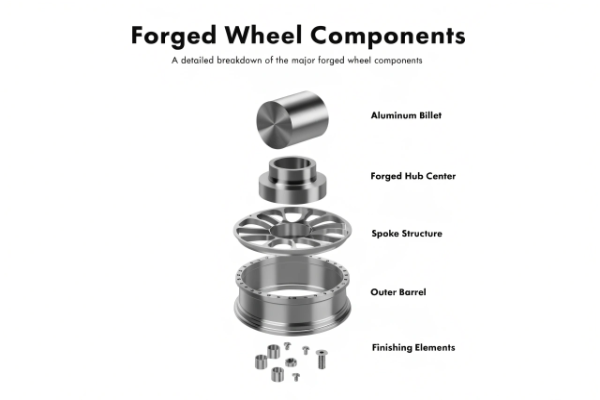
Custom forged wheels consist of five main components: the aluminum alloy billet, the forged hub center, the spoke structure, the outer barrel, and the finishing elements. Each component undergoes precise manufacturing processes that determine strength, weight, and performance.
When I started TreeWheels, I spent months learning every detail about wheel components. Most people think a wheel is just a circle of metal, but reality is far more complex.
What Are Most Forged Wheels Made Of?
The aluminum choice determines everything about your wheel’s performance. Poor material selection leads to cracked wheels and safety risks.
Most forged wheels are made from 6061-T6 aluminum alloy, containing 95.8-98.6% aluminum, 0.8-1.2% magnesium, 0.4-0.8% silicon, and trace amounts of iron and copper. This composition provides optimal strength-to-weight ratio.
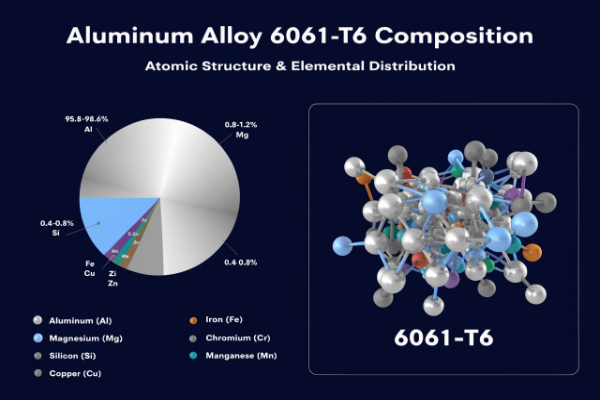
In our production, I discovered that 6061-T6 aluminum is just the starting point. The real difference lies in magnesium content ratios. Our technician told me: "Blake, an extra 0.1% magnesium means 15% strength improvement, but double the processing difficulty." This is why our MOQ is 4 wheels – each furnace of alloy melting carries high cost and risk.
Our 8000-ton hydraulic press consumes electricity equivalent to 100 households’ daily usage for each forging cycle. When I first felt that machine’s vibration, I understood why forged wheels achieve superior properties. We use X-ray detection that identifies 0.5mm internal bubbles. Last year, we rejected a batch that looked perfect because we found microscopic cracks inside. These wheels cost $180 each to manufacture, but safety always comes first.
| Property | Cast Wheels | Forged Wheels | Performance Gain |
|---|---|---|---|
| Density | 2.4 g/cm³ | 2.7 g/cm³ | +12.5% denser |
| Wall Thickness | Standard | 20% thinner | Weight reduction |
| Strength | Baseline | 40% stronger | Safety improvement |
| Grain Structure | Random | Unidirectional | Predictable behavior |
| 6061-T6 Alloy Components | Percentage Range | Function |
|---|---|---|
| Aluminum | 95.8-98.6% | Base material |
| Magnesium | 0.8-1.2% | Strength enhancement |
| Silicon | 0.4-0.8% | Workability |
| Iron + Copper | <1% | Trace elements |
What Are Custom Forged Wheels?
Custom forged wheels go beyond choosing colors and sizes. True customization happens at the engineering level where every component gets tailored.
Custom forged wheels are precision-engineered wheels manufactured to specific requirements including unique spoke patterns, custom offsets, personalized finishes, and application-specific load ratings. Each wheel undergoes individual design optimization based on vehicle specifications.
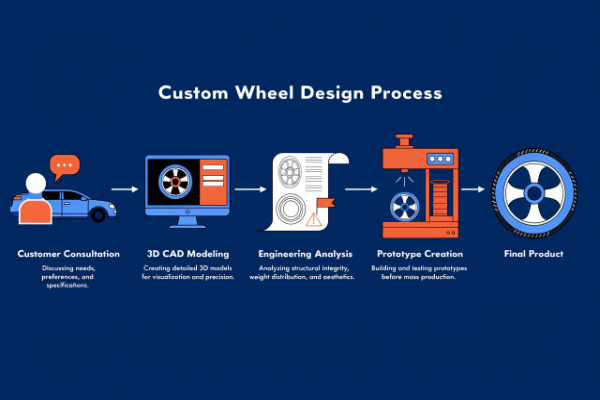
Real customization happens at the component level – hub design, spoke geometry, barrel depth, and bolt pattern positioning. Each component affects weight distribution, impacting both performance and aesthetics. The hub center requires the most precision. We machine each hub to 0.02mm tolerances for center bore and 0.05mm for bolt holes.
Three-piece wheels need 36 independent bolt holes, with each hole’s precision error not exceeding 0.05mm. Our CNC machines run 18 hours continuously to machine one three-piece wheel. I often encounter customers requesting 22-inch wheels while maintaining original weight. From physics perspective, this is nearly impossible – every 2-inch diameter increase requires at least 1.5 kg weight increase to maintain strength.
| Wheel Type | Production Time | Key Complexity | Precision Required |
|---|---|---|---|
| One-Piece | 15-20 days | Single forging | 0.02mm hub bore |
| Two-Piece | 20-25 days | Hub + barrel assembly | 0.05mm bolt holes |
| Three-Piece | 30-35 days | 36 bolt holes + sealing | 0.05mm all holes |
| Customization Options | Available Choices | Lead Time Impact |
|---|---|---|
| Size Range | 17-24 inches | Standard |
| Spoke Patterns | 50+ designs | +2-3 days for new patterns |
| Color Options | Unlimited | +3-5 days for custom colors |
| Offset Adjustments | ±50mm range | +5-7 days for analysis |
How Do They Make Forged Wheels?
The forging process transforms raw aluminum through controlled destruction and rebuilding. Each step determines final wheel characteristics.
Forged wheels are manufactured through five stages: aluminum billet preparation, heating to 480°C, hydraulic press forging under 8000+ tons pressure, precision CNC machining, and multi-stage quality control including X-ray inspection.
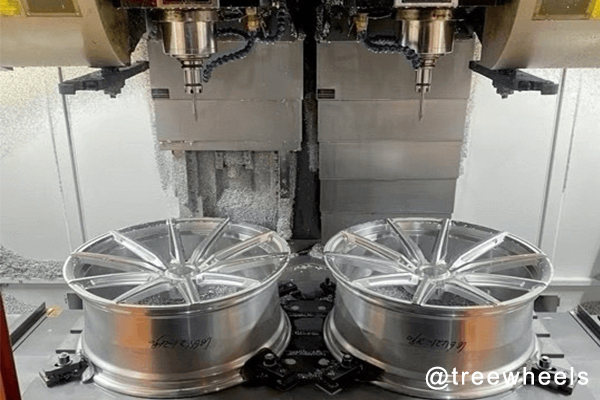
Having visited multiple facilities, I learned that forged wheel production is controlled destruction and rebuilding. We’re crushing aluminum billets under 8000+ tons pressure to eliminate weakness points. The process begins with billet selection. Each aluminum billet undergoes chemical analysis to verify exact alloy percentages.
Forging happens in multiple stages. First press shapes basic wheel form under 4000 tons pressure. Second press under full 8000+ tons creates final accuracy and eliminates porosity. After forging, each blank weighs 15-18 kg. CNC machining removes 40-60% of material to create final spoke pattern and hub details.
| Production Stage | Duration | Temperature/Pressure | Quality Check |
|---|---|---|---|
| Billet Preparation | 2 hours | Room temperature | Chemical analysis |
| Heating | 4 hours | 480°C ±10°C | Temperature monitoring |
| First Forging | 15 minutes | 4000 tons | Dimensional check |
| Final Forging | 15 minutes | 8000+ tons | Pressure logging |
| CNC Machining | 6-18 hours | 0.01mm precision | Dimensional inspection |
| Heat Treatment | 8 hours | 175°C | Hardness testing |
| Final Inspection | 2 hours | Multiple tests | X-ray + load test |
| Quality Control Tests | Detection Capability | Rejection Criteria |
|---|---|---|
| Visual Inspection | Surface defects | Any visible flaws |
| X-ray Testing | 0.5mm internal bubbles | Any internal voids |
| Dimensional Check | 0.01mm accuracy | Outside tolerance |
| Hardness Test | Material properties | Below 276 MPa |
| Load Testing | 300% normal load | Any structural failure |
Do Forged Wheels Bend or Crack?
Understanding how forged wheels fail explains why they cost more than cast alternatives. Failure patterns reveal engineering differences.
Forged wheels typically bend rather than crack due to unidirectional grain structure and higher density. When overloaded, forged wheels deform gradually and predictably, while cast wheels crack suddenly and catastrophically.
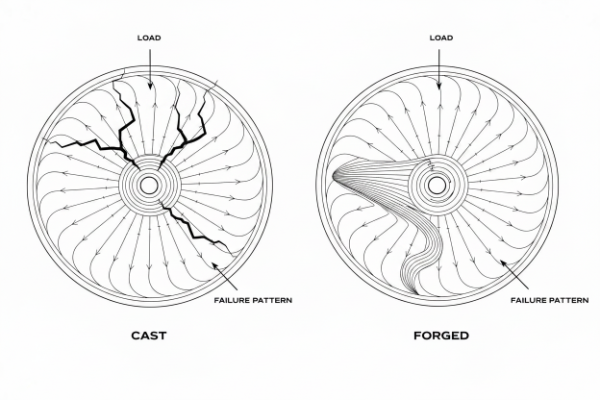
Through our ISO and DOT certification process, I discovered forged wheels don’t fail like cast wheels. Cast wheels crack suddenly. Forged wheels bend gradually, giving drivers warning signs. This isn’t just about strength – it’s about predictable failure patterns that save lives.
Our testing shows forged wheels withstand 40% more impact force than equivalent cast wheels. I’ve found 80% of shop owners don’t know the difference between DOT and TÜV certification. DOT tests impact strength, while TÜV tests fatigue durability through 2 million cycle load testing.
| Failure Characteristic | Cast Wheels | Forged Wheels | Safety Benefit |
|---|---|---|---|
| Failure Pattern | Sudden crack | Gradual bend | Warning signs |
| Impact Resistance | Baseline | +40% stronger | Higher safety margin |
| Temperature Range | -20°C to +80°C | -40°C to +120°C | Extended operation |
| Corrosion Response | Internal penetration | Surface only | Maintained strength |
| Failure Warning | None visible | Visible deformation | Driver awareness |
| Certification Type | Test Focus | Duration | Our Status |
|---|---|---|---|
| DOT | Impact strength | Standard cycles | Certified |
| ISO | Manufacturing quality | Continuous | Certified |
| TÜV | Fatigue durability | 2M cycles | Pending |
| JWL | Japanese standards | Extended testing | Pending |
Conclusion
Custom forged wheels combine precision engineering with advanced materials to deliver superior performance and safety through carefully engineered components.
TreeWheels delivers precision-engineered forged wheels with uncompromising quality standards for automotive excellence.