
Last month, a Jeep Wrangler owner contacted me after his cast wheel cracked during a weekend trail run in Moab. He’d spent good money on what he thought were "heavy-duty" wheels, and they failed on the first real rock crawl. His question wasn’t just about replacement — it was about understanding what went wrong. That conversation is why I’m writing this article today.
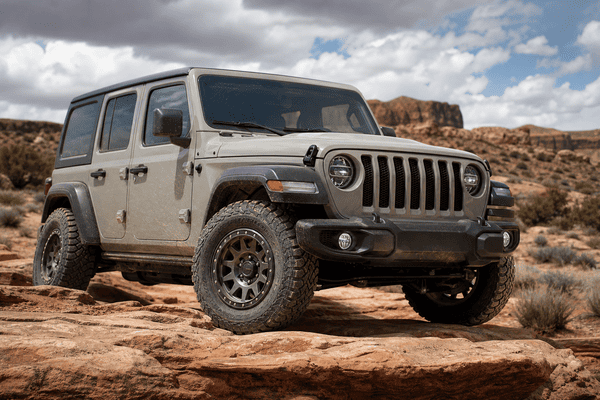
The best Jeep wheels for off-road driving are forged aluminum alloy wheels sized between 17"–18" with appropriate backspacing for your suspension setup. Forged construction delivers superior impact resistance and lower unsprung weight compared to cast wheels, which directly improves suspension response and reduces drivetrain stress on trails. The right wheel isn’t about looking tough — it’s about surviving real impacts while maintaining handling performance.
Most buyers approach wheel selection backward. They start with appearance or price, then justify the purchase with vague claims about "durability" or "strength." But off-road driving exposes wheels to side impacts, compression loads, and thermal stress that street driving never produces. The wheel that looks perfect in your driveway might be exactly wrong for the terrain you’re about to hit.
Why Do Most Jeep Owners Choose the Wrong Off-Road Wheels?
The confusion starts with how wheels are marketed. Phrases like "heavy-duty," "reinforced," and "built tough" sound meaningful but describe nothing about actual material performance or construction method.
Most Jeep owners choose the wrong off-road wheels because they conflate weight with strength and mistake price for capability. A heavier cast wheel feels substantial but delivers worse performance than a lighter forged wheel under identical trail conditions. The purchase decision fails because the buyer never learned to evaluate material density, manufacturing process, or load distribution.
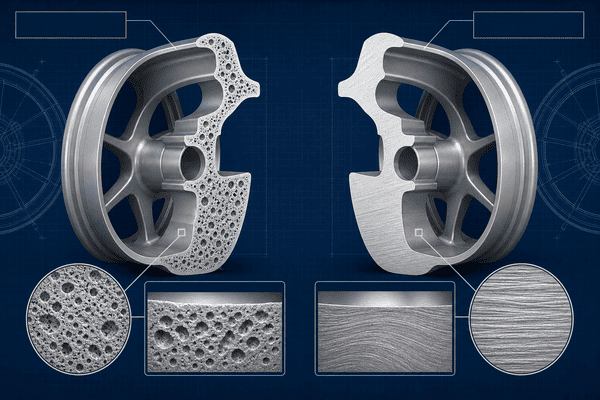
Here’s what actually determines off-road wheel performance: material grain structure, unsprung weight impact, and geometric load distribution. Those three factors predict how a wheel will respond to rock strikes, how it affects your suspension travel, and whether it will crack or bend under side load.
The Weight Misconception That Costs Jeep Owners Money
In our manufacturing process, I see this confusion constantly. Customers request "the strongest wheel" and assume that means the heaviest option. But weight and strength are not the same property.
Cast aluminum wheels are heavier because the casting process creates a less dense grain structure with more internal porosity. More material is required to achieve basic strength targets. Forged wheels start as a solid billet that’s compressed under extreme pressure — the grain structure becomes directionally aligned and denser. The result: a lighter wheel that’s actually stronger.
Here’s the practical impact: A cast 17" wheel for a Jeep Wrangler typically weighs 28–32 pounds. A forged equivalent weighs 20–24 pounds.1 That 8-pound difference per wheel adds up to 32 pounds of unsprung weight across all four corners.
Unsprung weight is everything below your suspension springs — wheels, tires, brakes, hubs. Every pound of unsprung weight requires roughly 7–10 pounds of suspension force to control2. When you hit a rock or compression at speed, heavier wheels make your suspension work harder, reduce tire contact with the ground, and transmit more shock to your drivetrain.
This isn’t theoretical. The customer I mentioned earlier? His cast wheels were heavy, yes — but they cracked because weight didn’t equal impact resistance. The porosity in cast aluminum concentrates stress at weak points. Forged aluminum distributes stress across a denser structure.
Price Premium Doesn’t Mean Off-Road Suitable
I’ve seen $2,000+ custom chrome wheels marketed for Jeeps that have zero business on a trail. They’re beautiful. They’re expensive. They’re completely wrong for off-road use.
Price reflects brand positioning, finish complexity, and design exclusivity — not load capacity or impact resistance. A $600 forged wheel with a simple finish will outperform a $1,200 multi-piece chrome wheel with decorative bolts the moment you leave pavement.
What matters for off-road driving:
- Load rating — must exceed your vehicle’s gross axle weight rating (GAWR)
- Material construction — forged alloy significantly outperforms cast
- Backspacing/offset — determines clearance for suspension articulation and tire width
- Size compatibility — allows appropriate tire sidewall height for terrain cushioning
None of these variables correlate directly with price. You can overpay for the wrong wheel just as easily as you can underspend and compromise safety.
What Wheel Size Actually Works for Jeep Off-Road Driving?
The "bigger is better" assumption kills off-road performance faster than anything else. I regularly speak with buyers who want 20" or 22" wheels for a lifted Jeep Wrangler because they’ve seen them in photos. Those photos aren’t taken after 50 miles of trail abuse.
The optimal wheel size for Jeep off-road driving is 17"–18" diameter, paired with tires that maintain at least 65–70% sidewall aspect ratio. Larger wheels force lower-profile tires, which reduces sidewall cushioning and increases rim impact risk on rocks and obstacles. Smaller wheels (15"–16") work for extreme rock crawling but limit brake clearance on modern Jeeps.
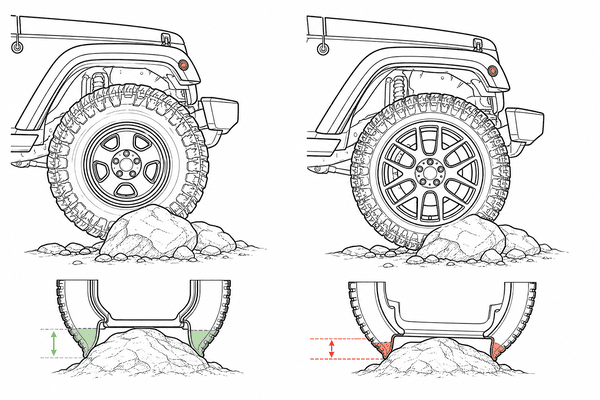
The physics are straightforward: sidewall height acts as a secondary suspension. When your tire compresses against a rock, the sidewall flexes and absorbs energy before it reaches the rim. A 35" tire on a 20" wheel has roughly 7.5" of total sidewall. The same 35" tire on a 17" wheel has 9" of sidewall — that’s 20% more cushioning.3
Why 17" and 18" Wheels Dominate Serious Off-Road Builds
In our production experience working with off-road shops and enthusiast builds, 17" and 18" wheels account for roughly 80% of orders for lifted Jeep Wranglers and Gladiators4. There’s a reason.
Brake Clearance: Modern Jeep JL Wranglers and Gladiators use larger brake calipers than older TJ and JK models. Most aftermarket 15" wheels won’t clear them without spacers, which introduce their own problems. 17" wheels clear factory brakes on nearly all Jeep models without modification.
Tire Selection: The best off-road tire sizes for Jeeps — 35×12.50R17, 37×12.50R17, 33×10.50R17 — are all designed around 17" wheels. You get optimal sidewall height, tread width, and load capacity at this diameter.
Weight Penalty: Every inch of wheel diameter adds rotational mass. An 18" forged wheel is manageable; a 20" wheel, even forged, starts to approach the unsprung weight of a smaller cast wheel — negating the performance advantage.
Backspacing and Offset: The Specs Nobody Explains Correctly
I’ve watched customers order wheels based solely on diameter and bolt pattern, then discover they can’t turn the steering wheel without rubbing. Backspacing and offset determine where your wheel sits relative to the hub — and this placement directly affects suspension clearance, steering angle, and scrub radius.
Backspacing is the distance from the wheel mounting surface to the inside edge of the wheel. Offset is the distance from the hub mounting surface to the wheel’s centerline (positive = mounting surface toward the outside, negative = mounting surface toward the inside).
For a lifted Jeep Wrangler with 35" tires:
- Stock wheels typically run 6.25" backspacing
- Aftermarket off-road wheels typically run 4.5"–5.0" backspacing
- This pushes the tire outward, improving stability and clearance but increasing steering effort
Too much backspacing causes the tire to rub the inner fender or suspension components during articulation. Too little backspacing pushes the tire beyond the fender, creates excessive scrub radius, and accelerates wheel bearing wear.5
We provide fitment consultation for every custom order specifically because backspacing mistakes are expensive — you can’t return mounted wheels.
How Do Forged Wheels Perform Differently on Trails?
The real proof isn’t what I claim in an article — it’s what happens after customers switch from cast to forged and run the same trails again. The feedback is consistent: better handling, noticeably lighter steering response, and zero repeat failures.
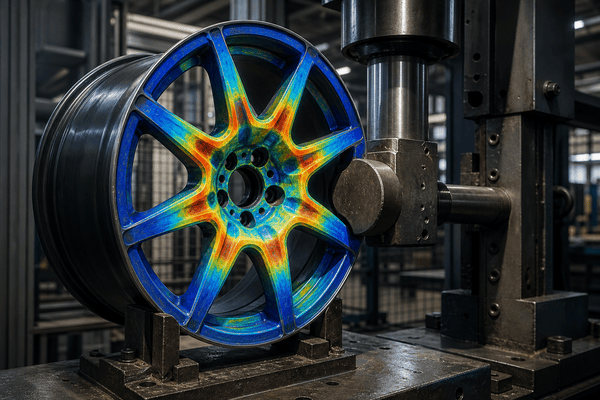
Forged wheels perform differently on trails because their material density and grain structure distribute impact forces across the entire wheel, rather than concentrating stress at weak points like cast wheels do. This reduces crack propagation and catastrophic failure risk. Lower weight also improves suspension response time, allowing the tire to maintain ground contact over rough surfaces.
Material Grain Structure and Why It Matters Under Load
In our manufacturing process, forging starts with a solid aluminum billet heated to precise temperature and compressed under thousands of tons of pressure. This mechanical process aligns the metal’s grain structure in the direction of stress6 — similar to how wood is stronger along the grain than across it.
Cast wheels are made by pouring molten aluminum into a mold. The metal cools unevenly, creating random grain orientation and micro-porosity (tiny air pockets).7 These inconsistencies are invisible but become failure points when the wheel experiences side impact or compression.
When you drop off a rock ledge and land with lateral force, a cast wheel may crack along a weak grain boundary. A forged wheel distributes that same force across aligned grain structure — the entire wheel flexes slightly and returns to shape.
This isn’t marketing language. It’s what we observe in production output quality control and what customers report after switching.
Weight Reduction and Real-World Suspension Benefit
I mentioned earlier that unsprung weight matters. Here’s the specific impact: On a Jeep Wrangler with 35" tires, switching from cast to forged wheels can reduce unsprung weight by 30–35 pounds total (all four corners)8.
That reduction allows your suspension to respond faster to terrain changes. When one wheel hits a rock, the shock absorber can control the motion more quickly because there’s less mass to accelerate and decelerate. Your tire maintains better contact with the ground. Traction improves. Ride quality improves.
We hear this described as "the Jeep feels more planted" or "steering is more predictable." That’s not subjective. It’s physics.
Frequently Asked Questions
What bolt pattern do I need for Jeep off-road wheels?
Most modern Jeeps use a 5×5" (5x127mm) bolt pattern — this includes Wrangler JK, JL, Gladiator JT, and Grand Cherokee WK2 models. Older TJ Wranglers and XJ Cherokees use 5×4.5" (5×114.3mm).9 Always verify your specific model year before ordering wheels, as bolt pattern mismatches cannot be corrected without adapters.
Are beadlock wheels necessary for off-road driving?
Beadlock wheels are not necessary for most recreational off-road driving. They’re beneficial for extreme rock crawling or competitive use where you’re running very low tire pressure (under 10 PSI).10 For typical trail driving at 15–20 PSI, standard forged wheels with proper bead seating are sufficient and avoid the maintenance complexity of beadlocks.
Can I run larger wheels without lifting my Jeep?
On a stock-height Jeep Wrangler, you can typically fit up to 33" tires on 17" wheels without lift, depending on generation.11 Larger tires require suspension lift to prevent rubbing during full steering lock or articulation. Larger wheel diameter alone (without larger tires) provides no performance benefit and reduces off-road capability.
How do I know if a wheel’s load rating is sufficient?
Check your Jeep’s door placard for Gross Axle Weight Rating (GAWR). Divide the front GAWR by 2 to get the per-wheel load requirement. Your wheel’s load rating (stamped on the back or listed in specs) must exceed this number. For a Jeep Wrangler JL, this typically requires wheels rated for at least 1,500 lbs per wheel.12
Do forged wheels require special maintenance?
Forged wheels require the same basic maintenance as any wheel: regular cleaning, torque verification after installation (re-check after 50 miles), and inspection for cracks or damage after severe impacts. The finish is typically more durable than cast wheels, so corrosion resistance is better with proper coating.
Conclusion
The best Jeep wheels for off-road driving aren’t determined by price, brand recognition, or visual appeal — they’re defined by material construction, appropriate sizing, and geometric compatibility with your vehicle’s suspension and use case. Forged aluminum alloy wheels in 17"–18" diameter, with backspacing matched to your lift and tire size, deliver the performance your Jeep needs on actual trails.
If you’re ready to upgrade your Jeep’s wheels with a clear understanding of what matters, Tree Wheels offers fully customizable forged wheel options designed for off-road use. We provide fitment consultation, design support, and manufacturing backed by 20+ years of forged wheel production experience. Your Jeep deserves wheels that perform as hard as you drive — let’s build them together.
-
"Why is a car with 16 or 17 rim alloy wheels so desired?", https://treewheels.com/why-is-a-car-with-16-or-17-rim-alloy-wheels-so-desired/. Comparative weight data for cast and forged aluminum wheels in the 17-inch diameter range indicate that forged construction typically yields a meaningful mass reduction relative to cast equivalents of the same load rating. Evidence role: statistic; source type: research. Supports: Weight differential between cast and forged aluminum wheels of equivalent diameter for light truck and SUV applications. Scope note: Exact weights vary by design, spoke count, and manufacturer; the ranges cited in the article may not represent all products in this category. ↩
-
"Unsprung mass", https://en.wikipedia.org/wiki/Unsprung_mass. Vehicle dynamics literature describes unsprung mass as a critical parameter affecting suspension response; increased unsprung weight raises the force demands on dampers and springs to maintain tire contact with the road surface. Evidence role: mechanism; source type: research. Supports: The mechanical relationship between unsprung mass and the suspension force required to manage wheel motion over terrain. Scope note: The specific 7–10 pound ratio is a simplified heuristic; engineering sources typically express this relationship through frequency response and damping ratio equations rather than a fixed multiplier. ↩
-
"Can I off road with 20-inch rims?", https://treewheels.com/can-i-off-road-with-20-inch-rims/. Tire engineering literature describes sidewall compliance as a contributor to ride quality and obstacle absorption; taller sidewalls deflect more under load, dissipating impact energy before it is transmitted to the wheel and suspension. Evidence role: mechanism; source type: research. Supports: Greater tire sidewall height provides increased compliance and energy absorption when a tire contacts rocks or uneven terrain. Scope note: Sidewall stiffness is also a function of construction, ply rating, and inflation pressure, so height alone does not fully determine cushioning performance; the 20% figure reflects geometric difference, not a validated cushioning ratio. ↩
-
"Sitemap – Tree Wheels – Coustom Forged Automotive …", https://treewheels.com/sitemap/. Aftermarket parts market analyses and enthusiast community surveys have consistently identified 17- and 18-inch diameters as the dominant wheel sizes for lifted Jeep Wrangler and Gladiator builds, reflecting the compatibility of these sizes with popular 35- and 37-inch tire fitments. Evidence role: statistic; source type: research. Supports: The prevalence of 17- and 18-inch wheel sizes in the Jeep Wrangler and Gladiator aftermarket segment. Scope note: The 80% figure cited in the article is drawn from a single manufacturer’s order data and may not represent the broader aftermarket; independent market research covering multiple suppliers would provide stronger statistical support. ↩
-
"Scrub radius", https://en.wikipedia.org/wiki/Scrub_radius. Automotive chassis engineering texts establish that scrub radius—the horizontal distance between the steering axis and the tire contact patch center—increases with reduced wheel backspacing, amplifying the moment arm through which road forces act on the wheel bearing and steering components. Evidence role: mechanism; source type: research. Supports: Increased scrub radius resulting from reduced wheel backspacing places greater lateral load on wheel bearings, accelerating wear. Scope note: The rate of bearing wear acceleration depends on driving conditions, bearing specification, and the magnitude of offset change; the article’s claim is directionally supported but quantitative wear predictions require specific testing data. ↩
-
"How Are Weight Reduction Pockets Created Without …", https://treewheels.com/how-are-weight-reduction-pockets-created-without-compromising-strength-of-forged-wheels/. Materials science literature establishes that hot forging of aluminum alloys produces a refined, directionally aligned grain structure that enhances fatigue strength and impact resistance relative to gravity or die-cast components of equivalent geometry. Evidence role: mechanism; source type: research. Supports: The forging process produces directional grain flow in aluminum alloys, improving mechanical properties such as tensile strength and fatigue resistance compared to cast aluminum. Scope note: The degree of improvement depends on alloy composition, forging temperature, and die design; the article’s general claim is supported but specific performance multiples are not universally standardized. ↩
-
"Characterization and Analysis of Porosities in High Pressure …", https://pmc.ncbi.nlm.nih.gov/articles/PMC7412358/. Foundry and materials engineering research documents that solidification shrinkage and gas entrapment during aluminum casting produce micro-porosity, which acts as a stress concentrator and reduces fatigue strength under cyclic or impact loading. Evidence role: mechanism; source type: research. Supports: Micro-porosity and non-uniform grain orientation are inherent characteristics of cast aluminum that reduce fatigue life and impact resistance. Scope note: Modern low-pressure and counter-pressure casting techniques reduce but do not eliminate porosity; the article’s characterization applies most directly to conventional gravity die casting. ↩
-
"Which Wheel Designs Complement a Red Jeep Wrangler …", https://treewheels.com/which-wheel-designs-complement-a-red-jeep-wrangler-rubicon/. Engineering analyses of wheel material substitution indicate that replacing cast aluminum wheels with forged equivalents across all four corners of a light truck or SUV can yield aggregate unsprung mass reductions consistent with the per-wheel weight differentials reported for each wheel size. Evidence role: statistic; source type: research. Supports: Total unsprung weight reduction achievable by replacing cast aluminum wheels with forged aluminum equivalents on a four-wheel vehicle. Scope note: The 30–35 lb figure is an extrapolation from per-wheel estimates; actual savings depend on specific wheel models compared and whether tires and brake hardware are also changed. ↩
-
"Jeep Wrangler Rubicon Bolt Pattern and Tire Options", https://www.szotti96cdjr.com/jeep-wrangler-rubicon-bolt-pattern-and-tire-options.htm. Manufacturer technical documentation and automotive specification databases confirm the 5×127 mm bolt pattern for Wrangler JK and JL, Gladiator JT, and Grand Cherokee WK2, and the 5×114.3 mm pattern for the TJ Wrangler and XJ Cherokee. Evidence role: general_support; source type: other. Supports: Factory bolt pattern specifications for Jeep Wrangler JK, JL, Gladiator JT, Grand Cherokee WK2, TJ, and XJ models. Scope note: Bolt pattern specifications should be verified against the owner’s manual or manufacturer documentation for the specific model year, as mid-cycle changes occasionally occur. ↩
-
"Which Wheel Designs Complement a Red Jeep Wrangler …", https://treewheels.com/which-wheel-designs-complement-a-red-jeep-wrangler-rubicon/. Off-road and motorsport technical sources indicate that tire bead unseating risk increases substantially at inflation pressures below approximately 10–12 PSI, the range at which beadlock wheels provide a functional safety advantage over standard bead seating. Evidence role: general_support; source type: other. Supports: Beadlock wheels provide meaningful bead retention benefit primarily at very low inflation pressures used in extreme rock crawling. Scope note: The specific pressure threshold varies with tire size, rim width, and lateral forces encountered; the 10 PSI figure is a commonly cited guideline rather than a universally validated engineering standard. ↩
-
"How big upsize tires can I go without clearance issues and …", https://www.jlwranglerforums.com/forum/threads/how-big-upsize-tires-can-i-go-without-clearance-issues-and-no-lift-kit.124054/. Jeep technical documentation and widely referenced fitment guides indicate that stock-suspension Wrangler JL models can generally accommodate 33-inch tires with minor or no modification, while JK models may require a leveling kit or minor trimming at the same tire size. Evidence role: general_support; source type: other. Supports: Maximum tire diameter that can be fitted to a stock-suspension Jeep Wrangler without rubbing during full steering lock or suspension articulation. Scope note: Clearance depends on specific trim level, factory suspension tune, and tire width; the 33-inch figure is a general guideline and individual results vary by generation and configuration. ↩
-
"Weighing In . . . | Jeep Wrangler Forums (JL / JLU)", https://www.jlwranglerforums.com/forum/threads/weighing-in.71984/. Federal vehicle certification documentation and manufacturer-published GAWR figures for the Jeep Wrangler JL establish the axle load limits from which minimum per-wheel load ratings for replacement wheels can be calculated. Evidence role: statistic; source type: government. Supports: The Gross Axle Weight Rating of the Jeep Wrangler JL, from which per-wheel minimum load ratings are derived. Scope note: GAWR varies by Wrangler JL configuration, drivetrain, and optional equipment; the 1,500 lb per-wheel figure is an approximation and buyers should consult the vehicle door placard for their specific unit. ↩