
Buyers researching forged wheels often hit the same wall: every supplier says "stronger, lighter, better" — but almost nobody explains for what. If you’re trying to justify a premium wheel purchase to yourself or to a client, vague performance claims don’t help. Understanding where forged wheels actually earn their cost changes the decision entirely.
Forged wheels are used across a wide range of applications — from daily performance driving and luxury vehicles to track days, modified street cars, and custom show builds. Their primary advantage is a higher strength-to-weight ratio under dynamic load compared to cast alternatives. The right forged wheel configuration — monoblock, two-piece, or three-piece — depends on the vehicle type, fitment requirements, and intended use.

That general answer is a starting point, not a decision. The more useful question is: which type of forged wheel, for which vehicle, doing what? That’s the conversation we have with almost every serious buyer who contacts Tree Wheels — and it’s the framework this article is built around.
Are forged wheels only for the race track?
Many buyers assume forged wheels are a motorsport product dragged into street use. That assumption keeps a lot of people from considering a wheel upgrade that would genuinely improve their daily driving experience.
Forged wheels are not limited to track applications. Their lower unsprung weight benefits everyday street driving by improving ride quality, steering response, and acceleration feel — particularly on sports cars, luxury vehicles, and heavier trucks or SUVs.1 Track use is one valid application, but far from the only one.

When I talk to modification shop owners, the most common misconception they relay from their clients is that forged wheels are "overkill" unless you’re running laps. That framing misunderstands what the product actually does in normal driving conditions.
The unsprung weight argument for street driving
Unsprung weight refers to the mass not supported by a vehicle’s suspension — wheels, tires, brake components. Reducing it has a direct, measurable effect on how a car feels and behaves at normal road speeds.2
Here’s why this matters for everyday buyers:
- Steering feel: Lighter wheels respond faster to steering input. On a luxury sedan or sports car, this is a perceptible quality-of-life improvement, not just a track metric.
- Ride comfort: Less unsprung mass means the suspension can track road imperfections more precisely. The ride quality often improves noticeably.
- Acceleration and braking: Rotating mass resists change in speed. Reducing wheel weight contributes to quicker acceleration response and slightly shorter braking distances under real-world conditions.3
- Long-term brake and suspension wear: Lighter wheels reduce the load cycling on suspension components over time.4
Luxury car and truck applications
Luxury car owners — think large German sedans, American muscle platforms, or high-end Japanese sports cars — are increasingly common customers for forged wheels. Their motivation is usually a combination of aesthetics and the tactile improvement in driving feel. They aren’t tracking their cars; they want a wheel that performs as well as the rest of the vehicle was engineered to.
Truck and SUV owners represent a growing segment we see at Tree Wheels. Heavy vehicles place significant dynamic load on wheels during cornering and load-carrying. Forged wheels handle that stress more reliably than equivalent cast options, particularly over time and in high-heat braking scenarios.5
The honest disclaimer here: forged wheels are a meaningful upgrade for vehicles and drivers where dynamic performance matters. For a standard commuter car driven conservatively, the benefit is real but smaller. Acknowledging that builds trust with buyers who are genuinely evaluating whether the investment fits their situation.
What are monoblock forged wheels used for?
Monoblock (one-piece) forged wheels are the default recommendation for buyers who aren’t sure where to start — but that default has real logic behind it.
A monoblock forged wheel is machined from a single forged aluminum billet. It offers maximum structural rigidity with the simplest construction. For performance street driving, daily sport use, and track-day applications, a well-made monoblock forged wheel is typically the most appropriate choice.
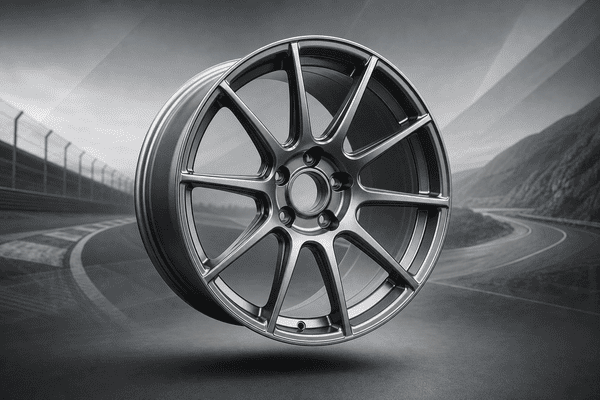
The strength of the monoblock structure comes from its single-piece integrity — there are no joints, seals, or hardware to manage.6 That simplicity is both a performance advantage and a maintenance one.
Use cases where monoblock forged wheels make the most sense
Performance street and occasional track use is the core application. If a customer comes to us with a sports car — Porsche, BMW M-series, Nissan GT-R, Corvette — and they drive it hard on the street with occasional track days, a monoblock forged wheel is almost always what we recommend first. It handles heat cycling, lateral load in aggressive cornering, and high-speed stress without the complexity of a multi-piece build.
Weight-sensitive builds also favor the monoblock. Because the wheel is machined from a single forging, manufacturers can optimize material placement precisely. The result is typically the lightest option for a given wheel diameter and width, which matters most in performance applications.
| Application | Why Monoblock Works |
|---|---|
| Daily performance driving | Light, rigid, no maintenance of joints |
| Track days | Handles heat cycling; high rigidity under lateral load |
| Sports cars (OEM+ upgrade) | Often replaces heavier cast OEM wheels directly |
| Weight-reduction builds | Best strength-to-weight ratio of the three types |
Fitment note: Monoblock wheels are made to a fixed offset and width. They suit vehicles with standard or near-standard fitment requirements. If a car has been modified with wide-body bodywork or requires non-standard offset, the monoblock may not accommodate those dimensions — which is where the two-piece becomes relevant.
- Production lead time at Tree Wheels: 15–20 days
- MOQ: 4 wheels
What are two-piece forged wheels used for?
Two-piece forged wheels solve a problem that the monoblock can’t: fitment flexibility for modified cars.
A two-piece forged wheel consists of a forged center (barrel/face) bolted to a separate outer lip. This construction allows the width, offset, and lip depth to be adjusted during manufacturing — making it the practical choice for modified vehicles with non-standard fitment needs.
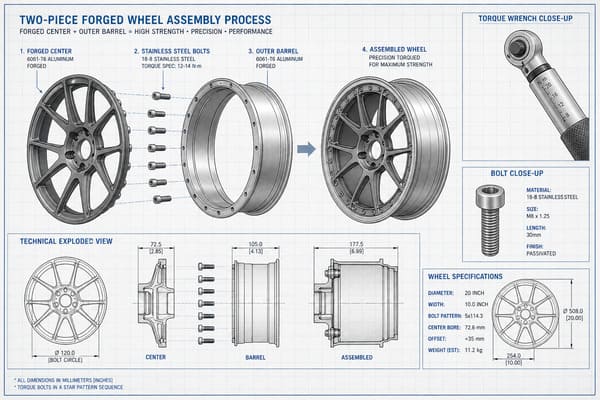
When a modification shop orders wheels for a customer running a wide-body kit, a stanced street build, or a car with heavily modified suspension geometry, the two-piece is typically the conversation we start with.
The fitment customization use case
Standard monoblock wheels come in defined offset and width combinations. For most factory-spec or lightly modified vehicles, that’s fine. But modification builds regularly require:
- Wider-than-standard widths to fill extended fender arches
- Custom offsets to achieve a specific flush or poke stance
- Mixed front/rear specifications where front and rear wheels need different dimensions
The two-piece construction accommodates all of these without requiring a full custom forging. The center and outer lip are manufactured separately, then joined — allowing the manufacturer to dial in the exact dimensions the build requires.
Aesthetic flexibility
Beyond fitment, two-piece wheels offer a distinct visual profile. The visible hardware at the barrel join — typically stainless or titanium bolts — is a recognized aesthetic in the custom wheel space.7 For buyers who want that look alongside custom fitment, the two-piece delivers both.
Important for buyers: Two-piece construction involves a sealed joint between barrel components. Verify that any supplier you work with uses high-quality sealing materials and assembly standards. At Tree Wheels, we treat this as a quality control checkpoint, not an assumption. Buyers should ask about assembly specifications and inspect sample wheels before committing to a production order.
Where two-piece forged wheels are most commonly used:
-
Wide-body modified street cars
-
Stanced or fitment-focused builds
-
Performance vehicles requiring non-catalog offset/width combinations
-
Custom builds where the visual profile of a multi-piece wheel is part of the design intent
-
Production lead time at Tree Wheels: 20–25 days
What are three-piece forged wheels used for?
Three-piece forged wheels represent the maximum level of dimensional customization available in aftermarket wheel construction. They are the right choice for extreme fitment builds, show cars, and any application where every single dimension needs to be independently specified.
A three-piece wheel consists of a forged center, an inner barrel, and an outer lip — three separate components bolted together. This allows independent adjustment of inner barrel depth, outer lip depth, and center offset, giving the builder total control over the final wheel profile.
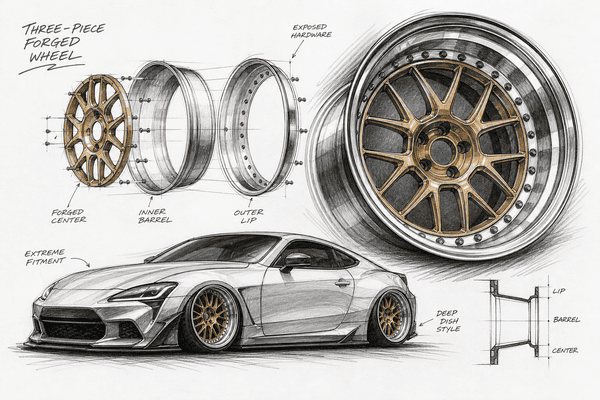
When a buyer contacts us with a show build or a car where the fitment is genuinely unusual — deep dish requirements, extreme lip depth, custom step lips — the three-piece is the product we discuss.
Where three-piece forged wheels genuinely earn their place
Show cars and display builds are the clearest use case. On a vehicle built for concours presentation, car shows, or magazine features, the wheel is a visual centerpiece. Three-piece construction allows for large outer lip depths, polished barrel finishes, and contrast between center and lip that simply isn’t achievable with a one- or two-piece construction.8
Extreme fitment builds — particularly in the JDM and Euro custom scenes — often require dimensional combinations that no catalog wheel offers. The three-piece’s independent component design allows exactly those combinations.
Restoration and heritage builds sometimes specify three-piece wheels to achieve period-correct visual proportions that aren’t available in modern monoblock production.
Practical considerations for buyers
Three-piece wheels have the highest complexity of the three types. This has real implications:
| Factor | Consideration |
|---|---|
| Sealing | Two joint points require quality sealing; verify supplier standards |
| Weight | Typically heavier than equivalent monoblock due to additional hardware |
| Lead time | Longest production time of the three types |
| Cost | Highest price point — justified only when customization is actually needed |
| Maintenance | Hardware torque and seal condition should be checked periodically |
Three-piece wheels are not the default recommendation for performance street driving. The additional weight from hardware and triple-component construction offsets the strength-to-weight advantages that make forged wheels attractive in performance applications. Recommending a three-piece to a track-day buyer would be the wrong advice — and that’s the kind of mismatch we try to prevent early in the conversation.
- Production lead time at Tree Wheels: 30–35 days
How do you match a forged wheel to your actual use case?
The question we ask before recommending any wheel configuration isn’t "what’s your budget?" — it’s "what is this car being used for, and what does the fitment actually require?"
Matching a forged wheel to the right application involves four variables: vehicle type, use scenario, fitment requirements, and customization need. Getting all four right prevents the most common purchasing mistakes.
When a modification shop owner contacts Tree Wheels with a client vehicle, here’s the framework we typically work through together:
The four decision variables
1. Vehicle type and weight class
Heavier vehicles — trucks, large SUVs, full-size luxury sedans — benefit from forged wheels differently than sports cars. The structural load is higher, and the wheels spend more time under sustained stress (carrying load, towing, braking from higher speeds). For these vehicles, the strength-to-weight advantage of forged construction is particularly relevant.
Lighter sports cars benefit most from the unsprung weight reduction, which is most perceptible at those vehicle weights.
2. Intended use scenario
- Daily street driving: Monoblock or two-piece if fitment is standard
- Track or performance driving: Monoblock, prioritizing minimum weight
- Modified fitment or wide-body: Two-piece
- Show or extreme custom: Three-piece
3. Fitment requirements
This is where the monoblock/two-piece/three-piece decision often gets made. If the car is running at or near factory spec, a monoblock in the right size is usually the clean answer. Once the offset or width requirements move outside standard catalog ranges, the multi-piece options become necessary rather than optional.
4. Customization depth needed
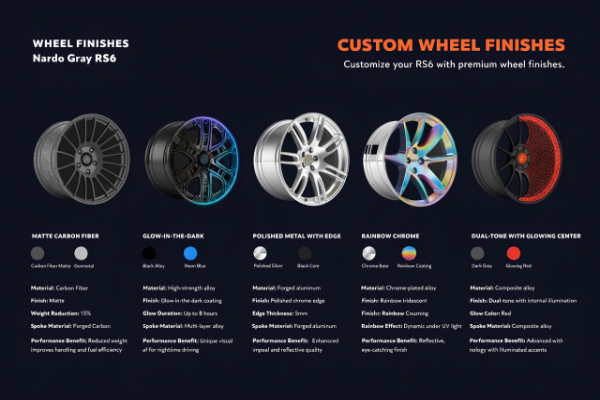
Surface finish, color, spoke design — these are independent of structure type and available across all three. But if the customer needs a deeply custom visual profile and non-standard dimensions, that combination typically points to three-piece.
Frequently Asked Questions
Are forged wheels worth it for daily driving?
For sports cars, luxury vehicles, and trucks or SUVs that are driven with any level of enthusiasm, yes — the reduction in unsprung weight produces a perceptible improvement in steering response, ride quality, and acceleration feel. For conservative commuter use on a standard vehicle, the benefit is real but less significant. Evaluate based on your specific vehicle and driving habits.
What is the difference between one-piece, two-piece, and three-piece forged wheels?
A one-piece (monoblock) wheel is machined from a single forged billet — lightest, most rigid, best for performance use. A two-piece wheel has a separate center and outer lip, allowing custom width and offset for modified vehicles. A three-piece wheel adds a separate inner barrel, providing maximum dimensional customization for show or extreme fitment builds.
Can forged wheels be made in custom sizes and finishes?
Yes. Custom sizing, offset, spoke design, color, and surface treatment are standard for forged wheel manufacturers with full production capabilities. At Tree Wheels, we work from customer drawings or references and offer design sketches and 3D models before production begins. MOQ starts at 4 wheels.
Are forged wheels heavier than cast wheels?
No — in most cases, the opposite is true. Forged wheels are typically lighter than cast equivalents at equivalent structural strength.9 The forging process produces a denser, stronger grain structure, which allows manufacturers to use less material to achieve the same or higher load ratings.10
What certifications should I verify when sourcing forged wheels from a manufacturer?
Buyers should verify ISO 9001 (quality management), IATF 16949 (automotive quality systems), DOT (US highway safety compliance), and TÜV (German/European structural testing) certifications11 as applicable to their target market. Always request current certification documents directly from the supplier — certifications should be verified, not assumed.
Conclusion
Forged wheels serve a wide range of real-world applications — performance street driving, track days, luxury vehicles, heavy trucks, modified fitment builds, and custom show cars. The key insight is that forged wheels are not a single product; the right configuration depends on what the car is doing and what the fitment actually requires. Monoblock construction suits performance and daily use. Two-piece opens fitment flexibility for modified vehicles. Three-piece delivers maximum customization for show and extreme builds.
If you’re sourcing forged wheels for a modification shop, a specific client vehicle, or your own build, the most useful first step is mapping your use case to the right structural type — before comparing prices or finishes. At Tree Wheels, that’s the conversation we start with every order. Contact us with your vehicle type, use scenario, and fitment requirements, and we’ll help you identify the right configuration from the start.
-
"Lightweight Materials for Cars and Trucks", https://www.energy.gov/cmei/vehicles/lightweight-materials-cars-and-trucks. Vehicle dynamics research indicates that unsprung mass reduction improves the ability of the suspension to follow road surface variations, reducing transmitted vibration and improving steering feedback; these effects are present across vehicle categories but are most perceptible in vehicles with performance-tuned suspension systems. Evidence role: general_support; source type: research. Supports: That reductions in wheel mass produce measurable improvements in steering response and ride quality in passenger vehicles under normal street driving conditions.. Scope note: The perceptibility of improvement in everyday driving conditions depends on vehicle suspension tuning, tire characteristics, and driver sensitivity; controlled subjective evaluations are limited in the published literature. ↩
-
"Influence of unsprung weight on vehicle ride quality – ADS", https://ui.adsabs.harvard.edu/abs/1988JSV…124..497H/abstract. Vehicle dynamics literature establishes that unsprung mass directly influences wheel-to-road contact fidelity and suspension response frequency, with reductions in unsprung weight generally improving ride comfort and handling precision across a range of road speeds. Evidence role: mechanism; source type: research. Supports: That reducing unsprung mass improves suspension response, ride quality, and handling at normal driving speeds.. Scope note: Most formal studies focus on suspension system design rather than wheel material specifically; the magnitude of improvement attributable to wheel weight alone may vary by vehicle platform. ↩
-
"Moment of inertia", https://en.wikipedia.org/wiki/Moment_of_inertia. Classical rotational mechanics establishes that the moment of inertia of a rotating body is proportional to its mass distribution; reducing wheel mass therefore lowers the rotational kinetic energy that must be overcome during acceleration and braking events. Evidence role: mechanism; source type: education. Supports: That rotational inertia of wheel assemblies resists changes in angular velocity, meaning lighter wheels require less torque to accelerate or decelerate.. Scope note: The practical magnitude of braking distance improvement attributable to wheel weight reduction alone is small relative to other braking system variables and may not be perceptible in all real-world scenarios. ↩
-
"Quantification of structural loading during off-road cycling", https://pubmed.ncbi.nlm.nih.gov/10464694/. Suspension fatigue analysis indicates that dynamic load amplitudes experienced by control arms, ball joints, and wheel bearings are influenced by unsprung mass, with higher unsprung weight increasing peak stress cycles over a given distance traveled. Evidence role: mechanism; source type: research. Supports: That lower unsprung mass reduces dynamic load amplitudes transmitted through suspension components, potentially extending component service life.. Scope note: Empirical data specifically isolating wheel weight as the independent variable in suspension wear studies is limited; most durability research addresses suspension geometry and road surface conditions as primary variables. ↩
-
"Fatigue life prediction of brake discs for high-speed trains via …", https://pmc.ncbi.nlm.nih.gov/articles/PMC10358543/. Structural testing of aluminum wheel specimens indicates that forged wheels generally demonstrate higher fatigue life under cyclic bending and radial load conditions compared to cast counterparts, attributed to the refined grain structure and reduced porosity achieved through the forging process. Evidence role: general_support; source type: research. Supports: That forged aluminum wheels exhibit superior fatigue resistance and thermal stability compared to cast aluminum wheels under repeated dynamic and thermal loading conditions.. Scope note: Performance differences are specification-dependent; a high-quality cast wheel may outperform a low-quality forging, and direct comparisons require controlled testing of matched alloy grades and geometries. ↩
-
"Fatigue Analysis of Preloaded Bolted Joints", https://www.academia.edu/92765461/Fatigue_Analysis_of_Preloaded_Bolted_Joints. Mechanical engineering analysis of bolted joint assemblies identifies joint interfaces as locations of stress concentration and potential fretting fatigue under cyclic loading; single-piece construction eliminates these interfaces, providing a continuous load path through the wheel structure. Evidence role: mechanism; source type: research. Supports: That single-piece wheel construction eliminates bolted joint interfaces, which are potential sites for fatigue crack initiation and fretting under cyclic loading.. Scope note: The practical structural difference between a well-engineered multi-piece wheel and a monoblock of equivalent specification may be small under normal operating loads; the advantage is most relevant under extreme or repeated high-stress conditions. ↩
-
"What Are the Best Wheel Styles for JDM Car Modifications?", https://treewheels.com/what-are-the-best-wheel-styles-for-jdm-car-modifications/. Multi-piece wheel designs with exposed barrel fasteners became prominent in the aftermarket automotive sector during the 1980s and 1990s, associated with custom and performance vehicle builds where the visible hardware and deep-lip profiles became stylistically significant within enthusiast communities. Evidence role: historical_context; source type: other. Supports: That multi-piece wheel designs with visible barrel hardware have an established history in the aftermarket automotive customization market.. Scope note: Documentation of this aesthetic history is primarily found in automotive enthusiast publications and trade sources rather than peer-reviewed literature. ↩
-
"Review of Magnesium Wheel Types and Methods of Their …", https://pmc.ncbi.nlm.nih.gov/articles/PMC10856444/. Three-piece wheel construction separates the inner barrel, outer lip, and center face into independently manufactured components, allowing each dimension to be specified without constraint from the others; this contrasts with monoblock designs, where offset and width are fixed at the forging stage, and two-piece designs, where inner barrel depth is determined by the center forging geometry. Evidence role: mechanism; source type: other. Supports: That three-piece wheel construction, by independently specifying inner barrel depth, outer lip depth, and center offset, enables a wider range of finished wheel profiles than fixed or two-component designs.. Scope note: The practical dimensional range achievable also depends on the manufacturer’s tooling and assembly capabilities; not all three-piece suppliers offer the full theoretical range of customization. ↩
-
"What Are the Performance Differences Between Forged and …", https://treewheels.com/what-are-the-performance-differences-between-forged-and-cast-wheels/. Comparative analyses of aluminum wheel manufacturing processes indicate that the higher mechanical properties of forged aluminum — including tensile strength and yield strength — allow material to be removed from non-critical sections while maintaining required load ratings, resulting in lower finished wheel mass relative to cast designs meeting the same structural specification. Evidence role: general_support; source type: research. Supports: That forged aluminum wheels achieve equivalent or superior structural ratings at lower mass compared to cast aluminum wheels of the same diameter and width.. Scope note: Weight savings vary by wheel design, diameter, and manufacturer; the comparison is most valid when controlling for alloy grade, wheel geometry, and load rating. ↩
-
"The Effect of Fe Addition on Microstructure, Mechanical …", https://pubmed.ncbi.nlm.nih.gov/33404468/. Materials science literature documents that hot or cold forging of aluminum alloys produces a refined, directionally aligned grain structure that increases tensile strength and fatigue resistance relative to gravity or die-cast equivalents, enabling equivalent load-bearing capacity at reduced material volume. Evidence role: mechanism; source type: research. Supports: That the forging process aligns aluminum grain structure along stress lines, producing higher tensile strength and fatigue resistance compared to cast aluminum of equivalent composition.. Scope note: The degree of improvement depends on alloy composition, forging temperature, and post-process heat treatment; direct comparisons require specification of identical alloy grades. ↩
-
"Interpretation ID: 86-1.39", https://www.nhtsa.gov/interpretations/86-139. IATF 16949 is an international automotive quality management system standard developed by the International Automotive Task Force, specifying requirements for design, development, production, and service of automotive-related products; DOT compliance denotes conformance with US Federal Motor Vehicle Safety Standards, while TÜV certification indicates structural testing by an accredited German technical inspection authority. Evidence role: definition; source type: institution. Supports: That IATF 16949 is an automotive-sector quality management standard and that DOT and TÜV represent market-specific safety and structural compliance requirements for wheels.. Scope note: Specific wheel testing protocols vary by certifying body and product category; buyers should confirm which standard version and test scope applies to the wheels under consideration. ↩