
ET values confuse most car owners. You see the number on a wheel spec sheet, but no one explains what it actually controls — and getting it wrong is expensive.
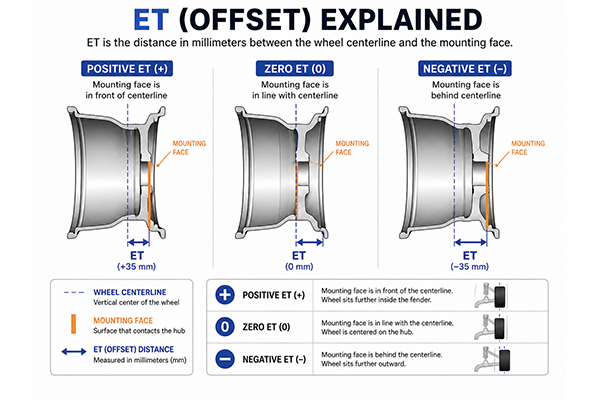
ET stands for "Einpresstiefe," a German word meaning "insertion depth." It measures the distance in millimeters between the wheel’s mounting face and its centerline. A positive ET means the mounting face sits closer to the outside of the wheel. A negative ET means it sits closer to the inside.
I work with forged wheel customization every day. Most customers come to me thinking ET is a minor technical detail. It is not. ET is one of the most important numbers in any wheel build, and I want to break it down in plain terms so you understand exactly what it controls.
What Is the ET Value of a Wheel?
You see "ET45" or "ET-20" stamped on a wheel, and you have no idea what it means. You just want wheels that fit. Picking the wrong ET can mean the wheel rubs your fender or hits your brake caliper.
The ET value tells you where the mounting face sits inside the wheel barrel. It is measured in millimeters from the centerline of the wheel. Positive ET values push the wheel inward toward the car. Negative ET values push the wheel outward away from the car.
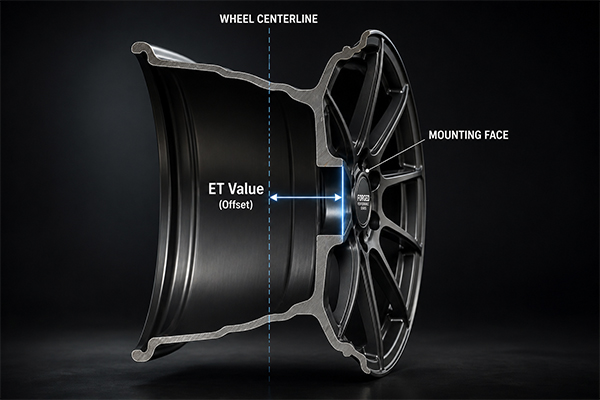
To understand ET fully, you need to picture the wheel as a barrel. The centerline is the exact middle of that barrel from side to side. The mounting face is the flat surface that bolts to your hub. The distance between those two points — measured in millimeters — is your ET value.
How ET Affects Wheel Position
Here is a simple breakdown of how ET values shift the wheel’s position on the car:
| ET Value | Mounting Face Position | Wheel Sits… |
|---|---|---|
| Positive (e.g., ET45) | Closer to the outside lip | Further inward toward the car |
| Zero (ET0) | Exactly at the centerline | Perfectly centered |
| Negative (e.g., ET-20) | Closer to the inside lip | Further outward from the car |
This directly affects how much the wheel sticks out from the fender. A wheel with ET45 will tuck neatly under the arch. The same wheel with ET-20 will push outward and give a much more aggressive, flush or poked stance. For standard road cars, most factory ET values sit between ET30 and ET55. For modified builds, customers often go lower to push the wheel out further. The key point is this: ET is not a random number. It is a calculated measurement that controls the entire lateral position of your wheel on the vehicle.
What Does 45 ET Mean on Rim Size?
You keep seeing ET45 listed in wheel specs, but you are not sure what that actually looks like on a real car or why it matters for your build.
ET45 means the mounting face is 45mm outboard of the wheel’s centerline. The wheel sits relatively deep inside the fender arch. This is a common factory specification for many European sedans and SUVs. It gives a clean, tucked look with good fender clearance.
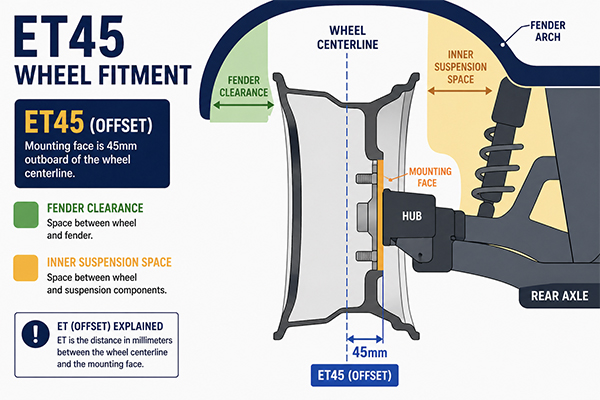
ET45 is one of the most common values I deal with from customers driving daily vehicles. It is a safe, practical number that works well for standard road use.
Why ET45 Is So Common on Factory Wheels
Car manufacturers choose ET values based on suspension geometry, steering feel, and legal fender clearance requirements. ET45 hits a useful middle ground for many front-wheel-drive and all-wheel-drive platforms. Here is what ET45 means in practical terms for different wheel widths:
| Wheel Width | ET45 Outer Edge Position | Visual Result |
|---|---|---|
| 7.5 inch | Slightly inside fender lip | Clean, stock look |
| 8.5 inch | Close to flush | Mild aggressive stance |
| 9.5 inch | Near or slightly outside lip | Requires fender check |
When customers ask me about upgrading from factory wheels, I always ask for their current ET first. If the factory spec is ET45 and they want a wider wheel, we need to adjust ET downward to keep the outer edge in a safe position. Going wider while keeping ET45 would push the outside of the wheel dangerously close to — or into — the fender liner. This is where ET and wheel width work together as a system, not as separate numbers. You cannot change one without thinking about the other.
What Does ET-40 Mean on a Wheel?
Negative ET values look unusual the first time you see them. ET-40 sounds like a technical error, but it is actually a deliberate choice made for very specific build styles.
ET-40 means the mounting face is 40mm inboard of the wheel’s centerline. This pushes the entire wheel significantly outward from the car. ET-40 is common on trucks, off-road vehicles, and aggressive stance builds where maximum wheel poke or deep concave spoke designs are the goal.
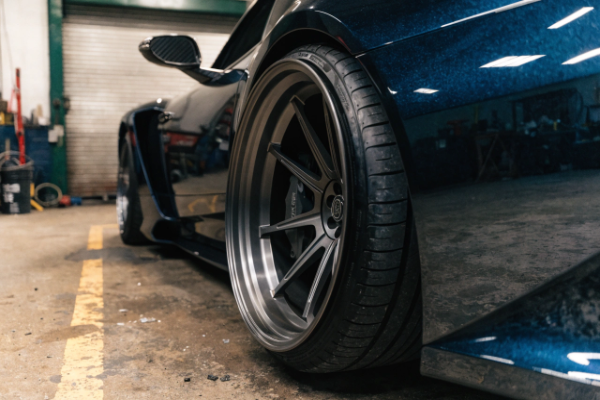
When I receive a customer inquiry asking for ET-40 or lower, I immediately know they are building something aggressive. Negative ET wheels are a completely different design territory compared to standard positive ET fitments.
What Negative ET Does to Wheel Design and Fitment
Negative ET opens up the design space on the inside of the wheel barrel. The mounting face moves toward the back of the wheel, which means the spokes have more room to travel inward before they connect to the hub. This is exactly what creates a deep concave spoke profile.
| ET Value | Concave Depth Potential | Common Application |
|---|---|---|
| ET45 | Shallow or flat face | Daily drivers, factory replacements |
| ET15 | Moderate concave | Mild custom builds |
| ET0 | Deep concave possible | Performance and show builds |
| ET-20 to ET-40 | Extreme concave | Trucks, aggressive stance cars |
However, negative ET also compresses the space between the inner barrel of the wheel and your brake caliper, rotor, and suspension components. This is a clearance problem many customers do not think about until it is too late. At Tree Wheels, before we produce any wheel with low or negative ET, we require the customer to confirm their brake caliper dimensions and inner suspension clearance. A few millimeters of error at negative ET can mean the wheel physically cannot be installed — or worse, it installs but contacts the brake system under load. This is a production detail we treat as non-negotiable.
Is Higher ET Wider?
This is one of the most common misunderstandings I hear from customers. They assume a higher ET number means a wider wheel. The two things are not the same, and mixing them up leads to bad fitment decisions.
Higher ET does not mean wider. ET only measures the offset of the mounting face from the centerline. Wheel width is a completely separate measurement. A high ET wheel and a low ET wheel can both be the same width. ET controls how far inward or outward the wheel sits, not how wide it is.
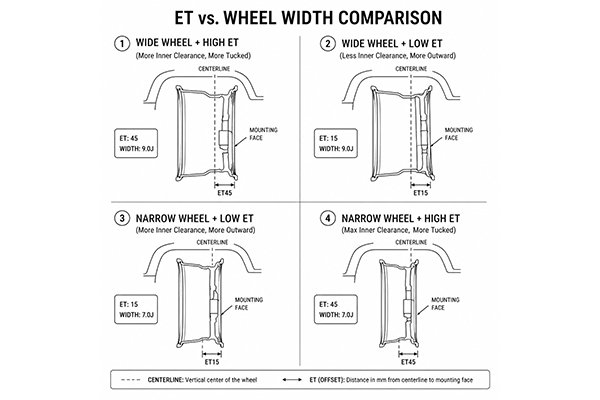
I have to clarify this point with customers regularly. When someone tells me they want a "wider look," the answer is not simply "lower ET." Width and ET are two separate variables that work together.
ET and Width Work as a System
Here is the clearest way I can explain the relationship between ET and wheel width:
| Wheel Width | ET Value | Visual Outcome |
|---|---|---|
| 10 inch | ET45 | Wide wheel tucked under arch |
| 10 inch | ET15 | Wide wheel sitting flush or near flush |
| 10 inch | ET-20 | Wide wheel poking outside fender |
| 7 inch | ET-20 | Narrow wheel poking outside fender |
A wider wheel with a high ET still tucks inward. A narrow wheel with a low ET still pokes outward. The outer edge position depends on both measurements together. When customers send me a wheel inquiry and say they want "low ET for a more aggressive look," I always ask for their current wheel width, their target wheel width, and their fender clearance. Without all three pieces of information, I cannot tell them whether their build will clear the arch, sit flush, or require a fender roll. This is why, at Tree Wheels, we guide every customer through their full fitment data before we ever begin a design. Forged wheels are custom-made. Once they are produced, changing the ET means starting over. Getting this right the first time is the only acceptable standard.
Conclusion
ET is not just a spec number. It controls wheel position, concave depth, and brake clearance all at once. Understanding it protects your build. Tree Wheels offers fully customizable ET values on all forged wheel orders — get your fitment right from the start.