
Rotary forged wheels create a lot of confusion because many buyers hear “forged” and assume the whole wheel is made like a fully forged wheel. That misunderstanding can lead to the wrong purchase, especially for track cars or heavy vehicles. The better answer is simple: compare the process, not only the label.
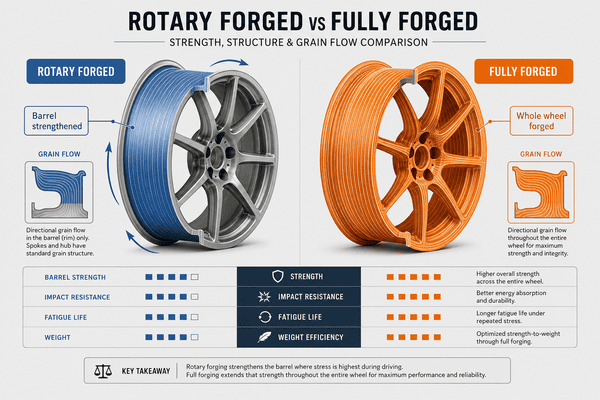
Rotary forged is usually not stronger than fully forged across the whole wheel. Rotary forging improves the barrel area by spinning and stretching the rim under pressure1, but fully forged wheels are compressed from a forged billet so the grain structure is worked through the entire wheel2, including the spokes, hub, and center section.
I have heard customers say, “I was told rotary forged is the same as forged, just lighter.” I understand why they ask. The wording sounds close. But in wheel sourcing, small wording differences can mean a big difference in structure, cost, and safety margin.
What Does Rotary Forged Actually Mean?
Rotary forged wheels sound simple, but the term often hides important details. Buyers see phrases like “flow formed,” “spin forged,” or “rotationally forged,” and they assume every part of the wheel receives full forging pressure. That is where the confusion begins.
Rotary forged means the wheel barrel is mechanically spun and compressed after the wheel center is formed. This process stretches and work-hardens the rim area, which can reduce weight and improve strength compared with standard cast wheels3. However, it does not fully forge the entire wheel center, spoke, and hub structure.
The Process Works on a Specific Area
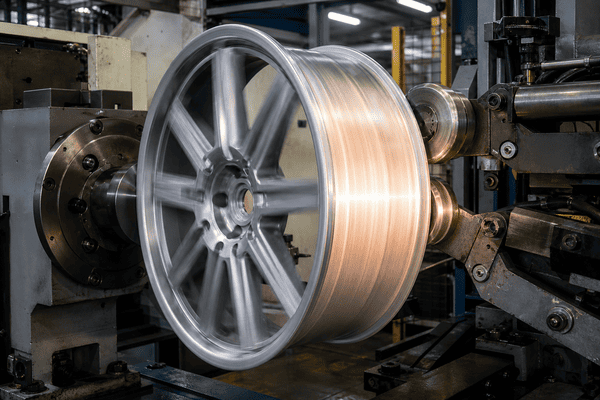
In simple terms, rotary forging acts mainly on the barrel or rim section of the wheel. The wheel starts from a pre-formed blank, often with a cast or semi-formed center. Then rollers press against the outer barrel while the wheel spins. The material stretches outward and becomes thinner, denser, and stronger in that region.
That is a real manufacturing improvement. I do not dismiss it. In many customer conversations, I explain that this process can make sense for street cars, daily drivers, and appearance-focused builds where buyers want a lighter wheel than a standard cast option.
However, the key point is this:
Rotary forging improves the rim barrel, but it does not automatically create a fully forged spoke and hub structure.
That matters because wheel loads do not only affect the barrel. Loads also pass through the spokes, bolt pad, hub area, and mounting face. When a car brakes hard, corners aggressively, hits a pothole, or runs wide tires, stress travels through the full wheel structure4.
Common Terms Buyers See
Many suppliers use different names for similar partial-forming methods. These terms are not always dishonest, but they can be confusing.
| Marketing Term | What Buyers May Think | What Buyers Should Verify |
|---|---|---|
| Flow formed | Fully forged wheel | Usually barrel-formed, not fully forged |
| Spin forged | Forged throughout | Often rotary forming of rim section |
| Rotary forged | Same as fully forged | Process scope depends on wheel construction |
| Flow forged | Full billet forging | Ask which areas are forged or formed |
| Hybrid forged | Premium full forging | Request process details and test documents |
Why the Word “Forged” Causes Confusion
The word “forged” carries a strong reputation in the wheel industry. Many enthusiasts connect it with motorsport, strength, lightweight design, and premium manufacturing. That reputation is earned by fully forged wheels, but it is sometimes borrowed by other processes.
From what buyers typically describe to me, the confusion is not always their fault. Some product pages place rotary forged wheels beside fully forged wheels and use similar strength language. A buyer may see “forged technology” and assume the whole wheel is forged.
When I evaluate a wheel description, I ask three basic questions:
- Which part of the wheel receives pressure forming?
- Is the center cast, forged, or machined from a forged blank?
- What testing or certification documents can the supplier provide?
For procurement teams, modification shops, and performance buyers, these questions matter more than the marketing label. A good supplier should explain the process clearly. If the supplier cannot explain where the process acts on the wheel, I would be careful.
Why Is Fully Forged Usually Stronger Than Rotary Forged?
Fully forged wheels are often stronger across the complete wheel because the entire billet is compressed under high pressure before machining. The problem is that many buyers only compare final weight or appearance. That can hide the deeper structural difference between full forging and rotary forging.
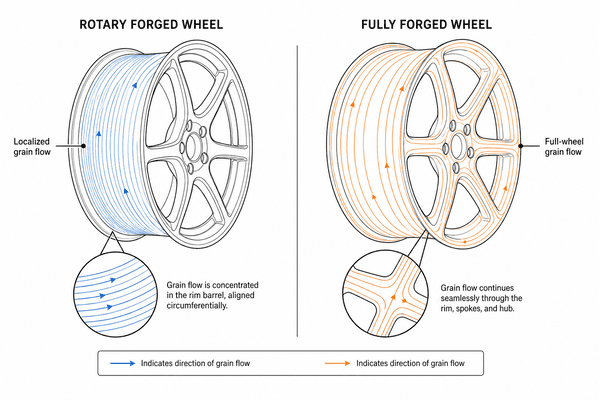
Fully forged wheels usually provide higher strength potential because the forging process works the entire aluminum billet. This pressure helps align and compress the metal grain structure through the spokes, hub, mounting pad, and rim. Rotary forged wheels mainly improve the barrel, so the strength benefit is more localized.
Full Forging Starts Before the Wheel Shape Exists
A fully forged wheel usually begins with a solid aluminum billet. The billet is heated and pressed under very high force5. After that, the forged blank is CNC-machined into the final wheel design. In plain language, the metal is compressed before the wheel shape is cut.
This is different from a process where a pre-shaped wheel is later rolled or stretched in one area.
The practical difference is important:
- Fully forged: The entire blank is forged before machining.
- Rotary forged: The barrel is spun and formed after the wheel center already exists.
- Cast: Molten aluminum is poured into a mold, then cooled and machined.
Each method can produce a usable wheel when done correctly. The question is not whether one term sounds better. The question is whether the process gives enough strength margin for the buyer’s use case.
Grain Flow in Plain Language
I try not to overuse metallurgical terms with customers. Still, “grain flow” is useful if we explain it simply.
Metal has an internal structure. When forging pressure compresses aluminum, that internal structure becomes denser and more directional6. It is similar to how wood grain affects how a piece of wood handles force7. The structure does not become magic, but it can become more resistant to fatigue and impact when engineered correctly.
In full forging, that benefit can extend through the whole wheel blank. In rotary forging, the main improvement is in the rim barrel where rollers apply pressure.
Structural Comparison
| Area of Wheel | Rotary Forged Effect | Fully Forged Effect |
|---|---|---|
| Outer barrel | Strong improvement over cast in many cases | Strong, machined from forged blank |
| Inner barrel | Often improved by rolling/forming | Strong, depending on design and machining |
| Spokes | Usually not fully forged in the same way | Forged blank supports spoke structure |
| Hub pad | Often depends on original center process | Part of forged blank |
| Bolt area | Depends on center construction | Part of forged structure |
| Weight control | Good value for many street builds | Excellent potential with engineering |
| Cost | Usually lower | Usually higher |
Strength Is Not Only a Material Claim
A fully forged wheel can still be poorly designed. A rotary forged wheel can still be well made for its intended use8. Buyers should avoid a simple “forged always wins” mindset.
Real strength depends on several factors:
- Design thickness
- Spoke shape
- Load rating
- Heat treatment
- Material grade
- Machining quality
- Testing standard
- Vehicle weight and use
For example, a heavy SUV and a lightweight coupe do not place the same demand on wheels. A daily-driven luxury car and a track-focused car also have different risk profiles. That is why I always ask about the vehicle model, tire size, road conditions, and driving style before recommending a wheel type.
For B2B buyers, this is also a supplier evaluation issue. A serious wheel supplier should be able to provide load rating information, drawings, fitment support, and relevant test or certification documents. At Tree Wheels, our business context includes ISO9001, DOT, TÜV, and IATF16949 documentation availability, but I always encourage buyers to verify current documents directly before procurement decisions.
When Is Rotary Forged the Better Buying Decision?
Rotary forged wheels may be the smarter choice when the buyer wants a lighter, better-performing wheel than standard cast, but does not need the full strength margin or custom flexibility of a fully forged wheel. The mistake is not choosing rotary forging. The mistake is choosing it for the wrong job.
Rotary forged is often a strong value choice for street cars, light performance builds, and customers who want weight savings without fully forged pricing. Fully forged is better for track use, high-load vehicles, aggressive fitments, and buyers who need maximum customization or strength margin.

Use Case Comes First
I have spoken with shop owners who start by asking, “Which wheel is strongest?” That is a fair question, but it is not the first question I ask back. I usually ask, “What is the car used for?”
That one question changes everything.
A weekend cruiser does not need the same wheel as a time-attack car. A luxury sedan with mild fitment does not need the same margin as a heavy SUV on rough roads. A show car that sees smooth roads may prioritize finish and design. A track car should prioritize fatigue resistance, load rating, and predictable performance.
Simple Buyer Framework
Use this table as a starting point. It is not a substitute for professional fitment or engineering evaluation, but it helps buyers make a practical first decision.
| Buyer Situation | Rotary Forged Fit? | Fully Forged Fit? | Notes |
|---|---|---|---|
| Daily street driving | Yes | Yes | Rotary forging may offer strong value |
| Mild modification | Yes | Yes | Check load rating and fitment |
| Luxury appearance upgrade | Yes | Yes | Finish quality and design matter |
| Track days | Maybe | Better | Fully forged gives more margin |
| Heavy SUV or truck | Maybe | Better | Load rating is critical |
| Aggressive offset | Maybe | Better | Spoke and hub strength matter |
| Big brake clearance needs | Maybe | Better | Fully forged allows more customization |
| Low MOQ custom project | Depends | Yes | Tree Wheels supports MOQ from 4 wheels |
Why Rotary Forged Can Be Enough
Rotary forging is not a fake process. It solves real problems found in basic casting. A standard cast wheel may need more material thickness to reach required strength9. That can increase weight. A rotary-formed barrel can allow a thinner and lighter rim section while maintaining better performance than a basic cast barrel.
This benefit is useful for many customers. For example, a driver who wants improved handling feel and better appearance on a daily car may not need the cost of fully forged wheels. A modification shop may also carry rotary forged options for customers who want an upgrade but have a fixed budget.
In those situations, a good rotary forged wheel can be the honest recommendation.
When I Would Recommend Fully Forged Instead
I become more careful when the buyer describes any of these conditions:
- Frequent track use10
- Heavy braking and hard cornering
- High vehicle weight
- Poor road conditions
- Very wide wheels
- Aggressive concave designs
- Low-profile tires11
- High-horsepower applications
- Customer wants exact custom size, color, and design
- Customer needs maximum strength-to-weight balance
Fully forged wheels give more control over structure and design because the wheel is machined from a forged blank. This allows careful adjustment of spoke thickness, pocketing, brake clearance, offset, and load capacity.
In our production experience through a partner factory with more than 20 years in forged wheel manufacturing, full forging is usually the stronger platform when buyers need custom wheels for demanding applications. That does not mean every fully forged wheel is automatically suitable for every car. It means the process gives a better starting point for high-performance engineering.
How Can Buyers Compare Rotary Forged and Fully Forged Suppliers?
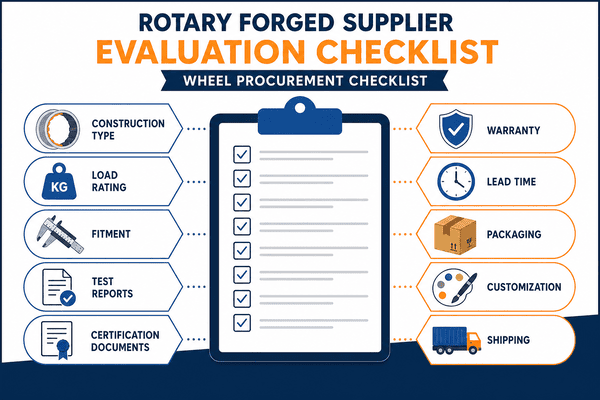
Buyers can compare rotary forged and fully forged suppliers by asking process-specific questions instead of accepting broad claims. The danger is that some sellers use similar language for different manufacturing scopes. A buyer should verify construction, load rating, testing documents, material details, lead time, and after-sales support.
A reliable comparison starts with documentation and clear explanations. Ask whether the wheel center is cast, forged, or machined from a forged billet. Then request load ratings, fitment drawings, test reports, certification documents, warranty terms, and production timelines before placing an order.
Red Flag Phrases to Watch
I do not like calling out specific brands. That rarely helps buyers. But I do think buyers should recognize language patterns that create confusion.
Be careful when you see phrases like:
- “Same as forged”
- “Forged technology”
- “Fully forged style”
- “Rotary forged equals forged”
- “Track-grade” with no load rating
- “TÜV quality” with no document
- “Lightweight racing wheel” with no test information
- “Flow forged monoblock” without explaining the center construction
Some of these terms may appear on legitimate products. The phrase itself is not always a problem. The problem is when the supplier cannot explain what it means.
Supplier Questions That Actually Help
Here are questions I recommend buyers ask before comparing price:
- Which part of the wheel is forged or flow formed?
- Is the wheel center cast, forged, or machined from a forged blank?
- What aluminum material is used?
- What is the load rating for my size?
- Which test standard applies to this wheel?
- Can I see current certification or test documents?
- What is the warranty policy?
- What is the production lead time?
- Can you support custom offset, PCD, center bore, and brake clearance?
- How is the wheel packaged for international shipping?
For Tree Wheels, I usually explain our process in this order: vehicle information first, use case second, fitment requirements third, then wheel construction. That order prevents buyers from choosing only by style or price.
Procurement Checklist for Shops
Modification shops and service centers have extra responsibility because they recommend products to end users. A poor recommendation can damage customer trust.
| Evaluation Area | What to Check | Why It Matters |
|---|---|---|
| Construction | Cast, rotary forged, or fully forged | Avoids misleading comparisons |
| Load rating | Per wheel and per size | Matches vehicle demand |
| Fitment | PCD, offset, center bore, brake clearance | Prevents installation issues |
| Finish | Paint, polish, brushed, anodized, custom color | Affects appearance and durability |
| Lead time | One-piece, two-piece, three-piece timelines | Helps manage customer expectations |
| MOQ | Minimum order quantity | Impacts inventory and cash flow |
| Packaging | Foam, guards, strong cartons | Reduces shipping damage |
| Warranty | Repair or replacement terms | Supports after-sales confidence |
| Documents | ISO, DOT, TÜV, IATF16949, test reports | Buyers should verify authenticity |
Lead Time and Customization Matter Too
Strength is important, but B2B buyers also care about delivery and repeatability. A beautiful wheel is still a problem if it arrives late, fits poorly, or has unclear documentation.
In our business, Tree Wheels focuses on customized forged wheels, including:
- One-piece forged wheels: usually 15–20 days
- Two-piece forged wheels: usually 20–25 days
- Three-piece forged wheels: usually 30–35 days
- MOQ: 4 wheels
- Support: design sketches, 3D models, and sample production
- Packaging: foam protection, strong corner guards, and seven-layer corrugated cartons
- Shipping: door-to-door options depending on destination
These details do not replace engineering evaluation, but they help buyers compare suppliers in a practical way. If a buyer is sourcing wheels for the USA, Canada, Australia, Dubai, or the UK, documentation and logistics become part of the buying decision.
The Best Supplier Explains Trade-Offs
A trustworthy supplier should not force every buyer into the most expensive option. In my view, the best recommendation comes from the buyer’s actual use.
If a customer needs a value street wheel, rotary forged may be the right answer. If a customer needs a custom wheel for hard driving, heavy loads, or a high-end build, fully forged may be the safer recommendation. The supplier should explain the trade-off clearly and let the buyer make an informed choice.
Frequently Asked Questions
Is rotary forged the same as fully forged?
No. Rotary forged usually means the barrel is spun and formed under pressure, while fully forged means the wheel is machined from a forged billet. The words sound similar, but the manufacturing scope is different. Buyers should ask which parts of the wheel are actually forged or formed.
Are rotary forged wheels safe for daily driving?
Yes, rotary forged wheels can be safe for daily driving when they are properly designed, tested, load-rated, and matched to the vehicle. Buyers should verify fitment, load rating, and supplier documentation. For harsh roads, heavy vehicles, or aggressive driving, a professional evaluation is recommended.
Why do some brands call flow formed wheels forged?
Some brands use terms like flow forged, spin forged, or rotary forged because the barrel is formed under pressure. The process is real, but it is not the same as fully forging the entire wheel. The key is whether the supplier clearly explains the manufacturing scope.
Are fully forged wheels always worth the extra cost?
Not always. Fully forged wheels are often better for track use, heavy vehicles, aggressive fitments, and custom specifications. However, many street-driven cars can use a quality rotary forged wheel with good results. The right choice depends on use case, budget, and safety requirements.
What should I ask before buying custom forged wheels?
Ask about material, construction, load rating, fitment, brake clearance, test documents, certification documents, warranty, lead time, and packaging. For custom wheels, also confirm size, offset, PCD, center bore, color, surface treatment, and whether the supplier can provide drawings or 3D support.
Conclusion
Rotary forged is not usually stronger than fully forged across the whole wheel, because the two processes work different areas of the structure. Rotary forging improves the barrel and can be an excellent value for many street cars. Fully forged construction gives more strength potential across the spokes, hub, and rim, especially for demanding use. If you are comparing wheel options, I recommend starting with your vehicle, driving style, and load requirements. If you need help evaluating a custom forged wheel project, Tree Wheels can review your fitment needs and suggest a practical direction.
-
"How to Choose Forged Wheels for a Black Ferrari 488?", https://treewheels.com/how-to-choose-forged-wheels-for-a-black-ferrari-488/. Technical literature on metal forming processes confirms that rotary forging applies radial pressure through spinning rollers to compress and elongate the barrel section of wheels, work-hardening the material through plastic deformation. Evidence role: mechanism; source type: research. Supports: the mechanical process by which rotary forging compresses and stretches wheel barrel material. Scope note: Sources describe the general process but may not address all proprietary variations used by different manufacturers. ↩
-
"What Quality Control Measures Ensure Consistency in Forged …", https://treewheels.com/what-quality-control-measures-ensure-consistency-in-forged-wheel-production/. Materials science research demonstrates that forging processes apply compressive forces that refine grain structure and create directional grain flow aligned with the component geometry, potentially improving mechanical properties throughout the forged part. Evidence role: mechanism; source type: research. Supports: how forging pressure affects aluminum grain structure throughout a component. Scope note: The degree of grain refinement depends on forging parameters, alloy composition, and heat treatment, which vary by manufacturer. ↩
-
"Work hardening", https://en.wikipedia.org/wiki/Work_hardening. Metallurgical studies indicate that plastic deformation processes like flow forming induce work hardening (strain hardening) in aluminum alloys by increasing dislocation density, which can increase yield strength and allow for thinner wall sections compared to as-cast material. Evidence role: mechanism; source type: research. Supports: the work-hardening effect of plastic deformation on aluminum alloys and its impact on mechanical properties. Scope note: Actual strength improvements depend on specific alloy, degree of deformation, and subsequent heat treatment; comparative data varies across studies. ↩
-
"Design and Analysis of Wheel Rim Using Finite Element …", https://www.academia.edu/107406665/Design_and_Analysis_of_Wheel_Rim_Using_Finite_Element_Method. Automotive engineering research using finite element analysis shows that operational loads from braking, cornering, and road impacts generate stress distributions throughout wheel structures, including spokes, hub mounting areas, and rim sections, with stress concentrations varying by wheel geometry and loading conditions. Evidence role: mechanism; source type: research. Supports: how mechanical loads are distributed through wheel components during vehicle operation. Scope note: Specific stress patterns depend on wheel design, vehicle parameters, and loading scenarios; generalized claims may not reflect all configurations. ↩
-
"Enhancement of Aluminum Alloy Forgings through Rapid …", https://digital.library.unt.edu/ark:/67531/metadc892267/m2/1/high_res_d/886705.pdf. Manufacturing engineering literature describes aluminum forging as typically involving heating billets to temperatures between 350-500°C and applying compressive forces ranging from hundreds to thousands of tons, depending on part size and alloy, to achieve plastic deformation and grain refinement. Evidence role: mechanism; source type: research. Supports: typical temperature and pressure parameters used in aluminum forging processes. Scope note: Specific parameters vary by alloy composition, part geometry, and manufacturer equipment; exact values are often proprietary. ↩
-
"Is 4×100 the Right Bolt Pattern for a Honda Civic EK?", https://treewheels.com/is-4×100-the-right-bolt-pattern-for-a-honda-civic-ek/. Metallurgical research confirms that forging processes refine grain structure through dynamic recrystallization and grain boundary reorganization, creating finer, more uniform grains and directional grain flow patterns that follow material movement during deformation, which can enhance mechanical properties along specific orientations. Evidence role: mechanism; source type: research. Supports: how forging affects aluminum microstructure at the grain level. Scope note: The extent of grain refinement and directionality depends on forging temperature, strain rate, total deformation, and subsequent heat treatment. ↩
-
"The fundamental relationships between grain orientation, …", https://www.nist.gov/document/mseapaper-2pdf. Materials science recognizes that both wood and metals exhibit anisotropic properties due to their internal structure, with wood’s cellular fiber orientation and metal’s crystallographic grain orientation both creating directional variations in mechanical properties such as strength and stiffness. Evidence role: general_support; source type: research. Supports: the concept that grain structure creates directional properties in materials. Scope note: While the directional property concept applies to both materials, the underlying mechanisms differ significantly—wood has cellular structure while metals have crystalline structure. ↩
-
"Wheel Failure Investigation Program: Phase I", https://rosap.ntl.bts.gov/view/dot/54652/dot_54652_DS1.pdf. Automotive engineering literature emphasizes that wheel performance and safety depend on integrated design factors including spoke geometry, wall thickness distribution, material selection, heat treatment, and load rating validation, with manufacturing method being one component of overall structural integrity rather than the sole determinant. Evidence role: general_support; source type: research. Supports: that wheel performance depends on multiple engineering factors beyond manufacturing method alone. ↩
-
"Review of Magnesium Wheel Types and Methods of Their …", https://pmc.ncbi.nlm.nih.gov/articles/PMC10856444/. Materials engineering research indicates that cast aluminum alloys generally exhibit lower tensile strength and ductility compared to wrought (forged or formed) alloys due to differences in microstructure, porosity, and grain characteristics, often requiring greater section thickness to achieve equivalent load-bearing capacity. Evidence role: general_support; source type: research. Supports: the relative material efficiency and mechanical properties of cast versus wrought aluminum processes. Scope note: Modern casting techniques and alloy development have reduced this gap; specific comparisons depend on alloy selection and quality control measures. ↩
-
"Investigation of Wheel and Rail Rolling Contact Fatigue Using …", https://railroads.dot.gov/sites/fra.dot.gov/files/2022-03/Wheel%20and%20Rail%20Rolling%20Contact-A.pdf. Automotive engineering analysis indicates that track driving subjects wheels to elevated and sustained loads including higher lateral cornering forces, increased thermal cycling from aggressive braking, repeated high-stress loading cycles that accelerate fatigue, and reduced margin for structural defects, creating more demanding service conditions than typical street driving. Evidence role: general_support; source type: research. Supports: that track driving conditions impose greater mechanical demands on wheels than typical street use. Scope note: The severity of track demands varies with vehicle type, driver skill, track characteristics, and session duration. ↩
-
"Discrete Tire Model Application for Vehicle Dynamics …", https://vtechworks.lib.vt.edu/bitstream/handle/10919/74394/Siramdasu_Y_D_2015.pdf?isAllowed=y&sequence=1. Automotive engineering research indicates that low-profile tires with reduced sidewall height provide less cushioning and impact absorption compared to higher-profile tires, resulting in more direct transfer of road impact forces to the wheel structure and potentially increasing stress on wheel components, particularly the rim and spoke junctions. Evidence role: mechanism; source type: research. Supports: how tire profile affects load transfer and impact forces on wheels. Scope note: The practical significance depends on road conditions, driving style, and wheel structural design; many vehicles are engineered for low-profile tire use. ↩