
Most buyers think more pieces means higher quality. That belief costs them money and performance. Here is what the engineering data actually shows.
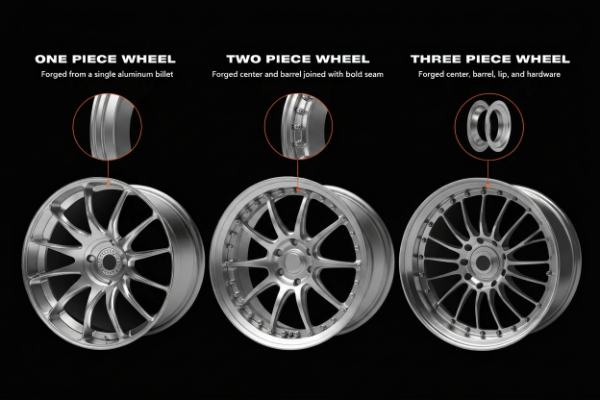
One-piece forged wheels are machined from a single aluminum billet, making them the strongest and most cost-effective option. Two-piece wheels join a forged center to a spun or forged barrel. Three-piece wheels bolt three separate components together, offering the most visual customization but the lowest structural integrity of the three.
I have been supplying forged wheels to modification shops and luxury car centers across the USA, Dubai, Australia, and the UK. One question comes up more than almost any other: what is the real difference between these three construction types? The answer matters because the right choice depends on your customer’s actual needs, not on marketing language. I will walk you through each type, the data behind them, and the decision process I use with every B2B partner who works with us.
What’s the Difference Between 2-Piece and 3-Piece Wheels?
Many shop owners ask me this question expecting a simple answer. The gap between these two types is bigger than most people think, and it goes beyond looks.
A 2-piece wheel joins a forged center to a barrel using welding or hardware. A 3-piece wheel uses bolts to connect a center, an outer barrel, and an inner barrel as three separate parts. The 3-piece design allows more component-level customization but introduces more potential stress points.
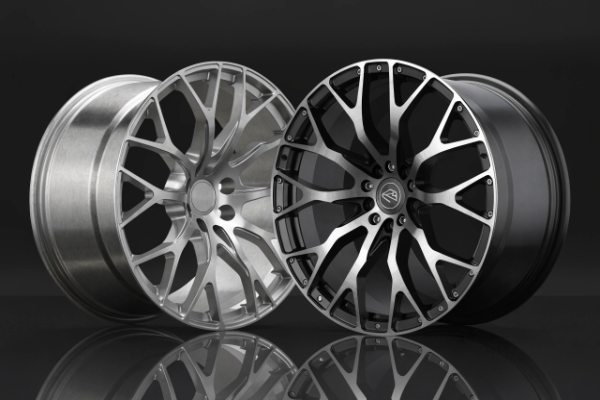
The core difference is the number of joints. Every joint is a potential stress concentration point. In a 2-piece wheel, there is one joint. In a 3-piece wheel, there are two. Our fatigue testing data shows that each additional joint reduces the overall fatigue lifespan of the wheel under repeated load cycling.
How Does the Joint Count Affect Structural Performance?
The structural impact of joint count is measurable and direct.
| Feature | 2-Piece Wheel | 3-Piece Wheel |
|---|---|---|
| Number of joints | 1 | 2 |
| Primary connection method | Weld or hardware | Bolts |
| Stress concentration points | Low | Moderate to High |
| Fatigue lifespan (relative) | Moderate | Lower |
| Maintenance complexity | Moderate | High |
In real-world conditions, a bolted 3-piece assembly requires periodic torque checks. Road vibration can loosen hardware over time. Our production team sees this reflected in warranty claims: 3-piece wheels account for a higher proportion of stress-related issues per unit sold compared to 2-piece wheels. This is not a flaw in the design concept. It is a direct consequence of having more mechanical interfaces under dynamic load. For shop owners advising end customers, this is a fact worth communicating clearly.
What About Cost Differences Between 2-Piece and 3-Piece?
Our pricing reflects actual manufacturing complexity. A 2-piece forged wheel costs roughly twice the price of a comparable 1-piece wheel. A 3-piece wheel costs roughly three times as much. The price gap between 2-piece and 3-piece comes entirely from manufacturing labor and component count, not from a performance advantage. Three-piece production requires more machining operations, more quality inspection steps, and more assembly time. Our production time for 3-piece wheels is 30 to 35 days, compared to 20 to 25 days for 2-piece. If a customer’s design goal can be met by a 2-piece wheel, the 3-piece option adds cost without adding strength.
What Is the Difference Between 1-Piece and 2-Piece Forged Wheels?
This is the comparison I spend the most time explaining to new B2B partners. The performance gap here is larger than most people expect.
A 1-piece forged wheel is machined from a single aluminum billet with no joints or connections. A 2-piece wheel is made from two components joined together. The 1-piece design has no weak points, no joints, and no potential separation under load. It is the structurally superior option in every measurable category.
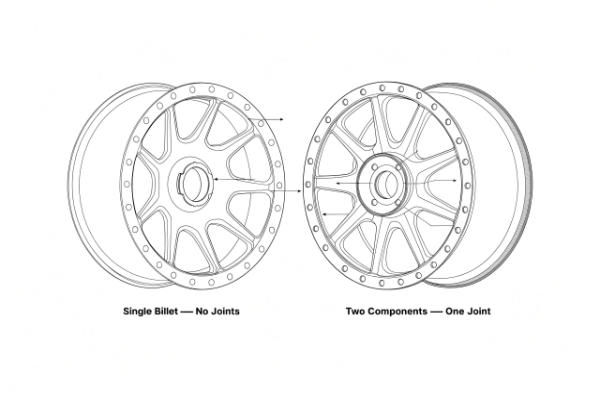
Our fatigue testing data shows that 1-piece forged wheels outperform 3-piece wheels by 40 to 60 percent in fatigue lifespan. The gap between 1-piece and 2-piece is smaller, but the 1-piece advantage is still clear. The reason is simple: there is no joint to fail.
Why Do Racing Series and Performance Applications Use 1-Piece Wheels?
Formula 1 and professional racing series have used 1-piece forged wheels for decades. The reason is not tradition. It is engineering logic.
| Performance Factor | 1-Piece | 2-Piece |
|---|---|---|
| Structural integrity | Highest | High |
| Weight (same size) | Lightest | Slightly heavier |
| Fatigue lifespan | Highest | Moderate to High |
| Failure mode risk | Lowest | Low to Moderate |
| Production time (Tree Wheels) | 15–20 days | 20–25 days |
A single-billet forged wheel has a continuous grain structure throughout the entire piece. There is no point where two materials or two surfaces meet under load. When a 2-piece wheel is stressed repeatedly, the joint area experiences a slightly different load distribution than the surrounding material. Over tens of thousands of load cycles, this difference becomes measurable. For daily road use on high-performance vehicles, the 1-piece wheel is the most reliable option available. I tell every B2B partner the same thing: if the design can be achieved in a 1-piece format, that is the recommendation I will always make first.
Does the 1-Piece Option Limit Design Choices?
This is the most common objection I hear. The short answer is: less than it used to.
CNC machining and forging technology have advanced significantly. Many spoke designs and face profiles that previously required a multi-piece construction can now be produced in a 1-piece format with the same visual result. Some of our latest 1-piece designs closely match the aesthetic of traditional 3-piece styles. The gap between what is achievable in 1-piece versus multi-piece continues to narrow every year. About 90 percent of the design briefs we receive from modification shops can be fulfilled with a 1-piece wheel. The cases where a multi-piece format is genuinely necessary are fewer than most buyers assume.
Are 2-Piece and 3-Piece Rim Components Interchangeable?
This question usually comes from shop technicians who want to know whether they can mix parts across different wheel builds. The answer has real implications for stocking and servicing.
2-piece and 3-piece rim components are not interchangeable. Each wheel is engineered as a matched system. The barrel dimensions, bolt patterns, and center offsets are specific to each design. Mixing components from different builds or manufacturers will result in fitment failure and creates a serious safety risk.
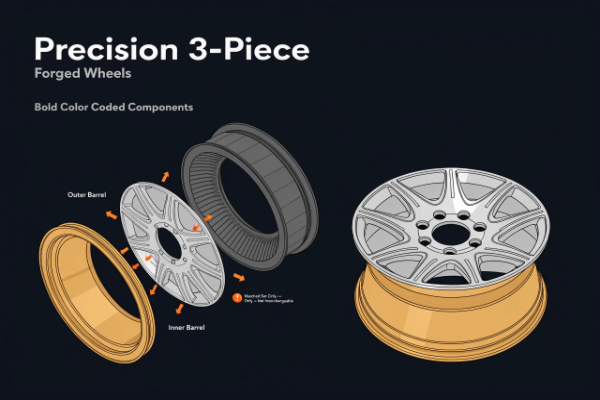
Some technicians assume that because both 2-piece and 3-piece wheels use barrels and centers, the parts should swap between builds. This is not the case.
Why Can’t You Mix Components Between Builds?
The engineering reason is straightforward. Every multi-piece wheel is designed as a system. The center and barrel are matched to specific tolerances. The hardware used to assemble them is torqued to specific values based on the material thickness and joint design of that particular wheel. Changing even one component breaks the engineering assumptions behind the original design.
| Component Factor | Why It Matters |
|---|---|
| Barrel width and offset | Determines load path and clearance |
| Hardware specification | Torque values are load-specific |
| Center thickness | Affects stress distribution at the joint |
| Surface finish at joint | Affects sealing and long-term fit |
| Manufacturer tolerances | Varies between suppliers |
At Tree Wheels, every multi-piece wheel we produce is manufactured and assembled as a complete matched set. We do not sell individual components as replacements for third-party builds. This is not a commercial policy. It is a safety requirement. If a single barrel or center from a 3-piece wheel is damaged, the correct solution is to assess whether a full replacement wheel is needed, not to source a mismatched part. I advise every shop we work with to communicate this clearly to their end customers at the point of sale.
What Is the Advantage of 3-Piece Wheels?
After covering the structural limitations of 3-piece wheels, it is fair to address where they genuinely deliver value. There are real reasons why 70 percent of our Dubai clients choose 3-piece builds.
The primary advantage of 3-piece wheels is visual and customization flexibility. Each of the three components can carry a different surface finish, color, or machining treatment. This makes 3-piece wheels the right choice for customers who require a completely unique aesthetic that cannot be achieved in a 1-piece or 2-piece format.

The 3-piece format exists for a specific reason. It allows the center, outer barrel, and inner barrel to each be treated independently. No other construction type can match this level of component-level customization.
When Does a 3-Piece Wheel Make Sense?
I use a clear set of criteria when advising B2B partners on whether a 3-piece wheel is the right recommendation for their customer.
| Customer Requirement | Best Construction Type |
|---|---|
| Maximum strength, standard design | 1-piece |
| Custom spoke design, single color or finish | 1-piece or 2-piece |
| Dual-tone color scheme | 2-piece or 3-piece |
| Fully independent finish on each component | 3-piece only |
| Extreme width or custom offset not achievable in 1-piece | 2-piece or 3-piece |
| Luxury/exclusivity-focused end customer | 3-piece |
The customers who benefit most from 3-piece wheels are those who want a wheel that looks like no other wheel on the road. Polished outer barrel, brushed center, anodized inner barrel — that combination is only possible in a 3-piece format. For luxury car owners in markets like Dubai, where exclusivity is a primary purchase driver, this matters more than fatigue lifespan statistics. As a supplier, I do not discourage this choice. I make sure the customer understands what they are getting and what trade-offs come with it. That is what honest supplier guidance looks like.
What Is the Total Cost of Ownership for 3-Piece Wheels?
The initial price of a 3-piece wheel is higher. The long-term cost picture is more complex than most buyers realize.
3-piece wheels require periodic hardware inspection and re-torquing. Any disassembly for refinishing or repair involves labor costs that do not apply to 1-piece wheels. The hardware itself has a service life and may need replacement. When a 1-piece wheel is damaged, direct replacement is usually the most cost-effective path. When a 3-piece wheel is damaged, the shop must assess whether individual component repair is practical or whether full replacement is cheaper. In most cases I have seen, total cost of ownership over three to five years is lower for 1-piece wheels, even though the initial price is lower. I share this data with every B2B partner who asks. The goal is always to help them give their end customers the most accurate picture, not the most appealing one.
Conclusion
Choose your wheel construction based on engineering needs, not marketing appeal. Stronger, simpler, and more cost-effective is almost always the better answer. Tree Wheels supplies custom forged wheels built on honest technical guidance — contact us to find the right fit for your customers.