
The wrong wheel finish on the right car can ruin the whole build. Most people don’t realize how much the shade of blue changes everything — until they see it in person.
Gold wheels on a blue Mitsubishi Lancer Evolution create a high-contrast, aggressive look — especially on bright blues like WR Blue. The result depends heavily on the exact shade of blue, the gold finish type, and the wheel fitment. Choosing the right combination makes the difference between a clean build and a clashing one.
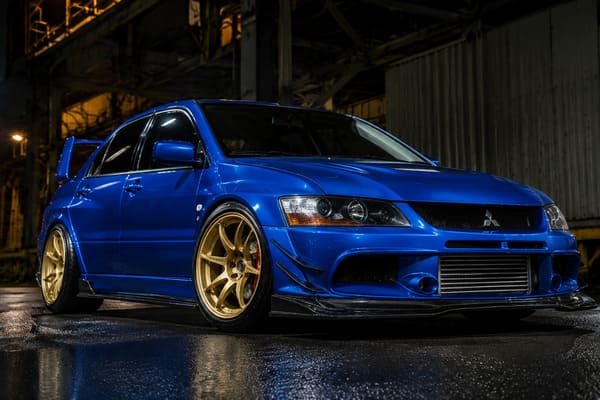
I’ve worked with a lot of Evo owners over the years. Some come in with a clear vision. Others come in with a reference photo taken on a completely different car, in different lighting, on a different shade of blue. The gap between what they imagine and what actually happens on their specific car is where most fitment mistakes happen. This article walks through every part of that decision — color logic, finish types, sizing, offset, wheel construction, and how to match it all to the car you actually drive.
Do Bronze Wheels Look Good on Blue Cars?
Most people default to gold when they think about warm-toned wheels on a blue car. But bronze is a completely different finish — and on the right build, it’s the stronger choice.
Bronze wheels on blue cars create a more reserved, sophisticated look compared to gold. Bronze sits at roughly 40–50% reflectivity, while gloss gold reaches 85–90%.1 On an aggressive car like the Evo, bronze frames the bodywork instead of competing with it — making the car look intentional rather than loud.
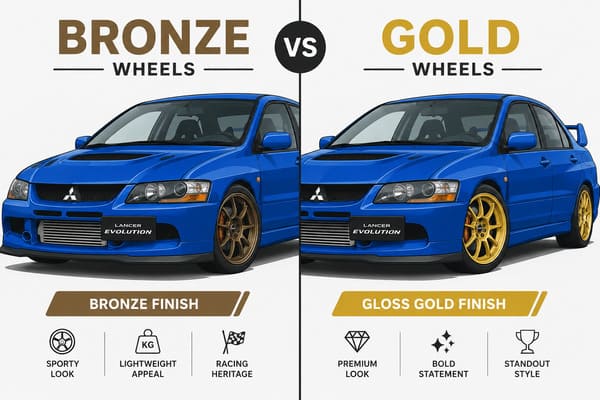
I had a shop owner tell me he used to recommend gold to almost every customer with a blue car. Then one day a customer insisted on bronze. The shop owner thought it was the wrong call. But when the build was finished, it was one of the best-looking Evos that had ever left his shop. That story stuck with me, and it changed how I talk to customers about this choice.
Gold vs. Bronze: What the Numbers Actually Mean
The difference between gold and bronze is not just a color preference — it’s a difference in how the wheel interacts with the car’s body lines and surrounding light.
| Property | Gloss Gold | Bronze |
|---|---|---|
| Reflectivity | 85–90% | 40–50% |
| Visual Weight | High | Medium |
| Contrast on WR Blue | Very High | Moderate |
| Contrast on Dark Navy | High | Low–Medium |
| Personality | Loud, assertive | Understated, precise |
| Best Use Case | Show builds, statement cars | Performance builds, daily drivers |
The Evo already has sharp, angular bodywork.2 Its lines are aggressive by design. Gold announces the car — it adds a layer of visual noise on top of the existing design. Bronze doesn’t compete with those lines. It supports them. On a car where the body is doing a lot of the talking, bronze lets the engineering speak instead of the finish. Neither choice is wrong. But they are not interchangeable, and treating them as the same decision is where a lot of builds go off track.
What Wheel Size and Offset Should You Choose for a Mitsubishi Lancer Evolution?
Size gets all the attention. But the number that actually determines how a wheel looks and performs on an Evo is the offset — and most buyers don’t think about it until something feels wrong.
For a Mitsubishi Lancer Evolution, 18×9.5 is the most common performance fitment.3 Offset should sit between ET35 and ET38 for stock or mildly modified cars.4 Going below ET30 requires confirmed fender clearance and suspension modifications.5 Getting offset wrong by even 7mm changes how the car looks and handles.6
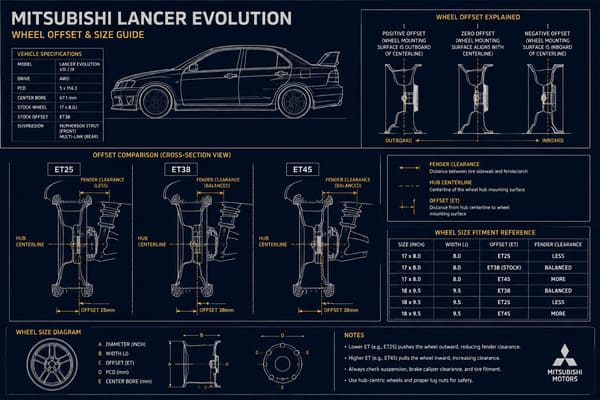
I once had a customer order a set of 18×9.5 wheels for his Evo and told me size was the most important thing to get right. We built the wheels exactly to his spec. When they arrived and went on the car, he called and said something felt off — the wheels looked like they were sitting too deep inside the arch. The size was perfect. The offset was wrong. He had gone with ET45 when his build needed ET38. That 7mm difference pushed the wheel further inward, and visually the car looked narrow and hesitant — completely wrong for an Evo.
Fitment Reference Table for Evo Builds
Understanding how size and offset interact is the most practical thing you can do before placing a wheel order.
| Spec | Stock Setup | Mild Modification | Aggressive Fitment |
|---|---|---|---|
| Wheel Width | 8.5–9 inch | 9–9.5 inch | 9.5–10 inch |
| Wheel Diameter | 17–18 inch | 18 inch | 18–19 inch |
| Recommended Offset | ET40–ET45 | ET35–ET38 | ET25–ET30 |
| Fender Modification | Not required | Usually not required | Often required |
| Tire Stretch | None | Minimal | Possible |
| Visual Stance | Stock | Planted | Aggressive flush |
Offset is the number that determines whether a wheel looks planted or lost inside the arch.7 A wheel that is 1mm too far inward or outward changes the visual balance of the entire car. For most Evo owners who want a clean, performance-oriented look without pulling fenders, ET35 to ET38 is where I recommend starting. Go lower only when the rest of the build supports it.
Are Forged Wheels Worth It for a Mitsubishi Lancer Evolution?
The question isn’t really whether forged wheels are worth it. The better question is: what are you using the car for? Because the answer changes depending on that.
Forged wheels on a Mitsubishi Lancer Evolution reduce unsprung weight by approximately 4 kg per wheel — around 16 kg total.8 This directly improves suspension response, braking performance, and steering feel.9 For a car built around performance like the Evo, forged wheels work with the engineering rather than against it.
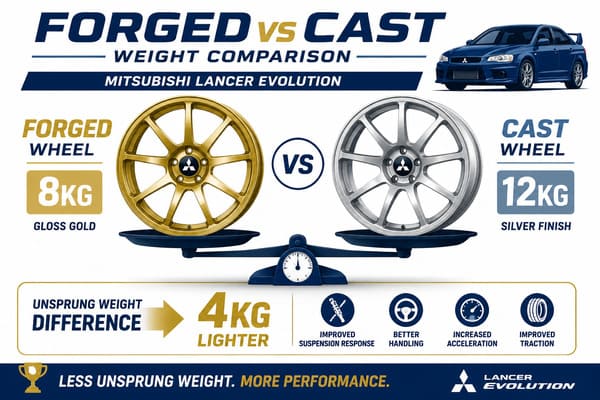
The number is simple. A cast wheel in 18×9.5 typically weighs between 11 and 13 kg per wheel. A forged wheel at the same size comes in at 7 to 9 kg.10 That’s roughly 16 kg of unsprung weight removed from a car that weighs around 1,400 kg11. That sounds small until you understand what unsprung weight actually does.
Why Unsprung Weight Matters More Than Total Weight
Unsprung weight is the weight that moves with the wheel and suspension — not the weight the suspension has to carry.12 It affects the car differently from overall weight because it directly controls how fast the suspension can react.
| Factor | Cast Wheels (11–13 kg each) | Forged Wheels (7–9 kg each) |
|---|---|---|
| Total Unsprung Weight (4 wheels) | ~44–52 kg | ~28–36 kg |
| Suspension Response | Slower to follow road surface | Faster, more precise |
| Braking Performance | More rotational inertia to stop | Less inertia, shorter stopping distance |
| Steering Feedback | Dampened, less direct | Cleaner, more communicative |
| AWD System Load | Higher | Lower |
| Build Strength | Adequate for road use | Higher tensile strength, more durable |
The Evo was engineered as a performance machine from the factory. Its suspension geometry, its AWD system, its braking — all of it was designed to work with a car that responds quickly. Putting heavy cast wheels on it works against that engineering. For a show-only garage build, cast is a reasonable choice. For anything involving real driving — commuting, canyon roads, track days — forged is not a luxury. It is the correct tool for what the car was built to do.
How Do You Pick the Right Gold Finish for Your Evo’s Wheels?
Most people choose a wheel finish by looking at photos online. That’s one of the most common mistakes I see — because photos don’t show you how a finish behaves in real lighting conditions.
The right gold finish for an Evo depends on where and when the car is seen. Gloss gold performs best in direct sunlight and show environments. Brushed gold maintains its appearance across all lighting — covered parking, overcast days, and bright shows. Matching the finish to your car’s real environment produces a more consistent result.
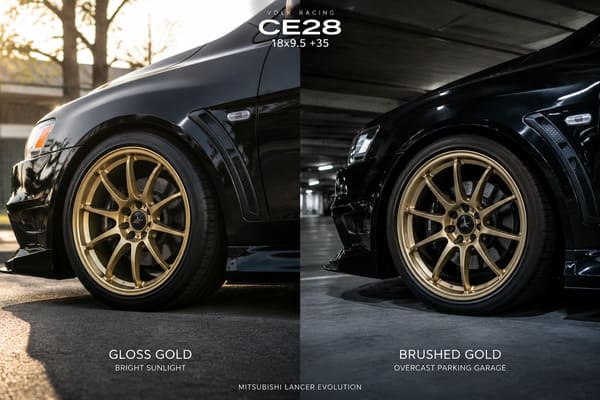
A customer of mine spent three weeks going back and forth between gloss gold and brushed gold for his Evo build. He kept looking at photos online and couldn’t decide. I told him to stop looking at photos and think about where his car actually lives. He drives to work three days a week, parks in a covered garage, and takes the car to shows on weekends. That information told me everything I needed to know about which finish would serve him best.
Gold Finish Comparison: Real-World Performance
Choosing a finish is really a decision about lighting conditions — not just aesthetics.
| Finish Type | Direct Sunlight | Overcast / Cloudy | Indoor / Covered Parking | Show Environment | Maintenance |
|---|---|---|---|---|---|
| Gloss Gold | Excellent | Can look flat | Can look dull | Excellent | Requires regular polishing |
| Brushed Gold | Very Good | Good | Good | Very Good | Low maintenance |
| Satin Gold | Good | Good | Good | Good | Low maintenance |
| Two-Tone (Brushed + Machined) | Excellent | Very Good | Good | Excellent | Moderate |
Gloss gold looks incredible in direct sunlight and at a well-lit show. But in a covered parking structure or on a grey morning, it can look flat and almost cheap — which is not what you paid for. Brushed gold holds its character across all conditions. It looks intentional at 7am in a grey car park just as much as it does at noon in direct sun. The customer went with brushed gold. Three months later he told me it was the best decision he made on the entire build. The finish you choose is a decision about where and when your car gets seen — not just how it looks in a photoshoot.
Conclusion
Gold wheels on a blue Evo work — but only when the shade, finish, size, offset, and construction all align. Every detail in this guide points to one thing: precision matters. TreeWheels offers fully customized forged wheels built to your exact spec, delivered to your door.
-
"Chromaticity and Glossiness of Gold, Silver, and Bronze Colors – PMC", https://pmc.ncbi.nlm.nih.gov/articles/PMC5393752/. A source on optical reflectance of metallic and painted surfaces can contextualize that perceived brightness varies with coating material, surface finish, and illumination conditions; it should be used to support the general reflectance-based distinction rather than exact automotive-wheel percentages unless those values are directly measured. Evidence role: statistic; source type: paper. Supports: Bronze wheel finishes are less reflective than gloss gold finishes, with bronze claimed at roughly 40–50% reflectivity and gloss gold at 85–90%.. Scope note: The stated 40–50% and 85–90% figures are highly specific and may require a coating datasheet or measured reflectance study rather than a general optics reference. ↩
-
"Mitsubishi Lancer Evolution – Wikipedia", https://en.wikipedia.org/wiki/Mitsubishi_Lancer_Evolution. An automotive design or model-history source can support the characterization of the Lancer Evolution’s exterior as performance-oriented with prominent aerodynamic and angular styling elements; this is contextual support rather than an objective measurement of visual sharpness. Evidence role: general_support; source type: encyclopedia. Supports: The Mitsubishi Lancer Evolution has sharp, aggressive, angular bodywork.. Scope note: Design descriptions are partly interpretive, so the source should be used to support the broader styling characterization, not prove subjective taste. ↩
-
"Mitsubishi Lancer 18×9.5 Gallery – Fitment Industries", https://www.fitmentindustries.com/wheel-offset-gallery?make=Mitsubishi&model=Lancer&wheel_diameter_from=18&wheel_width_from=9.5. A fitment database, motorsport preparation guide, or owner-community survey can document common Lancer Evolution wheel sizes used for performance setups; such evidence would support prevalence in practice but may not establish an official manufacturer recommendation. Evidence role: general_support; source type: other. Supports: An 18×9.5 wheel is a common performance fitment for the Mitsubishi Lancer Evolution.. Scope note: Common aftermarket fitments vary by Evo generation, tire choice, suspension setup, and market, so the source may only support this as a typical rather than universal specification. ↩
-
"Mitsubishi Lancer 18×9.5 Gallery – Fitment Industries", https://www.fitmentindustries.com/wheel-offset-gallery?make=Mitsubishi&model=Lancer&wheel_diameter_from=18&wheel_width_from=9.5. A technical fitment guide or fitment database can support that ET35–ET38 is commonly used on 18×9.5 Lancer Evolution wheels for stock or mildly modified cars; the citation should note that safe fitment depends on tire size, suspension, ride height, and Evo generation. Evidence role: general_support; source type: other. Supports: ET35 to ET38 is an appropriate starting offset range for stock or mildly modified Mitsubishi Lancer Evolution fitments.. Scope note: Wheel-offset suitability is vehicle- and setup-specific, so the source should not be treated as a universal clearance guarantee. ↩
-
"Wheel Offset (ET) Explained: Complete Guide – Hodoor Performance", https://hodoor.world/blogs/blog/wheel-offset-et-explained-complete-guide. A vehicle-specific fitment reference can support that lower offsets move the wheel outward and often require fender rolling, additional camber, or suspension adjustments on Lancer Evolution builds; this supports the clearance concern but not every individual car will require the same modification. Evidence role: mechanism; source type: other. Supports: Offsets below ET30 on a Mitsubishi Lancer Evolution often require confirmed clearance and possible body or suspension modification.. Scope note: Actual clearance depends on wheel width, tire section width, ride height, camber, and body tolerances. ↩
-
"[PDF] Introduction to Formula SAE Suspension and Frame Design", https://racing.byu.edu/0000018a-6be7-df21-a5fe-fbef2f9d0001/intro-to-frame-and-suspension-design. A suspension-geometry source can explain that wheel offset changes track width, scrub radius, bearing load, and steering behavior; it supports the mechanical plausibility of a 7 mm offset change affecting handling, while the visual impact remains partly subjective. Evidence role: mechanism; source type: education. Supports: A 7 mm wheel-offset change can alter vehicle appearance and handling characteristics.. Scope note: The magnitude of the handling effect from a 7 mm change depends on the original geometry, tire, alignment, and suspension setup. ↩
-
"Wheel Offset Explained: How to Get the Right Fit – Holley Motor Life", https://www.holley.com/blog/post/wheel_offset_explained_how_to_get_the_right_fit/. A technical explanation of wheel offset can support that offset determines the inboard/outboard position of the wheel relative to the hub and therefore affects how far the wheel sits within the wheel arch; aesthetic judgments such as “planted” remain interpretive. Evidence role: definition; source type: education. Supports: Wheel offset controls how far a wheel sits inward or outward in the wheel arch.. Scope note: The source can define the geometry and positioning effect, but not objectively prove the preferred appearance. ↩
-
"Forged vs. Cast Wheels: Understanding the Differences", https://rnrtires.com/tips-guides/forged-vs-cast-wheels-understanding-the-differences/. A technical source comparing forged and cast wheel masses can support that forged wheels are commonly lighter than comparable cast wheels and can reduce unsprung mass; the exact 4 kg-per-wheel reduction should be tied to comparable wheel sizes and models. Evidence role: statistic; source type: paper. Supports: Forged wheels can reduce unsprung weight on a Mitsubishi Lancer Evolution by approximately 4 kg per wheel compared with cast wheels.. Scope note: Weight savings vary substantially by wheel design, diameter, width, load rating, and manufacturing method. ↩
-
"Unsprung mass – Wikipedia", https://en.wikipedia.org/wiki/Unsprung_mass. Vehicle-dynamics literature on unsprung mass can support that reducing unsprung and rotational mass can improve wheel control, ride response, steering behavior, and braking dynamics; the source may explain the mechanism rather than quantify the improvement for a specific Evo. Evidence role: mechanism; source type: paper. Supports: Reducing unsprung wheel mass can improve suspension response, braking performance, and steering feel.. Scope note: The degree of improvement depends on tire, damper tuning, brake system, road surface, and driver sensitivity. ↩
-
"HOME – KG1 FORGED WHEELS", https://kg1forged.com/. Comparable product specifications or an engineering comparison of cast and forged aluminum wheels can support typical mass ranges for 18×9.5 wheels; the citation should clarify that these are approximate market ranges rather than fixed values for all designs. Evidence role: statistic; source type: other. Supports: Typical 18×9.5 cast wheels weigh about 11–13 kg, while comparable forged wheels often weigh about 7–9 kg.. Scope note: Wheel weight depends on spoke design, load rating, diameter, width, material alloy, and manufacturing process, so exceptions are common. ↩
-
"Mitsubishi Lancer Evolution X – Wikipedia", https://en.wikipedia.org/wiki/Mitsubishi_Lancer_Evolution_X. Manufacturer specifications or an encyclopedia entry can support that Mitsubishi Lancer Evolution curb weights are generally around 1,400 kg, depending on generation, trim, transmission, and market. Evidence role: statistic; source type: encyclopedia. Supports: The Mitsubishi Lancer Evolution weighs around 1,400 kg.. Scope note: Curb weight differs across Evo generations and specifications, so a single figure is approximate. ↩
-
"Unsprung mass – Wikipedia", https://en.wikipedia.org/wiki/Unsprung_mass. An engineering or vehicle-dynamics reference can define unsprung mass as the mass not supported by the suspension, including wheels, tires, brakes, and portions of suspension components; this supports the concept while the article’s simplified wording may omit shared or partially sprung components. Evidence role: definition; source type: education. Supports: Unsprung weight refers to vehicle mass that moves with the wheels rather than being supported by the suspension.. Scope note: Some suspension and driveline components are partly sprung and partly unsprung, so practical definitions can be more nuanced than the article’s wording. ↩