
You’ve just gotten a quote from a modification shop. They’re recommending 20-inch wheels instead of your current 18s. The bigger wheel size looks incredible in the render — lower, more aggressive, more premium. But something makes you pause. You’re not sure if you’re buying performance or just buying looks. That uncertainty is worth taking seriously.
Bigger wheel size does not automatically mean better performance. In most cases, upsizing improves visual stance while introducing trade-offs in ride comfort, handling feel, and system compatibility. The real question isn’t how big — it’s whether the size fits your car’s suspension geometry, tire profile, and how you actually drive. Get those three things right, and upsizing can be a great decision. Ignore them, and you’ll notice the difference every time you hit a pothole.
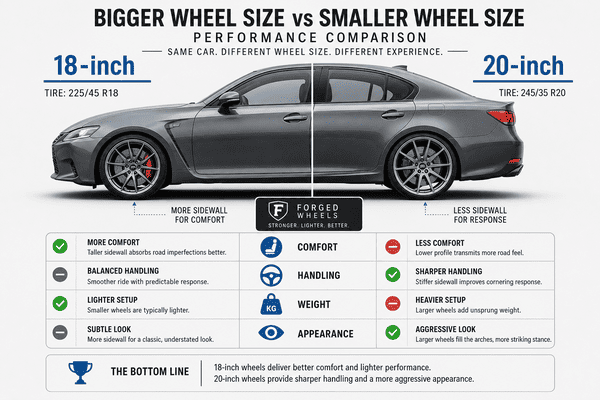
Most buyers we talk to arrive with the same starting assumption: bigger diameter equals higher performance. That assumption isn’t completely wrong — but it’s dangerously incomplete. The sections below break down exactly where that logic holds, where it fails, and what you should actually be evaluating before you commit to a size.
Is "Bigger = Sportier" a Performance Fact or a Visual Bias?
We hear this framing constantly. A buyer comes to us with a reference photo — usually a sports car on wide, low-profile rubber — and says, "I want that look." The wheel size in the photo reads as performance. The question is whether the performance impression is real or cosmetic.
Larger diameter wheels look more aggressive because they fill the arch more completely, reduce the visual tire sidewall, and create a low-profile stance associated with high-end vehicles. But visual association is not mechanical causation. A bigger wheel size that isn’t paired with the right tire and suspension setup can actually make handling feel less precise, not more.
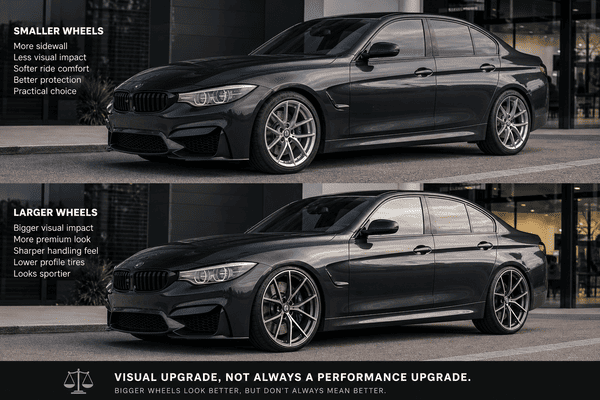
The gap between what a bigger wheel looks like it does and what it actually does depends entirely on how the rest of the system is adjusted around it. Here’s what drives that gap:
The Rotational Mass Factor
Larger wheels are heavier — even in forged aluminum, a 20-inch wheel carries more material than an 18-inch equivalent. Heavier unsprung mass (the weight below your suspension) makes the suspension work harder to keep tires in contact with the road.1 This matters more on winding roads than straight highways, which is exactly the context where most buyers want "sportier" performance.
Aspect Ratio: The Variable Most Buyers Miss
When you go up in wheel diameter, the tire needs to come down in sidewall height to maintain the same overall rolling circumference. This is called plus-sizing, and it’s where most upsizing decisions either work or break down.
| Wheel Size | Typical Tire Example | Sidewall Height |
|---|---|---|
| 17 inch | 225/55R17 | ~124mm |
| 18 inch | 225/45R18 | ~101mm |
| 19 inch | 225/40R19 | ~90mm |
| 20 inch | 225/35R20 | ~79mm |
Each step down in aspect ratio removes roughly 10–20mm of rubber between your wheel and the road. That rubber is suspension you didn’t know you had. Ignore the aspect ratio adjustment, and you’ll end up with an oversized overall diameter — which throws off your speedometer reading, confuses your ABS calibration, and can cause fitment issues inside the wheel arch.2
What "Handling Improvement" Actually Requires
A stiffer, lower-profile tire does sharpen steering response in clean conditions.3 That part of the bigger-wheel narrative is true. But it only holds if:
- Your suspension geometry is aligned for that tire width and profile4
- Road surfaces in your area are smooth enough that the reduced sidewall flex doesn’t translate into constant micro-jolts through the steering column
- Your wheel offset is correct for the new size
Without those three conditions, you’re not getting sports car handling. You’re getting a harsher ride and a car that’s more sensitive to road imperfections — which most people experience as worse, not better.
Does Wheel Size Actually Affect Ride Comfort?
This is one of the most underestimated trade-offs in any wheel upgrade conversation. Buyers who’ve driven on smooth showroom floors or in favorable conditions don’t always feel this until they’re back on their daily commute.
The tire sidewall is a shock absorber. Thinner sidewalls mean less air volume between your wheel and the road surface. Every road irregularity — expansion joints, pothole lips, tar strips — transmits more energy directly into the wheel and up through the suspension.5 This is a physics reality, not a product flaw.
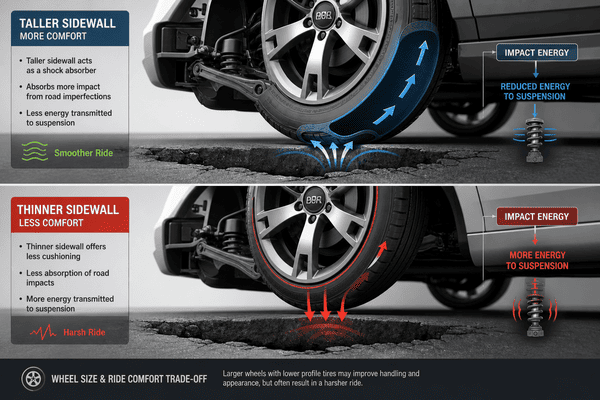
Whether that trade-off is acceptable depends entirely on your driving context. A buyer in Dubai running smooth highway miles has a very different calculation than a buyer in a northern city with aggressive seasonal road damage.
When the Comfort Trade-Off Is Acceptable
- You primarily drive on well-maintained highways or smooth urban roads
- You’re building a show car or weekend driver where aesthetic impact matters more than daily comfort
- You’re upgrading suspension components alongside the wheel upgrade to compensate
- The size increase is modest — one step up, not two or three
When the Comfort Trade-Off Becomes a Real Problem
- You commute daily on rough urban roads
- Your current suspension is standard or showing wear
- You’re upsizing multiple steps at once (e.g., 17 to 20 inches)
- You carry passengers regularly who will notice NVH (noise, vibration, harshness) changes
I had a customer who upgraded from 18s to 21s on a luxury SUV without adjusting the tire profile correctly. Within two months, he was back asking whether the wheels were defective. The wheels were fine. The sidewall had gone from 55 series to 45 series without recalculating the rolling diameter, and the resulting mismatch amplified road noise in a way that felt like a suspension problem. It wasn’t. It was a fitment decision that needed better information upfront.
A Practical Comfort vs. Style Framework
Consider this a rough guide — not a technical specification:
| Daily Driving Condition | Recommended Max Upsize |
|---|---|
| Smooth highways, warm climate | +2 to +3 inches from OEM |
| Mixed urban/highway | +1 to +2 inches from OEM |
| Rough urban roads, cold climate | +1 inch, with suspension review |
| Track/performance use | Consult suspension specialist |
Does a Bigger Wheel Improve Braking Performance?
This is one of the most persistent myths we encounter. The assumption is intuitive: a bigger wheel creates more room for bigger brakes, and bigger brakes stop faster. The logic is partially true but mostly misapplied.
A larger wheel diameter does create more physical clearance around the brake assembly. This means you can fit a larger caliper or a larger rotor inside a bigger wheel — but the wheel itself does not do the braking. The braking performance comes from caliper clamping force, rotor diameter, pad compound, and brake fluid response time. The wheel is simply the housing.
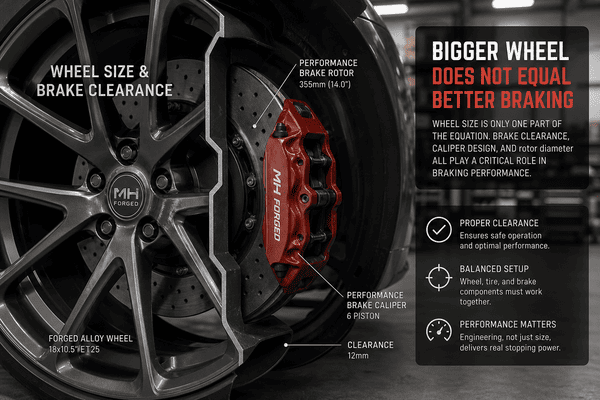
Here’s the distinction that matters for buyers:
- Buying larger wheels does not improve braking.
- Buying larger wheels with a purpose-built big brake kit can improve braking — but the braking upgrade is the brake kit, not the wheel.
Many buyers see high-performance vehicles with large-diameter wheels and visible brake calipers and conflate the two. The large wheel is there to clear the large caliper. The large caliper is what stops the car faster. If you upsize wheels without upgrading brakes, your braking performance remains unchanged.
What Actually Determines Braking Performance
- Rotor diameter — larger rotors increase leverage (mechanical advantage over the wheel’s rotational momentum)6
- Caliper quality — multi-piston calipers apply more even clamping force7
- Pad compound — high-friction pads perform better under heat
- Brake bias — front/rear balance matters especially under hard stopping
- Tire contact patch — tire width and compound affect grip, which affects stopping distance
Wheel size sits outside this chain entirely — unless you’re using it as a prerequisite to install a big brake kit that requires the clearance.
How Do You Choose the Right Wheel Size for Your Car?
The right wheel size is the one that fits correctly within your vehicle’s total system — not the largest one that physically clears the arch. Getting this right means checking four things before deciding.
Most modification shop buyers we work with haven’t gone through this checklist before their first inquiry. That’s completely normal. But going through it before you commit saves real money and prevents the kind of regret that shows up as "the wheels feel wrong" six months later.
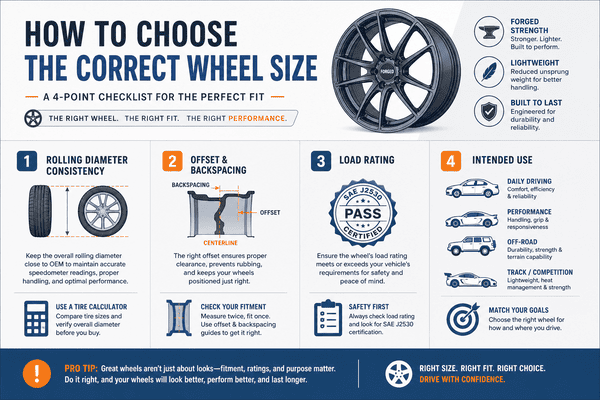
The Four-Point Fitment Checklist
1. Rolling Diameter Consistency
Calculate the overall tire diameter for your proposed wheel and tire combination. It should stay within approximately 3% of your original equipment diameter. Online plus-sizing calculators make this straightforward — and your wheel supplier should be willing to help you run the numbers.
2. Offset and Backspacing
Offset (measured in millimeters) determines how far the wheel sits inward or outward from the hub. The wrong offset causes rubbing against suspension components or against the inner fender. Every car has a safe offset range — verify it before ordering.
3. Load Rating
Each wheel carries a rated load capacity. Heavier vehicles — especially SUVs and trucks — need wheels rated appropriately for their axle weight. This is a compliance and safety issue, not just a performance preference. Certifications like DOT and TÜV are documents that speak directly to this — and buyers should verify them independently.
4. Intended Use
A track-day setup, a daily driver, and a weekend show car have different priorities. Track use prioritizes stiffness and weight. Daily driving prioritizes a balance of comfort and appearance. Show use may allow more aggressive sizing choices because mileage and road stress are lower.
Forged vs. Cast: A Size-Relevant Consideration
When upsizing, the wheel’s construction method matters more at larger diameters. Forged wheels maintain structural integrity at lower weight as diameter increases — which partially offsets the unsprung mass penalty of going bigger. Cast wheels gain weight more rapidly at larger sizes.8
| Construction | Weight at 20" | Structural Integrity | Cost |
|---|---|---|---|
| Forged (one-piece) | Lower | High | Higher |
| Forged (three-piece) | Moderate | High | Premium |
| Cast | Higher | Moderate | Lower |
This is why serious upsizing conversations tend to move toward forged construction — not for marketing reasons, but because the weight math works better at larger diameters.
Frequently Asked Questions
Does going from 18-inch to 20-inch wheels make my car faster?
Not directly. Larger wheel size alone does not increase engine output, reduce drag, or improve aerodynamics in measurable ways at street speeds. Any performance change you feel after upsizing is more likely related to changes in tire compound, tread width, or sidewall stiffness — not the wheel diameter itself.
Will bigger wheels affect my speedometer?
Yes, if your overall rolling diameter changes. A larger wheel paired with a tire that has too-tall a sidewall will cause your speedometer to read lower than your actual speed. Maintaining consistent overall tire diameter through correct aspect ratio selection prevents this. Most manufacturers recommend staying within 3% of the OEM rolling circumference.9
Do bigger wheels wear out tires faster?
Not inherently — but incorrect fitment, wrong offset, or a suspension setup not adjusted for new sizing can cause uneven tire wear. A correctly fitted larger wheel on aligned suspension should not accelerate tire wear beyond normal.
Can I upsize wheels without changing tires?
Technically possible in some cases, but generally not recommended. Keeping the same tire on a larger wheel changes the overall diameter and can cause the clearance, speedometer, and ABS issues described above. The wheel and tire sizing decision should be made together.
How do I know if a wheel supplier’s certifications are legitimate?
Ask for the actual certification documents — ISO 9001, DOT, TÜV, or IATF 16949 — and verify them against the issuing body’s records where possible. Reputable suppliers provide these without hesitation. Treat any reluctance to share documentation as a signal worth investigating before you order.
Conclusion
Bigger wheel size is not a performance upgrade by default — it’s a system decision. The buyers who get the most out of upsizing are the ones who treat wheel diameter as one variable in a connected set: tire profile, offset, load rating, suspension geometry, and intended use. Get those right, and a larger wheel can genuinely transform how a car looks and responds. Skip the fitment work, and you’ll feel the consequences every time road conditions aren’t perfect.
At Tree Wheels, we work with both modification shops and individual buyers who are navigating exactly this kind of decision. If you’re evaluating a wheel size change and want a second opinion on fitment, sizing, or construction options — reach out. We’d rather spend ten minutes helping you choose correctly than have you second-guess the decision later.
-
"Unsprung mass", https://en.wikipedia.org/wiki/Unsprung_mass. Vehicle dynamics literature establishes that unsprung mass — comprising wheels, tires, and brake assemblies — directly affects a suspension system’s ability to follow road irregularities, with higher unsprung mass reducing the speed at which the suspension can respond to surface changes. Evidence role: mechanism; source type: research. Supports: That increased unsprung mass requires greater suspension effort to maintain tire contact with road surfaces, particularly during dynamic cornering conditions. Scope note: Most foundational treatments of this relationship appear in automotive engineering textbooks rather than standalone empirical studies, and the magnitude of the effect varies significantly by suspension design and vehicle class. ↩
-
"Real-time Tire Imbalance Detection Using ABS Wheel …", https://www.academia.edu/5921502/Real_time_Tire_Imbalance_Detection_Using_ABS_Wheel_Speed_Sensors. ABS and electronic stability control systems calculate vehicle speed and wheel slip by comparing rotational frequency across wheel-speed sensors against a stored rolling circumference value; a tire diameter change outside calibrated tolerances can cause the system to misinterpret wheel slip thresholds. Evidence role: mechanism; source type: research. Supports: That ABS systems rely on wheel-speed sensor data calibrated to a specific rolling circumference, and that significant deviations from the original tire diameter can introduce errors in wheel-speed calculations used by ABS and related stability systems. Scope note: The sensitivity of ABS miscalibration to tire diameter changes varies by vehicle manufacturer and system generation; some modern vehicles include recalibration procedures for tire size changes. ↩
-
"Discrete Tire Model Application for Vehicle Dynamics …", https://vtechworks.lib.vt.edu/bitstream/handle/10919/74394/Siramdasu_Y_D_2015.pdf?isAllowed=y&sequence=1. Tire mechanics research indicates that lower aspect ratio tires exhibit higher lateral stiffness due to reduced sidewall height, which decreases the lag between steering input and tire contact patch response, contributing to more immediate handling feel under controlled road conditions. Evidence role: mechanism; source type: research. Supports: That reduced tire sidewall height increases lateral stiffness, which reduces sidewall flex during cornering and can improve steering response precision on smooth surfaces. Scope note: Steering response improvements are most pronounced on smooth surfaces; on rough or uneven roads, reduced sidewall compliance can introduce vibration that degrades steering feel, partially or fully offsetting the precision benefit. ↩
-
"A STUDY OF PARAMETERS INFLUENCING THE …", https://ninercommons.charlotte.edu/record/746/files/Patel_uncc_0694N_11115.pdf. Vehicle dynamics engineering establishes that suspension alignment settings are optimized for specific tire contact patch dimensions; changes in tire width or aspect ratio alter the contact patch shape and load distribution, and without corresponding alignment recalibration, the resulting geometry mismatch can reduce cornering stability and increase tire wear. Evidence role: mechanism; source type: research. Supports: That suspension alignment parameters — including camber, caster, and toe — interact with tire contact patch geometry, and that changes in tire width or profile without corresponding alignment adjustment can produce suboptimal or degraded handling characteristics. Scope note: The sensitivity of handling to alignment-tire geometry mismatch varies by vehicle type and suspension design; some vehicles tolerate moderate tire size changes without perceptible handling degradation, while performance-oriented suspensions are more sensitive to these parameters. ↩
-
"Tire–road interaction physics • Vibration and resonance …", https://www.facebook.com/SkillLyncOfficial/posts/-what-causes-the-difference-tireroad-interaction-excites-vibrations-rougher-road/1258854546354607/. Automotive NVH engineering literature characterizes the pneumatic tire as a primary filter for high-frequency road inputs, with sidewall compliance and enclosed air volume contributing to vibration attenuation; reductions in aspect ratio decrease this filtering capacity and increase the amplitude of vibration transmitted to the vehicle structure. Evidence role: mechanism; source type: research. Supports: That pneumatic tires act as a secondary suspension element through sidewall compliance and air volume, and that reducing sidewall height decreases this compliance, increasing the transmission of road-induced vibration energy to the wheel and suspension system. Scope note: The degree of NVH increase from aspect ratio reduction depends on road surface characteristics, vehicle suspension tuning, and subframe isolation, making direct quantification difficult without vehicle-specific testing. ↩
-
"When does the braking power stop scaling with Rotor Size", https://bicycles.stackexchange.com/questions/89973/when-does-the-braking-power-stop-scaling-with-rotor-size. Brake system engineering principles establish that braking torque is a product of caliper clamping force and the effective radius at which that force is applied; a larger rotor diameter increases this effective radius, producing greater braking torque for equivalent hydraulic pressure. Evidence role: mechanism; source type: education. Supports: That increasing brake rotor diameter increases the effective braking torque for a given caliper clamping force by extending the moment arm between the caliper contact point and the wheel’s rotational axis. Scope note: Increased rotor diameter also raises rotor mass and rotational inertia, which can partially offset braking gains if not accompanied by appropriate caliper and pad upgrades. ↩
-
"Bigger Brake Caliper Myth: 4-Piston vs 6-Piston Clamping …", https://www.facebook.com/WilwoodDiscBrakes/videos/is-bigger-better-a-smaller-4-piston-brake-caliper-with-a-total-piston-area-of-48/1482300436306147/. Brake engineering literature describes that fixed multi-piston calipers apply clamping force simultaneously at multiple pad contact points, reducing pressure gradients across the pad face and promoting more uniform pad wear and consistent friction coefficient under repeated braking cycles, particularly under high thermal loads. Evidence role: mechanism; source type: research. Supports: That multi-piston fixed calipers apply hydraulic clamping force at multiple points along the brake pad, producing more uniform pad-to-rotor contact pressure compared to single-piston sliding calipers, which apply force at a single point and rely on caliper movement for even distribution. Scope note: The practical braking performance difference between single and multi-piston calipers depends on pad compound, rotor condition, and operating temperature range; for typical street driving, the difference may be less significant than under track or repeated high-speed braking conditions. ↩
-
"Casting Wheels vs. Forged Wheels: Which Offers Better …", https://treewheels.com/casting-wheels-vs-forged-wheels-which-offers-better-performance-for-your-vehicle/. Materials science literature on aluminum processing establishes that forging aligns the metal’s grain structure along stress lines, increasing tensile and fatigue strength relative to cast aluminum of equivalent composition; this allows forged wheel designs to use less material for equivalent load-bearing capacity, resulting in lower finished weight at larger diameters. Evidence role: mechanism; source type: research. Supports: That the forging process aligns aluminum grain structure, producing higher strength-to-weight ratios compared to cast aluminum, allowing forged wheels to achieve equivalent structural performance at lower mass. Scope note: Weight differences between forged and cast wheels vary by specific alloy, design geometry, and manufacturing quality; not all forged wheels are lighter than all cast wheels, and design choices can partially offset the material advantage. ↩
-
"Safe Tire Size Change Guide: +3% Rule, Width, Rim Fitment", https://neotires.com/how-much-can-you-change-tire-size-safely-3-rule-upsizing-limits-and-fitment-guide?srsltid=AYCX9vLcrR3rBihRua-3jbDZ_rOWKHhgfhpRn2UrcLDQN-HpqUEs5paV. Industry fitment guidelines, including those referenced by tire associations and vehicle manufacturers, generally recommend that replacement tire overall diameter remain within 2–3% of the original equipment specification to maintain speedometer accuracy and avoid adversely affecting ABS and traction control system calibration. Evidence role: general_support; source type: institution. Supports: That a commonly cited industry guideline recommends replacement tire overall diameter remain within approximately 3% of the original equipment tire diameter to preserve speedometer accuracy and avoid disrupting vehicle safety system calibration. Scope note: The specific tolerance varies by manufacturer and model; some vehicles have tighter tolerances due to more sensitive stability control calibration, and the 3% figure represents a general industry reference rather than a universal regulatory standard. ↩