
The Lexus LC500 sits at the top of Toyota’s luxury lineup, so it’s a fair assumption that its wheels match that premium positioning. But when LC500 owners start asking whether their wheels are forged, the answer often surprises them — and that surprise is usually the beginning of a real upgrade conversation.
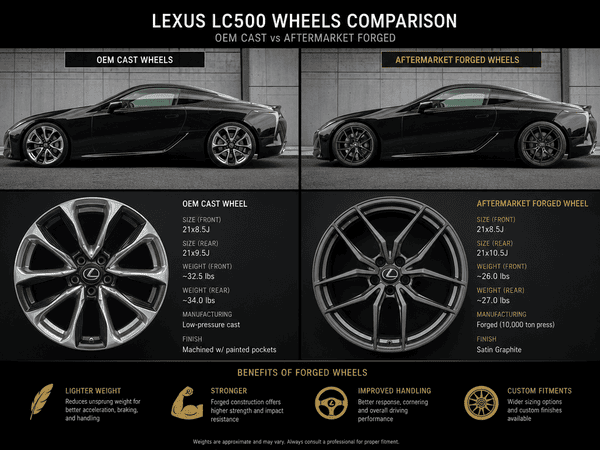
The stock wheels on the Lexus LC500 are not forged. Lexus fits the LC500 with cast or flow-formed alloy wheels from the factory. Flow-forming improves on basic gravity casting by stretching the barrel under pressure, but the process still starts from a cast blank — it is not the same as a fully forged wheel produced from a solid aluminum billet.1
That answer matters more than it might seem. Most people who ask this question aren’t just curious — they’re trying to decide whether the wheels they have are good enough, or whether an upgrade is actually worth pursuing. The sections below address both of those things directly.
What wheels does the Lexus LC500 come with from the factory?
Most LC500 owners I’ve spoken with are surprised to learn the car doesn’t ship with fully forged wheels. Given the price tag — typically above $90,000 USD — the assumption seems reasonable. But OEM wheel decisions at this level are driven more by cost-at-scale than by performance priorities.2
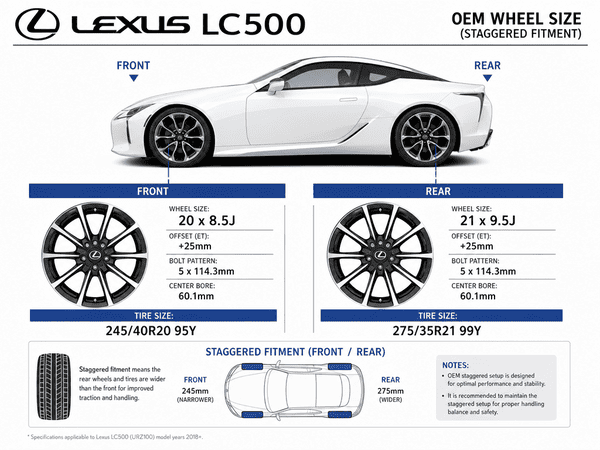
The Lexus LC500 comes with cast or flow-formed alloy wheels. Depending on the model year and trim, the OEM fitment is a staggered setup: 20×8.5 inches at the front and 20×10 inches at the rear. These wheels are functional and visually striking in their stock form, but they are not manufactured using the forging process.
Flow-forming vs. forging: why the distinction matters
It’s worth being precise here, because "flow-formed" is a term manufacturers sometimes use in marketing in a way that blurs the line.
- Gravity cast: Molten aluminum is poured into a mold and cooled. This is the most basic manufacturing method. It produces heavier, less dense wheels.
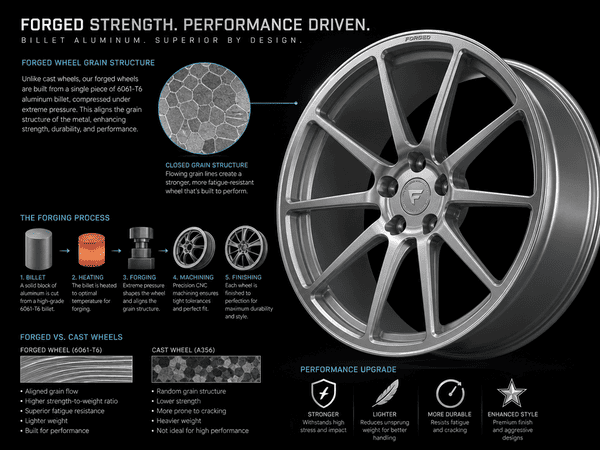
- Flow-formed (also called flow-forged or spun-formed): Starts as a cast blank, then the barrel is spun under hydraulic rollers while heated. This aligns the grain structure in the barrel and reduces weight compared to pure casting. The center section remains cast.
- Forged: A solid aluminum billet is pressed under extreme pressure — often 5,000 to 10,000 tons — before any machining begins.3 The entire wheel benefits from a continuous, compressed grain structure throughout.
Flow-forming is a genuine improvement over basic casting. It produces a lighter, stronger barrel. But it is a hybrid process, not a full forging. Buyers evaluating an upgrade should understand this distinction clearly.
The short version: Flow-formed wheels are better than gravity cast, but they do not match the structural density or weight reduction achievable with a fully forged wheel.
What this means for the LC500 specifically
The LC500 is a grand touring car — heavy by sports car standards (around 4,280 lbs)4, but built for a specific kind of driving experience: fast, refined, engaging over distance. Unsprung mass matters on a car like this. Wheels are one of the highest-impact areas for weight reduction because rotating mass affects steering response, braking, and ride quality disproportionately compared to static weight elsewhere in the vehicle.5
The OEM wheels are not a liability. For most owners driving on public roads, the stock setup is entirely adequate. But for owners who want better steering feel, reduced rotational inertia, or simply a wheel that reflects the caliber of the car more completely — the case for upgrading to forged is grounded in real mechanical benefit, not just aesthetics.
Does switching to forged wheels actually change how the LC500 drives?
This is the question behind the question for most buyers. They want to know whether the upgrade will feel like something, or whether it’s purely cosmetic.
Forged wheels are typically 20–30% lighter than equivalent cast wheels of the same size.6 On a staggered LC500 fitment where you’re dealing with two 20-inch rear wheels at 10 inches wide, that weight reduction is meaningful. Customers who’ve made this switch on GT cars have consistently described improvements in steering responsiveness and a reduction in the "heaviness" that wide-diameter cast wheels introduce.
Where the difference shows up in practice
The effects of switching from cast to forged wheels on a car like the LC500 tend to show up in three areas:
1. Steering feel and response
Reduced rotational inertia means the wheel changes direction with less resistance. On a car as heavy as the LC500, this is one of the few modifications that genuinely sharpens the driving experience without requiring suspension changes.7
2. Braking performance
Lighter rotating mass means less kinetic energy the brakes need to manage during deceleration. The improvement is modest under normal driving, but becomes more apparent under repeated hard braking — track days, mountain roads, or aggressive highway driving.8
3. Heat dissipation
Forged aluminum has a denser grain structure than cast aluminum. Under sustained load, this matters for thermal management around the brake system.9 It’s a minor factor in street use, but LC500 owners who occasionally track their cars should take note.
What about the staggered fitment?
The LC500’s staggered setup — wider at the rear than the front — is something buyers often overlook when researching aftermarket wheels. Not all wheel manufacturers accommodate staggered orders, and getting the offset and fitment wrong on a car with this suspension geometry creates real problems.
At Tree Wheels, we regularly handle staggered fitment orders for cars like the LC500. The process involves confirming:
| Specification | Front | Rear |
|---|---|---|
| Diameter | 20 inches | 20 inches |
| Width | 8.5 inches | 10 inches |
| Offset (ET) | Matched to OEM or adjusted for fitment | Matched to OEM or adjusted for fitment |
| Center bore | Confirmed to hub diameter | Confirmed to hub diameter |
Getting these numbers right is the most important part of a wheel upgrade on a staggered car. I’d always recommend having a qualified shop confirm fitment specs before finalizing an order — not because it’s complicated, but because the consequences of getting it wrong (rubbing, stress on wheel bearings, handling changes) aren’t worth the risk.
Is ordering custom forged wheels for an LC500 actually realistic?
A lot of LC500 owners I’ve talked to assume custom forged wheels are either prohibitively expensive, require a large minimum order, or take months to arrive. In most cases, none of those assumptions hold up.
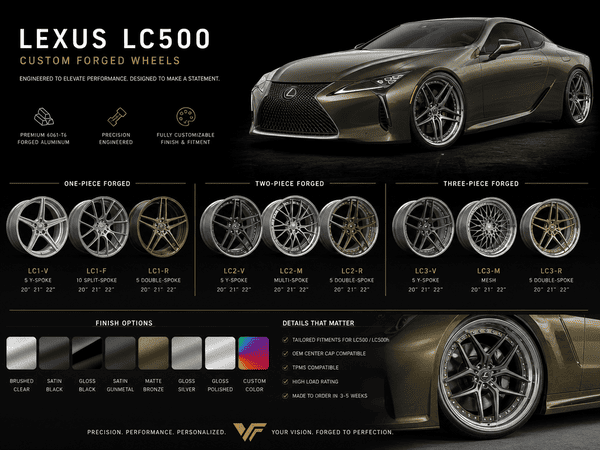
Custom forged wheels for the LC500 are more accessible than most owners expect. One-piece forged wheels can be produced in 15–20 days with an MOQ of just 4 wheels — which covers a single set. Two-piece and three-piece forged options are also available for owners who want a specific spoke-to-barrel finish combination.
What the customization process actually looks like
Based on the orders we’ve handled for GT car owners, the process typically follows these steps:
- Confirm fitment specs — diameter, width, offset, center bore, and whether the order is staggered
- Choose construction type — one-piece forged for weight priority, two-piece or three-piece for finish flexibility
- Select design and finish — from existing profiles or custom design via sketch or 3D reference
- Review sample or design rendering before production begins
- Production and shipping — with door-to-door logistics and protective packaging (foam, corner guards, seven-layer corrugated carton)
Certifications to verify
For buyers outside familiar markets, verifying certifications matters. When evaluating any forged wheel supplier, ask to see documentation for:
- DOT (required for road use in the United States)
- TÜV (German certification recognized widely for structural testing)
- ISO 9001 / IATF 16949 (quality management systems for automotive manufacturing)
Tree Wheels’ manufacturing partner holds all four of these certifications. I’d recommend treating certification claims as documents to verify rather than marketing assertions — any reputable manufacturer should be able to produce them.
Frequently Asked Questions
Are the Lexus LC500’s wheels forged from the factory?
No. The Lexus LC500 comes with cast or flow-formed alloy wheels as standard equipment. Flow-formed wheels are an improvement over basic gravity casting, but they are not manufactured from a forged billet. Owners wanting fully forged wheels will need to source them as an aftermarket upgrade.
What is the OEM wheel size on the Lexus LC500?
The LC500 uses a staggered fitment: 20×8.5 inches at the front and 20×10 inches at the rear. These dimensions are important to confirm when ordering any aftermarket or custom forged wheels, as an incorrect offset or width can affect handling and clearance.
How much lighter are forged wheels compared to the LC500’s stock wheels?
Forged wheels are typically 20–30% lighter than cast equivalents of the same size. Exact figures vary by design and construction. On a 20-inch staggered set, that weight difference is meaningful in terms of rotational inertia, steering response, and braking feel — particularly on the heavier rear wheels.
Can I order custom forged wheels for just one set (4 wheels)?
Yes. At Tree Wheels, the minimum order quantity is 4 wheels — meaning a single set for one vehicle is a valid order. One-piece forged wheels typically take 15–20 business days to produce. Two-piece and three-piece options have slightly longer lead times.
Do custom forged wheels come with any warranty?
Tree Wheels provides a 1-year warranty covering replacement or repair. Before ordering from any supplier, ask for written warranty terms and confirm what conditions are covered — this is particularly important for buyers ordering internationally.
Conclusion
The Lexus LC500’s wheels are not forged from the factory — they are cast or flow-formed, which is adequate for most driving conditions but falls short of what a fully forged wheel delivers in terms of weight, strength, and driving feel. For LC500 owners who’ve been assuming otherwise, that gap is exactly where a genuine upgrade decision begins. Custom forged wheels matched to the LC500’s staggered fitment are more accessible than most owners expect — with low minimum orders, reasonable lead times, and verifiable certifications from established manufacturing partners. If you’re evaluating this upgrade, I’m happy to walk through fitment specs and options with you directly.
-
"Metal spinning", https://en.wikipedia.org/wiki/Metal_spinning. Flow-forming, also termed spin-forming or flow-forging, begins with a cast preform that is subsequently worked over a mandrel under roller pressure; the center section retains its cast microstructure, differentiating the process from conventional closed-die forging of a wrought billet. Evidence role: mechanism; source type: research. Supports: Flow-forming begins with a cast blank whose barrel is worked under pressure, distinguishing it from full forging which starts with a solid billet. Scope note: Engineering literature on wheel manufacturing specifically may be limited; sources on metal spinning or rotary forming more broadly may need to be applied contextually. ↩
-
"What Testing Standards Do Quality Forged Wheels Meet?", https://treewheels.com/what-testing-standards-do-quality-forged-wheels-meet/. Automotive supply chain analyses note that forged aluminum wheels carry substantially higher per-unit manufacturing costs than cast or flow-formed alternatives due to material waste, tooling, and process complexity, making cast or flow-formed wheels the predominant OEM choice even on premium vehicles where performance considerations might otherwise favor forging. Evidence role: general_support; source type: research. Supports: Cost-at-scale is a primary factor in OEM selection of cast or flow-formed wheels over forged alternatives. Scope note: Publicly available sources on OEM wheel procurement decisions are limited; this characterization reflects general automotive manufacturing economics rather than documented Lexus-specific sourcing rationale. ↩
-
"What Are JWL, VIA, and TÜV Certifications for Wheels?", https://treewheels.com/what-are-jwl-via-and-tuv-certifications-for-wheels/. The Forging Industry Association notes that closed-die forging of aluminum alloys for structural automotive components requires substantial press forces, with large-scale operations commonly employing presses rated in the thousands of tons depending on part geometry and alloy. Evidence role: mechanism; source type: institution. Supports: Aluminum closed-die forging for automotive components typically requires press forces in the range of thousands of tons. Scope note: Publicly available sources may not specify wheel forging tonnage precisely; figures for general aluminum structural forging may need to be applied as a contextual range rather than a wheel-specific specification. ↩
-
"Lexus LC", https://en.wikipedia.org/wiki/Lexus_LC. According to Lexus official technical specifications, the LC500 has a published curb weight in the range of approximately 4,280 lbs, though this figure may vary slightly by model year and optional equipment. Evidence role: statistic; source type: other. Supports: The Lexus LC500 has a curb weight of approximately 4,280 lbs. Scope note: Curb weight can differ across model years and regional specifications; the cited figure should be verified against the specific model year in question. ↩
-
"How Do Designers Balance Weight Reduction and Structural …", https://treewheels.com/how-do-designers-balance-weight-reduction-and-structural-strength-for-wheels/. Vehicle dynamics literature establishes that unsprung mass, particularly rotating unsprung mass at the wheel, affects ride quality, steering response, and braking performance to a degree greater than an equivalent reduction in sprung mass, owing to its direct influence on wheel-to-road contact forces and rotational inertia. Evidence role: mechanism; source type: research. Supports: Unsprung and rotating mass has a disproportionate effect on vehicle dynamics compared to equivalent static sprung mass. Scope note: The magnitude of the effect is design- and speed-dependent; general vehicle dynamics principles support the directional claim, but quantified comparisons for the LC500 specifically are not available in public literature. ↩
-
"Review of Magnesium Wheel Types and Methods of Their …", https://pmc.ncbi.nlm.nih.gov/articles/PMC10856444/. Comparative studies of aluminum wheel manufacturing methods indicate that forged wheels can achieve significant mass reductions relative to gravity-cast equivalents of identical geometry, with reported figures varying by design and alloy but commonly cited in the range of 15–30% in automotive engineering literature. Evidence role: statistic; source type: research. Supports: Forged aluminum wheels are meaningfully lighter than cast equivalents of the same dimensions. Scope note: The precise 20–30% figure may vary substantially by wheel design, size, and alloy; available sources may report ranges rather than a single percentage, making direct verification of this specific claim approximate. ↩
-
"How Does Wheel Weight Impact Vehicle Acceleration and …", https://treewheels.com/how-does-wheel-weight-impact-vehicle-acceleration-and-handling/. Vehicle dynamics research indicates that reducing the polar moment of inertia of road wheels improves transient steering response and reduces the gyroscopic resistance to directional changes, with effects measurable in objective handling metrics even without alterations to suspension geometry. Evidence role: mechanism; source type: research. Supports: Reducing wheel rotational inertia improves steering response and transient handling behavior. Scope note: The perceptibility of steering improvements from wheel mass reduction alone depends on the magnitude of mass change, vehicle weight, and steering system design; subjective driver perception may vary. ↩
-
"Braking distance", https://en.wikipedia.org/wiki/Braking_distance. The kinetic energy of a rotating wheel includes both translational and rotational components; reducing wheel mass and moment of inertia therefore decreases the total energy the braking system must absorb during deceleration, an effect that compounds under repeated braking events where thermal load on brake components is a limiting factor. Evidence role: mechanism; source type: research. Supports: Reducing rotating wheel mass decreases the total kinetic energy that braking systems must dissipate during deceleration. Scope note: The practical braking distance improvement from wheel mass reduction alone is typically small relative to brake system capacity; the benefit is most relevant in sustained high-load scenarios rather than single-stop events. ↩
-
"Thermal Conductivity of Aluminum Alloys—A Review – PMC", https://pmc.ncbi.nlm.nih.gov/articles/PMC10144406/. Metallurgical analysis of wrought versus cast aluminum alloys demonstrates that the forging process produces a refined, work-hardened grain structure with reduced porosity compared to gravity casting, which influences mechanical strength and, to a lesser degree, thermal conductivity. Evidence role: mechanism; source type: research. Supports: Forging produces a refined, continuous grain structure in aluminum alloys compared to casting, which affects mechanical and thermal properties. Scope note: The direct link between grain structure density and brake-area thermal management in wheel applications is an inferential extension of general metallurgical principles; direct experimental data on this specific application may not be publicly available. ↩