
We once received an order from Texas. The customer had a black Camaro SS. He sent a reference photo with five different wheel styles circled and asked me: "Which one fits my car best?" I sent him back one question: "What do you want people to feel the moment they see this car?" He thought about it for two days, then replied: "Menacing." From that point, the choice became very clear.
Choosing wheels for a black Chevrolet Camaro SS is not about aesthetics alone. It is about what message you want to send. The answer to that question determines everything — the color, the size, and the design of the wheel.
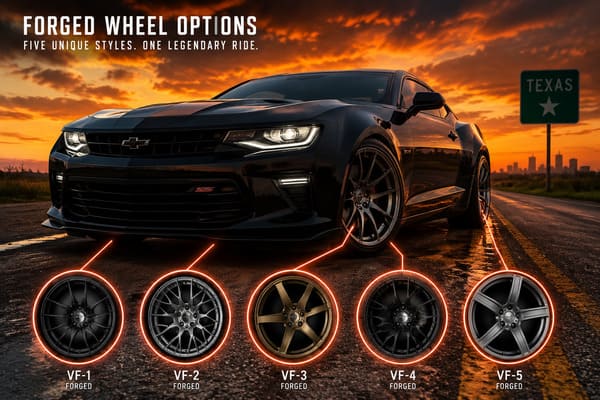
Picking the wrong wheel for a black Camaro SS is easy. The car already has strong visual weight. One wrong call on color or offset, and you lose the entire stance. This guide covers every decision point — color, finish, material, size, and offset — so you can make a choice that works for your specific build.
What Color Wheels Look Best on a Black Car?
About 60% of our customers say the same thing when they first come to us: "Black car, black wheels — that has to be the safe choice." I show all of them the same comparison photo. Same black Camaro SS, black wheels on the left, Gunmetal wheels on the right. Almost every single one of them goes quiet for three seconds, then says: "The right one."
Gunmetal, Matte Bronze, and two-tone finishes tend to look better on black cars than solid black wheels. Black-on-black causes the wheel arch area to disappear visually. Contrast colors pull the wheel out from the body and restore definition to the car’s lines.1
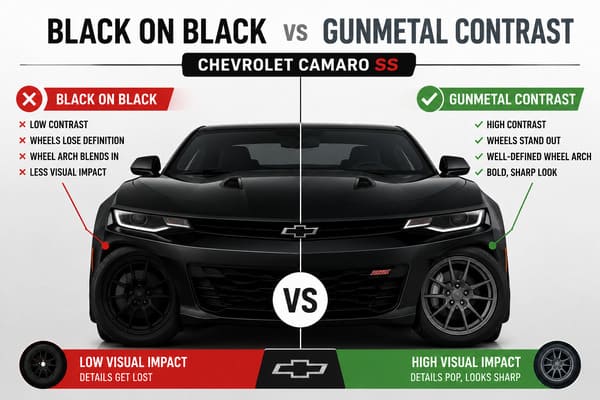
The reason black-on-black fails is simple. When the wheel color matches the body, the wheel arch area becomes one flat dark mass. The car looks like it is floating on a black block. There is no separation, no layering, and no visual interest.
Gunmetal works because its deep gray tone creates just enough contrast to cut the wheel shape out from the body.2 You can still see the spoke design clearly. The car looks planted and defined.
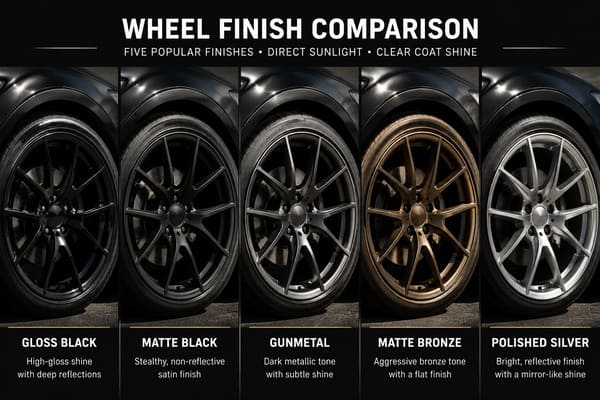
Matte Bronze goes further. In direct sunlight, a matte bronze finish has a texture that looks close to heat-scorched metal. That quality fits the Camaro SS muscle car identity very well. One of our Australian customers ordered a set of 20-inch matte bronze forged wheels. After he installed them and posted photos, his Instagram account gained over 4,000 followers. The wheels alone drove that response.
Color Options Compared
| Finish | Visual Effect | Best Light Condition | Fits Camaro SS Character? |
|---|---|---|---|
| Gloss Black | Blends into body, low contrast | Any | Low — loses definition |
| Matte Black | Slightly better than gloss black | Overcast | Medium — subtle aggression |
| Gunmetal | Strong contrast, clean line definition | Any | High — balanced and aggressive |
| Matte Bronze | Heat-scorched texture, bold statement | Direct sunlight | Very High — raw muscle feel |
| Polished Silver | High contrast, classic look | Bright sun | Medium — depends on build style |
If your goal is menacing, Gunmetal or Matte Bronze are the two finishes I recommend first. If your goal is something more classic or show-oriented, polished silver or a two-tone combination can work. But straight black-on-black is the one finish I would steer you away from on a black car.
Should I Get Black or Chrome Rims for My Black Car?
Chrome wheels get very different reactions depending on where the customer is. Our Dubai clients almost always prefer chrome or a polished finish. The sunlight there is intense, and the reflective quality of chrome creates a visual dominance that reads as luxury. But among our US and Canadian customers, one of the most common reasons for a return or a change order is: "Chrome does not look as good on a cloudy day as I expected."
For black cars in markets with mixed weather, full chrome is a high-risk choice. A better option is a three-piece forged wheel with a polished lip and a dark or gunmetal face.3 This gives you chrome-level highlights in strong light while keeping visual weight in lower light conditions.
Full chrome has one core problem. Its entire visual appeal depends on reflection.4 In a bright parking lot on a sunny day, it looks incredible. In an overcast afternoon or indoor lighting, it flattens out and loses its character. One of our Canadian customers ordered a full chrome set on his first purchase. He photographed the car himself after installation and sent me the photo. His exact words were: "It looks like a taxi in the parking lot." His second order was a polished lip with a dark face. The photos he sent after that second install looked like a completely different car.
Chrome vs. Alternative Finishes for Black Cars
| Rim Style | Strong Light | Low Light | Weather Sensitivity | Recommended? |
|---|---|---|---|---|
| Full Chrome | Excellent | Poor | High | No — too dependent on conditions |
| Full Gloss Black | Flat | Flat | Low | No — no contrast on black car |
| Polished Lip + Dark Face | Excellent | Good | Medium | Yes — best of both |
| Polished Lip + Gunmetal Face | Very Good | Very Good | Low | Yes — most versatile |
| Matte Black + Machined Face | Good | Good | Low | Yes — clean and aggressive |
The three-piece forged wheel format gives you the most control here. You can specify the lip finish separately from the face and barrel. That means you can dial in exactly how much reflective contrast you want without committing to a full chrome look. This level of customization is one of the main reasons our clients choose three-piece forged wheels over cast or monoblock options.5
How Much Difference Do Forged Wheels Make?
A customer once asked me: "What is the actual difference between forged and cast wheels when you are driving?" I gave him the numbers first. A cast aluminum wheel in a typical size range weighs around 11 to 13 kilograms. A forged wheel in the same size range weighs around 7 to 9 kilograms.6 Four wheels total saves roughly 16 kilograms. Every single kilogram of that saving is unsprung mass — the weight the suspension has to control directly.7
Reducing unsprung mass by 1 kilogram improves handling at a level equivalent to removing 7 to 10 kilograms from the car body.8 Switching to a forged wheel set on a Camaro SS is equivalent to reducing the car’s effective handling weight by over 100 kilograms.
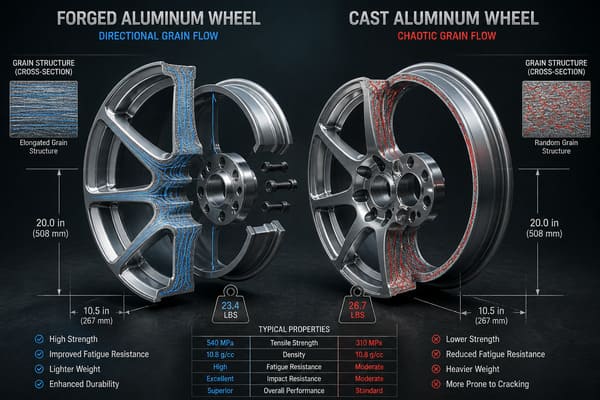
The weight saving matters. But there is another point I think is more important for a car like the Camaro SS. Our forging process applies high pressure to the aluminum blank inside a die. That pressure causes the metal grain structure to align in a specific direction.9 The result is a wheel with a consistent density and strength distribution throughout the entire piece.10 Four wheels from the same forging run will have nearly identical structural characteristics.
Forged vs. Cast Wheels: Key Differences
| Factor | Cast Wheels | Forged Wheels |
|---|---|---|
| Weight (typical 20") | 11–13 kg per wheel | 7–9 kg per wheel |
| Grain Structure | Random, uncontrolled | Directionally aligned under pressure |
| Consistency Across 4 Wheels | Variable | Near identical |
| Strength-to-Weight Ratio | Lower | Higher11 |
| Impact Resistance | Lower | Higher |
| Customization Range | Limited | Full custom size, finish, and design |
The Camaro SS chassis is engineered around the assumption that all four corners respond symmetrically to dynamic inputs. That is how the suspension geometry and the stability control calibration were designed. When you install forged wheels with consistent structural properties across all four corners, you are working with that engineering logic. When you install cast wheels with variable density and higher weight, you are working against it. The car was built for better. Forged wheels let it perform the way it was designed to.
What Wheel Size and Offset Work Best for a Black Chevrolet Camaro SS?
I have seen too many Camaro SS builds with 20-inch wheels that look wrong when you stand next to the car. The wheel sits inside the arch with a visible gap between the tire and the fender lip. The owner spent serious money and the result looks smaller than a well-fitted 18-inch set. The problem is almost never the size. The problem is the offset.
For a Camaro SS, the front axle benefits from an offset in the +20mm to +30mm range to achieve a flush or slightly proud stance. The factory offset of around +40mm to +45mm pushes the wheel inward and creates the gap that makes larger wheels look undersized.
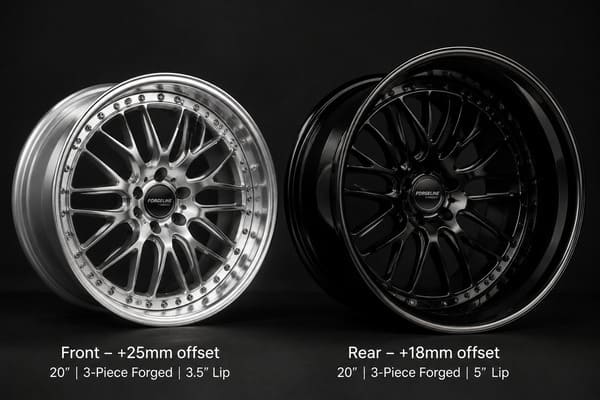
Offset controls how far the wheel sits inward or outward from the hub face.12 A higher positive offset pushes the wheel inward toward the suspension. A lower positive offset moves the wheel outward toward the fender lip. For a muscle car like the Camaro SS, the goal is to fill the arch — not float inside it.
Recommended Wheel Fitment for Camaro SS
| Position | Recommended Size | Recommended Offset | Lip Depth (3-Piece) | Visual Result |
|---|---|---|---|---|
| Front | 19"–20" x 9.5"–10" | +20mm to +30mm | 3.5" | Flush to slightly proud |
| Rear | 20"–21" x 10.5"–11" | +15mm to +25mm | 4.5"–5" | Wide, planted, aggressive |
The rear axle has more clearance. That means you can run a wider wheel with a more aggressive low offset on the rear, which gives the car its planted, wide-body visual weight. The front runs a slightly narrower wheel with a less aggressive offset to maintain steering clearance.
Three-piece forged wheels have a specific advantage here that cast and monoblock wheels cannot match. You can specify the lip depth of the front and rear wheels independently. The overall diameter stays the same, but the inner barrel depth changes to control exactly how far the wheel face sits relative to the fender. One of our customers built a Camaro SS fitment with a 3.5-inch lip on the front and a 5-inch lip on the rear. The visual difference between front and rear created a crouched, forward-leaning stance that no off-the-shelf wheel can replicate. That kind of precision is only possible with a fully custom three-piece forged build.
Conclusion
Choosing forged wheels for a black Camaro SS comes down to four decisions: color, finish, material, and fitment. Each one builds on the last, and getting all four right is what separates a great build from a forgettable one. At Tree Wheels, we help you get all four right — with custom forged wheels built to your exact specs, backed by 20+ years of manufacturing experience.
-
"Contrast affects stimulus detection in natural scenes – PMC – NIH", https://pmc.ncbi.nlm.nih.gov/articles/PMC12120249/. Research on visual perception and luminance contrast supports that adjacent low-contrast dark regions are harder to distinguish, while higher contrast improves edge and shape discrimination. Evidence role: mechanism; source type: paper. Supports: Low contrast between black wheels and a black body can reduce visible separation around the wheel arch, while contrasting finishes improve visual definition.. Scope note: This supports the perceptual mechanism behind the styling claim, not a Camaro-specific aesthetic preference. ↩
-
"Color needs luminance for visual selection during scene search – PMC", https://pmc.ncbi.nlm.nih.gov/articles/PMC12966192/. Color-vision and contrast-perception literature explains that differences in luminance and chromatic contrast make object boundaries more detectable against a background. Evidence role: mechanism; source type: paper. Supports: A gunmetal wheel creates enough contrast against a black body to make the wheel shape more visually distinct.. Scope note: The evidence would explain why a gray wheel can be more legible against black paint, but it would not prove that gunmetal is universally preferred. ↩
-
"Everything You Need to Know About Rebuilding 3-Piece Wheels", https://www.youtube.com/watch?v=qYRNlwfnr5Y. Technical descriptions of multi-piece wheel construction document that separate rim and center components can be finished independently, providing different visual and dimensional configurations. Evidence role: definition; source type: institution. Supports: Three-piece wheel construction allows a polished lip and darker center face to be specified separately.. Scope note: This supports the feasibility of separate lip and face finishes, not that the combination is aesthetically superior. ↩
-
"[PDF] Specular Reflections from Rough Surfaces Lecture #4", http://www.cs.cmu.edu/afs/cs/academic/class/16823-s16/www/pdfs/appearance-modeling-4.pdf. Optics references describe chrome-like surfaces as specular reflectors whose appearance depends strongly on reflected surroundings and illumination conditions. Evidence role: mechanism; source type: education. Supports: Chrome wheel appearance depends heavily on reflected light and environmental illumination.. Scope note: This supports the physical basis of chrome’s lighting dependence, not the subjective judgment that chrome is a poor styling choice. ↩
-
"Monoblock vs 2-Piece vs 3-Piece Wheels: Which Structure Is Best …", https://flexiforgewheel.com/monoblock-vs-2-piece-vs-3-piece-wheels-which-structure-is-best-for-your-project/. Engineering and wheel-construction references distinguish one-piece monoblock wheels from multi-piece wheels, noting that multi-piece assemblies permit separate component dimensions and finishes. Evidence role: general_support; source type: institution. Supports: Three-piece wheels generally offer more dimensional and finish customization than one-piece cast or monoblock wheels.. Scope note: This supports the technical basis for greater customization, not the author’s customer-purchase statistics or motives. ↩
-
"Is there a weight difference between new forged aluminum wheels …", https://www.facebook.com/groups/bmwr1300gs/posts/725169073079659/. Comparative engineering sources on cast and forged aluminum wheels commonly report that forged wheels can achieve lower mass for a given size because of their higher strength-to-weight characteristics. Evidence role: statistic; source type: research. Supports: Forged aluminum wheels are often lighter than cast aluminum wheels of comparable size, with typical mass differences in the range claimed.. Scope note: Exact wheel mass varies by diameter, width, load rating, design, and manufacturer; the cited ranges should be treated as typical examples rather than universal values. ↩
-
"Unsprung mass – Wikipedia", https://en.wikipedia.org/wiki/Unsprung_mass. Vehicle dynamics texts define unsprung mass as the mass of components not supported by the suspension, including wheels and tires, and explain that suspension systems directly control their vertical motion. Evidence role: definition; source type: education. Supports: Wheel weight is part of vehicle unsprung mass, so reducing wheel weight reduces the mass the suspension must control.. Scope note: This supports the classification of wheel-weight reduction as unsprung-mass reduction, not the exact magnitude of performance improvement. ↩
-
"Unsprung mass – Wikipedia", https://en.wikipedia.org/wiki/Unsprung_mass. Vehicle dynamics literature supports that reductions in unsprung mass can improve suspension response, tire contact, and ride/handling behavior, but simple fixed equivalence ratios to sprung mass are not generally established. Evidence role: expert_consensus; source type: paper. Supports: Reducing unsprung mass has a greater handling effect than an equal reduction in sprung body mass.. Scope note: A neutral source is likely to support the importance of unsprung mass, while the specific 1:7–1:10 equivalence should be framed as a rule of thumb unless directly sourced. ↩
-
"[PDF] Forging of Carbon and Alloy Steels – Mines Files", https://wpfiles.mines.edu/wp-content/uploads/aspprc/ResearchMaterials/Publications/280-Van-Tyne.pdf. Materials engineering references on forging explain that plastic deformation under compressive force can refine and orient the metal grain flow, improving directional mechanical properties compared with as-cast structures. Evidence role: mechanism; source type: education. Supports: Forging pressure can align or refine metal grain structure in aluminum components.. Scope note: The source would support forging in general; specific grain-flow patterns depend on alloy, die design, temperature, and process parameters. ↩
-
"A Review on Porosity Formation in Aluminum-Based Alloys – PMC", https://pmc.ncbi.nlm.nih.gov/articles/PMC10004325/. Metallurgical sources comparing casting and forging describe forging as reducing porosity and producing a more uniform, worked microstructure than casting, which can improve consistency of mechanical properties. Evidence role: mechanism; source type: paper. Supports: Forging can produce more uniform density and strength distribution than casting by reducing porosity and refining microstructure.. Scope note: This supports the general material-process claim; actual uniformity in a wheel depends on quality control, alloy selection, and heat treatment. ↩
-
"Comparative study of mechanical properties of cast and forged Al …", https://www.sciencedirect.com/science/article/pii/S2405844020301201. Engineering references on aluminum wheel manufacturing report that forged aluminum components generally provide higher strength-to-weight performance than cast components because working the metal improves grain structure and reduces defects. Evidence role: expert_consensus; source type: research. Supports: Forged wheels generally have a higher strength-to-weight ratio than cast wheels.. Scope note: This comparison is process-level; individual wheels may vary by design, alloy, heat treatment, and certification standard. ↩
-
"Steering geometry – Course Websites", https://courses.grainger.illinois.edu/tam212/su2025/avs.xhtml. Automotive technical references define wheel offset as the distance between the wheel mounting surface and the wheel centerline, determining whether the wheel sits farther inward or outward in the wheel well. Evidence role: definition; source type: institution. Supports: Wheel offset determines the inward or outward position of the wheel relative to the hub and fender.. Scope note: This supports the general definition of offset, not the article’s specific recommended Camaro SS fitment values. ↩