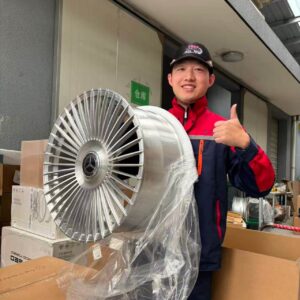

Most buyers read about forged wheels and still can’t explain why one costs $800 and another costs $3,000. I couldn’t either — until I walked the factory floor myself.
A premium forged wheel goes through 7 core production stages: billet selection, forging under 10,000+ tons of pressure, T6 heat treatment (8–12 hours), CNC machining (4–6 hours per wheel), surface finishing, quality inspection, and final assembly. Each stage directly affects the wheel’s strength, weight, and lifespan.
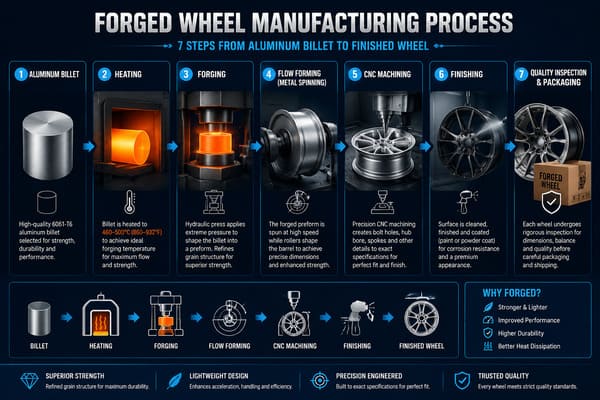
When I first visited our manufacturing partner’s facility, I expected to see a machine press aluminum and call it done. What I saw instead was a process where the actual forging press — the dramatic part — takes maybe 3 minutes. The other 95% of production time is what most articles never explain. That gap is exactly what this article fills. If you’re considering a $2,000–$8,000 order, you deserve to know what you’re actually paying for.
How Are Forged Wheels Manufactured?
Most people picture a machine stamping out a wheel shape. That’s not what happens. What I watched at our facility was closer to surgery — slow, precise, and unforgiving of shortcuts.
Forged wheels are made through a multi-stage process: an aluminum billet is heated and pressed under extreme force to align the metal’s grain structure, then heat-treated, CNC machined to final dimensions, finished, and inspected. Skipping or rushing any stage creates structural weaknesses that may not appear until the wheel fails under load.
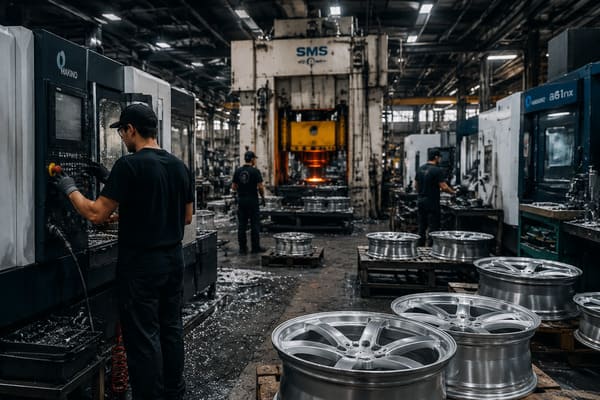
Here is what each stage actually involves — and what goes wrong when a factory cuts corners.
Stage 1: Billet Selection
The raw material is a cylindrical aluminum billet, typically 6061-T6 or 7075 aluminum1. The billet is cut to a precise weight before anything else happens. A wrong starting weight means the forging die won’t fill correctly, and the wheel’s wall thickness will be uneven before machining even begins.
Stage 2: Forging Under Pressure
The billet is heated to around 400–500°C2 and placed under a forging press. Our facility uses presses exceeding 10,000 tons of force3. This pressure compresses the aluminum’s internal grain structure into a continuous, interlocked pattern4. That grain structure is the core reason forged wheels are stronger than cast wheels — the metal flows rather than solidifies from liquid, so there are no voids or porosity inside5.
Stage 3: T6 Heat Treatment
This step takes 8–12 hours, and it is not optional. T6 heat treatment involves solution heat treating the forged blank at high temperature, then quenching it rapidly, then artificially aging it6. The result is a wheel with maximum hardness and internal stress relief7. A factory that skips or shortens this step produces a wheel that looks identical but carries internal stress. Under hard cornering at 120 mph, that stress can cause a crack. The wheel looked perfect when it shipped. The failure happens on the road.
Stage 4: CNC Machining
A single wheel goes through 4–6 hours of CNC machining. The machine removes material to hit tolerances within 0.05mm8. This is where the spoke geometry, bolt pattern, hub bore, and lip profile are cut to final dimensions. It is also where most of the aluminum is removed — more on that in the next section.
Stage 5: Surface Treatment
This includes painting, powder coating, polishing, or anodizing — depending on the customer’s specification. Surface treatment is the most visible part of the wheel, but it is also the most fragile. A good surface job starts with proper prep: cleaning, sandblasting, and priming9. A factory that skips prep will produce a finish that peels within 12 months.
Stage 6: Quality Inspection and Testing
Every wheel at our facility goes through dimensional checks, balance testing, and impact testing before it ships. Wheels destined for the US market must pass DOT standards10. Wheels for European markets go through TÜV testing11. These are independent certifications — not self-reported numbers.
Stage 7: Packaging and Shipping
Each wheel is wrapped in foam, placed in a strong corner-guard box, and packed in a seven-layer corrugated carton. This is not decoration. A wheel that survives 20 hours of CNC machining should not arrive cracked because the packaging failed.
What Is the Manufacturing Process of Wheel Rims?
The answer changes depending on which type of wheel you’re buying. One-piece, two-piece, and three-piece forged wheels are not just different products — they are built through meaningfully different processes.
One-piece forged wheels are machined from a single aluminum billet. Two-piece wheels combine a forged center with a spun or flow-formed barrel. Three-piece wheels are assembled from three separately forged or formed components12 using aerospace-grade hardware. Each construction type has different lead times, tolerances, and structural characteristics.
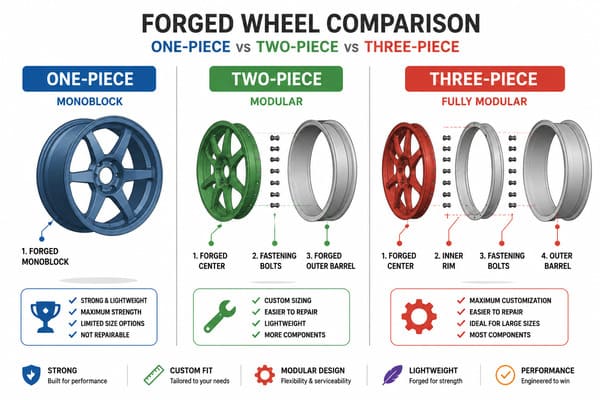
Here is a direct comparison of how each type is built and what that means for the buyer.
One-Piece Forged Wheels
A one-piece wheel starts as a single aluminum billet weighing 25–35 kg. After forging and full CNC machining, the finished wheel weighs 7–9 kg. That means 60–70% of the raw material is removed by the CNC machine. The machining time is long because the machine is removing that much material while holding 0.05mm tolerances throughout. A good factory recovers and recycles the aluminum scrap. A bad factory wastes it — and passes that waste cost to you.
| Specification | Detail |
|---|---|
| Starting billet weight | 25–35 kg |
| Finished wheel weight | 7–9 kg |
| Material removed | 60–70% |
| CNC machining time | 4–6 hours per wheel |
| Lead time (Tree Wheels) | 15–20 days |
Two-Piece Forged Wheels
A two-piece wheel uses a forged center section and a barrel that is typically flow-formed or spun from aluminum sheet. Flow-forming is not the same as forging, but it is not a shortcut either — the barrel’s structural role is different from the center’s. The barrel handles lateral load; the center handles the rotational and radial forces. The two pieces are joined with hardware and, in most cases, sealed. The manufacturing complexity here is in matching the center to the barrel within tolerance. A poor fit creates vibration and uneven stress distribution.
| Specification | Detail |
|---|---|
| Center construction | Forged aluminum |
| Barrel construction | Flow-formed or spun aluminum |
| Assembly hardware | Aerospace-grade bolts |
| Lead time (Tree Wheels) | 20–25 days |
Three-Piece Forged Wheels
A three-piece wheel consists of a forged center and two separate barrel halves — an outer lip and an inner barrel — assembled with aerospace-grade titanium or steel hardware. Each of the three components is produced separately, which means three separate quality checks before assembly. The assembly itself requires all three parts to fit within 0.1mm tolerance. That is why our three-piece lead time is 30–35 days. Not because we are slow. Because that is how long it takes to produce three separate precision components and assemble them correctly.
| Specification | Detail |
|---|---|
| Components | Forged center + outer lip + inner barrel |
| Hardware | Aerospace-grade titanium or steel |
| Fit tolerance | Within 0.1mm |
| Lead time (Tree Wheels) | 30–35 days |
Are Forged Wheels Made in China?
Yes. China manufactures probably 60–70% of the world’s aftermarket forged wheels by volume. Some of them are outstanding. Some of them are dangerous. The difference is not the country. It is the factory.
China is a major global producer of forged wheels, and quality varies widely between manufacturers. The key indicators of a reliable Chinese forged wheel manufacturer are independent certifications (ISO9001, DOT, TÜV, IATF16949), verifiable production history, and the ability to provide actual test reports — not just marketing claims.
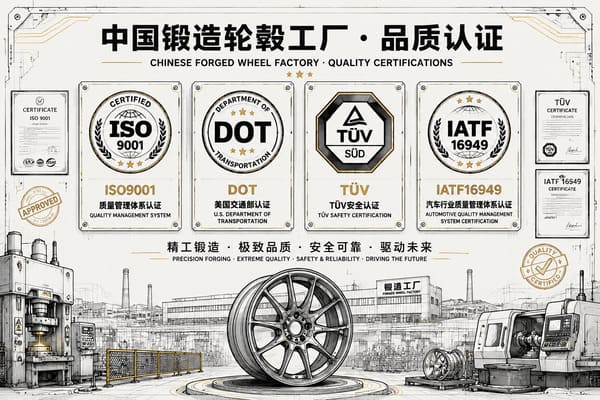
When I was building Tree Wheels, I did not just search for a factory online and pick the first result. I spent months evaluating manufacturing partners. The facility I work with has been producing forged wheels for over 20 years. That production history matters because forging is a process-driven discipline — the knowledge of how to set up a die, how to control temperature, how to read a forging blank for internal stress — that knowledge is built over years, not purchased with a new machine.
What Certifications Actually Mean
| Certification | What It Covers | Why It Matters |
|---|---|---|
| ISO9001 | Quality management system | Factory has documented, audited processes |
| DOT | US Department of Transportation | Required for legal road use in the United States |
| TÜV | German technical safety testing | One of the strictest independent safety standards globally |
| IATF16949 | Automotive-specific quality system | Standard used by major OEM automotive suppliers |
DOT and TÜV are not self-reported. They require independent testing by third-party organizations. A factory that holds both has submitted its wheels to external load testing, impact testing, and fatigue testing — and passed. That is a paper trail, not a marketing claim.
The Right Question to Ask Any Supplier
The wrong question is: "Is it made in China?" The right question is: "Can you show me the test reports for this wheel?" A legitimate manufacturer can produce DOT or TÜV test reports for specific wheel models within 24 hours. If a supplier hesitates, asks for time, or sends you a generic certificate without a wheel-specific test number — that tells you something important. At Tree Wheels, we can provide test documentation for every certified model we produce. Most factories cannot say the same.
What Are the Disadvantages of Forged Wheels?
I will be direct here. A customer who understands the real tradeoffs makes better decisions. Better decisions mean fewer complaints and longer business relationships. Sincerity is not just a brand value for me — it is how I run this business.
Forged wheels have four real disadvantages: higher cost than cast alternatives, longer lead times due to custom production, difficulty of repair after severe impact damage, and design complexity limits for one-piece construction. Understanding these tradeoffs helps buyers choose the right wheel for their actual situation.
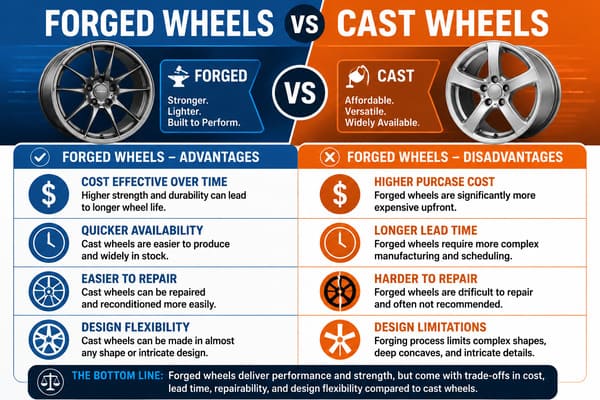
Here is each disadvantage explained without softening it.
Disadvantage 1: Cost
A basic one-piece forged wheel set starts around $1,500–$2,000. A premium three-piece custom set can reach $4,000–$10,000 or more. That is real money. If a customer is building a daily commuter and does not care about weight savings or aesthetics, cast wheels are probably the right choice for them. I would rather tell a customer that upfront than oversell them on a product that does not fit their situation.
Disadvantage 2: Lead Time
Every wheel we produce is custom-made. Our fastest turnaround is 15 days for a one-piece wheel. If a customer needs wheels in 5 days, we are not the right supplier — and I will say so directly. Rushing a forging cycle to meet an unrealistic deadline is how you get a wheel that fails at 80,000 miles instead of 150,000. No deadline is worth that.
Disadvantage 3: Repair Difficulty
Cast wheels can sometimes be reshaped after a bad pothole impact. Forged wheels, because of their dense grain structure, are much harder to reshape after damage. In most cases, a cracked or severely bent forged wheel needs to be replaced, not repaired. The tradeoff is that forged wheels are far less likely to crack in the first place — but when they do fail, it is a replacement cost, not a $50 repair.
Disadvantage 4: Design Limits in One-Piece Construction
Very thin spokes, sharp undercuts, and complex multi-layer spoke geometries are harder to achieve in a one-piece forging. Casting allows more freedom in shape because liquid metal flows into a mold. For customers who want highly intricate spoke designs, a two-piece or three-piece construction is the better technical answer — not a compromise, but the correct engineering choice for that design.
| Disadvantage | Real Impact | Best Response |
|---|---|---|
| Cost | $1,500–$10,000+ per set | Match wheel type to actual use case |
| Lead time | 15–35 days minimum | Plan orders in advance |
| Repair difficulty | Replacement, not repair, after severe damage | Weigh against lower failure rate |
| Design limits (1-piece) | Complex geometries harder to achieve | Use 2-piece or 3-piece for those designs |
Conclusion
A premium forged wheel is the result of 7 precise stages, the right certifications, and a manufacturer who will not cut corners to save time. Every number in this article — the tolerances, the hours, the weights — reflects what the process actually costs to do correctly. If you are ready to work with a manufacturer who can back every claim with documentation, Tree Wheels is here to build the wheel your project deserves.
-
"[PDF] Aluminum Alloy AA-6061 and RSA-6061 Heat Treatment for Large …", https://digitalcommons.usu.edu/cgi/viewcontent.cgi?article=1101&context=sdl_pubs. Aluminum alloy references identify 6061 and 7075 as heat-treatable wrought alloys widely used where high strength-to-weight performance is required; this supports their suitability as forged-wheel billet materials, though it does not prove that every premium wheel uses these alloys. Evidence role: general_support; source type: education. Supports: Forged wheel billets are typically made from 6061-T6 or 7075 aluminum.. Scope note: Contextual support for alloy suitability, not direct proof of the author’s supplier’s material choices. ↩
-
"[PDF] Lehigh Preserve Institutional Repository", https://preserve.lehigh.edu/_flysystem/fedora/2024-01/2345.pdf. Metallurgical forging references describe hot forging of aluminum alloys at elevated temperatures in the approximate range of several hundred degrees Celsius, supporting the stated temperature range as plausible process context rather than a universal wheel-specific requirement. Evidence role: mechanism; source type: education. Supports: The aluminum billet is heated to around 400–500°C before forging.. Scope note: The exact temperature depends on alloy, billet size, die design, and plant process controls. ↩
-
"Forging of Aluminum Alloys", https://materialsdata.nist.gov/bitstream/handle/11115/223/Forging%20of%20Aluminum%20Alloys.pdf. Industrial forging and wheel-manufacturing descriptions note that large hydraulic presses rated in thousands to tens of thousands of tons are used for high-load aluminum forging; this supports the feasibility of a 10,000-ton-class press but does not verify the specific facility’s equipment. Evidence role: general_support; source type: research. Supports: Premium forged wheels can be produced using presses exceeding 10,000 tons of force.. Scope note: Supports industrial plausibility, not the audited capacity of the author’s manufacturing partner. ↩
-
"Influence of the Grain-Flow Orientation after Hot Forging Process …", https://preserve.lehigh.edu/lehigh-scholarship/faculty-and-staff-publications/faculty-publications/influence-grain-flow. Forging literature explains that plastic deformation can refine and orient grain flow along the part geometry, improving directional mechanical properties; this supports the mechanism described for forged aluminum wheels in general. Evidence role: mechanism; source type: education. Supports: Forging pressure alters aluminum grain structure into a more continuous, oriented pattern.. Scope note: The exact grain-flow pattern depends on die design and forging parameters. ↩
-
"(PDF) Analysis of Internal Defects Appeared in the Continuous Casting", https://www.academia.edu/97889855/Analysis_of_Internal_Defects_Appeared_in_the_Continuous_Casting. Materials-engineering sources distinguish forged products from cast products by noting that casting can introduce shrinkage porosity and gas porosity, while forging of wrought stock generally reduces such internal defects; this supports the comparison in principle. Evidence role: mechanism; source type: education. Supports: Forged wheels generally avoid the voids and porosity associated with cast metal solidification.. Scope note: Forging reduces porosity risk but does not guarantee absolute absence of all internal defects in every wheel. ↩
-
"[PDF] Optimization of quench history of aluminum parts for superior …", https://engineering.purdue.edu/mudawar/files/articles-all/1996/1996_1.pdf. Aluminum heat-treatment standards define the T6 temper as solution heat treatment followed by quenching and artificial aging, directly supporting the sequence described here. Evidence role: definition; source type: institution. Supports: T6 heat treatment consists of solution heat treatment, quenching, and artificial aging.. ↩
-
"[PDF] Development of Stress Relief Treatments for High Strength …", https://ntrs.nasa.gov/api/citations/19660009121/downloads/19660009121.pdf. Technical references on precipitation hardening state that T6 aging increases strength and hardness in heat-treatable aluminum alloys; separate sources on residual stress note that quenching and aging influence internal stresses, so the statement is directionally supported but simplified. Evidence role: mechanism; source type: paper. Supports: T6 heat treatment increases hardness and affects internal stresses in forged aluminum wheels.. Scope note: T6 treatment is optimized for strength and hardness, but it does not necessarily produce maximum stress relief; residual-stress outcomes depend on quench rate and subsequent processing. ↩
-
"[PDF] Measuring the Geometric Accuracy of CNC End Mill Manufacturing …", https://pdxscholar.library.pdx.edu/cgi/viewcontent.cgi?article=1894&context=honorstheses. CNC machining references and precision-manufacturing texts report that modern CNC processes can hold tolerances on the order of hundredths of a millimeter under controlled conditions, supporting the feasibility of the tolerance stated here. Evidence role: general_support; source type: education. Supports: CNC machining can achieve tolerances within 0.05 mm in controlled wheel production.. Scope note: General CNC capability does not verify that every wheel feature or factory batch is held to ±0.05 mm. ↩
-
"Guide to Protective Coatings, Inspection, and Maintenance", https://www.usbr.gov/tsc/techreferences/mands/mands-pdfs/GuideToProtectiveCoatingsInspectionMaintenance2012_508.pdf. Coating and corrosion-control guidance identifies surface cleaning, abrasive preparation, and suitable primers as important steps for coating adhesion and durability on metal substrates; this supports the need for preparation before wheel finishing. Evidence role: mechanism; source type: government. Supports: Proper cleaning, abrasive preparation, and priming improve coating adhesion and durability.. Scope note: The source would support general coating practice, not a specific 12-month peeling timeline for wheels. ↩
-
"8326 | NHTSA", https://www.nhtsa.gov/interpretations/8326. U.S. federal motor vehicle safety regulations include rim and tire-and-rim requirements administered by NHTSA, supporting the relevance of DOT compliance for road wheels in the United States. Evidence role: historical_context; source type: government. Supports: Road wheels for the U.S. market are subject to applicable DOT/NHTSA safety requirements.. Scope note: U.S. DOT/NHTSA compliance is generally based on manufacturer self-certification rather than DOT pre-approval of each wheel model. ↩
-
"Wheel and Tire Testing | US | TÜV Rheinland", https://www.tuv.com/usa/en/type-testing-wheels-and-tires.html. TÜV organizations and German type-approval frameworks describe independent technical assessment and testing for vehicle components, supporting the claim that TÜV certification involves third-party safety evaluation for wheels sold in relevant European contexts. Evidence role: expert_consensus; source type: institution. Supports: TÜV testing is an independent technical safety assessment relevant to wheels in European markets.. Scope note: Requirements vary by country, vehicle use, and certification route; TÜV is not a single universal European approval for every wheel. ↩
-
"What Are 3-Piece Wheels? 3-Piece, 2-Piece, and 1-Piece …", https://apexwheels.com/blog/technical-discussion/3-piece-2-piece-and-1-piece-wheels-explained?srsltid=AfmBOoqpUyiYGPc_bGMwGXX6mxccNcFYyhq9mP6bBjMqc7EzA6ulz9qC. Wheel-engineering and automotive technical references distinguish one-piece, two-piece, and three-piece wheel construction by the number and function of structural components, supporting the article’s classification of these manufacturing formats. Evidence role: definition; source type: encyclopedia. Supports: One-piece, two-piece, and three-piece forged wheels differ by component construction and manufacturing method.. Scope note: Specific materials and forming methods can vary by manufacturer and product line. ↩