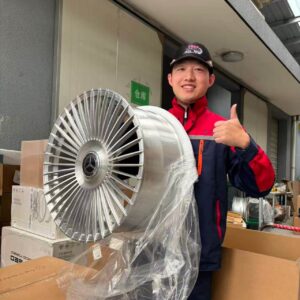

Most wheel buyers focus on looks. They pick a finish, choose a size, and move on. But the real difference in wheel strength happens at a level you can’t see with your eyes.
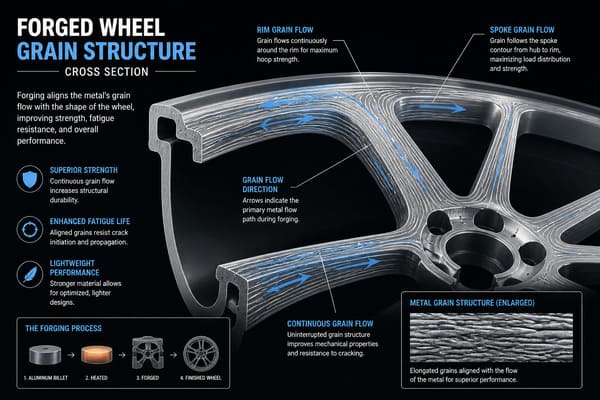
Grain structure is the internal arrangement of metal crystals inside a wheel. In forged wheels, the forging process aligns these grains along the wheel’s stress paths. This continuous grain flow makes the wheel far stronger and more resistant to fatigue than a cast wheel, where grains are randomly arranged.
I have worked with forged wheel manufacturing for years, and the grain structure question comes up less often than it should. Most buyers ask about weight, finish, and price. Very few ask about what is happening inside the metal. That gap in knowledge is exactly why I want to explain this properly. If you are serious about wheel quality, understanding grain structure is not optional.
What Makes Forged Wheels Better?
Many people know that forged wheels are stronger. Fewer people know exactly why. And almost no one talks about both reasons together.
Forged wheels use 6061 aluminum alloy, while cast wheels typically use A356. 6061 is stronger on its own. But forging also reshapes the internal grain structure of that material. The result is two separate advantages working together: a better base material, and a better internal arrangement of that material.
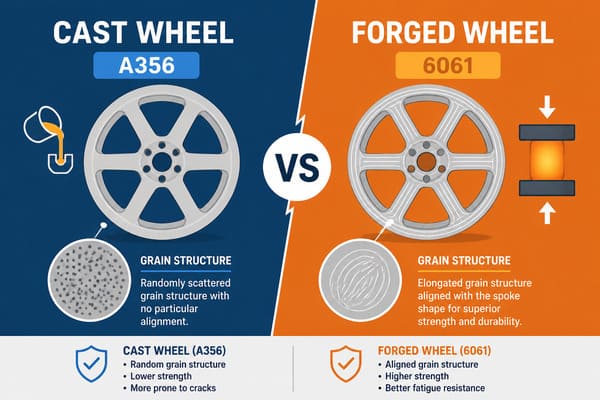
Most conversations about forged wheels stop at the first advantage. People say "6061 is stronger than A356" and leave it there. That is true, but it is only half the story. The second advantage is the one that separates a well-made forged wheel from a poorly made one, even when both use the same alloy.
Think of it this way. You can give two builders the same high-grade timber. One builder places the wood so the grain runs with the load. The other builder places it randomly. Both are using the same material. But the first structure will outlast the second by a wide margin. The same logic applies to aluminum alloy in a forged wheel.
At Tree Wheels, we work with a manufacturing partner that has over 20 years of forged wheel production experience. That depth of experience matters because getting both advantages right, material and grain direction, requires precise control at every step of production. It is not something a new factory can replicate just by buying the right equipment.
How Does Forging Affect Grain Structure?
Forging does more than shape metal. It reorganizes the metal from the inside.
During forging, a billet of 6061 aluminum is compressed under high pressure. This pressure forces the internal grains to flow and align along the shape of the wheel. The grains follow the contours of the spoke and rim, running continuously in the direction the wheel will experience stress during use.
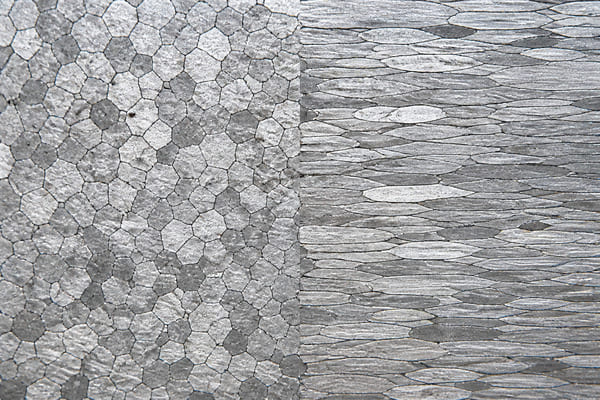
This is the core mechanical event that makes a forged wheel perform differently from a cast wheel. In casting, liquid aluminum is poured into a mold and cools. The grains form as the metal solidifies, and they grow in random directions. There is no external force guiding them. The result is an isotropic structure, meaning the material has roughly equal properties in all directions. That sounds neutral, but it is actually a weakness. Wheels do not experience stress equally in all directions. Stress concentrates along specific paths, and a random grain structure does not help channel that stress safely.
Forging changes this. The compression forces the grains to move. They stretch and align. They follow the geometry of the wheel. By the time the forging is complete, the grain flow maps closely to the stress map of the finished wheel. This is not an accident. It is the result of deliberate mold design, controlled forging temperature, precise pressure timing, and careful cooling.
Each of those variables affects where the grains go. Get one wrong, and the grain flow drifts off the intended path. This is why experience is not just a marketing claim. A manufacturer who has seen grain flow go wrong knows which parameters cannot be compromised. That negative knowledge, knowing what not to do, is something that only comes with time.
What Is Grain Structure in a Forged Wheel?
Before we go further, it helps to understand what grain structure actually means in physical terms.
Grain structure refers to the size, shape, and orientation of individual metal crystals inside an aluminum alloy. These crystals, called grains, form when the alloy solidifies or is deformed under pressure. Their arrangement determines how the metal responds to stress, impact, and fatigue over time.
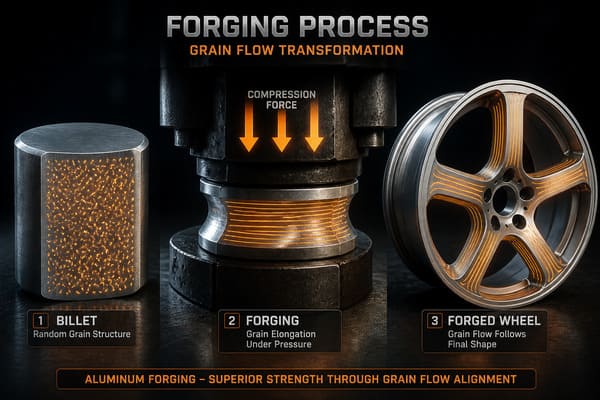
Aluminum alloy is not a uniform solid. Under a microscope, it looks like a tightly packed mosaic of small crystals. Each crystal has its own orientation. The boundaries between crystals are called grain boundaries. These boundaries are not weak points by default, but they do behave differently from the interior of each grain under stress.
When grains are small and randomly oriented, as in a cast wheel, stress distributes unevenly. Some grains carry more load than others. Some grain boundaries become stress concentration points. Over time, with repeated loading and unloading, tiny cracks can start at these boundaries. This is fatigue failure.
When grains are elongated and aligned, as in a well-forged wheel, the picture changes. The grain boundaries run roughly parallel to the stress paths. Stress distributes more evenly across the structure. There are fewer points where one grain boundary is forced to carry a disproportionate load. The wheel resists fatigue far more effectively.
| Property | Cast Wheel (A356) | Forged Wheel (6061) |
|---|---|---|
| Base material strength | Lower | Higher |
| Grain arrangement | Random | Aligned to stress paths |
| Fatigue resistance | Moderate | High |
| Response to peak stress | Stress concentrates | Stress distributes |
| Typical failure mode | Sudden fracture at boundary | Gradual, predictable wear |
This table shows why material choice and grain alignment are two separate factors. Changing only the material gives you one improvement. Forging the material correctly gives you both.
Why Is a Continuous Grain Flow Stronger Than a Cut Grain?
Grain alignment is only valuable if the grains stay aligned. This is where machining decisions become critical.
A continuous grain flow means the grains run without interruption through the wheel’s structure, from rim to spoke to hub. When machining cuts across these grains, it exposes the cross-section of each grain to the surface. These exposed cross-sections are where fatigue cracks begin under repeated stress.
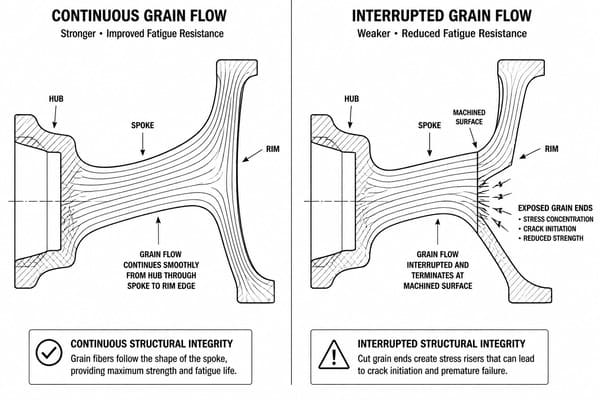
Machining has a reputation for precision. And it is precise. But precision in shape does not mean strength in structure. Every cut made across a grain flow is a structural interruption. The grain no longer runs continuously to transfer load. Instead, it terminates at the machined surface. That termination point is where stress concentrates. Under normal driving, you may never notice. But under hard braking, a high-speed corner, or a sudden impact, those termination points are where cracks start.
This is a critical distinction that separates experienced forged wheel manufacturers from less careful ones. A well-designed forging mold minimizes the need for post-forging machining across grain paths. The shape of the forging is designed so that the final wheel geometry requires as little cross-grain cutting as possible. The grains follow the spoke shape. They follow the rim contour. The machining that does happen is done along the grain direction, not across it.
I find a useful comparison in carbon fiber composites. Anyone in the racing industry knows that carbon fiber’s strength is highly directional. The fibers must run in the direction of the load. If you cut across the fibers, you get a weak edge. This is why carbon fiber layup is such a precise science. The same logic applies to forged aluminum grain flow. The grains are the fibers. The forging process is the layup. And cross-grain machining is the equivalent of cutting across carbon fiber.
The analogy is worth keeping in mind because it makes an invisible structural property visible through a familiar reference point. Grain flow direction is not a theoretical concept. It is the same principle that makes carbon fiber panels behave differently depending on how they are oriented. Forged aluminum just looks more familiar, so people forget to ask the same questions.
At Tree Wheels, our manufacturing partner’s 20 years of experience means the mold designs are developed with grain flow in mind from the start. The question of where the grains will go is asked before the mold is cut, not after the wheel is finished.
Conclusion
Grain structure is the invisible factor that separates a truly strong forged wheel from one that only looks the part. At Tree Wheels, we build with both advantages in mind, every time.