
Most wheel buyers ask the wrong question. They ask which is better. But the real question is whether your wheel was made for your car — or for everyone’s car.
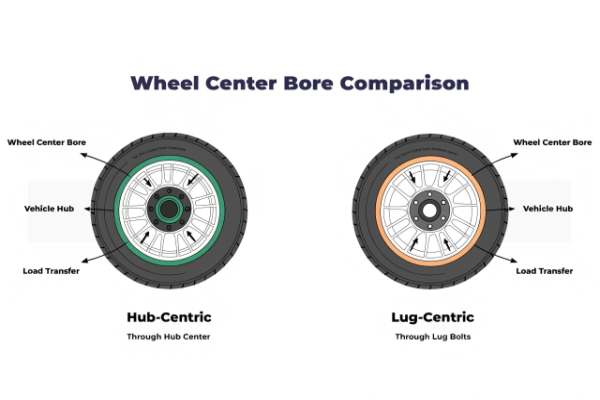
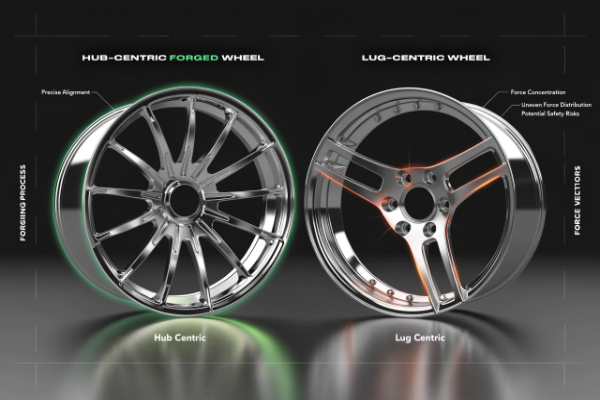
Hub-centric wheels use a center bore that matches your vehicle’s hub exactly, so the hub carries the wheel’s load. Lug-centric wheels use a larger center bore and rely on the lug bolts to center and support the wheel. Hub-centric fitment is more precise, more stable, and reduces vibration at high speed.
This difference sounds small. But in practice, it changes how your wheel performs, how long your hardware lasts, and whether you feel that annoying vibration through your steering wheel. I want to break this down from the perspective of someone who manufactures forged wheels — not someone who just sells them.
What Is Better, Hub-Centric or Lug-Centric?
You have probably seen a dozen articles that just say "hub-centric is better." But that answer skips the real reason why.
Hub-centric is better because the center bore carries the radial load of the vehicle. Lug-centric design shifts that load to the lug bolts, which are not designed to bear it. For performance driving, heavy vehicles, or high-speed use, hub-centric fitment is the safer and more durable choice.
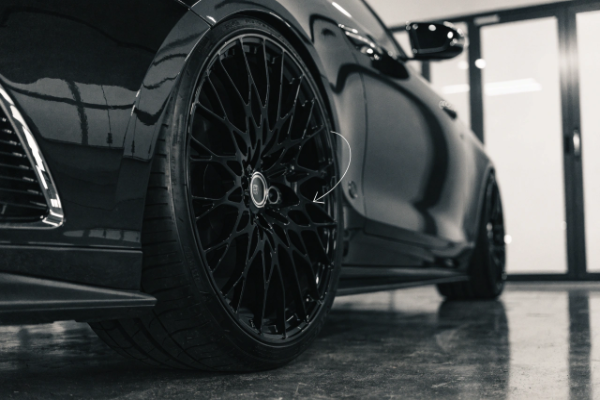
The reason lug-centric wheels exist at all is not because they are a better design. It is because they are cheaper to manufacture at scale. When a factory produces cast wheels for a mass market, making one center bore size that fits ten different car models saves inventory costs. The lug bolts do the centering work instead. That logic makes sense for high-volume, low-cost production. It does not make sense for custom forged wheels.
When we produce a forged wheel at Tree Wheels, the center bore is machined to match the customer’s specific vehicle hub from the start. There is no extra cost to do this. There is no added complexity. It is simply how custom production works. If a forged wheel supplier gives you a lug-centric fitment with an oversized center bore, the honest question to ask them is: why? You are paying for a custom product. You should receive a custom fit.
| Fitment Type | Load Distribution | Centering Method | Best Use Case |
|---|---|---|---|
| Hub-Centric | Hub carries radial load | Center bore matches hub | Performance, luxury, high-speed |
| Lug-Centric | Lug bolts carry radial load | Bolts center the wheel | Budget mass-market applications |
For our customers — modification shops, luxury car owners, and track enthusiasts — lug-centric fitment is not an acceptable standard. The safety margin is too narrow for the way they use their vehicles.
How to Tell If Your Rims Are Hub-Centric or Lug-Centric?
You want to check your rims but you are not sure what to look for. This is simpler than most guides make it seem.
To check if your rims are hub-centric, measure the center bore diameter and compare it to your vehicle’s hub diameter. If they match closely, the rim is hub-centric. If the center bore is noticeably larger than the hub, the rim is lug-centric. A hub-centric ring in the gap is another sign the rim is not a direct fit.
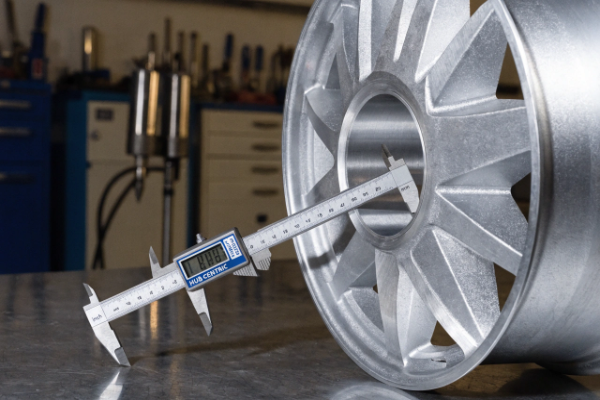
Here is a practical way to check this at your shop or at home.
Step 1: Find your vehicle’s hub bore size. This is listed in your vehicle’s owner manual or available from the manufacturer’s spec sheet. Common sizes range from 54.1mm to 74.1mm depending on the make and model.
Step 2: Measure the center bore of your rim. Use a caliper to measure the inner diameter of the center hole on the wheel. Do this carefully, as even a few millimeters matter.
Step 3: Compare the two numbers. If they match within 0.1mm to 0.5mm, the wheel is hub-centric for your vehicle. If the wheel’s center bore is several millimeters larger, the wheel is lug-centric on your application.
Step 4: Look for hub-centric rings. These are plastic or aluminum rings inserted between the hub and the wheel’s center bore. Their presence tells you the wheel’s center bore is larger than the hub, meaning the wheel is lug-centric by design and the ring is compensating.
| Check Method | What It Tells You | Tool Needed |
|---|---|---|
| Compare center bore to hub diameter | Direct fit or oversized bore | Caliper |
| Look for hub-centric rings | Rings present = lug-centric wheel | Visual inspection |
| Check spec sheet from manufacturer | Official fitment designation | Owner manual or supplier data |
When a customer comes to us with fitment questions, this is the process we walk them through. For every wheel we produce, we request the customer’s exact hub bore measurement before machining begins. That measurement determines the center bore of the finished wheel.
What Happens If a Wheel Is Not Hub-Centric?
Here is a problem that almost nobody in the industry talks about directly. Many customers blame bad wheel balancing for their vibration issues. But the real cause is often wheel centering.
If a wheel is not hub-centric on your vehicle, the center bore does not sit flush against the hub. The wheel can sit slightly off-center, even by less than a millimeter. This small offset causes vibration at speed, uneven load on the lug bolts, and accelerated wear on bolt holes over time.
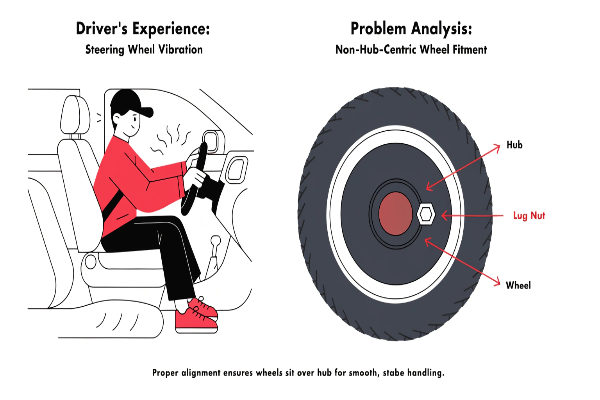
I have heard this from shop owners more times than I can count. A customer brings their car in for wheel balancing. The tech balances the wheels twice, sometimes three times. The vibration does not go away. The customer is frustrated. The shop is frustrated. Then someone checks the center bore fitment and finds the wheel is sitting 0.5mm off-center. That small gap is enough to create a noticeable wobble at highway speeds.
This is one of the most common hidden costs in the aftermarket wheel industry. The product looks fine. The installation looks correct. But the fitment is wrong, and no amount of balancing will fix a centering problem.
Beyond vibration, the long-term mechanical impact matters too. When a lug-centric wheel is mounted, the lug bolts are doing two jobs: clamping the wheel and centering it. Over thousands of kilometers, especially on uneven roads or under hard cornering, that dual load causes micro-movement at the bolt holes. This gradually enlarges the holes and reduces clamping force.
| Problem | Root Cause | Long-Term Effect |
|---|---|---|
| Steering wheel vibration | Off-center wheel position | Persistent vibration at speed |
| Lug bolt fatigue | Bolts carrying lateral load | Bolt hole enlargement, reduced clamp force |
| Uneven tire wear | Slight misalignment from poor centering | Premature tire replacement |
| Repeated balancing failure | Centering issue, not balance issue | Wasted time and money |
For customers driving performance cars or modified vehicles, these risks are not acceptable. Precision fitment is not a luxury. It is the baseline.
Are Lug-Centric Rims Safe?
This is a fair question, and I want to give you a straight answer without oversimplifying it.
Lug-centric rims are generally safe for normal, low-speed driving when properly installed and torqued to spec. However, their safety margin is smaller than hub-centric wheels. Under high-speed driving, heavy loads, or aggressive cornering, lug-centric fitment introduces risks that hub-centric design avoids entirely.
Let me be specific about what "safe" actually means in context.
If you drive a standard commuter car at normal speeds on well-maintained roads, and your lug-centric wheels are properly installed with correct torque, you are unlikely to experience a dangerous failure. The design works within its limits in that scenario.
But the moment you change the conditions, the limits tighten fast. High-speed highway driving puts more lateral force on the wheel during lane changes. Track days and hard cornering put sustained lateral loads on the wheel every corner. Heavy vehicles — trucks and SUVs — add constant downforce that multiplies every road impact.
In all of these cases, lug-centric fitment is working harder to hold the wheel in place. The bolts are managing forces they were not primarily designed to carry. The risk does not appear suddenly. It builds up gradually through wear.
| Driving Scenario | Lug-Centric Risk Level | Recommended Fitment |
|---|---|---|
| City driving, low speed | Low | Either acceptable |
| Highway driving | Medium | Hub-centric preferred |
| Performance or track use | High | Hub-centric required |
| Heavy vehicles (SUV/truck) | High | Hub-centric required |
| Luxury and modified cars | High | Hub-centric required |
For the customers Tree Wheels serves — luxury car owners, track enthusiasts, and modification shops — lug-centric is not a risk worth taking. Our custom forged wheels are machined to each customer’s exact hub bore specification. This is not a premium add-on. It is how we build every single wheel.
Conclusion
Hub-centric wheels center on the hub. Lug-centric wheels rely on bolts. For custom forged wheels, precise hub-centric fitment should always be the standard, not the exception. At Tree Wheels, every forged wheel is built to your exact hub specification — because custom means precise, every time.