
Blue BMW M5 owners often get this wrong. They pick wheels based on what looks good in photos — and end up with a car that disappoints in real life.
Selecting the right wheels for a blue BMW M5 comes down to four decisions: color pairing, wheel size, surface finish, and offset. Get all four right, and the car looks intentional. Miss one, and the whole build feels off. This guide walks through each decision in detail.
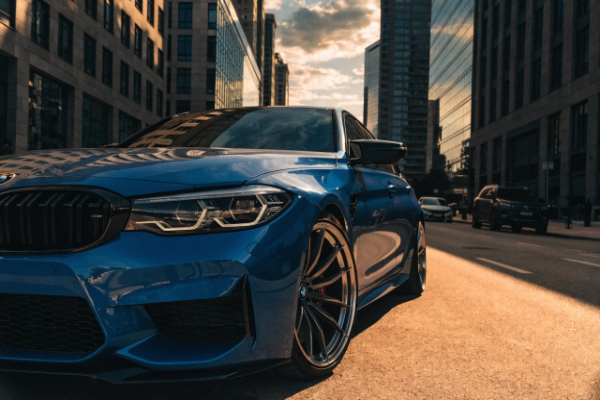
The BMW M5 is not a simple car to build wheels for. The blue variants alone cover at least five different shades, each with a different undertone. The chassis has specific engineering tolerances that punish bad fitment choices. And the performance expectations of an M5 owner are higher than average. Each section below addresses one part of the decision. Work through all four before you finalize anything.
What Color Wheels Go Well With Blue?
Not all blue BMWs are the same blue. Most owners pick a wheel color based on "blue BMW" images online — and end up with a combination that clashes with their specific shade.
Blue BMW M5 models come in at least five distinct shades: Marina Bay Blue, Tanzanite Blue, Snapper Rocks Blue, Laguna Seca Blue, and San Marino Blue. Each sits at a different point on the warm-to-cool color spectrum. The right wheel color depends entirely on where your specific shade falls on that spectrum.
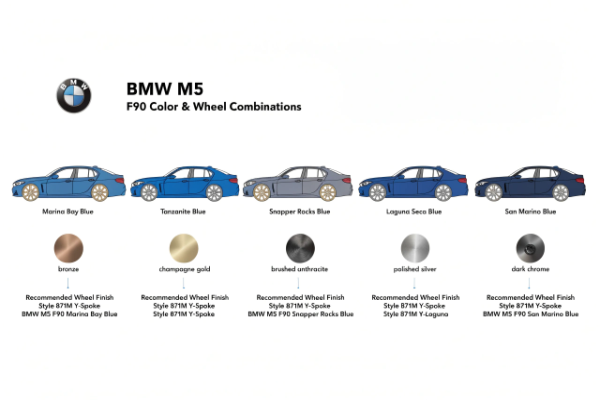
The core principle here is simple: warm blues pair with warm metals, and cool blues pair with cool metals. Tanzanite Blue has a strong violet undertone. Flat black wheels kill that undertone — the car just looks dark and heavy. Satin bronze or champagne gold, on the other hand, pulls the violet out and makes the whole build feel deliberate. San Marino Blue is a bright, almost electric blue with no warmth in it. That is where high-polish silver or a machined face with dark spokes works — the cool tone of polished aluminum mirrors the blue instead of fighting it.
Warm Blues vs. Cool Blues: A Pairing Guide
| BMW Blue Shade | Undertone | Recommended Wheel Finish | Finishes to Avoid |
|---|---|---|---|
| Tanzanite Blue | Warm violet | Satin bronze, champagne gold, gunmetal (brown tint) | Flat black, cool chrome |
| Marina Bay Blue | Warm navy | Bronze, brushed gold, dark gunmetal | Polished silver |
| Snapper Rocks Blue | Neutral-warm | Brushed anthracite, smoke finish | Gloss black |
| Laguna Seca Blue | Cool bright | Polished silver, dark anthracite | Bronze, gold |
| San Marino Blue | Cool electric | Machined face with dark spokes, dark chrome | Warm gold, satin bronze |
The table above is the starting point. From there, the specific finish style — gloss, satin, brushed, polished — adds another layer of personality. Gloss and polished finishes reflect more light and look more aggressive. Brushed and satin finishes are more refined and easier to maintain. For a car used daily, brushed finishes hold their appearance longer. For show use or low-mileage builds, polished finishes reward the extra maintenance effort. The shade of blue on your specific car is the first filter. Apply that filter first, then move to finish style.
What Wheel Size Fits a Blue BMW M5 Best?
The F90 BMW M5 runs 20×9.5 front and 20×10.5 rear from the factory. Most owners want to go bigger. The question is how much bigger is actually smart.
For a street-driven F90 BMW M5, 21 inches is the practical ceiling for wheel diameter — and only when the wheels are forged. A staggered 21×10 front and 21×11 rear setup gives the visual upgrade most owners want without compromising the car’s engineered performance balance.
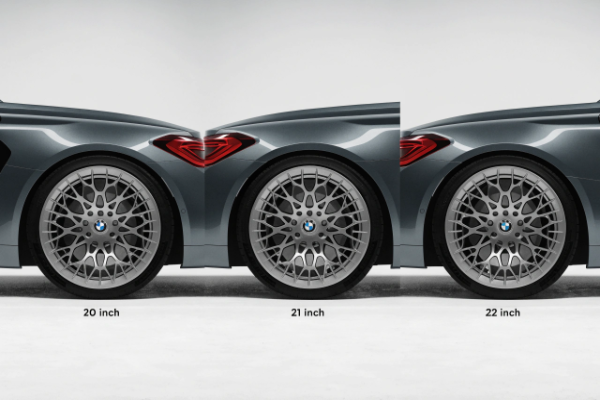
The F90 M5 weighs over 4,000 lbs. That weight matters when you start adding rotational mass. A cast or flow-formed 21" wheel can add 2–3 lbs per corner compared to a forged equivalent. That is 8–12 lbs of unsprung weight on a car whose adaptive suspension was tuned around a specific unsprung weight range. Push past that range, and the car feels slower to respond, not faster.
Size vs. Weight vs. Performance: What the Numbers Mean
| Wheel Size | Construction | Estimated Weight per Corner | Street Performance Impact |
|---|---|---|---|
| 20" (factory) | Cast OEM | Baseline | Factory-tuned, fully optimized |
| 21" | Cast / Flow-formed | +2–3 lbs vs. forged | Noticeable suspension response lag |
| 21" | Forged | Near factory weight | Minimal impact, recommended ceiling |
| 22" | Forged | +1–2 lbs vs. 21" forged | Acceptable for show, not ideal for daily |
| 22" | Cast / Flow-formed | +4–6 lbs vs. forged | Not recommended for street use |
Going to 22" on a street car is mostly an aesthetic choice. I say that as a manufacturer who produces 22" wheels — it is just not the right call for daily driving. The tire sidewall gets too thin to absorb road imperfections, and the suspension has to work harder to compensate. A forged 21" setup gives you the visual step up from factory without asking the car to fight against itself. That is the range we build most M5 wheels in, and the feedback from customers confirms it is the right call.
Which Wheel Finish Looks Best on a Blue BMW M5?
Gloss black is the most requested finish we receive for blue BMW M5 builds. It is also the finish I spend the most time talking customers out of.
For a blue BMW M5, the most practical and visually effective wheel finish is a brushed aluminum face with a dark smoke or tinted clear coat over the spokes. This finish creates movement and contrast, holds up well to daily use, and works across nearly every shade of BMW blue.
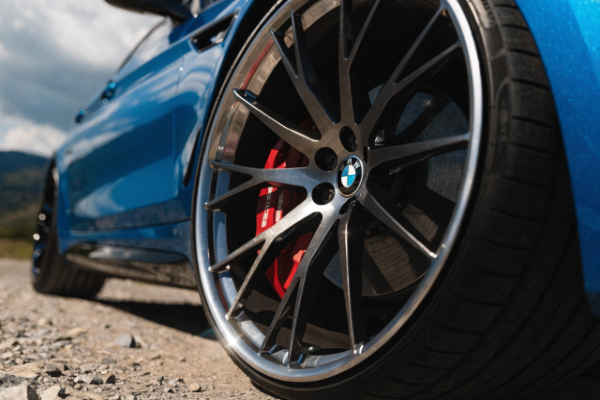
Gloss black does not look bad on day one. It looks bad by month six. It shows brake dust immediately. It shows water spots. It shows micro-scratches from every car wash. On a dark blue car, every piece of wheel grime is visible from ten feet away. The car stops looking like a performance vehicle and starts looking neglected. That is not the experience an M5 owner is paying for.
Finish Comparison for Blue BMW M5 Builds
| Finish Type | Visual Effect | Maintenance Level | Best Match (Blue Shade) |
|---|---|---|---|
| Gloss black | Aggressive, dark | High — shows dust and scratches | None recommended for daily |
| Brushed face + smoke spokes | Dynamic, refined | Low-medium | All BMW blue shades |
| Fully polished | Mirror, aggressive | High — shows fingerprints and water | Laguna Seca, San Marino Blue |
| Anthracite window + polished rim | Contrast, premium | Medium | Tanzanite, Marina Bay Blue |
| Satin bronze | Warm, intentional | Low | Tanzanite, Marina Bay Blue |
The brushed face with dark-tinted spokes is what I recommend most often. The brushed surface catches directional light and creates visual movement as the wheel spins. The tinted spokes add depth and contrast without the maintenance cost of a full gloss finish. It photographs well in all lighting conditions, and it ages well over time. The fully polished face with anthracite window is my second recommendation — it is more aggressive and better suited to cool-toned BMW blues where the mirror finish mirrors the paint rather than competing with it.
What Offset and Fitment Should You Choose for a BMW M5?
The F90 M5 already runs an aggressive factory offset — ET30 front and ET20 rear on the M Sport body. Many owners see those numbers and want to go lower to get a more flush or poked look.
For the F90 BMW M5, the recommended custom offset range is ET30–ET35 on the front and ET20–ET25 on the rear. This gives a flush-to-aggressive rear stance without altering the front strut geometry that controls steering feel and bearing wear.
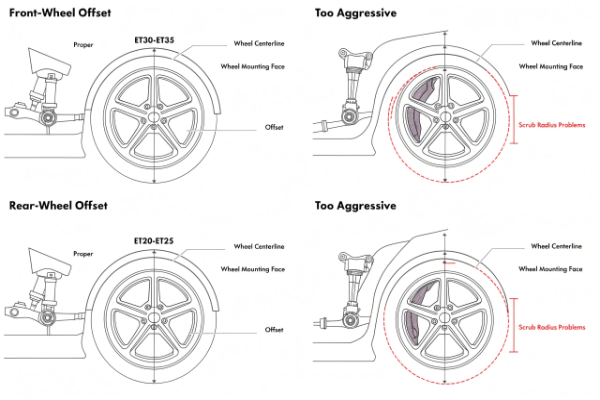
The M5’s front strut geometry is sensitive to offset changes. Going too far negative on the front increases scrub radius. That creates two problems: steering feedback becomes inconsistent, and front wheel bearing wear accelerates. These are not cosmetic problems — they are mechanical ones that show up in maintenance costs and driving feel over time.
Offset Ranges and Their Effects on the F90 M5
| Position | Factory Offset | Recommended Custom Range | Too Aggressive (Avoid) | Effect of Going Too Low |
|---|---|---|---|---|
| Front | ET30 | ET30–ET35 | Below ET20 | Increased scrub radius, steering issues, bearing wear |
| Rear | ET20 | ET20–ET25 | Below ET10 | Rubbing under load, suspension bind |
The rear offset is where you create the flush look that most M5 owners are actually after. A rear wheel at ET20–ET25 fills the arch properly on the wider M Sport body. The visual result is a car that looks planted and aggressive without needing spacers. Spacers are a compromise. They change the load path on wheel studs and add a potential failure point. The right way to achieve correct fitment is to specify the exact offset at the time of ordering and have it machined into the wheel from the start. That is what custom forged production allows — you get the exact number you need, built in from the beginning, with no afterthought hardware required.
Conclusion
Wheel selection for a blue BMW M5 depends on shade, size, finish, and offset — get all four right, and the result is a car that looks and drives exactly as it should. At Tree Wheels, we build custom forged wheels to your exact specifications — contact us to start your M5 build today.