
Choosing the wrong wheel offset can ruin your car’s handling, wear out your bearings, and even cause safety issues. Most guides make it sound simple. It is not.
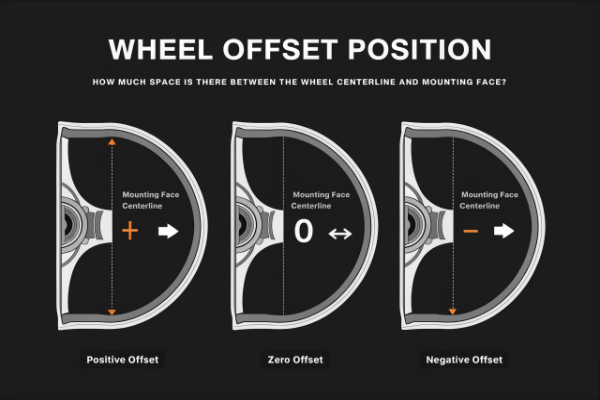
Wheel offset is the distance between a wheel’s mounting face and its centerline. A positive offset moves the wheel inward, toward the suspension. A negative offset pushes it outward. This measurement directly affects steering feel, bearing load, and how much the wheel sticks out from the fender.
I have worked with forged wheel manufacturing for years, and I see the same misunderstandings come up again and again. Customers pick an offset number because it looks right, or because a friend recommended it. But offset is not just a style choice. It is a structural and mechanical decision that affects every part of how your car drives. Let me walk you through the most common questions we get, and give you answers based on what we actually see in production.
How Much Difference in Wheel Offset Is Okay?
You changed your offset by a few millimeters, and now your tire rubs the fender on every turn. Sound familiar? A small number on paper can have a big real-world effect.
Most vehicles can tolerate an offset change of ±5mm to ±10mm from the factory spec without major issues. Beyond that range, you risk tire rubbing, suspension interference, or increased stress on wheel bearings. Always check your specific vehicle’s clearances before going further.
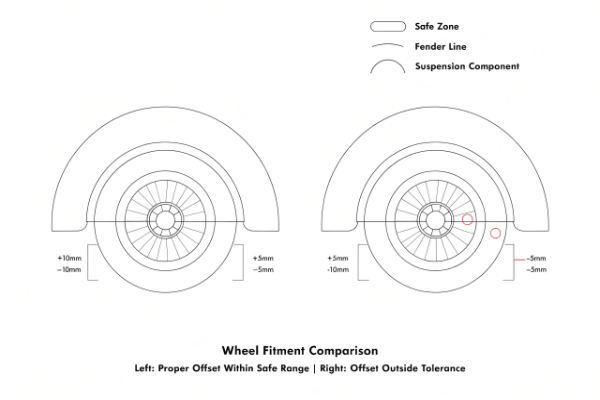
The tolerance range depends heavily on your vehicle’s suspension design, fender clearance, and the width of the wheel itself. A wider wheel leaves less room for error. A lowered car has even tighter clearances. Here is what changes when you move outside the safe range:
What Happens When You Push the Offset Too Far?
| Change | Effect on Vehicle |
|---|---|
| Too much positive offset | Wheel tucks in, may hit suspension components |
| Too much negative offset | Wheel sticks out, rubs fender, increases bearing load |
| Large offset change on wide wheel | Rubbing risk increases significantly |
| Offset change without suspension check | Risk of uneven tire wear and poor handling |
From a manufacturing perspective, offset is not just a number we stamp on a wheel. When a customer requests an extreme negative offset, the load path through the spokes changes completely. The stress concentration zone moves outward, toward the spoke roots. We have to recalculate wall thickness and material flow during the forging process to make sure the wheel is structurally sound, not just visually correct. A wheel that looks aggressive but carries hidden structural weakness is not something we are willing to produce. So when customers ask how far they can go, our answer is always: tell us your vehicle specs first, and we will design the offset around what the structure can actually support.
What Does +35 Offset Mean on a Rim?
You keep seeing "+35" listed on wheels, especially on European cars. But what does that number actually tell you about how the wheel will sit on your car?
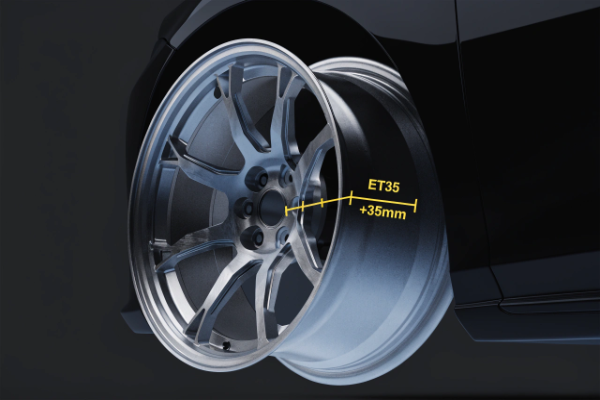
A +35 offset means the wheel’s mounting face sits 35mm toward the outside of the wheel, measured from the centerline. This is a positive offset, which positions the wheel further inward, closer to the suspension. It is one of the most common OEM offset values on European vehicles.
The +35 value did not become common because it is the best performance setting. It became common because it works across many different vehicle models and is cost-efficient for mass production.
Why +35 Is the Default, Not the Ideal
Most European OEM wheels fall between +35 and +45. Car manufacturers chose this range because it fits a wide variety of body styles without modification. It keeps the wheel tucked in enough to avoid fender clearance problems, and it reduces stress on the hub bearing by keeping the wheel load closer to the bearing centerline.
| Use Case | Recommended Offset Range | Reason |
|---|---|---|
| Daily street driving | +35 to +45 | Safe bearing load, good clearance |
| Performance street | +20 to +35 | Slightly wider track, better cornering |
| Track or motorsport | +10 to +25 | Maximum track width where geometry allows |
| Show car / aggressive fitment | 0 to -20 | Visual effect, higher bearing stress |
For customers who want better cornering stability or a wider stance, +35 is often too conservative. Lowering the offset widens the track, which improves cornering balance. But this only works if your suspension geometry allows it. Running a much lower offset without checking your control arm and strut clearance can cause contact under full steering lock. This is exactly why forged wheel customization matters: we can set the offset to the precise millimeter your vehicle needs, instead of forcing you to pick from a limited list of catalog options.
What Does +15 Offset Mean on Wheels?
You have seen +15 on wheels built for lifted trucks and off-road builds. It sounds like a small number. But it represents a very different design philosophy than +35.
A +15 offset means the mounting face is only 15mm outboard of the wheel’s centerline. This positions the wheel noticeably further outward compared to a +35 offset. The result is more wheel and tire visible beyond the fender, a wider visual stance, and a wider effective track width.
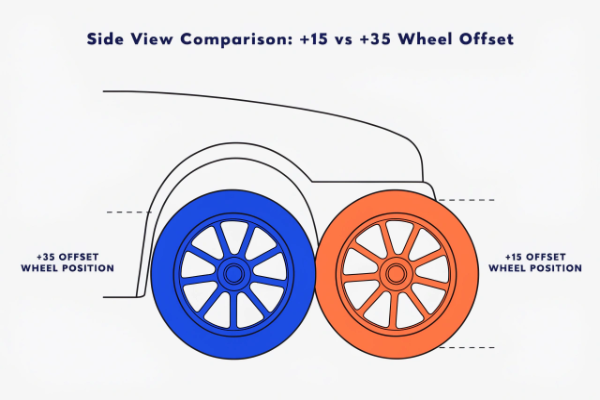
The difference between +15 and +35 is 20mm. That means each wheel sits 20mm further out. Across both sides of the axle, your track width increases by 40mm. This is a meaningful change, both visually and mechanically.
How +15 Offset Affects Your Vehicle
| Factor | +35 Offset | +15 Offset |
|---|---|---|
| Wheel position | Closer to suspension | Further outward |
| Visual stance | Standard / tucked | Wide / aggressive |
| Track width | Factory spec | ~40mm wider (both sides) |
| Hub bearing load | Lower | Higher |
| Fender clearance needed | Less | More |
| Common application | European street cars | Trucks, SUVs, off-road builds |
One point that many modification shops do not tell their customers directly: a lower offset increases the bending moment on the hub bearing. The wheel’s contact patch is further from the bearing centerline, so every bump and cornering force creates more leverage against the bearing. Over time, this accelerates wear. This does not mean +15 is wrong for your build. It means you need to know about it and plan accordingly. On a vehicle that sees heavy use, upgrading the bearing or monitoring wear intervals becomes more important when running a low-offset setup.
How Far Does 0 Offset Stick Out?
People assume 0 offset is neutral. They think it means the wheel sits exactly in the middle and does not stick out at all. That assumption is wrong.
0 offset means the wheel’s mounting face is exactly at the centerline of the wheel. Whether the wheel sticks out beyond the fender depends entirely on the wheel’s width and the vehicle’s fender clearance. A 0 offset does not mean the wheel will be flush with the body.
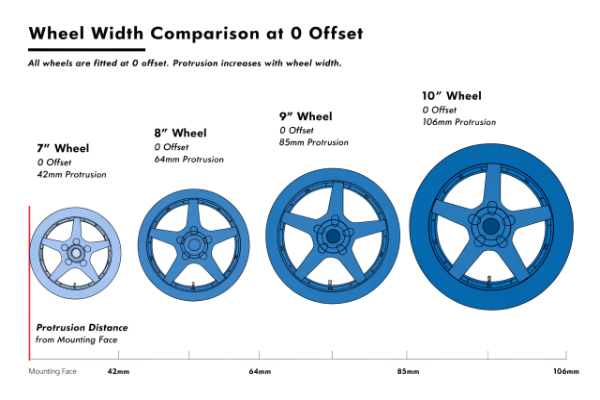
This is one of the most common misunderstandings we encounter from customers. They request 0 offset expecting a specific visual result, without realizing that wheel width completely changes the outcome.
0 Offset and Wheel Width: The Real Relationship
Here is a practical example. If you have a 9-inch wide wheel with 0 offset, the outer edge of the wheel sits 114.3mm (4.5 inches) outside the mounting face. If you have a 7-inch wide wheel with 0 offset, the outer edge sits only 88.9mm (3.5 inches) outside the mounting face. That is a difference of over 25mm between the two wheels, both at 0 offset.
| Wheel Width | Half Width (protrusion from mounting face) | Difference vs 7" wheel |
|---|---|---|
| 7 inches | 88.9mm | — |
| 8 inches | 101.6mm | +12.7mm |
| 9 inches | 114.3mm | +25.4mm |
| 10 inches | 127.0mm | +38.1mm |
This is why we always ask customers for both the offset they want and the wheel width before we begin any design work. The two numbers work together to determine where the outer edge of the wheel actually sits relative to the fender. A customer asking for "0 offset" is giving us half the information we need. The forging process allows us to hit any offset value with millimeter precision, but we need the full picture to design a wheel that fits correctly and looks exactly the way the customer expects.
Conclusion
Wheel offset controls how your wheel sits, how your car handles, and how long your bearings last. Get it right, and everything works together. Get it wrong, and the problems are expensive. At Tree Wheels, we build fully customized forged wheels with precise offset specifications tailored to your exact vehicle — because the right fit starts at the millimeter level.