

Most buyers get this question wrong before they even start shopping. They compare specs, read reviews, and still end up confused — or worse, they pay forged prices for something that is not fully forged.
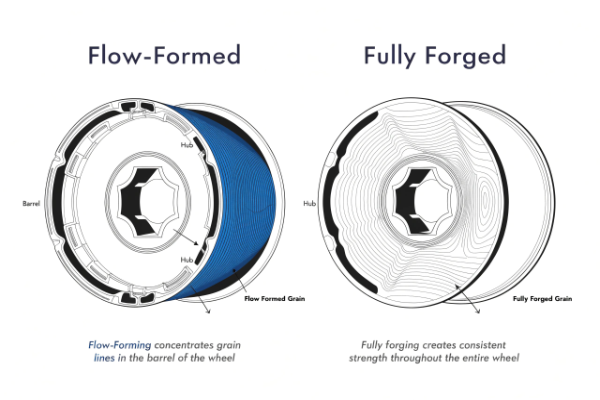
Flow-formed wheels start as a cast blank, then get spun and pressed to strengthen the barrel. Fully forged wheels are shaped from a single solid billet of aluminum under extreme pressure. The result is a continuous grain structure throughout the entire wheel — not just in the barrel wall.
I have talked to enough modification shop owners and car enthusiasts to know that this confusion costs people real money. So let me break this down the way I wish someone had explained it to me earlier — starting with the question almost everyone asks first.
Is Flow Formed Stronger Than Forged?
This question is asked constantly, and almost always answered the wrong way. Most articles throw strength numbers at you, but the numbers miss the point entirely.
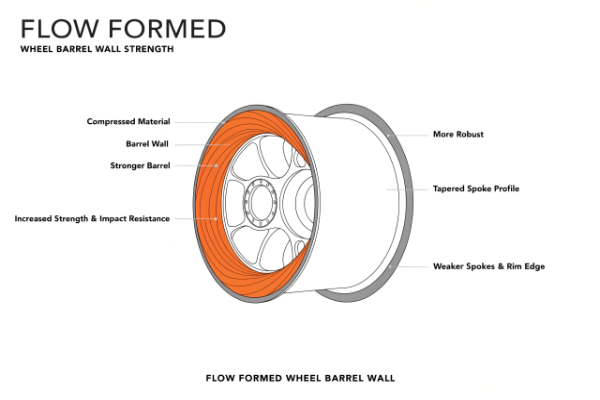
Flow-forming does increase strength — but only in the barrel wall. The process stretches and compresses the barrel, which aligns the metal grain in that specific area. Fully forged wheels have a continuous grain structure across the entire wheel, giving uniform strength from the spoke to the rim edge.
The real question is not which one is stronger. The real question is: where is the strength, and where do you actually need it?
For a daily driver on normal roads, a strong barrel wall is usually enough. Flow-formed handles that job well. But the moment you push the wheel harder — track days, big brake kits, aggressive cornering, rough road conditions — you are loading the entire wheel, not just the barrel. That is where fully forged shows its advantage. The strength is not concentrated in one zone. It is built into the whole structure.
I think of it this way. Flow-formed strength is targeted. Fully forged strength is total. If your driving only tests one part of the wheel, you might never notice the difference. If your driving tests the whole wheel, you will.
| Strength Factor | Flow-Formed | Fully Forged |
|---|---|---|
| Barrel Wall Strength | High (stretched and compressed) | Very High |
| Spoke Strength | Standard (cast origin) | Very High (forged grain) |
| Rim Edge Strength | Standard (cast origin) | Very High |
| Overall Structural Integrity | Moderate | Excellent |
| Best Use Case | Daily driving, mild performance | Track, heavy load, full custom builds |
Is Flow Forged and Fully Forged Different?
Yes — and this naming confusion is one of the biggest problems in the wheel industry right now. It costs buyers money and trust.
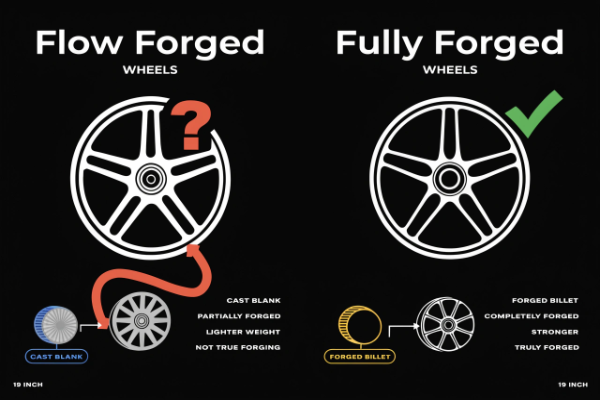
"Flow forged" is a marketing term. It describes the same process as flow-forming — a cast blank spun and pressed to shape the barrel. It is not a forging process. The starting material is still cast aluminum, not a forged billet. The word "forged" in "flow forged" is there to make the product sound more premium than it is.
I have seen this cause real problems for modification shop owners. A shop buys a batch of "flow forged" wheels thinking they are selling their customers a forged product. The customer pays a premium price. Later, someone asks about the manufacturing process, and the shop owner does not have a clean answer — because the answer is not clean.
If you want to cut through all the vague language, ask one direct question: Is the starting blank cast or forged? That single question exposes the whole picture.
If the blank is cast, the wheel is flow-formed, no matter what name is printed on the box. If the blank starts as a forged billet and is then machined or further processed, that is a fully forged wheel. The word "flow" in front of "forged" does not change what the material started as.
| Term | Starting Material | Process | Is It Truly Forged? |
|---|---|---|---|
| Cast Wheel | Molten aluminum poured into mold | Casting only | No |
| Flow-Formed Wheel | Cast blank | Cast + barrel spinning/pressing | No |
| "Flow Forged" Wheel | Cast blank (usually) | Cast + barrel spinning/pressing | No — it is marketing language |
| Fully Forged Wheel | Solid aluminum billet | High-pressure forging + CNC machining | Yes |
The automotive modification industry runs on trust. When product names are designed to blur the line between two very different things, it makes that trust harder to build. At Tree Wheels, we do not use "flow forged" because we do not need to. Our wheels start as forged billets — and that is the only story worth telling.
Which Is Lighter: Flow-Formed or Forged?
Weight is one of the most marketed differences between these two wheel types. And yes, the difference is real — but it is also one of the most overstated selling points in the industry.
Fully forged wheels are generally lighter than flow-formed wheels of the same size. Because forged aluminum is denser and stronger, less material is needed to meet the same load rating. This allows for thinner spokes and a lighter overall structure without sacrificing strength.
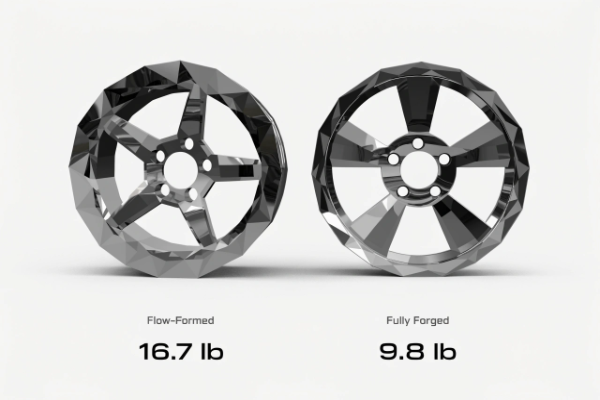
Flow-formed wheels are lighter than standard cast wheels — that part is true and worth noting. The barrel compression removes some material and increases density in that zone, which helps bring the weight down compared to a basic cast wheel. So if you are upgrading from a stock cast wheel, flow-formed does feel like a meaningful improvement.
But when you put flow-formed next to fully forged, the weight gap exists — and the people who actually feel it are a very specific group. Track drivers care about unsprung mass. Unsprung mass is the weight that moves with the wheel and suspension, not the body of the car. Reducing it improves handling response, braking, and acceleration feel. For that group, every kilogram matters, and fully forged wins clearly.
For the other 99% of drivers on public roads, the real-world weight difference between a well-designed flow-formed wheel and a fully forged wheel is not something you feel through the steering wheel on a Tuesday morning commute. What you actually get from choosing fully forged in that context is not just lighter weight — it is a stronger, more consistent structure and the ability to have the wheel made exactly for your car. That is the honest reason to choose forged, not a few hundred grams.
| Weight Factor | Flow-Formed | Fully Forged |
|---|---|---|
| Weight vs. Standard Cast | Lighter | Much Lighter |
| Weight vs. Each Other | Heavier | Lighter |
| Practical Difference for Daily Driving | Minimal | Minimal |
| Practical Difference for Track Use | Noticeable | Significant advantage |
| Weight Reduction Method | Barrel compression | Less material needed due to higher density |
Do Flow-Formed Wheels Crack?
They do. But the reason is more specific than most people explain — and understanding it helps you make a smarter buying decision.
Flow-formed wheels can crack under heavy lateral impact, particularly at the rim edge and the junction between the spokes and the barrel. These areas retain the properties of the original cast blank. The barrel wall is stronger, but the rest of the wheel was not flow-formed — so it remains the structural weak point.
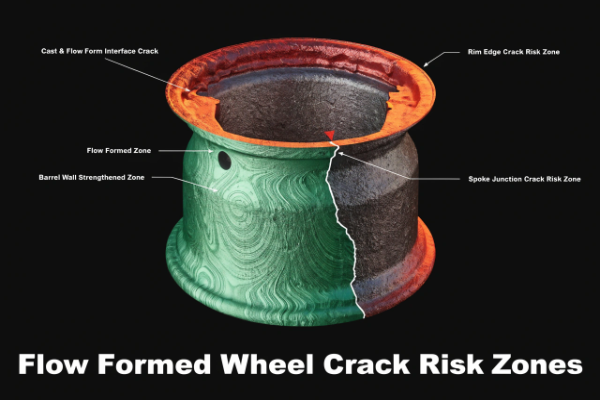
This is not a quality control failure. It is a structural reality built into how flow-forming works. The process only strengthens what it touches — the barrel wall. Everything else, the spokes, the face, the rim lip, the junction zones — stays as cast aluminum. Cast aluminum handles compression well but handles sharp, sudden impact less cleanly than forged aluminum. When a flow-formed wheel takes a hard hit from the side — a curb strike, a pothole at speed, an aggressive track corner — the stress concentrates at the boundary between the strengthened barrel and the unstrengthened face. That boundary is where cracks begin.
Fully forged wheels do not have this boundary. The entire wheel comes from one solid billet, and the grain structure flows continuously through every part of the wheel — spoke, face, barrel, and rim edge. There is no weak zone where one type of material meets another. The wheel can flex and absorb impact more evenly across its whole structure. That is why fully forged wheels handle abuse better — not because the aluminum is magical, but because the structure has no internal divide.
So when someone asks me if flow-formed wheels crack, my answer is: yes, under the right conditions, and those conditions are not rare for performance driving. If your wheel use stays within normal daily driving, the risk is low. If you push harder, the structural limitation of flow-forming becomes a real factor.
| Crack Risk Factor | Flow-Formed | Fully Forged |
|---|---|---|
| Barrel Wall Crack Risk | Low (strengthened zone) | Very Low |
| Rim Edge Crack Risk | Moderate (cast origin) | Low |
| Spoke Junction Crack Risk | Moderate (cast origin) | Low |
| Impact Absorption | Uneven (strong barrel, weaker face) | Even throughout |
| Recommended for Track/Heavy Use | Not ideal | Yes |
Conclusion
Flow-formed is a solid upgrade from standard cast. Fully forged is a different category — built for strength, customization, and serious use. At Tree Wheels, we build fully forged wheels from billet aluminum, made to your exact specifications, shipped to your door.