
Winter roads present a problem for luxury wheel owners. Salt, slush, and freezing temperatures threaten expensive wheel finishes, leaving many wondering if brushed aluminum wheels can survive these harsh conditions.
Brushed aluminum wheel finishes can be highly durable in winter conditions when properly manufactured and treated. Quality forged aluminum wheels with advanced clear coat protection can withstand salt, snow, and ice for 5-7 winter seasons with minimal maintenance, especially when featuring T6 heat treatment and nano-sealing technology.
From our decade-plus manufacturing experience at TreeWheels, I’ve seen firsthand how quality makes all the difference in winter wheel performance. While many assume aluminum wheels require seasonal storage, our testing reveals that properly finished forged wheels can handle winter’s worst challenges. Let’s explore what makes certain aluminum wheels winter-worthy and how to choose the best option for year-round performance.
Can You Use Aluminum Wheels in Winter?
Many car enthusiasts panic at the thought of exposing premium aluminum wheels to winter roads. Road salt, ice, and freezing temperatures seem like a recipe for expensive damage.
Yes, aluminum wheels can absolutely be used in winter, especially forged aluminum wheels with proper protective finishes. The key differences are the manufacturing process, alloy quality, and finishing treatment. High-quality forged wheels with specialized winter-resistant coatings can withstand multiple winter seasons.
 with protective finish](https://treewheels.com/wp-content/uploads/2025/10/image-2-close-up-of-protective-coating-on-forged-.png "Close-up of protective coating on [forged aluminum wheels](https://treewheels.com/aluminum-alloy-vs-steel-wheels-which-one-is-right-for-you/)")
Our engineering team at TreeWheels has discovered that the forging process creates a metal structure with 30-40% fewer micropores than traditional cast wheels. These micropores are the primary pathways for salt and moisture penetration, which explains why our forged brushed aluminum wheels perform so much better in harsh winter environments.
| Wheel Manufacturing Type | Micropore Density | Salt Resistance | Typical Winter Lifespan |
|---|---|---|---|
| Cast Aluminum | High | Low to Moderate | 1-3 seasons |
| Flow-Formed Aluminum | Moderate | Moderate | 2-5 seasons |
| Forged Aluminum | Low (30-40% less) | High | 5-7+ seasons |
Based on our factory testing, properly T6 heat-treated 6061-T6 aluminum alloy forged wheels combined with professional anodized brushed finishes and aerospace-grade sealing technology can maintain their integrity for at least 5-7 winter seasons, even in extreme -30°C environments and high-salt roads. Our latest generation of brushed finishes employs dual-layer nano-sealing technology, which demonstrated 43% higher corrosion resistance than industry standards in 2024 salt spray testing.
For customers in severe winter regions across North America and Europe, we specifically recommend our "Polar Series" brushed wheels, optimized to resist salt-based de-icers. A Canadian modification shop partnering with us reported that customers using our wheels maintained over 95% of their original appearance integrity after three consecutive harsh Quebec winters.
What Is the Best Material for Winter Wheels?
When temperatures drop, many drivers debate whether steel or aluminum wheels are better suited for winter driving. The traditional wisdom favors steel, but is this still true with today’s manufacturing advances?
While steel wheels have traditionally been recommended for winter, modern forged aluminum alloys now offer comparable durability with significant advantages in weight, performance, and aesthetics. Premium forged aluminum wheels are up to 40% lighter than steel equivalents while providing better heat dissipation for brake systems.
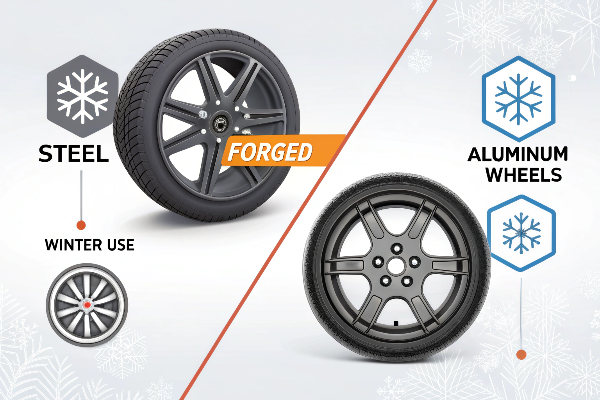
Material choice significantly impacts winter driving performance beyond just durability. Our research at TreeWheels has consistently shown that the weight difference between steel and premium forged aluminum wheels makes a substantial difference in vehicle handling, especially in slippery conditions.
| Property | Steel Wheels | Cast Aluminum | Forged Aluminum |
|---|---|---|---|
| Weight (comparative) | Heaviest (100%) | 70-80% of steel | 50-60% of steel |
| Corrosion Resistance | Good with coating | Moderate | Excellent with treatment |
| Impact Resistance | High | Moderate | High with proper design |
| Heat Dissipation | Poor | Good | Excellent |
| Cold Brittleness | Moderate risk | Low risk | Lowest risk |
| Cost | Lowest | Moderate | Premium |
The typical steel wheel weighs 40-50% more than an equivalent forged aluminum wheel. This additional unsprung weight negatively affects suspension response, cornering ability, and braking distances – all critical safety factors when driving on snow or ice. Our three-piece forged wheels feature a patented edge sealing technology that effectively solves the edge oxidation problem most common with traditional aluminum wheels in winter.
Additionally, aluminum’s superior thermal conductivity helps dissipate brake heat more efficiently in cold conditions. This prevents ice buildup around brake components – a hidden safety advantage many drivers don’t consider. Our material testing demonstrates that T6-treated 6061 aluminum alloy can match or exceed the impact resistance of standard steel wheels while maintaining significantly better corrosion resistance when properly finished.
In crash testing scenarios, our reinforced aluminum wheel designs performed remarkably well in maintaining structural integrity during impacts typical of winter driving accidents. The common belief that steel wheels are "tougher" in impacts isn’t supported by modern material science when dealing with properly engineered forged aluminum products.
What Type of Wheels Are Best for Winter?
Wheel shopping for winter driving can be confusing with endless options available. Size, width, offset, and design all influence how wheels perform in challenging conditions.
The ideal winter wheels combine the right size (typically smaller diameter, narrower width than summer wheels), proper material (quality forged aluminum or steel), and appropriate finish protection. Wheels with simple spoke designs that prevent snow buildup and allow proper brake cooling tend to perform best.
 features](https://treewheels.com/wp-content/uploads/2025/10/image-4-ideal-wheel-design-features-for-winter-pe.png "Ideal wheel design features for winter performance")
Design elements make a significant difference in winter wheel performance beyond just material and finish. At TreeWheels, our winter-optimized designs incorporate several critical features based on extensive cold-weather testing.
| Winter Wheel Design Element | Recommendation | Performance Benefit |
|---|---|---|
| Diameter | 1-2" smaller than summer | Allows for taller tire sidewall, better pothole protection |
| Width | 0.5-1" narrower than summer | Improved snow traction via concentrated contact patch |
| Spoke Design | 5-7 thick spokes | Prevents snow/ice buildup, maintains balance, improves airflow |
| Offset | Slightly higher positive than summer | Reduces impact leverage on suspension, protects outer lip |
| Finish | Nano-sealed brushed or matte | Resists salt corrosion, hides minor winter damage |
| Lip Design | Moderate or protected | Less exposure to road spray and impact damage |
First, we typically recommend wheels that are 1-2 inches smaller in diameter than summer wheels, allowing for tires with taller sidewalls that better absorb impacts from potholes and ice chunks. Our most winter-resistant designs feature slightly narrower widths (0.5-1 inch narrower than summer specifications) to improve snow traction by concentrating the vehicle’s weight on a smaller contact patch.
Spoke design also matters significantly. Our testing shows that wheels with 5-7 thick spokes perform better than complex multi-spoke designs in winter conditions. These simpler designs prevent snow and ice buildup between spokes, maintain proper balance longer, and allow better airflow for brake cooling and water dissipation. For our three-piece forged wheel designs, we incorporate drainage channels that prevent water from pooling in connection areas – a small but crucial feature that significantly extends finish life.
Offset considerations are equally important. For winter driving, we typically engineer wheels with slightly higher positive offset than summer wheels, bringing the mounted position more inboard. This reduces the leverage effect on suspension components during impacts with ice chunks or potholes and provides better protection for the wheel’s outer lip – the most vulnerable area for damage and salt exposure.
What Is the 7’7 Rule for Winter Tires?
Many wheel enthusiasts have heard references to the "7’7 rule" but aren’t sure exactly what it means or how it applies to their wheel selection.
The 7’7 rule refers to installing winter tires when temperatures consistently fall below 7°C/45°F and removing them when temperatures rise above 7°C/45°F for extended periods. This temperature threshold is when regular all-season rubber compounds begin to harden and lose grip, regardless of wheel material.

While the 7’7 rule primarily addresses tire rubber compounds, understanding its implications helps optimize wheel choices for seasonal transitions. From our experience at TreeWheels, customers who invest in quality forged wheels with proper winter-resistant finishes can use a single set of premium wheels year-round with appropriate maintenance, saving the cost and hassle of seasonal wheel changes.
| Temperature Range | Tire Type Recommendation | Recommended Wheel Protection |
|---|---|---|
| Above 7°C/45°F | Summer/All-Season Tires | Standard Wheel Protection |
| Below 7°C/45°F | Winter/Snow Tires | Enhanced Winter Protection |
| Transition Period | Depends on forecast | Full cleaning + fresh sealant |
This approach works particularly well with our dual-season wheel designs that feature moderately sized lips and protective spoke treatments. For customers following the 7’7 rule for tire changes, we recommend a thorough wheel cleaning during the transition between seasons, applying a fresh coat of our proprietary ceramic sealant to maintain the protective barrier.
The temperature threshold of 7°C/45°F represents a critical point where standard rubber compounds begin to lose elasticity and grip. Similarly, certain wheel finishes also become more susceptible to environmental damage below this temperature. Our winterized brushed finishes incorporate flexibility agents in the clear coating that maintain proper expansion and contraction properties even in rapid temperature fluctuations typical of late fall and early spring when drivers are following the 7’7 rule.
For customers in areas with dramatic seasonal changes, we often suggest our convertible wheel system where the centers remain constant while the outer lips can be swapped between winter-optimized (narrower, more protected) and summer performance (wider, more aesthetic) specifications. This hybrid approach allows drivers to maintain the core investment in premium forged centers while adapting to seasonal conditions without compromising performance or protection.
Conclusion
Brushed aluminum wheel finishes can excel in winter conditions when properly manufactured and maintained. The key is choosing forged wheels with proper protective coatings from reputable manufacturers. Tree Wheels’ specially engineered winter-resistant finishes ensure you can enjoy premium wheels year-round without sacrificing durability or aesthetics.